
Calcium nitrate hydroponics feeding is the standard way to supply calcium and nitrate nitrogen in water culture. Greenhouse-grade calcium nitrate contains about 19% calcium and 15.5% nitrogen, and it dissolves completely. A common home dose is about 2.4 grams per gallon alongside an equal amount of a base fertilizer such as Masterblend 4-18-38, which adds roughly 120 ppm calcium and 98 ppm nitrogen. The most important rule is to dissolve it separately; never mix concentrated calcium nitrate with sulfates or phosphates.
Key takeaway: Weigh it, dissolve it in its own container or “A” tank, add it to a mostly full reservoir, and check EC and pH afterward.
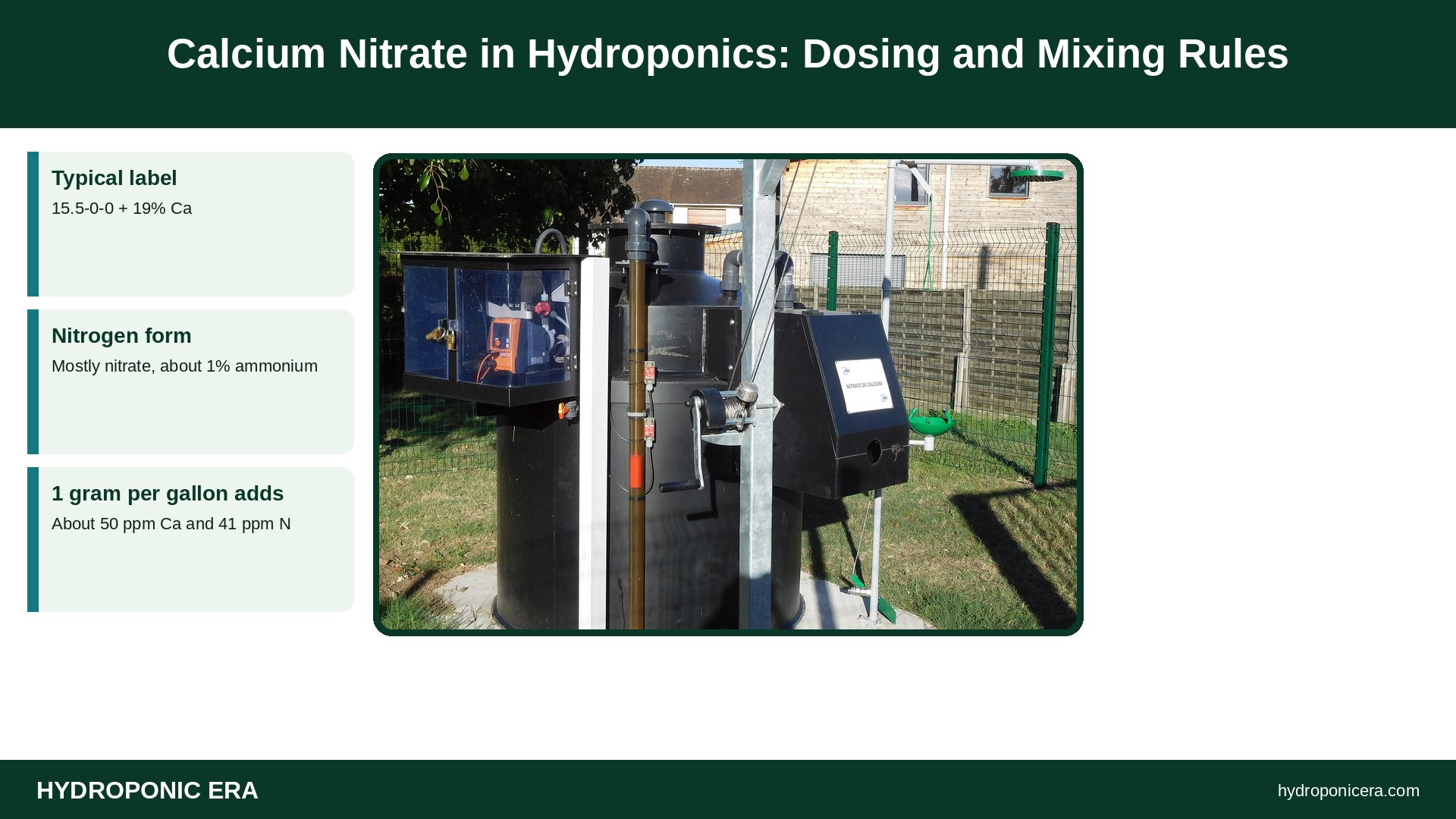
| Fact | Value |
|---|---|
| Typical label | 15.5-0-0 + 19% Ca |
| Nitrogen form | Mostly nitrate, about 1% ammonium |
| 1 gram per gallon adds | About 50 ppm Ca and 41 ppm N |
| Common home dose | 2–3 grams per gallon |
| Never mix concentrated with | Epsom salt, sulfates, phosphates |
| Storage | Sealed, dry container; it absorbs moisture |
Why Calcium Nitrate Hydroponics Feeding Matters
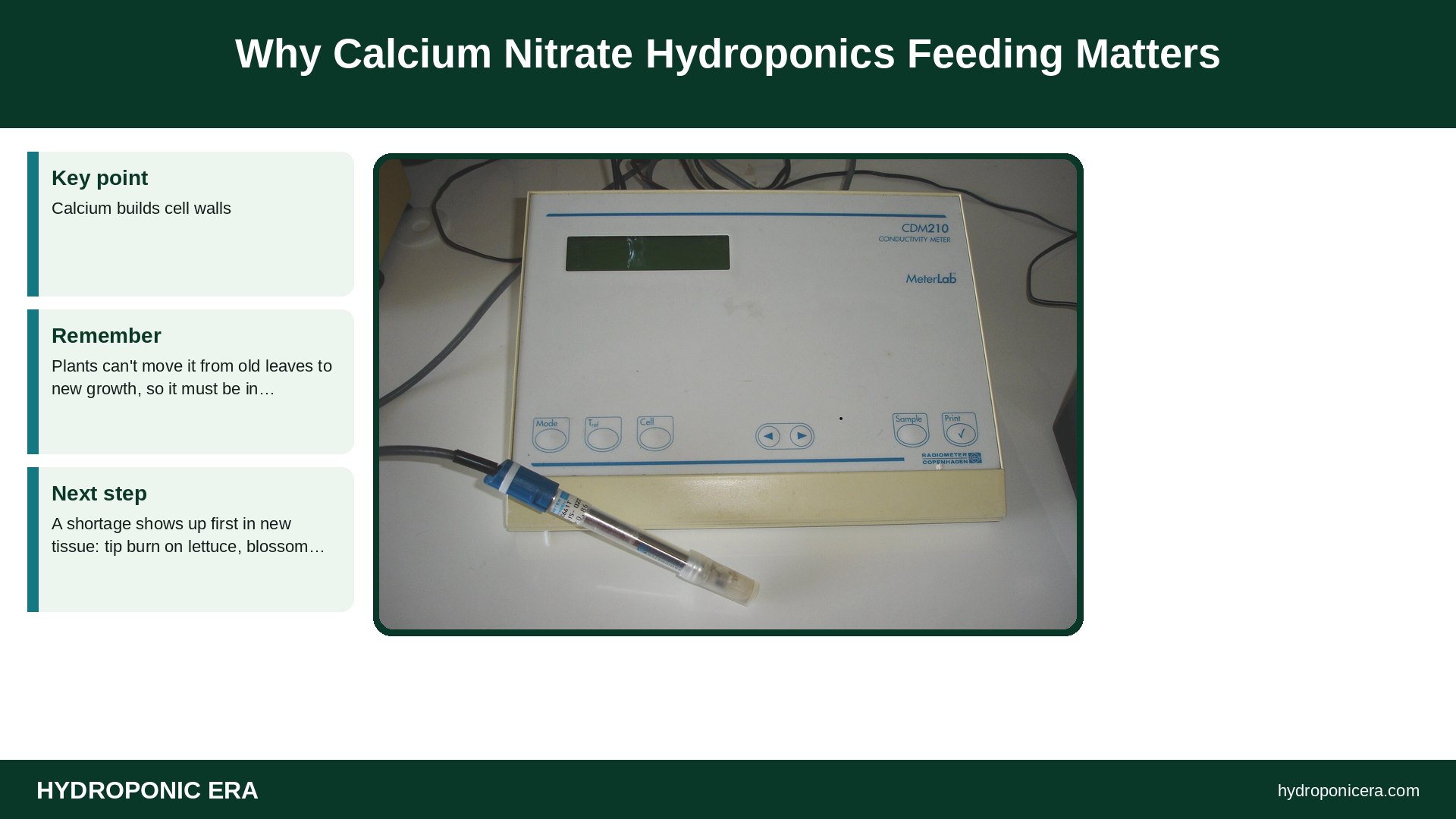
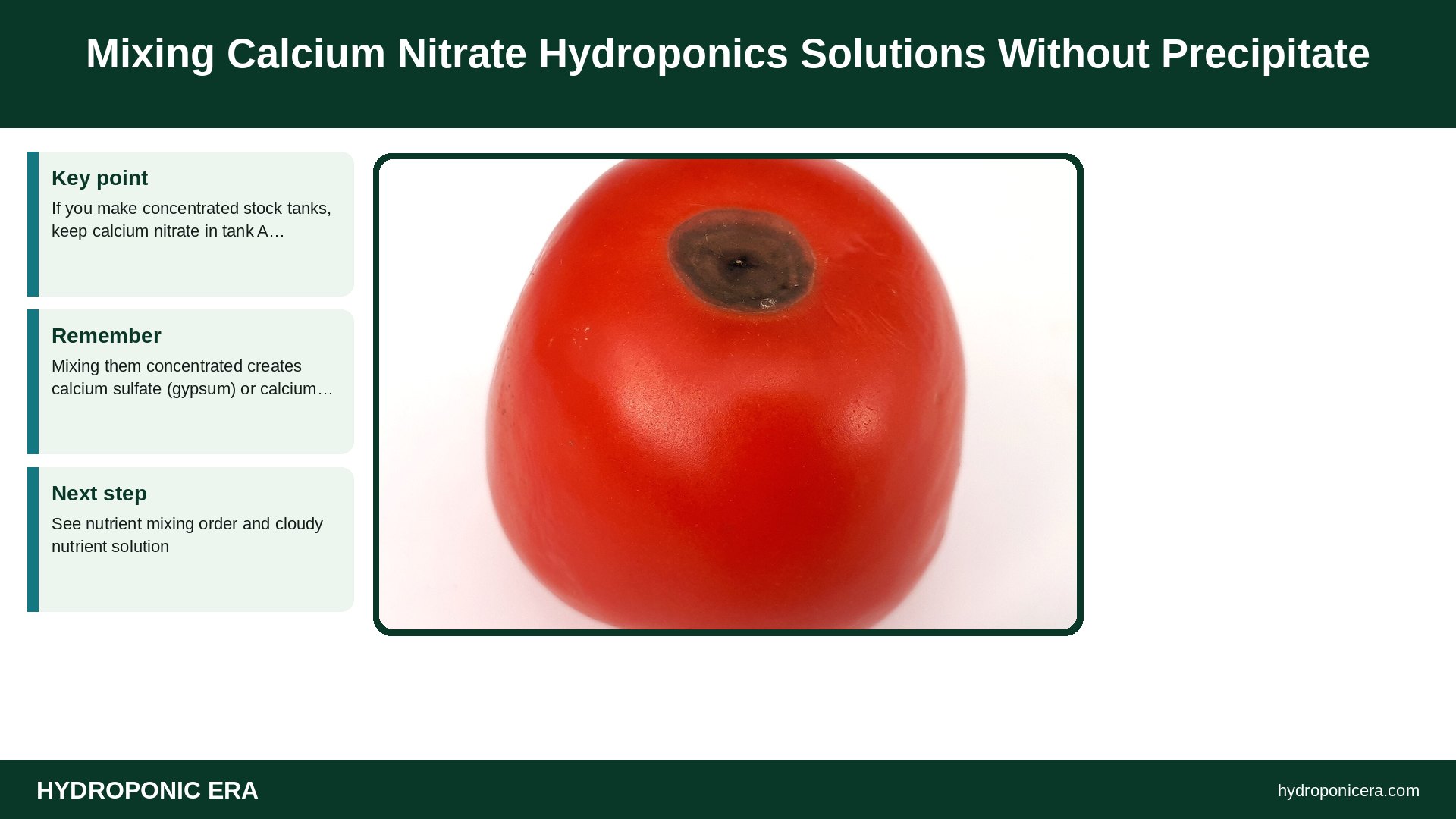
Calcium builds cell walls. Plants can’t move it from old leaves to new growth, so it must be in the solution all the time. A shortage shows up first in new tissue: tip burn on lettuce, blossom end rot on tomatoes and peppers, and deformed strawberry leaves.
Most one-bag hydroponic fertilizers leave out calcium because calcium reacts with phosphate and sulfate in the bag. That is why recipes like Masterblend, Jack’s 5-12-26, and Hoagland solution all add calcium nitrate as a separate part. See calcium and magnesium deficiency.
How Much Calcium Nitrate to Use
You can calculate ppm from the label. One gram per liter of a 19% Ca product adds 190 ppm Ca. A gallon is 3.785 liters, so 1 gram per gallon adds about 50 ppm Ca and about 41 ppm N.
| Grams per gallon | Ca (ppm) | N (ppm) | Typical use |
|---|---|---|---|
| 1.2 | 60 | 49 | Seedlings, quarter strength |
| 2.0 | 100 | 82 | Lettuce and herbs |
| 2.4 | 120 | 98 | Masterblend standard |
| 3.0 | 150 | 123 | Tomatoes, peppers, cucumbers |
Penn State Extension shows how to do these calculations for any salt using percent and molecular weight. See the hydroponic nutrient calculator.
Mixing Calcium Nitrate Hydroponics Solutions Without Precipitate
- Fill the reservoir about 80% with water.
- Dissolve the base fertilizer (such as 4-18-38) in a jug of water and pour it in. Stir.
- Dissolve Epsom salt separately and add it. Stir.
- Dissolve calcium nitrate in a separate jug and add it last. Stir.
- Top up, wait 15 minutes, then check EC and pH.
If you make concentrated stock tanks, keep calcium nitrate in tank A and phosphates and sulfates in tank B. Mixing them concentrated creates calcium sulfate (gypsum) or calcium phosphate, a cloudy white sludge that plants can’t use. See nutrient mixing order and cloudy nutrient solution.
Calcium Nitrate Hydroponics and pH
As plants absorb nitrate, they release hydroxide and bicarbonate, which slowly raises pH. Nitrate-heavy solutions drift upward over a few days. Check pH daily for the first week and adjust with pH down. The small ammonium share in commercial calcium nitrate slows this a little. See fixing high or low pH.
Choosing the Right Product
- Use greenhouse or hydroponic grade. It dissolves fully. Some garden-store prills include coatings that leave residue.
- Check the label for 15.5-0-0 and 19% Ca. Products labeled “calcium ammonium nitrate” are different and used for field crops.
- Buy what you’ll use in a year. It absorbs moisture from the air and clumps.
Calcium Nitrate Hydroponics for Different Crops
Leafy greens do well around 100–150 ppm calcium. Fruiting crops use more, often 150–200 ppm. UF/IFAS tomato formulas in Florida raise calcium as plants move into fruiting. If you have hard water, measure its calcium first; some well water already supplies 60 ppm or more.
For crop-specific feeding see nutrients for tomatoes and preventing tip burn.
Safe Storage and Handling
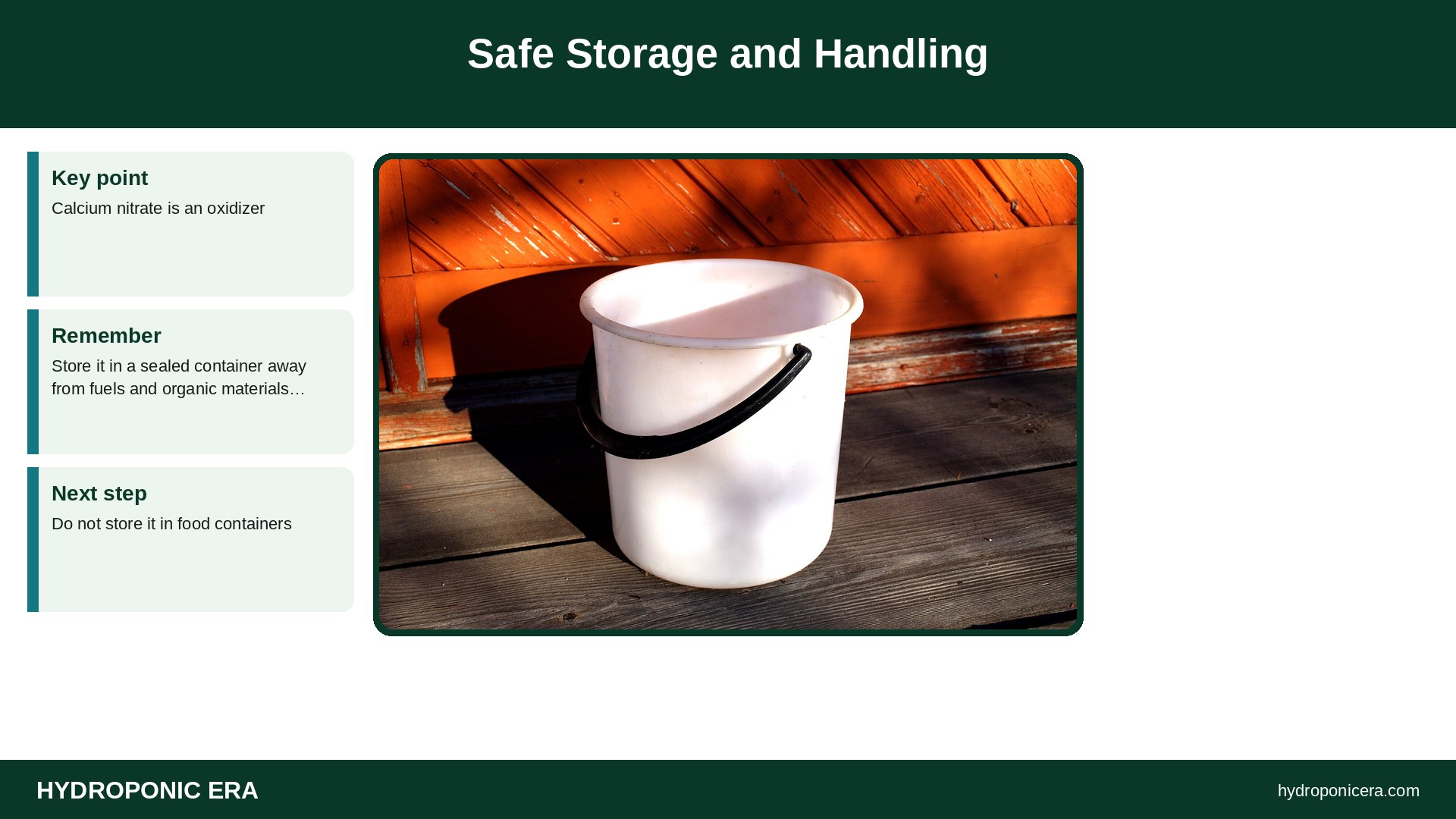
Calcium nitrate is an oxidizer. Store it in a sealed container away from fuels and organic materials, keep it out of reach of children and pets, and wear gloves and eye protection when weighing. Rinse spills with water. Do not store it in food containers.
Calcium Nitrate Hydroponics Example: 10-Gallon Reservoir
Suppose you run a 10-gallon DWC with lettuce and use the common three-part dry recipe. Weigh 24 grams of 4-18-38, 24 grams of calcium nitrate, and 12 grams of Epsom salt. Dissolve the 4-18-38 in a quart of warm water and add it. Add the Epsom salt the same way. Finally, dissolve the calcium nitrate in a separate quart and add it. You should land near EC 1.6–1.9 mS/cm depending on your tap water. For lettuce, you can use about three quarters of these amounts.
Calcium Nitrate Hydroponics Troubleshooting
- White sediment on the bottom: calcium reacted with phosphate or sulfate. Mix more slowly and keep components separate.
- Tip burn despite calcium nitrate: calcium may be present but not moving. Improve airflow and lower humidity at night so plants transpire.
- EC much higher than expected: check your scale; calcium nitrate absorbs water and weighing errors are common with clumped product.
- pH climbing quickly: normal with nitrate feeding; adjust daily.
Calcium Nitrate in Hard Water Areas
If your tap or well water is hard, it may already contain 40–100 ppm calcium. Ask your water utility for a report or send a sample to a lab. Subtract that calcium from your target, then reduce calcium nitrate to match. Keep in mind that cutting calcium nitrate also cuts nitrate nitrogen, so you may need a little potassium nitrate to make up the difference.
FAQs
How much calcium nitrate per gallon?
About 2–3 grams per gallon for most crops.
Can I mix calcium nitrate with Epsom salt?
Not as concentrates. Dissolve them separately and add each to the reservoir.
Why is my calcium nitrate hydroponics solution cloudy?
Calcium reacted with sulfate or phosphate, usually from mixing concentrates.
Does calcium nitrate raise pH?
It tends to make pH drift up as plants take up nitrate.
Is calcium nitrate the same as Cal-Mag?
No. Cal-Mag products add magnesium and often iron; calcium nitrate adds only calcium and nitrogen.
What does calcium deficiency look like?
Tip burn on new leaves, blossom end rot, and stunted roots.
Sources
- Penn State Extension — Nutrient Solution Programs and Recipes
- Penn State Extension — Using the Two Basic Equations to Calculate a Nutrient Solution Recipe
- UF/IFAS Extension — Nutrient Solution Formulation for Hydroponic Tomatoes in Florida
- Photo credits (Wikimedia Commons, edited with titles): Calcium nitrate, waste water treatment by Cjp24 (CC BY-SA 4.0); Electrical conductivity meter by Nuno Nogueira (Nmnogueira) (CC BY-SA 2.5); Blossom end rot tomato 2017 A by Fructibus (CC0); Romaine lettuce by Rainer Zenz (CC BY-SA 3.0); White plastic bucket by Santeri Viinamäki (CC BY-SA 4.0)