
Hydroponic nutrients for tomatoes should supply a complete mix with extra potassium and steady calcium, rising in strength as fruit clusters form. UF/IFAS’s tomato formulation (Hochmuth) raises nitrogen from 70 ppm at transplant to 150 ppm late in the season and potassium from 120 to 200 ppm, with a final pH of 5.8–6.2. Oklahoma State lists tomatoes at an EC of 2.0–4.0 mS/cm and pH 6.0–6.5. For home growers, a two- or three-part hydroponic base or a tomato-specific mix with calcium nitrate does the job.
Key takeaway: Feed tomatoes a complete nutrient, raise strength as clusters set, keep potassium and calcium high, and hold pH around 5.8–6.5.
| Stage (UF/IFAS) | N (ppm) | K (ppm) |
|---|---|---|
| Transplant to 1st cluster | 70 | 120 |
| 1st to 2nd cluster | 80 | 120 |
| 2nd to 3rd cluster | 100 | 150 |
| 3rd to 5th cluster | 120 | 150 |
| 5th cluster to end | 150 | 200 |

What Hydroponic Nutrients for Tomatoes Must Include

Tomatoes need nitrogen, phosphorus, and potassium, plus calcium, magnesium, sulfur, and micronutrients such as iron, manganese, zinc, copper, boron, and molybdenum. UF/IFAS builds its recipe from fertilizer salts and adjusts for calcium and magnesium already in well water. Potassium supports fruit quality, and calcium protects against blossom end rot. See blossom end rot.
Hydroponic Nutrients for Tomatoes: Feeding by Growth Stage
UF/IFAS increases nitrogen and potassium as the plant sets more fruit clusters, as shown in the table. Young plants need less, and too much nitrogen early leads to leafy growth with few flowers. As fruit load rises, the plant draws more potassium. If you use a bottled base, follow its grow and bloom stages and check EC rather than raising doses blindly.
EC and pH for Hydroponic Nutrients for Tomatoes

Oklahoma State gives tomatoes an EC range of 2.0–4.0 mS/cm and pH 6.0–6.5, while UF/IFAS recommends a final pH of 5.8–6.2. In practice, many growers run about 5.8–6.3. Start in the lower part of the EC range with young plants and raise it as fruiting begins. Higher EC can improve flavor but may reduce fruit size if pushed too far. See pH and EC meters.
Bottled Hydroponic Nutrients for Tomatoes
Most two- and three-part bases work for tomatoes. Use the “bloom” or fruiting ratio once flowers appear. Brand charts differ, so match EC to your target instead of copying another brand’s doses. See Advanced Nutrients feeding chart and CANNA Aqua feeding schedule.
Hydroponic Nutrients for Tomatoes: Mixing Your Own

Some growers mix tomato nutrient from a premix such as a 4-18-38 tomato formula plus calcium nitrate and magnesium sulfate. Dissolve each separately in water, and never combine calcium nitrate with sulfates in concentrate. See Masterblend 4-18-38 recipe and homemade hydroponic nutrients.
Hydroponic Nutrients for Tomatoes: Signs of Nutrient Problems in Tomatoes
- Yellow lower leaves: nitrogen or magnesium shortage.
- Yellow new leaves: iron lockout from high pH.
- Blossom end rot: calcium supply or uneven watering.
- Leaf edge scorch: potassium shortage or EC too high.
- Lush leaves, few flowers: too much nitrogen.
See hydroponic tomato yellow leaves.
Reservoir Management
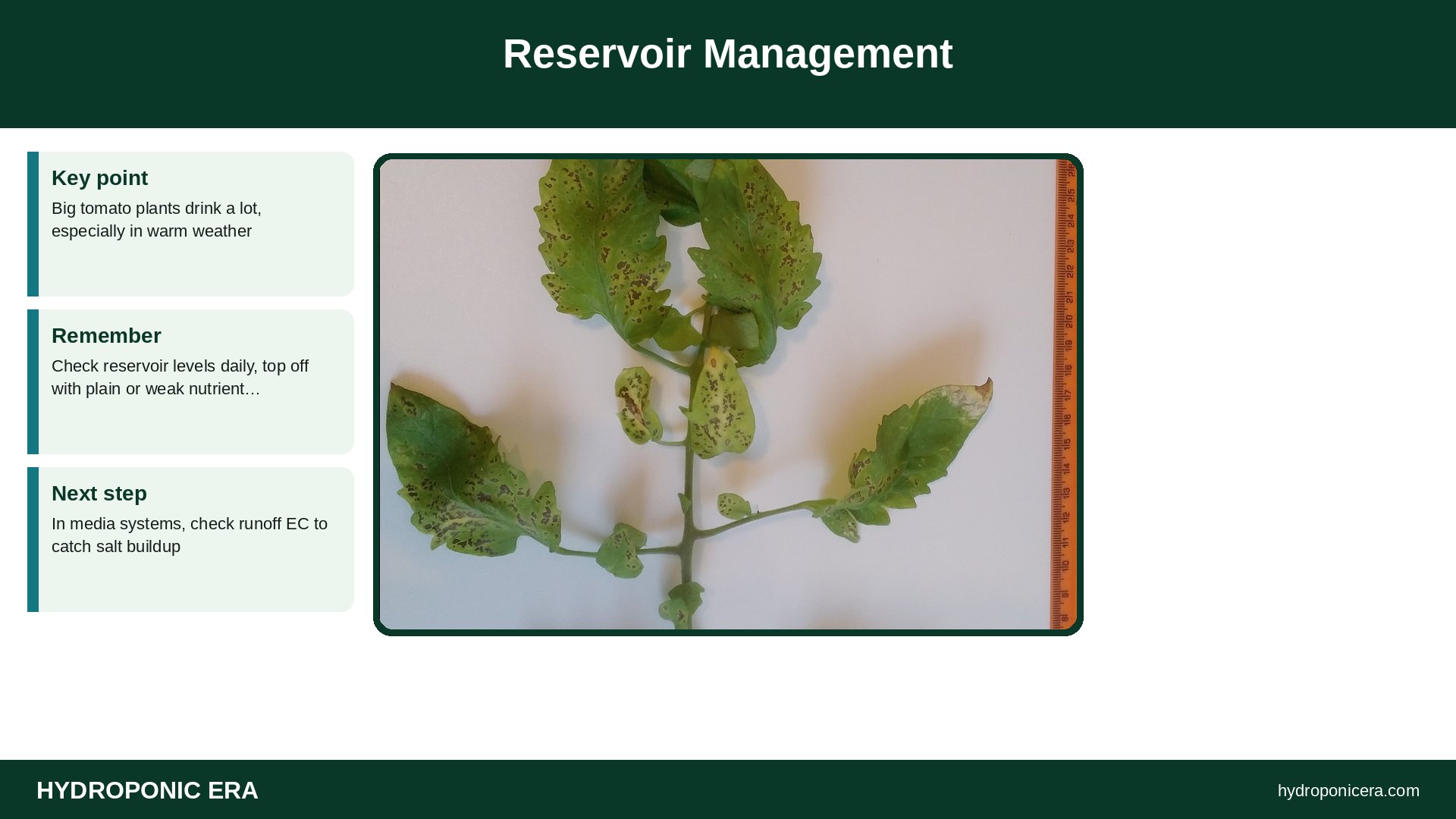
Big tomato plants drink a lot, especially in warm weather. Check reservoir levels daily, top off with plain or weak nutrient depending on EC, and change the full reservoir every one to two weeks. In media systems, check runoff EC to catch salt buildup.
Weekly Routine
- Check pH and EC every few days.
- Record nutrient strength and stage.
- Inspect new and old leaves for color changes.
- Look for blossom end rot on young fruit.
- Change the reservoir on schedule.
Hydroponic Nutrients for Tomatoes in Different Systems
In drip-fed perlite, rockwool, or coco, the UF/IFAS approach of feeding a measured solution and letting excess drain works well, and you can check runoff EC to spot salt buildup. In recirculating systems like NFT or DWC buckets, the reservoir drifts faster, so check EC and pH more often and change the solution every one to two weeks. Big plants in small reservoirs can swing EC within a day in hot weather.
Water Quality and Tomato Feeding
UF/IFAS adjusts its recipe for calcium and magnesium already in well water. If your tap water is hard, test it and reduce added calcium and magnesium accordingly. If you use RO or rain water, a full nutrient with calcium and magnesium becomes essential. Measure your source water EC before mixing so you know how much of the final reading comes from nutrients.
Equipment Checklist for Hydroponic Nutrients for Tomatoes
- A calibrated EC meter.
- A pH meter or kit and pH up/down.
- A measuring syringe or cup in milliliters.
- A notebook or app to log readings.
- A clean reservoir with volume marks.
- Plain, low-salt water for top-offs.
Most of this gear is reusable from crop to crop, so the first setup costs the most. Buy reliable meters first; they prevent the majority of problems.
Beginner Mistakes With Hydroponic Nutrients for Tomatoes
The most common mistakes are feeding full strength to young plants, ignoring calcium, and letting pH drift high. Each one shows up in the leaves or fruit within days.
Getting Started With Hydroponic Nutrients for Tomatoes
Start small, change one thing at a time, and keep a simple log of pH, EC, temperature, and what you changed. Most hydroponic problems show up as patterns in those numbers before they show on the plant. Compare your notes with the sources below, and adjust slowly rather than chasing every small swing. A steady routine matters more than any single product or setting.
FAQs: Hydroponic Nutrients for Tomatoes
What EC do hydroponic tomatoes need?
Oklahoma State lists 2.0–4.0 mS/cm.
What pH is best?
About 5.8–6.5; UF/IFAS recommends 5.8–6.2.
Do tomatoes need extra calcium?
They need steady calcium; most recipes use calcium nitrate.
When should I switch to bloom nutrients?
When flowers start to appear.
How much nitrogen do tomatoes need?
UF/IFAS starts at 70 ppm and rises to 150 ppm.
Should I flush tomatoes?
Change or flush when EC drifts or salts build up.
Sources
- UF/IFAS — Nutrient Solution Formulation for Hydroponic (Perlite, Rockwool, NFT) Tomatoes in Florida
- Oklahoma State University Extension — Electrical Conductivity and pH Guide for Hydroponics
- Photo credits (Wikimedia Commons, edited with titles): Hydroponic g12 by Giancarlo Dessì (CC BY-SA 3.0); Ripening Tomatoes by WarmPhoto (CC BY-SA 4.0); Electrical conductivity meter by Nuno Nogueira (Nmnogueira) (CC BY-SA 2.5); Several green unripe and red ripe tomatoes growing on the vine. (086c449c-117b-44f6-a7c4-e2acbf284092) by NPS (Public domain); Septoria leaf spot symptoms on tomato leaf (Septoria lycopersici on Solanum lycopersicum leaf) by MerielGJones (CC BY-SA 4.0)