
Homemade hydroponic nutrients work when you mix them from proper water-soluble fertilizer salts, such as calcium nitrate, potassium nitrate, monopotassium phosphate, magnesium sulfate (Epsom salt), and a chelated micronutrient mix. That’s exactly how university and research recipes are built. Kitchen hacks like banana peel water, coffee grounds, or compost tea alone don’t work as a complete hydroponic feed, because they can’t supply all the essential nutrients in the right balance. Penn State Extension describes three reliable approaches: fertilizer programs (a base fertilizer plus calcium nitrate and Epsom salt), crop recipes built from individual salts, and complete hydroponic fertilizers.
Key takeaway: Make homemade hydroponic nutrients from fertilizer salts and a tested recipe, keep calcium separate from sulfates and phosphates in concentrates, and check EC and pH.
| Approach | What it is | Works? |
|---|---|---|
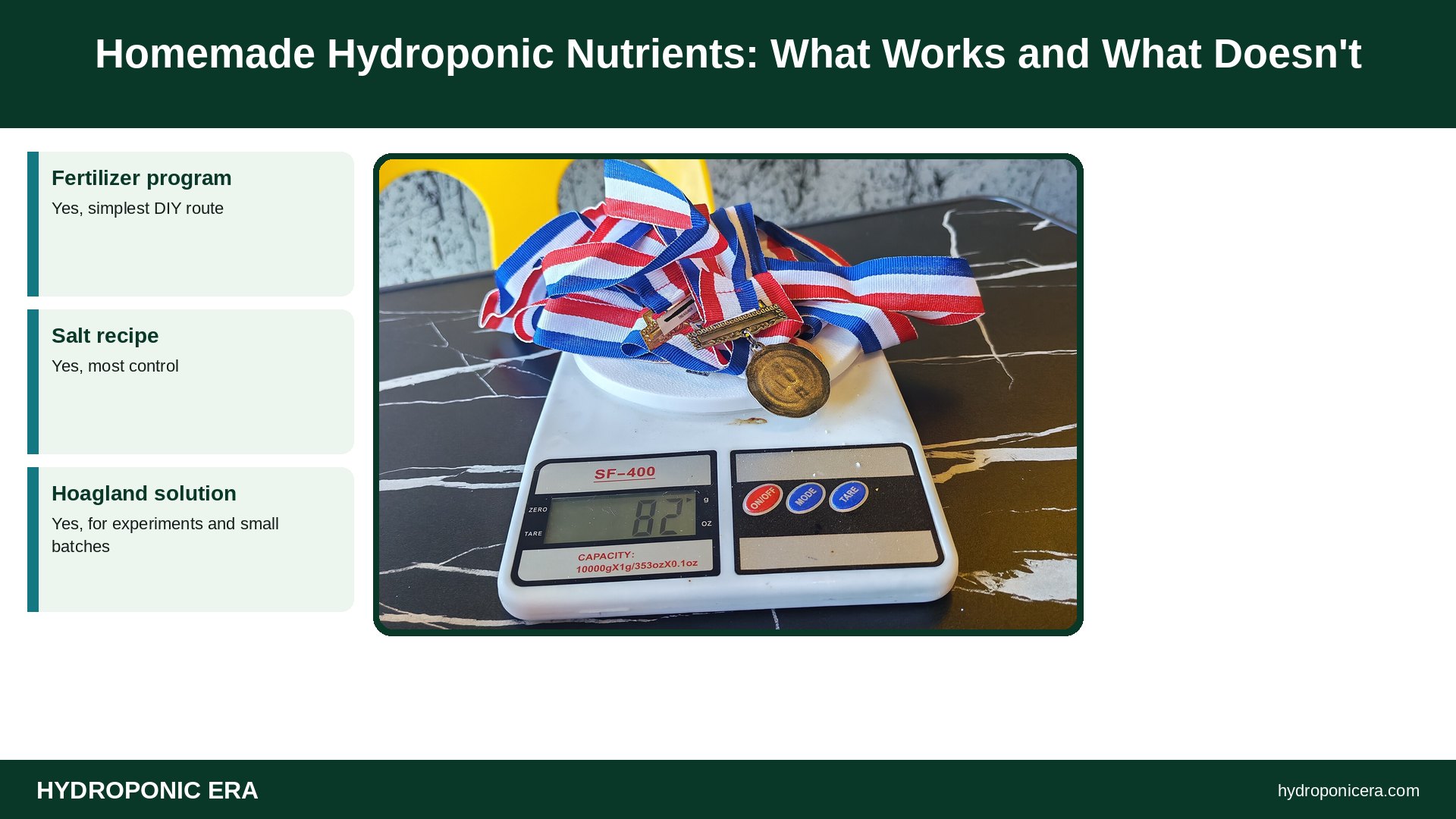
| Fertilizer program | Base like 4-18-38 + calcium nitrate + Epsom salt | Yes, simplest DIY route |
| Salt recipe | Individual salts mixed to target ppm | Yes, most control |
| Hoagland solution | Classic research recipe | Yes, for experiments and small batches |
| Kitchen scraps (peels, grounds) | Soaked organic waste | No, incomplete and can rot |
| Compost or worm tea alone | Biological extract | Not reliable as a complete feed |
Why Homemade Hydroponic Nutrients Need Salts

In soil, organic matter and microbes slowly release nutrients. In hydroponics, there’s no soil, so every nutrient must already be dissolved in a form roots can take up. Plants need nitrogen, phosphorus, potassium, calcium, magnesium, and sulfur, plus micronutrients like iron, manganese, zinc, copper, boron, and molybdenum. Water-soluble salts deliver these directly and predictably. That’s why every research recipe, including USDA ARS’s modified Hoagland solution, is built from salts.
The Easiest Homemade Hydroponic Nutrients: A Three-Part Program
Penn State Extension gives a fertilizer program example: a 4-18-38 tomato base fertilizer with magnesium and micronutrients, supplemented with calcium nitrate and magnesium sulfate depending on the crop and stage. Many home growers use the same idea with Masterblend 4-18-38, calcium nitrate, and Epsom salt. See Masterblend 4-18-38 recipe.
Homemade Hydroponic Nutrients From a Recipe

Penn State’s example for herbs in NFT is a Modified Sonneveld solution with these targets:
- Nitrogen 150 ppm, phosphorus 31 ppm, potassium 210 ppm
- Calcium 90 ppm, magnesium 24 ppm
- Iron 1 ppm, manganese 0.25 ppm, zinc 0.13 ppm, boron 0.16 ppm
- Copper 0.023 ppm, molybdenum 0.024 ppm
Penn State explains that 1 ppm equals 1 mg per liter, and that fertilizer labels list phosphate (P₂O₅) and potash (K₂O), not elemental P and K: P₂O₅ is 43% phosphorus and K₂O is 83% potassium. Use those factors when converting a label into ppm.
Classic Hoagland Solution
USDA ARS publishes a modified Hoagland recipe made from stock solutions of monopotassium phosphate, potassium nitrate, calcium nitrate, magnesium sulfate, Fe-DTPA, and trace salts, with final pH adjusted to 5.6–6.0. It’s precise but requires lab-style weighing and several stock bottles, so it suits small batches and experiments.
Mixing Rules for Homemade Hydroponic Nutrients
- Use a scale: weigh salts in grams; measuring spoons aren’t accurate enough.
- Two stock tanks: Penn State advises keeping calcium in a different concentrate than sulfates and phosphates, because they can form precipitates.
- Add to water, not to each other: fill the reservoir, then add part A, mix, then part B.
- Check EC: confirm strength with a meter. See EC and TDS.
- Adjust pH last: most crops do well around 5.5–6.5.
What Doesn’t Work as Homemade Hydroponic Nutrients
- Banana peel water: some potassium, but no balanced nitrogen, calcium, or micronutrients, and it rots. See banana peel water.
- Coffee grounds: not a soluble nutrient source; they clog and decompose.
- Eggshells: calcium carbonate doesn’t dissolve readily at hydroponic pH.
- Soil fertilizer spikes: slow-release and not meant for water.
Organic Homemade Hydroponic Nutrients

Organic hydroponics is possible but harder. Organic inputs must be broken down by microbes before plants can use the nutrients, and they can cloud water and lower oxygen. Growers who do it well use biological filters and careful management. See organic and bioponic nutrients.
Is Making Your Own Cheaper?
Bulk salts cost far less per gallon of solution than bottled liquid nutrients, especially for larger systems. The trade-offs are time, a scale, and the risk of mistakes. For one small kitchen system, a powdered complete fertilizer may be just as practical.
Safety Tips
- Store salts dry, labeled, and away from children and pets.
- Wear gloves and eye protection when handling acids for pH down.
- Never mix concentrated calcium nitrate with concentrated sulfates or phosphates.
Planning Tips: Homemade Hydroponic Nutrients
The biggest risk with homemade hydroponic nutrients is leaving something out. Plants need nitrogen, phosphorus, and potassium, plus calcium, magnesium, sulfur, and micronutrients like iron, manganese, zinc, copper, boron, and molybdenum. Kitchen recipes using compost tea, banana peels, or Epsom salt alone miss several of these and can also cloud the water and feed microbes that rob roots of oxygen.
If you mix from individual fertilizer salts, buy hydroponic- or greenhouse-grade products, weigh them on a gram scale, and keep calcium nitrate in a separate stock solution from sulfates and phosphates so they don’t form a solid. Label every container and record each batch.
Weekly Routine for Homemade Hydroponic Nutrients
- Check pH and EC, and record them.
- Top off the reservoir with plain, pH-adjusted water.
- Look at roots for color and smell.
- Check leaves, especially undersides, for pests.
- Clean filters, emitters, and pump intakes.
- Change the nutrient fully every two to three weeks, or sooner if EC drifts.
Beginner Mistakes With Homemade Hydroponic Nutrients
The most common mistakes are skipping pH testing, using nutrient that’s too strong, letting light reach the water, and ignoring water temperature. Each one is easy to fix once you know to check for it. Start with fewer plants than you think you need, learn the routine, and expand once the system runs smoothly.
FAQs: Homemade Hydroponic Nutrients
Can I make my own hydroponic nutrients?
Yes, from water-soluble fertilizer salts and a tested recipe.
What is the easiest homemade recipe?
A 4-18-38 base plus calcium nitrate and Epsom salt.
Do kitchen scraps work?
No. They’re incomplete and can rot in the reservoir.
Why keep calcium separate?
Penn State notes it can precipitate with sulfates and phosphates in concentrates.
What pH should the solution be?
USDA ARS adjusts Hoagland solution to pH 5.6–6.0.
Sources
- Penn State Extension — Nutrient Solution Programs and Recipes
- Penn State Extension — Calculating a Nutrient Solution Recipe
- USDA ARS — Modified Hoagland’s Standard Nutrient Recipe
- Photo credits (Wikimedia Commons, edited with titles): Medals weighed in digital scale by Kpubkalanami (CC BY-SA 4.0); Epsomite by WTucker (talk) (CC BY-SA 3.0); Compost pile by Ksd5 (CC0); US Navy 050107-N-0057P-246 Aviation Electronics Technician 2nd Class Jason D. Schapp of Oakridge, Ore., and members of the Indonesian Army unload jugs of water that were purified in distilling plant aboard USS Abraham Lincoln ( by U.S. Navy photo by Photographer’s Mate 2nd Class Seth C. Peterson (Public domain); Banane-A-05 cropped by Priwo (Public domain)