
Hoagland solution is the classic plant nutrient recipe published by D.R. Hoagland and D.I. Arnon at the University of California in 1938 and revised in 1950. Full-strength Hoagland No. 1 supplies roughly 210 ppm nitrogen, 235 ppm potassium, 200 ppm calcium, 31 ppm phosphorus, 48 ppm magnesium, and 64 ppm sulfur, plus trace elements. It is made from separate stock solutions of potassium nitrate, calcium nitrate, monopotassium phosphate, magnesium sulfate, iron, and a micronutrient mix. Most home growers today use it at half strength, or buy a modern premix that copies its ratios.
Key takeaway: Hoagland solution is a reliable lab standard, but it is strong for lettuce. Use half strength for leafy greens, keep pH at 5.8–6.2, and mix stocks separately so calcium does not settle out.
| Nutrient | Full-strength ppm (No. 1) | Main source salt |
|---|---|---|
| Nitrogen (N) | 210 | Calcium nitrate, potassium nitrate |
| Potassium (K) | 235 | Potassium nitrate, KH2PO4 |
| Calcium (Ca) | 200 | Calcium nitrate |
| Phosphorus (P) | 31 | Monopotassium phosphate |
| Magnesium (Mg) | 48 | Magnesium sulfate |
| Sulfur (S) | 64 | Magnesium sulfate |
| Iron (Fe) | 1–5 | Iron chelate (modern) or iron tartrate (original) |
| Boron, manganese, zinc, copper, molybdenum | 0.5, 0.5, 0.05, 0.02, 0.01 | Micronutrient stock |
Where Hoagland Solution Came From

Hoagland and Arnon published “The Water-Culture Method for Growing Plants Without Soil” as California Agricultural Experiment Station Circular 347. Their goal was a solution that grew many crops well enough for research. It became the standard reference recipe in plant science, and many commercial nutrients are still compared to it.
The circular gives two versions. Solution No. 1 uses only nitrate nitrogen. Solution No. 2 replaces the phosphate salt with ammonium phosphate, so some nitrogen comes as ammonium, which helps keep pH from drifting upward.
Hoagland Solution Recipe From Stock Solutions
The original method uses 1 molar stock solutions. For each liter of final solution, add:
| Stock (1 M) | Solution No. 1 (mL per liter) | Solution No. 2 (mL per liter) |
|---|---|---|
| KH2PO4 (monopotassium phosphate) | 1 | — |
| NH4H2PO4 (monoammonium phosphate) | — | 1 |
| KNO3 (potassium nitrate) | 5 | 6 |
| Ca(NO3)2 (calcium nitrate) | 5 | 4 |
| MgSO4 (magnesium sulfate) | 2 | 2 |
Then add 1 mL per liter of micronutrient stock and 1 mL per liter of iron stock. Modern versions use iron EDTA or DTPA instead of iron tartrate because chelates stay available longer. For a 5-gallon (about 19-liter) reservoir, multiply every number by 19.
The Micronutrient Stock

The usual micronutrient stock contains, per liter of water: boric acid 2.86 g, manganese chloride (tetrahydrate) 1.81 g, zinc sulfate (heptahydrate) 0.22 g, copper sulfate (pentahydrate) 0.08 g, and molybdic acid 0.02 g. These amounts are tiny, so weigh them on a scale that reads to 0.01 g or buy a premade trace mix.
How to Mix Hoagland Solution Safely
- Fill the reservoir with most of the water first.
- Add each stock separately, stirring between additions.
- Add calcium nitrate by itself, never mixed with sulfate or phosphate concentrates.
- Add iron and micronutrients last.
- Top up to final volume, then check EC and pH.
Concentrated calcium plus sulfate forms gypsum, and calcium plus phosphate forms a white precipitate. That is why the stocks stay separate. See nutrient mixing order. Wear gloves and eye protection when handling dry salts, and label every bottle.
Hoagland Solution Strength and EC
Full-strength Hoagland No. 1 reads around EC 2.0–2.3 mS/cm, depending on your water. That suits tomatoes and cucumbers, but it is strong for lettuce, which UF/IFAS targets at 1.2–1.8 mS/cm. Half strength gives about 1.0–1.2 mS/cm, a good start for greens and herbs. Quarter strength is common for seedlings.
Check the result with a calibrated meter. See the hydroponic ppm chart for crop targets.
pH for Hoagland Solution
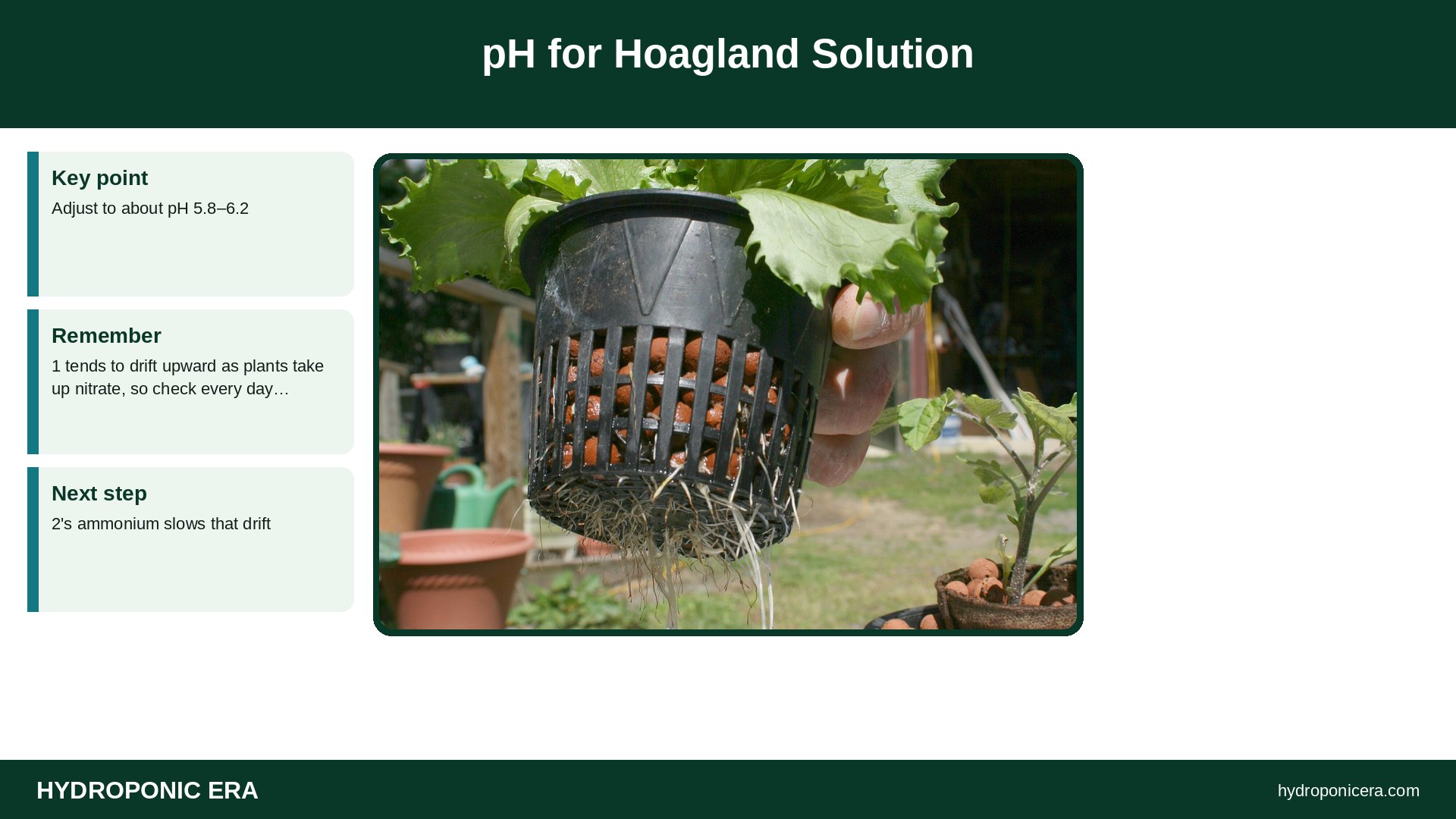
Adjust to about pH 5.8–6.2. Nitrate-only Solution No. 1 tends to drift upward as plants take up nitrate, so check every day or two. Solution No. 2’s ammonium slows that drift. See pH rising vs falling.
Hoagland Solution vs Modern Commercial Nutrients
| Factor | Hoagland solution | Commercial two-part |
|---|---|---|
| Cost per gallon | Very low once salts are bought | Higher |
| Effort | Weighing and many stocks | Measure two bottles |
| Flexibility | Fully adjustable | Fixed ratios |
| Iron form | Chelate added separately | Included |
| Best for | Classrooms, research, DIY growers | Most home systems |
If you want DIY savings with less weighing, see the Masterblend recipe or homemade hydroponic nutrients.
Storing Hoagland Solution Stocks
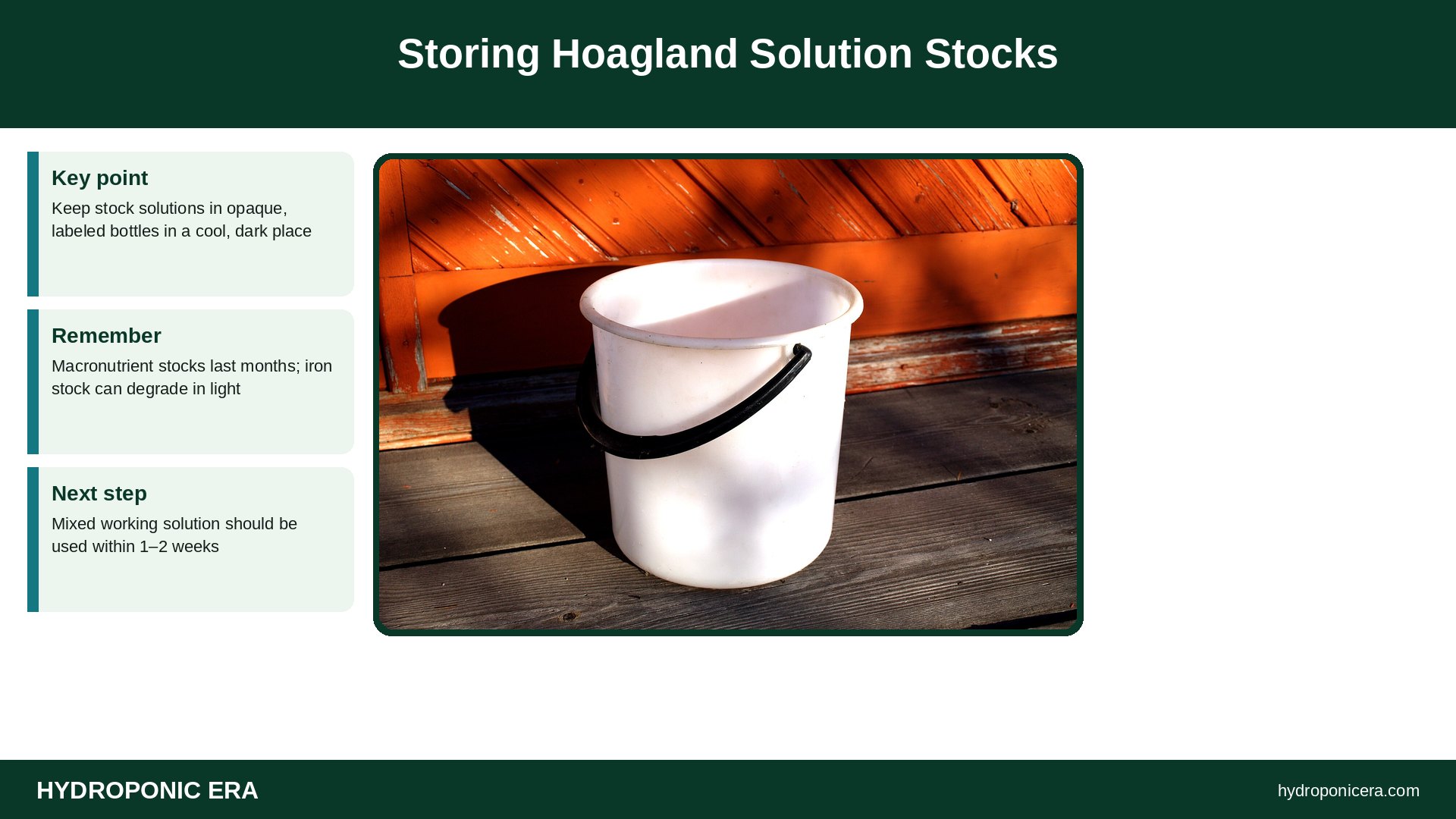
Keep stock solutions in opaque, labeled bottles in a cool, dark place. Macronutrient stocks last months; iron stock can degrade in light. Mixed working solution should be used within 1–2 weeks. See stock shelf life.
Hoagland Solution for Home Growers: A 5-Gallon Example
Making 1 molar stocks is easy if you have a scale. For each stock, dissolve the salt’s molecular weight in grams in water and bring it to 1 liter: potassium nitrate 101 g, calcium nitrate tetrahydrate 236 g, monopotassium phosphate 136 g, and magnesium sulfate heptahydrate 246 g. Store each in its own labeled bottle.
For a 5-gallon (19-liter) reservoir of half-strength Hoagland solution No. 1, add about 9.5 mL KH2PO4 stock, 47.5 mL KNO3 stock, 47.5 mL calcium nitrate stock, 19 mL magnesium sulfate stock, 9.5 mL micronutrient stock, and 9.5 mL iron chelate stock. Add them one at a time to a mostly full reservoir, stirring between each. Then measure EC and pH.
When Hoagland Solution Is a Good Choice
Hoagland solution shines in classrooms, science fair projects, and research, where a documented recipe matters. It is also useful for growers who want to adjust single elements, since each salt is separate. For a basic home lettuce system, a commercial two-part nutrient is usually simpler and gives similar results. See hydroponics science fair projects.
FAQs
What is Hoagland solution used for?
It is a standard complete nutrient for growing plants in water, used in research and hydroponics.
Can I use full-strength Hoagland solution for lettuce?
Half strength is safer for lettuce and herbs.
What is the difference between No. 1 and No. 2?
No. 2 supplies some nitrogen as ammonium, which steadies pH.
Is Hoagland solution organic?
No. It is made from mineral salts.
What EC is full-strength Hoagland?
Roughly 2.0–2.3 mS/cm, depending on source water.
Can I buy premixed Hoagland solution?
Yes. Lab suppliers sell premixed powders; follow the label’s dilution.
Sources
- Hoagland, D.R. and Arnon, D.I. — The Water-Culture Method for Growing Plants Without Soil (Circular 347)
- Penn State Extension — Hydroponics Systems: Nutrient Solution Programs and Recipes
- UF/IFAS Extension — Growing Lettuce in Small Hydroponic Systems
- Photo credits (Wikimedia Commons, edited with titles): Water droplets on a late cotoneaster (Cotoneaster coriaceus) leaf, Jardim da Fundação Calouste Gulbenkian, Lisbon, Portugal julesvernex2 by Jules Verne Times Two (CC BY-SA 4.0); US Navy 050107-N-0057P-246 Aviation Electronics Technician 2nd Class Jason D. Schapp of Oakridge, Ore., and members of the Indonesian Army unload jugs of water that were purified in distilling plant aboard USS Abraham Lincoln ( by U.S. Navy photo by Photographer’s Mate 2nd Class Seth C. Peterson (Public domain); Electrical conductivity meter by Nuno Nogueira (Nmnogueira) (CC BY-SA 2.5); 2009-03-30 Lettuce roots by Ildar Sagdejev (Specious) (CC BY-SA 4.0); White plastic bucket by Santeri Viinamäki (CC BY-SA 4.0)