
For hydroponic lettuce EC, aim for about 1.2–1.8 mS/cm with pH 5.8–6.2 during most of the crop, which is the range UF/IFAS Extension recommends for lettuce in small hydroponic systems. Start seedlings lower, around 0.6–1.0 mS/cm, and move to the full range after transplant. In hot weather, run toward the low end to reduce tip burn; in cool weather, the high end is fine. On a 500-scale ppm meter, 1.2–1.8 mS/cm reads 600–900 ppm.
Key takeaway: Seedlings 0.6–1.0, young plants 1.0–1.4, and finishing heads 1.2–1.8 mS/cm, all near pH 6.0, with lower EC when it’s hot.
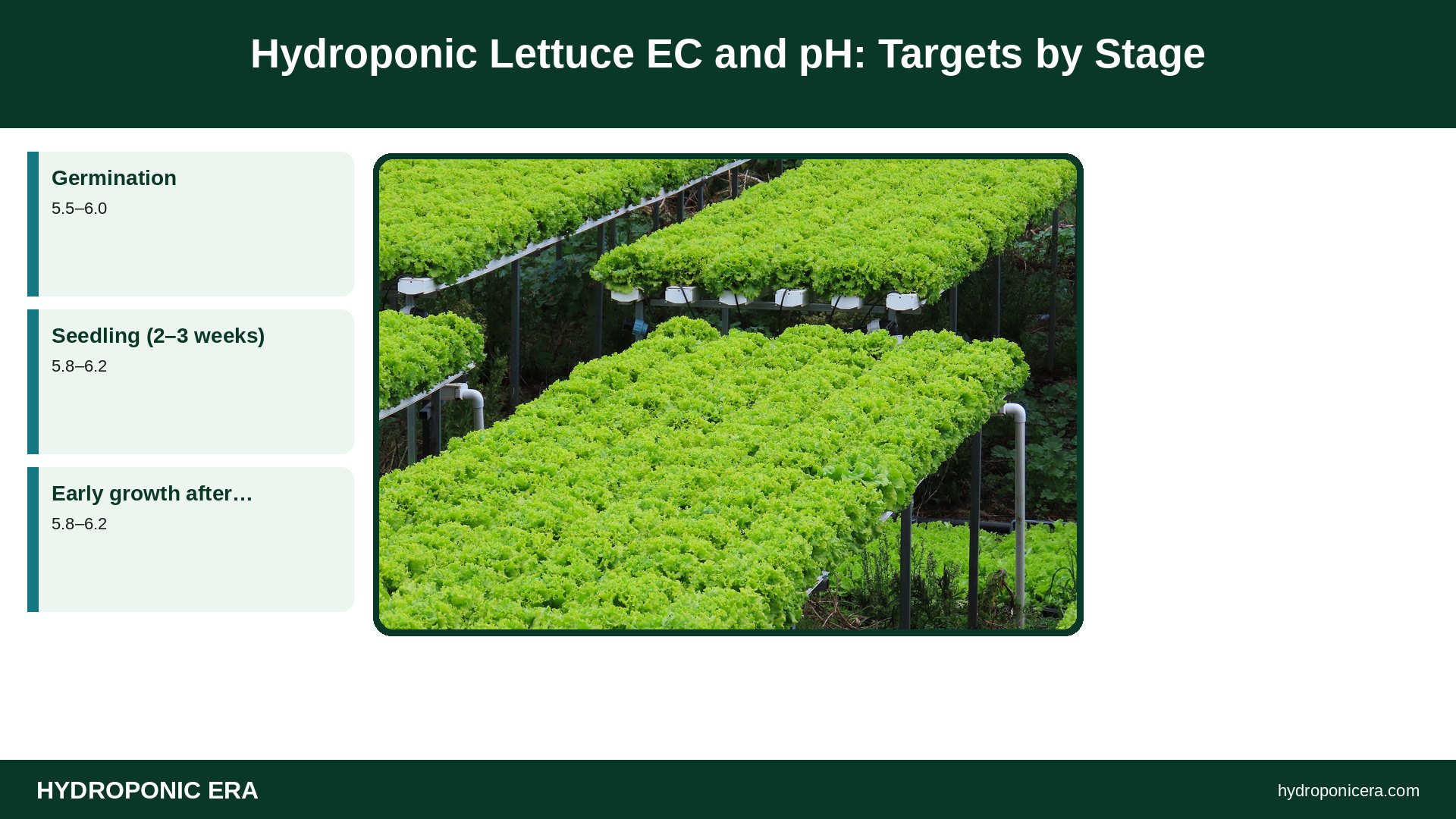
Hydroponic Lettuce EC and pH by Stage
| Stage | EC (mS/cm) | PPM (500) | PPM (700) | pH |
|---|---|---|---|---|
| Germination | 0–0.4 | 0–200 | 0–280 | 5.5–6.0 |
| Seedling (2–3 weeks) | 0.6–1.0 | 300–500 | 420–700 | 5.8–6.2 |
| Early growth after transplant | 1.0–1.4 | 500–700 | 700–980 | 5.8–6.2 |
| Main growth to harvest | 1.2–1.8 | 600–900 | 840–1,260 | 5.8–6.2 |
| Hot weather (above 80°F) | 1.0–1.2 | 500–600 | 700–840 | 5.8–6.2 |
Why Hydroponic Lettuce EC Matters
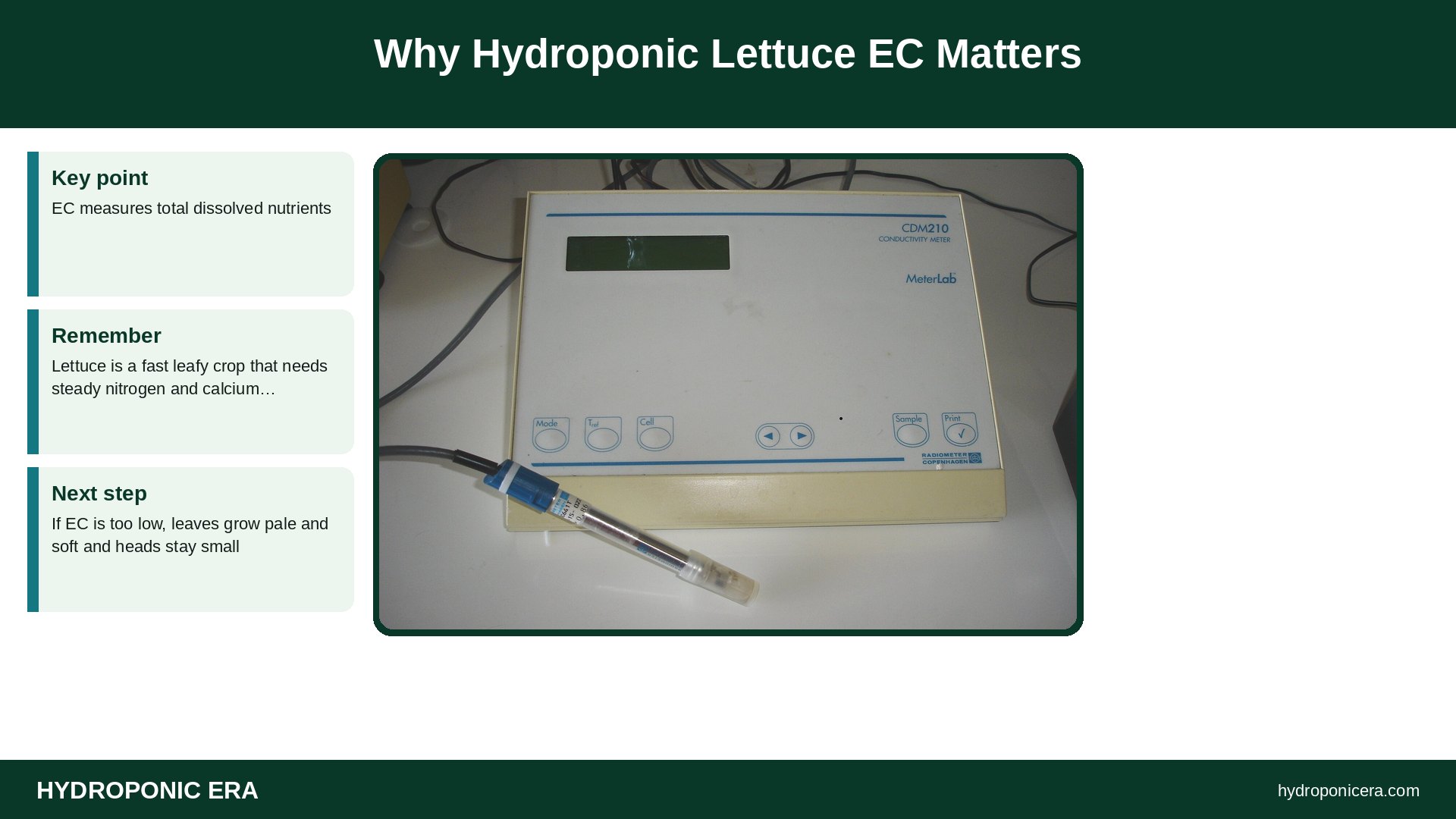
EC measures total dissolved nutrients. Lettuce is a fast leafy crop that needs steady nitrogen and calcium but does not tolerate salty water well. If EC is too low, leaves grow pale and soft and heads stay small. If it is too high, roots struggle to take up water, and tender leaf margins burn.
The University of Kentucky’s hydroponic lettuce guide, written for small commercial growers, uses a similar range and stresses daily monitoring. Both guides are good references for home growers.
Setting Hydroponic Lettuce EC in a New Reservoir
- Measure source water EC. Many city supplies read 0.1–0.4 mS/cm.
- Mix your nutrient at about three quarters of the label’s leafy rate.
- Check EC and add nutrient in small amounts until you reach about 1.2–1.4 for young plants.
- Adjust pH to 5.8–6.0 after the EC is right.
- Recheck both after an hour of circulation.
See mixing nutrient solution and EC to ppm conversion.
Daily Hydroponic Lettuce EC Changes
Read EC at the same time each day. A slow rise usually means the plants are drinking more water than they take up in nutrients, which is common in warm, dry rooms. Top off with plain water. A steady drop means plants are feeding well; add a little nutrient to hold the target.
If EC jumps by more than about 0.2 a day, look at evaporation, reservoir size, and temperature. See EC climbing too fast.
pH for Hydroponic Lettuce
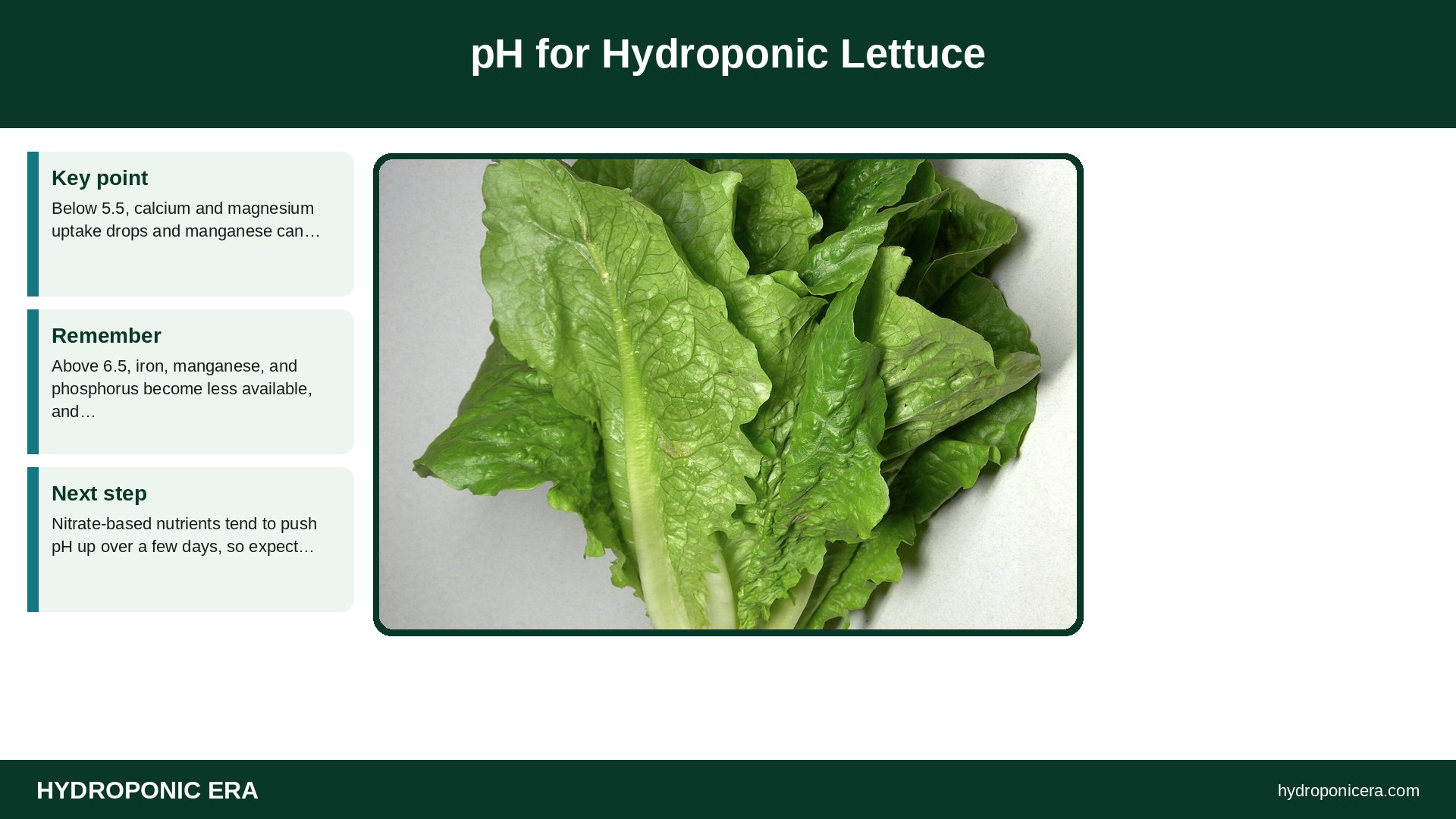
Keep pH at 5.8–6.2. Below 5.5, calcium and magnesium uptake drops and manganese can become excessive. Above 6.5, iron, manganese, and phosphorus become less available, and new leaves turn pale between the veins. Nitrate-based nutrients tend to push pH up over a few days, so expect to add a little pH down. See controlling pH.
Hydroponic Lettuce EC and Tip Burn
Tip burn, the browning of the edges of young inner leaves, is the most common lettuce problem. It is a calcium delivery problem. Calcium moves with water, and fast-growing inner leaves transpire little. High EC, high temperatures, strong light, and still, humid air all make it worse.
- Lower EC to 1.0–1.2 in hot weather.
- Run a fan across the canopy.
- Keep the root zone below about 72°F.
- Harvest a few days earlier if tip burn appears near maturity.
Lettuce Type Makes a Small Difference

Butterhead and loose-leaf varieties are more prone to tip burn and do well at the lower to middle part of the range. Romaine and crisp summer types handle the upper part better. Red-leaf varieties color best with good light, not with higher EC. See best lettuce varieties.
System Effects on Hydroponic Lettuce EC
| System | Typical EC | Note |
|---|---|---|
| Kratky | 1.0–1.4 | EC rises as water drops; start lower |
| DWC raft | 1.2–1.6 | Stable; large volume buffers changes |
| NFT | 1.2–1.8 | Small volume; check daily |
| Tower | 1.2–1.6 | Top plants dry fastest in heat |
For Kratky jars and tubs, see mason jar hydroponics and the Kratky method.
When to Change the Solution
Even at the right EC, the balance of individual nutrients shifts as plants take what they need. Replace the solution every 2–3 weeks in small home systems, or sooner if EC keeps drifting, the water smells, or plants show deficiency signs with a normal EC reading. See how often to change hydroponic water.
A Simple Hydroponic Lettuce EC Log

A simple log helps you learn your system. Each day, write the date, water level, EC, pH, and water temperature. Add a note when you top off or add nutrient. After one crop, you’ll know how fast EC moves in your setup and what number gives your best heads. See record keeping logs.
Troubleshooting Hydroponic Lettuce EC Problems
- EC correct, but leaves pale: check pH first, then light. Low light gives pale, loose heads even at the right EC.
- EC correct, but slow growth: check water temperature and roots. Brown roots point to root rot, not feeding.
- EC keeps rising: top off with plain water and reduce evaporation with a reservoir lid.
- EC falls fast: plants are big and hungry; increase strength slightly or change the solution more often.
- Bitter taste: heat and long days, not EC. Harvest earlier in summer. See lettuce bitterness and bolting.
Hydroponic Lettuce EC in Winter
In a cool basement or winter greenhouse, lettuce grows slowly and drinks little. EC tends to stay stable, and you can run toward 1.6–1.8 without burn. Watch that the root zone stays above about 60°F, since cold roots take up nutrients slowly no matter what the meter says.
FAQs
What is the best hydroponic lettuce EC?
About 1.2–1.8 mS/cm for most of the crop, per UF/IFAS.
What ppm is that?
600–900 on a 500-scale meter, or 840–1,260 on a 700-scale meter.
What pH should lettuce be grown at?
5.8–6.2.
Should hydroponic lettuce EC change in summer?
Yes. Lower it to about 1.0–1.2 to reduce tip burn.
What EC for lettuce seedlings?
About 0.6–1.0 mS/cm.
Can EC be too low for lettuce?
Below about 0.8, leaves grow pale and heads stay small.
Sources
- UF/IFAS Extension — Growing Lettuce in Small Hydroponic Systems
- University of Kentucky — Hydroponic Lettuce Production
- UF/IFAS Extension — Leafy Greens in Hydroponics and Protected Culture for Florida
- Photo credits (Wikimedia Commons, edited with titles): Hydroponic lettuce @ Plaine des Cafres 03 by Rémih (CC BY-SA 4.0); Electrical conductivity meter by Nuno Nogueira (Nmnogueira) (CC BY-SA 2.5); Romaine lettuce by Rainer Zenz (CC BY-SA 3.0); Deep water culture by ArcadiYay (CC BY-SA 4.0); Romaine lettuce by Rainer Zenz (CC BY-SA 3.0)