
Mason jar hydroponics is the simplest way to grow herbs or a single lettuce head without a pump: fill a quart or half-gallon jar with nutrient solution, set a 2- or 3-inch net pot in the mouth so the roots touch the liquid, and block light from the glass. This is the Kratky (non-circulating) method developed at the University of Hawaii. As the plant drinks, the water level drops and an air gap forms, so roots get oxygen without an air stone. A quart jar grows one basil, mint, or leaf lettuce plant to harvest with one or two top-ups.
Key takeaway: Use a wide-mouth jar, a net pot that fits, a mild nutrient mix, and a sleeve to keep light out. Never refill to the brim once roots have formed an air zone.
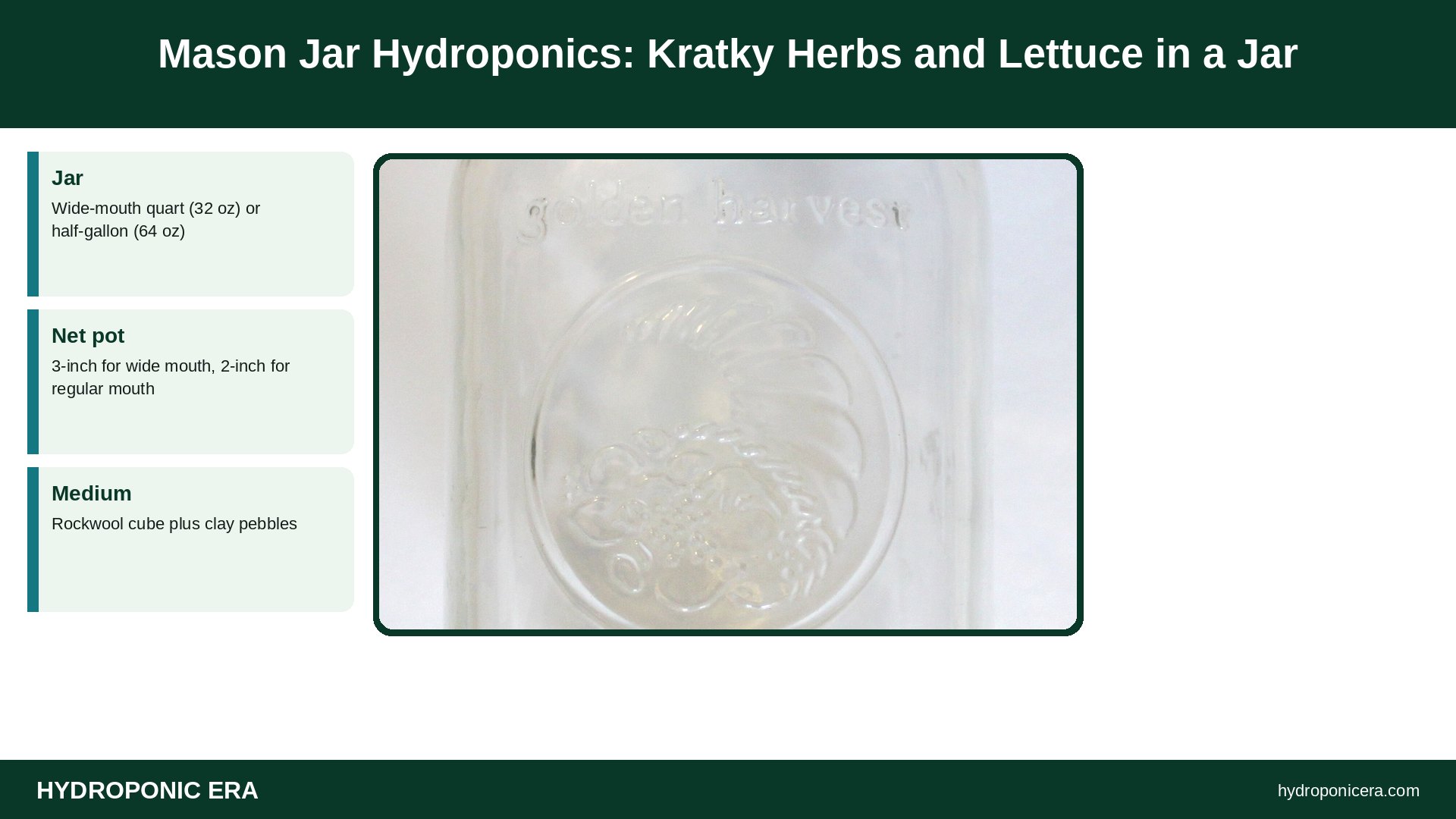
| Item | Recommended choice |
|---|---|
| Jar | Wide-mouth quart (32 oz) or half-gallon (64 oz) |
| Net pot | 3-inch for wide mouth, 2-inch for regular mouth |
| Medium | Rockwool cube plus clay pebbles |
| Nutrient strength | EC 0.8–1.2 mS/cm for herbs and lettuce |
| pH | 5.8–6.2 |
| Light block | Paint, sock, paper sleeve, or foil wrap |
How Mason Jar Hydroponics Works
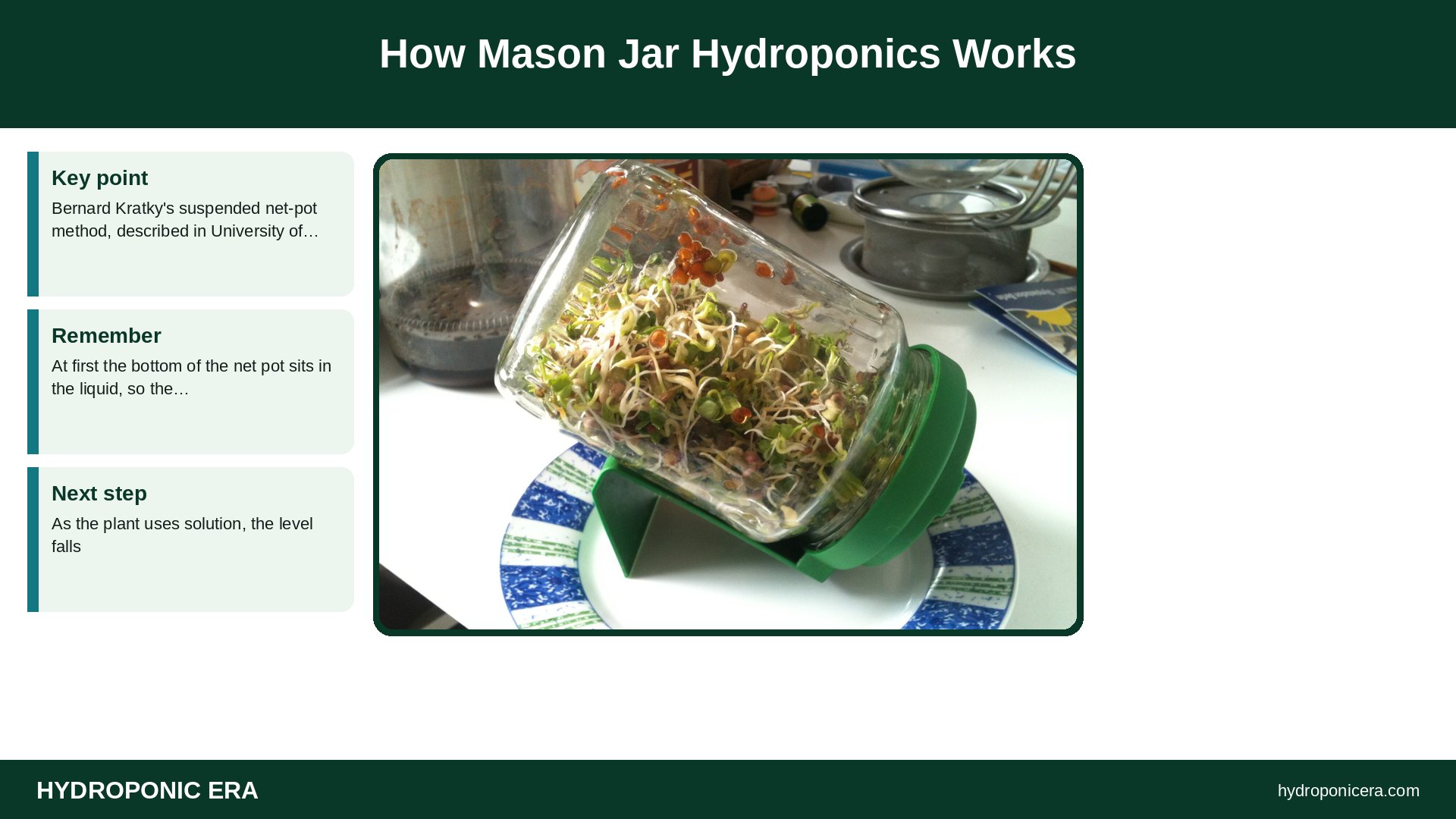
Dr. Bernard Kratky’s suspended net-pot method, described in University of Hawaii publication VC-1, places the plant above a still nutrient solution. At first the bottom of the net pot sits in the liquid, so the seedling can wick water. As the plant uses solution, the level falls. The roots follow it down, and the upper roots stay in moist air where they take up oxygen.
That self-made air gap is the whole trick. If you top the jar back up to the rim, you drown the air roots and they can rot. Instead, add only enough to cover the lowest third of the root mass.
For more on the method in larger tubs, see the Kratky method.
What You Need for a Mason Jar Hydroponics Setup
- A clean wide-mouth mason jar. Quart jars suit herbs; half-gallon jars suit lettuce.
- A 3-inch net pot (wide mouth) or a 2-inch net pot that rests in a regular-mouth band.
- A rockwool cube or starter sponge plus a handful of clay pebbles.
- A complete hydroponic nutrient, not a soil fertilizer.
- A pH test kit or meter.
- Something opaque to wrap the glass.
Step-by-Step: Set Up Mason Jar Hydroponics
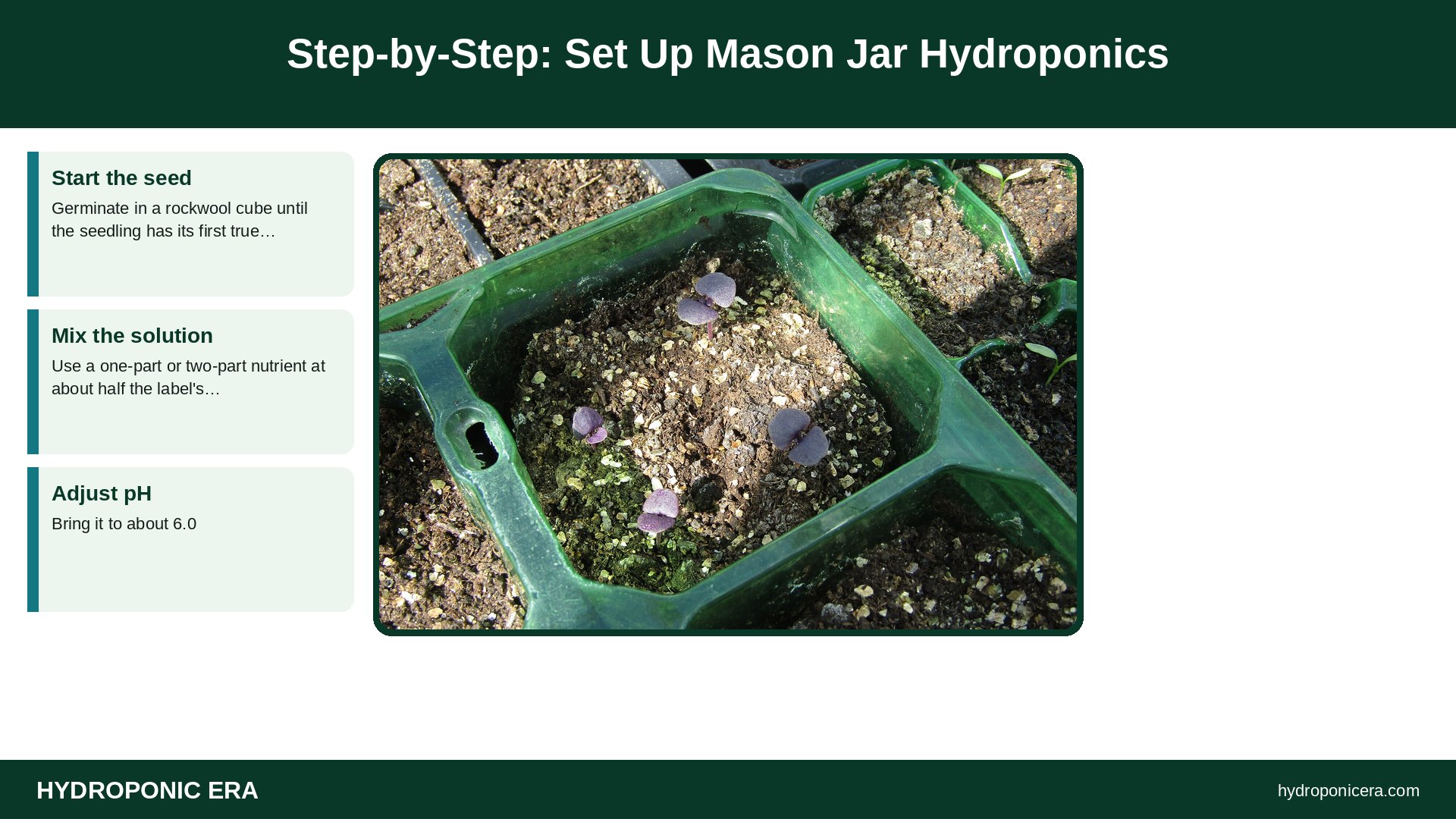
- Start the seed. Germinate in a rockwool cube until the seedling has its first true leaves and roots poke out the bottom.
- Mix the solution. Use a one-part or two-part nutrient at about half the label’s vegetative rate. Aim for EC 0.8–1.2 mS/cm.
- Adjust pH. Bring it to about 6.0.
- Fill the jar. Fill so the bottom 1/2 inch of the net pot sits in the solution.
- Add the plant. Set the cube in the net pot and pack clay pebbles around it.
- Block light. Wrap the jar so algae can’t grow.
- Place it under light. Use a sunny south window or a small LED.
Best Plants for Mason Jar Hydroponics
Choose plants that stay compact and drink modestly. Large fruiting crops empty a jar in days.
- Good: basil, mint, chives, parsley, cilantro, green onions, leaf lettuce, and Thai basil.
- Possible with a half-gallon jar: butterhead lettuce, bok choy, and a single dwarf pepper.
- Avoid: tomatoes, cucumbers, squash, and anything that gets taller than about 18 inches.
See best herbs for hydroponics for more options.
Light, Temperature, and Water Use
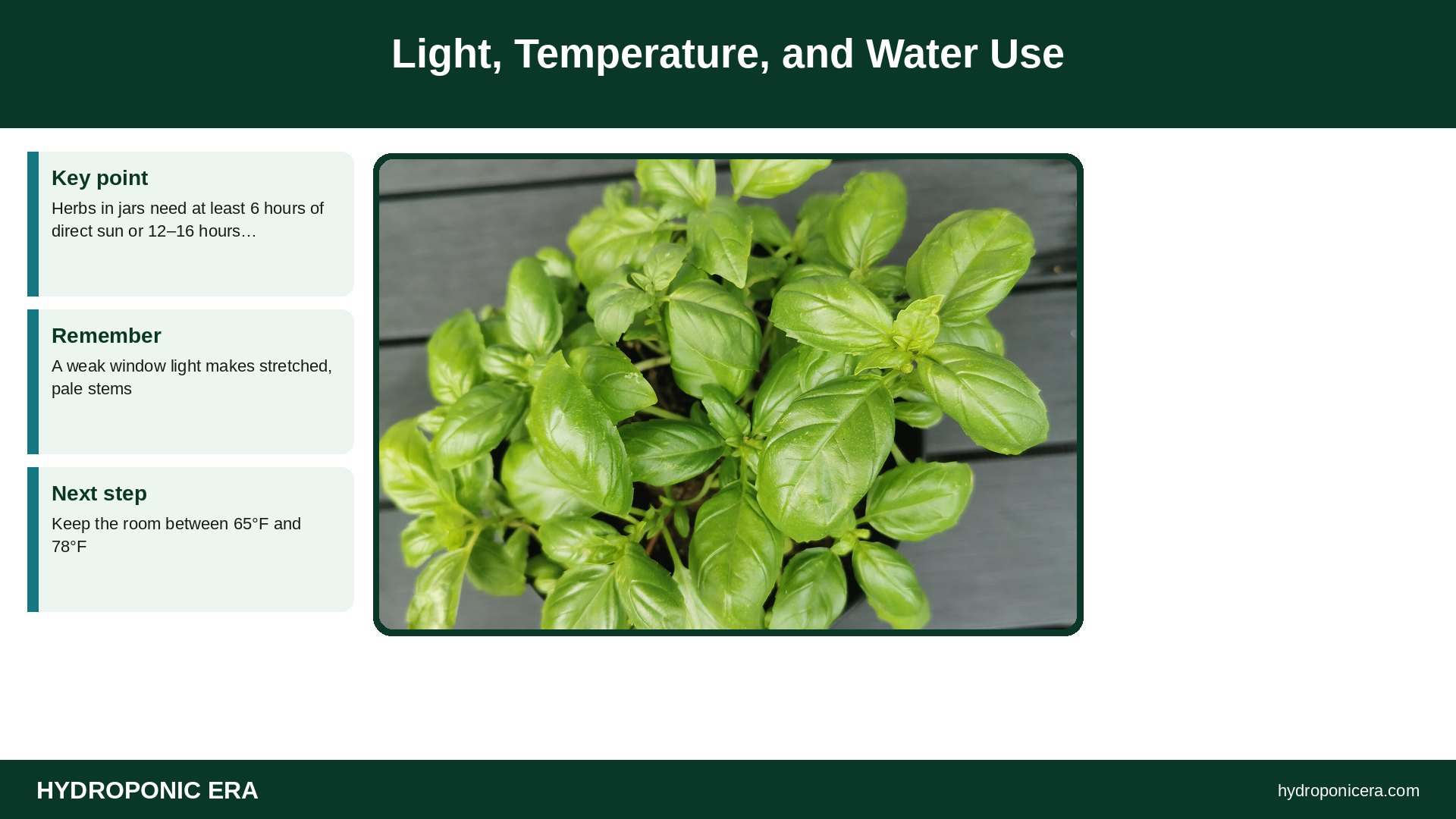
Herbs in jars need at least 6 hours of direct sun or 12–16 hours under an LED. A weak window light makes stretched, pale stems. Keep the room between 65°F and 78°F. Warm solution holds less oxygen, so keep jars off hot sills in summer.
A basil plant can drink 2–4 fluid ounces a day once it is established. Mark the jar with tape when you plant, so you can see the level drop. When less than a quarter remains, top up with half-strength solution, filling only to the bottom of the root mass.
Mason Jar Hydroponics Problems and Fixes
- Green water or slime: light is reaching the solution. Wrap the jar better and replace the solution.
- Brown, smelly roots: the jar was overfilled, or it is too warm. Rinse roots, lower the level, and move it somewhere cooler. See root rot in hydroponics.
- Yellow lower leaves: the nutrient is too weak or used up. Refresh with a new mix.
- Leggy plant: it needs more light.
- Burnt leaf tips: the solution is too strong. Dilute it.
Is Mason Jar Hydroponics Safe?
Yes, if you keep it clean. Glass is inert and food-safe, which is one reason jars are popular. Wash jars with hot soapy water between plantings, and rinse out any bleach thoroughly. Never use jars that held chemicals. Keep nutrient concentrate away from children and pets, and label every jar.
Making Your Mason Jar Hydroponics Last Longer
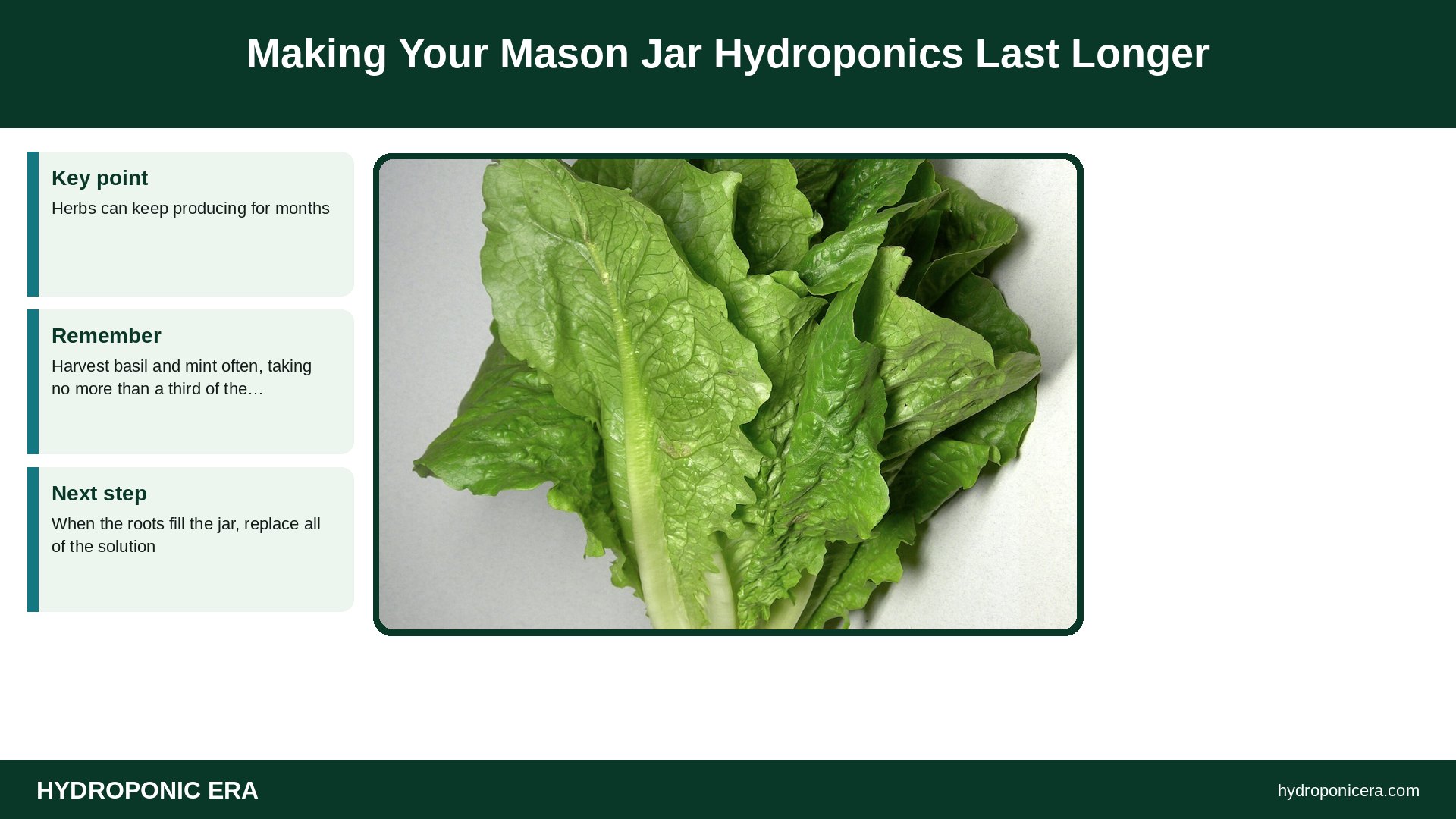
Herbs can keep producing for months. Harvest basil and mint often, taking no more than a third of the plant at a time. When the roots fill the jar, replace all of the solution. Once a plant becomes woody or root-bound, start a fresh seedling in a second jar so you always have one ready.
A row of three or four jars on a windowsill gives a steady supply of herbs. If you want a bigger harvest, step up to a 5-gallon bucket DWC.
Mason Jar Hydroponics vs Water Propagation
Putting cuttings in plain water is not hydroponics; the plant will root but slowly starve. A jar becomes a hydroponic system when you add a complete nutrient and manage pH. That is why jar-grown basil stays green and productive while a cutting in tap water fades after a few weeks.
A Simple Mason Jar Hydroponics Schedule
Here is what a typical basil jar looks like week by week on a sunny windowsill or under a small LED:
- Week 0: transplant a seedling with two true leaves. Solution touches the bottom of the net pot.
- Week 1: roots reach the solution and the level drops about an inch. Do nothing.
- Week 2–3: growth speeds up. Pinch the top above the second set of leaves to make the plant bushy.
- Week 4: the jar is about half empty. Top up with half-strength solution to cover only the lower roots.
- Week 5–8: harvest a few stems each week. Replace the whole solution once in this period.
Lettuce follows a shorter path. Plant a seedling in a half-gallon jar, leave it alone, and cut the whole head in about five to six weeks. Lettuce rarely needs a top-up if the jar starts full.
Cost of a Mason Jar Hydroponics Garden
A wide-mouth quart jar costs about a dollar in a case, a 3-inch net pot about 25 cents, and a bag of rockwool cubes a few dollars. One bottle of hydroponic nutrient makes hundreds of gallons at half strength. A pH kit is the largest single cost. Most people can start three jars for under $25, and the parts can be reused for years.
FAQs
What size mason jar is best for hydroponics?
A wide-mouth quart works for one herb. A half-gallon jar suits one lettuce head.
Do I need an air pump?
No. The Kratky air gap supplies oxygen, as long as you don’t overfill.
How often should I change the solution?
Top up as it drops; replace it fully every 3–4 weeks or when roots fill the jar.
Can I use clear jars?
Only if you block light; otherwise algae grows on the glass and roots.
What nutrient should I use in mason jar hydroponics?
A complete hydroponic nutrient at about half strength, near pH 6.0.
Can I grow lettuce in a jar?
Yes. Leaf lettuce is ready in about 5–6 weeks in a half-gallon jar.
Sources
- University of Hawaii CTAHR — A Suspended Net-Pot, Non-Circulating Hydroponic Method (VC-1)
- UF/IFAS Extension — Growing Lettuce in Small Hydroponic Systems
- Oklahoma State University Extension — Electrical Conductivity and pH Guide for Hydroponics
- Photo credits (Wikimedia Commons, edited with titles): Mason Jar with Screw Top by Dwight Burdette (CC BY 3.0); Growing bean sprouts by User:tlcoles (CC BY-SA 3.0); -2020-07-10 Purple basil (Ocimum basilicum) seedlings, Trimingham by Kolforn (Kolforn) I’d appreciate if you could mail me (Kolforn@gmail.com) if you (CC BY-SA 4.0); Basil plant in a pot 02 by Netha Hussain (CC BY-SA 4.0); Romaine lettuce by Rainer Zenz (CC BY-SA 3.0)