
Microgreen seed density for a standard 10 x 20 inch (25 x 51 cm) tray is usually about 10–15 grams for small seeds like broccoli, kale, arugula and mustard, 20–30 grams for medium seeds like radish, beet and cilantro, and much more for large seeds, such as about 150 grams of pea or 48 grams of sunflower. Weigh seed instead of guessing, scale the amount by tray area, and adjust after each tray: sow thinner if you see mold or stretching, thicker if the tray looks patchy.
Key takeaway: Use weight, not volume, and start with published rates. A kitchen scale that reads to 1 gram is the single best tool for consistent microgreens.
| Microgreen | Grams per 10 x 20 in (25 x 51 cm) tray (Johnny’s trial) | Grams per 1020 tray (USU guide) |
|---|---|---|
| Arugula | 10 | 10 |
| Kale (Red Russian) | 10 | 28 |
| Broccoli | 13 | 28 |
| Red cabbage | 10.5 | — |
| Mustard (Garnet Giant) | 8 | — |
| Radish (Red Arrow / Champion) | 24.5 | 42 |
| Beet (Bull’s Blood) | 23 | — |
| Cilantro | 26 | 28 |
| Amaranth (Garnet Red) | 7.5 | — |
| Pea | — | 150 |
| Sunflower | — | 48 |
The two sources differ because they harvest at different sizes and use different media. Johnny’s harvested at the first true leaf; heavier sowing gives more, smaller seedlings per tray.
Why Microgreen Seed Density Matters
Sow too thin and you waste tray space and get a sparse, uneven harvest. Sow too thick and seedlings compete, stay damp and invite damping-off and mold. Penn State Extension says the goal is to produce as many seedlings as possible while avoiding stretching or disease, and it recommends lower rates in summer than in winter and for larger seed than for smaller seed. Johnny’s adds that if you want bigger plants, sow fewer seeds per flat for better airflow and slower use of water and nutrients.
Standard Starting Rates
- Penn State: 10–15 g per standard 12 x 20 inch (30 x 51 cm) 10-row tray worked for most of its crops; students use 10–12 g.
- University of Maryland: about 1 tablespoon of seed (about 10–15 g) per 10 x 20 inch (25 x 51 cm) flat, or seeds spaced 3/16–1/4 inch (5–6 mm) apart.
- Johnny’s (by eye): 6–8 large seeds or 10–12 small seeds per square inch (6.5 cm²), as cited by Penn State.
- Virginia Tech: gives 13 g per 1020 tray as an example and stresses testing density for your own system.
Seeds per Gram: Why Seed Size Changes Everything
Seed weight varies hugely, so the same weight can mean very different seed counts. Maryland Extension gives these approximate counts:
| Crop | Seeds per ounce (28 g) | Seeds per gram | Seeds per tablespoon |
|---|---|---|---|
| Beet | 1,500 | 53 | 800 |
| Broccoli | 8,000 | 281 | 3,000 |
| Mustard | 15,000 | 530 | 6,500 |
That’s why a tablespoon of mustard holds about eight times more seeds than a tablespoon of beet. Maryland notes a standard flat can accommodate about 1,500–4,500 seeds depending on seed size.
How to Calculate Microgreen Seed Density for Any Container
- Find the tray area. A 10 x 20 inch (25 x 51 cm) tray is 200 square inches (1,290 cm²).
- Measure your container. A 5 x 5 inch (13 x 13 cm) clamshell is 25 square inches (161 cm²).
- Divide. 25 ÷ 200 = 0.125, or one-eighth of a tray.
- Multiply by the rate. For broccoli at 13 g per tray: 13 × 0.125 ≈ 1.6 g.
- Adjust for germination. If your seed packet says 85% germination, divide by 0.85: about 1.9 g.
Penn State Extension offers a free Microgreens Seed Density Calculator spreadsheet that does this for square, rectangular and round containers using average seed weights for each species.
Volume Shortcuts When You Have No Scale
Penn State found one tablespoon of brassica seed weighs about 11–12 g. Mississippi State Extension suggests 2–3 teaspoons of red cabbage seed or 2–3 tablespoons of radish seed for a 10 x 20 inch (25 x 51 cm) tray. Weigh one spoonful once on a friend’s scale, write it on the seed bag, and you can use volume from then on.
Adjusting Microgreen Seed Density by Crop
| Seed type | Examples | Tips |
|---|---|---|
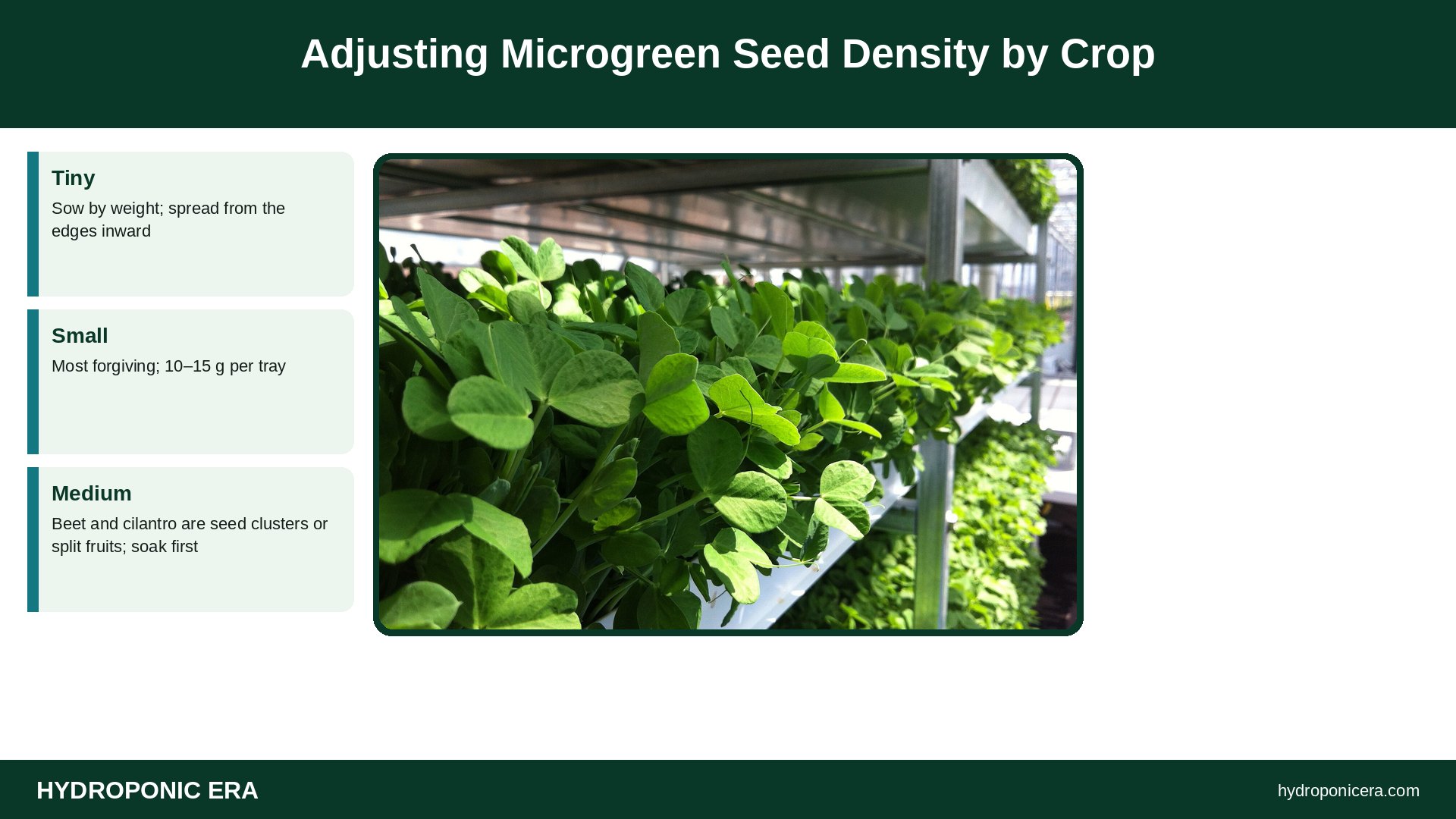
| Tiny | Amaranth, mustard, arugula | Sow by weight; spread from the edges inward |
| Small | Broccoli, kale, cabbage | Most forgiving; 10–15 g per tray |
| Medium | Radish, beet, cilantro | Beet and cilantro are seed clusters or split fruits; soak first |
| Large | Pea, sunflower, buckwheat | Soak 6–12 hours; weight the tray during germination |
Maryland lists pea, sunflower, beet, Swiss chard, cilantro and buckwheat among seeds that germinate faster after a 6–12 hour soak. See sunflower microgreens and pea shoots.
Signs You Got the Density Wrong
- Mold or a sour smell: too dense, too wet, or too little airflow. See microgreens mold.
- Seedlings collapsing in patches: damping-off, often worse in crowded trays. See damping-off.
- Bare spots: uneven sowing or poor germination; check seed age.
- Tall, thin, yellow stems: crowding plus low light.
Record and Refine
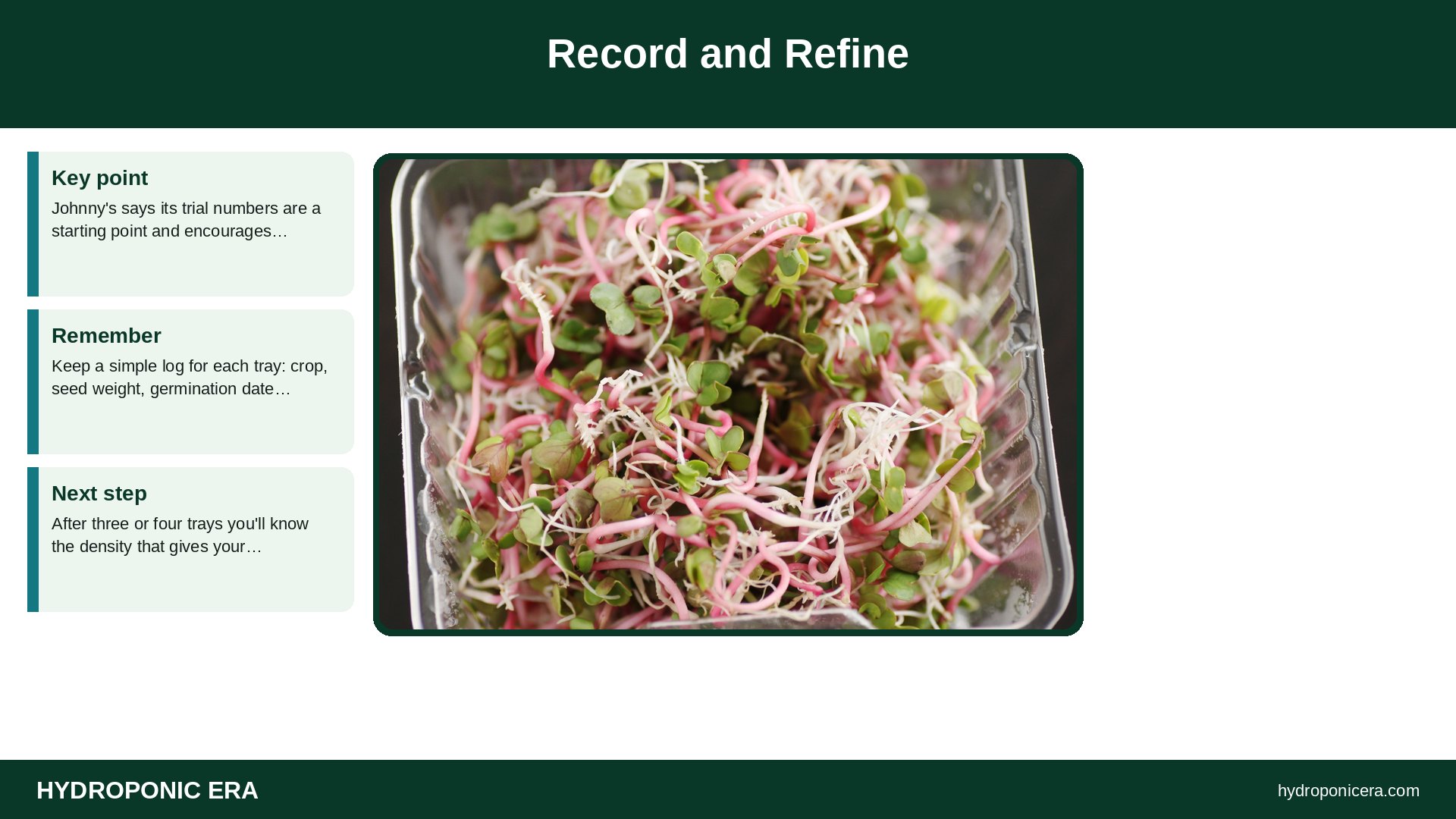
Johnny’s says its trial numbers are a starting point and encourages growers to run their own trials. Keep a simple log for each tray: crop, seed weight, germination date, harvest date and harvested weight. After three or four trays you’ll know the density that gives your best yield per gram of seed. Penn State’s yields averaged about 0.30 lb (136 g) per 10-row flat across its crops, which is a useful benchmark. See record keeping and microgreens cost worksheet.
Getting microgreen seed density right is mostly about consistency: same scale, same tray, same notes. Small changes of 1–2 grams per tray can make a visible difference. See growing microgreens hydroponically.
Microgreen Seed Density by Growing Method
Your growing method changes the best microgreen seed density. On a hemp or jute mat, seeds sit on the surface and roots spread sideways, so very thick sowing can stay wet and mat together. In soil or coir, roots anchor down and the surface dries faster, which tolerates slightly heavier sowing. Penn State notes that lower rates work better in summer, when warm, humid air favors disease, and higher rates can work in winter. Johnny’s rates come from one research-farm trial harvested at the first true leaf, so treat them as a baseline and start a little lighter on mats. See microgreen grow mats.
A Simple Microgreen Seed Density Test
- Split one tray into three sections with strips of tape.
- Sow the published rate in the middle, 20% less on one side and 20% more on the other.
- Grow all three under the same light and watering.
- At harvest, weigh each section and look for mold, stretching or bare spots.
- Use the section with the best weight and quality as your new microgreen seed density.
Repeat the test when you change seed lots, trays or seasons, since germination rates and room conditions shift over time.
FAQs
How many grams of seed for a 10 x 20 tray?
About 10–15 g for small seeds, 20–30 g for medium seeds and more for large seeds.
Can I sow microgreens too thick?
Yes; crowding raises mold and damping-off risk.
Should I soak seeds?
Soak large or hard seeds such as pea, sunflower, beet and buckwheat.
How do I measure seed without a scale?
Use spoons; a tablespoon of brassica seed is about 11–12 g.
Does seed density change with harvest size?
Yes; sow thinner if you want larger microgreens.
Is there a seed density calculator?
Yes, Penn State Extension offers a free one.
Sources
- Johnny’s Selected Seeds — Micro Greens Yield Trial 2017
- Penn State Extension — Growing Microgreens
- Penn State Extension — Microgreens Seed Density Calculator
- University of Maryland Extension — Growing Microgreens and Baby Greens Indoors
- Utah State University Extension — Grow Your Own Microgreens
- Mississippi State University Extension — Growing Microgreens for the Mississippi Gardener
- Virginia Cooperative Extension — Introduction to Microgreen Production
- Photo credits (Wikimedia Commons, edited with titles): Lufa Farms Microgreens in Trays by Lufa Farms (CC BY-SA 2.0); Medals weighed in digital scale by Kpubkalanami (CC BY-SA 4.0); Fleece lined greenhouse potting tray and seed pots – Flickr – peganum by peganum from Small Dole, England (CC BY-SA 2.0); Lufa Farms Microgreens in Trays by Lufa Farms (CC BY-SA 2.0); 11 microgreens by Stacy Spensley (CC BY 2.0)