
Full spectrum grow lights are grow lights, usually white LEDs, that emit a broad mix of colors similar to sunlight instead of just red and blue. That makes plants look natural, makes pests and deficiencies easier to spot, and is easier on your eyes. “Full spectrum” has no legal definition, though, so it doesn’t guarantee a good light. Judge a fixture by its PPFD (how much usable light reaches the plants) and its efficacy in µmol/J, not by the label or by lumens. A good modern full-spectrum LED delivers about 2.5 µmol/J or more.
Key takeaway: Buy full spectrum for comfort and visibility, but buy on numbers: a published PPFD map, efficacy of 2.5 µmol/J or higher and a spectrum chart.
| Feature | Full spectrum (white) LED | “Blurple” (red + blue) LED |
|---|---|---|
| Color to your eye | White, natural | Pink-purple |
| Seeing plant problems | Easy | Hard |
| Typical efficacy (Kusuma et al. 2020) | 2.5–2.8 µmol/J (white + red) | About 3.0 µmol/J (blue + red) |
| Plant growth | Excellent | Excellent |
| Best use | Homes, kitchens, mixed crops | Closed tents, rooms where looks don’t matter |
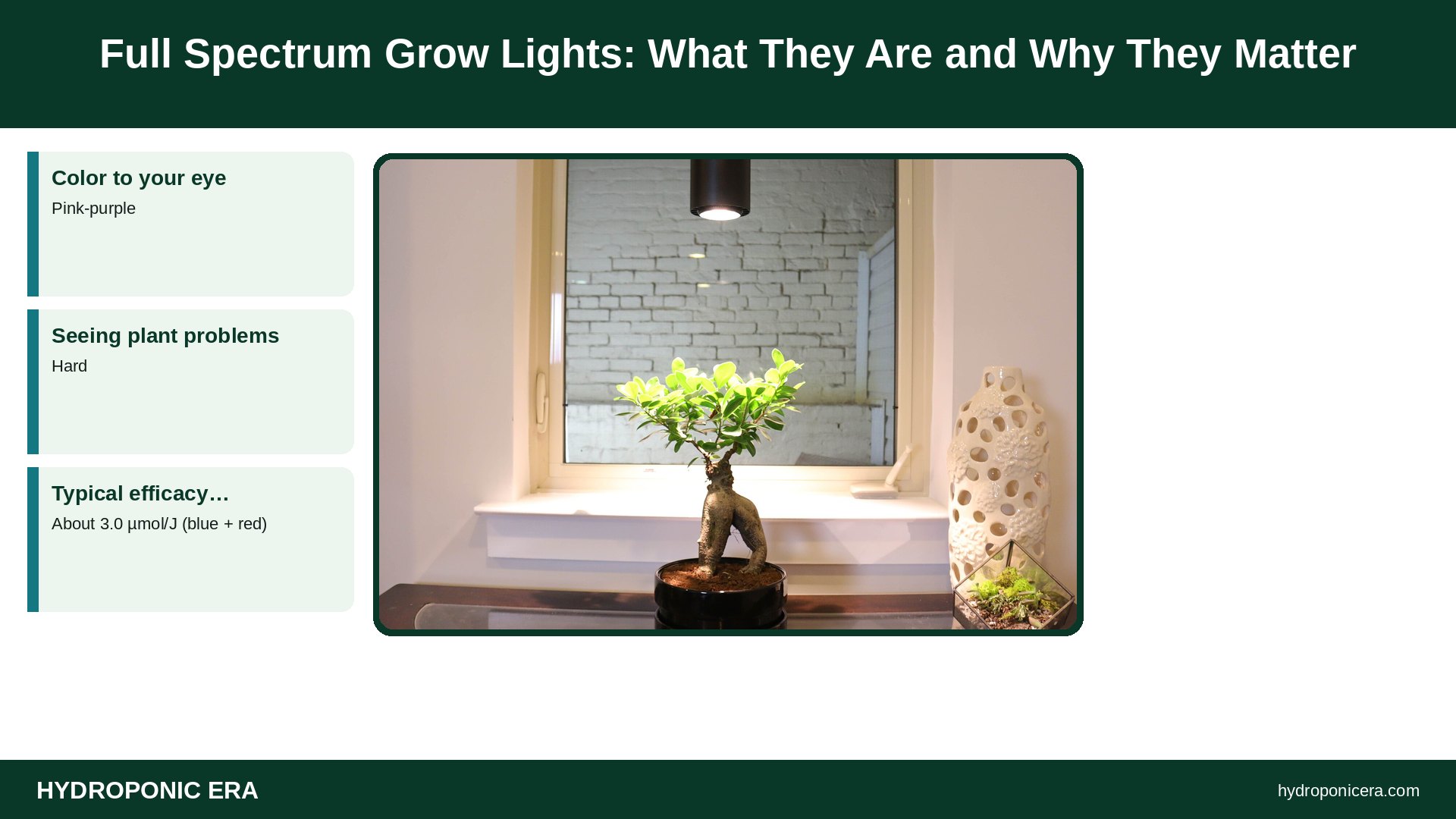
What Does “Full Spectrum” Mean?
University of Maryland Extension’s Maryland Grows blog explains that a light labeled full-spectrum produces each color in amounts that mimic natural sunlight, so the light looks fairly white. It adds that full-spectrum light isn’t required for acceptable growth and flowering, but it makes plants easier to view and reduces eye strain compared with harsh red-blue lights. For full spectrum grow lights, manufacturers should ideally publish a spectrum graph so you can see the relative amount of each color. Most full-spectrum LEDs are phosphor-converted white LEDs: blue chips coated with a phosphor that turns some blue light into green, yellow and red. Many add extra deep-red diodes.
Do Plants Need Full Spectrum Grow Lights?
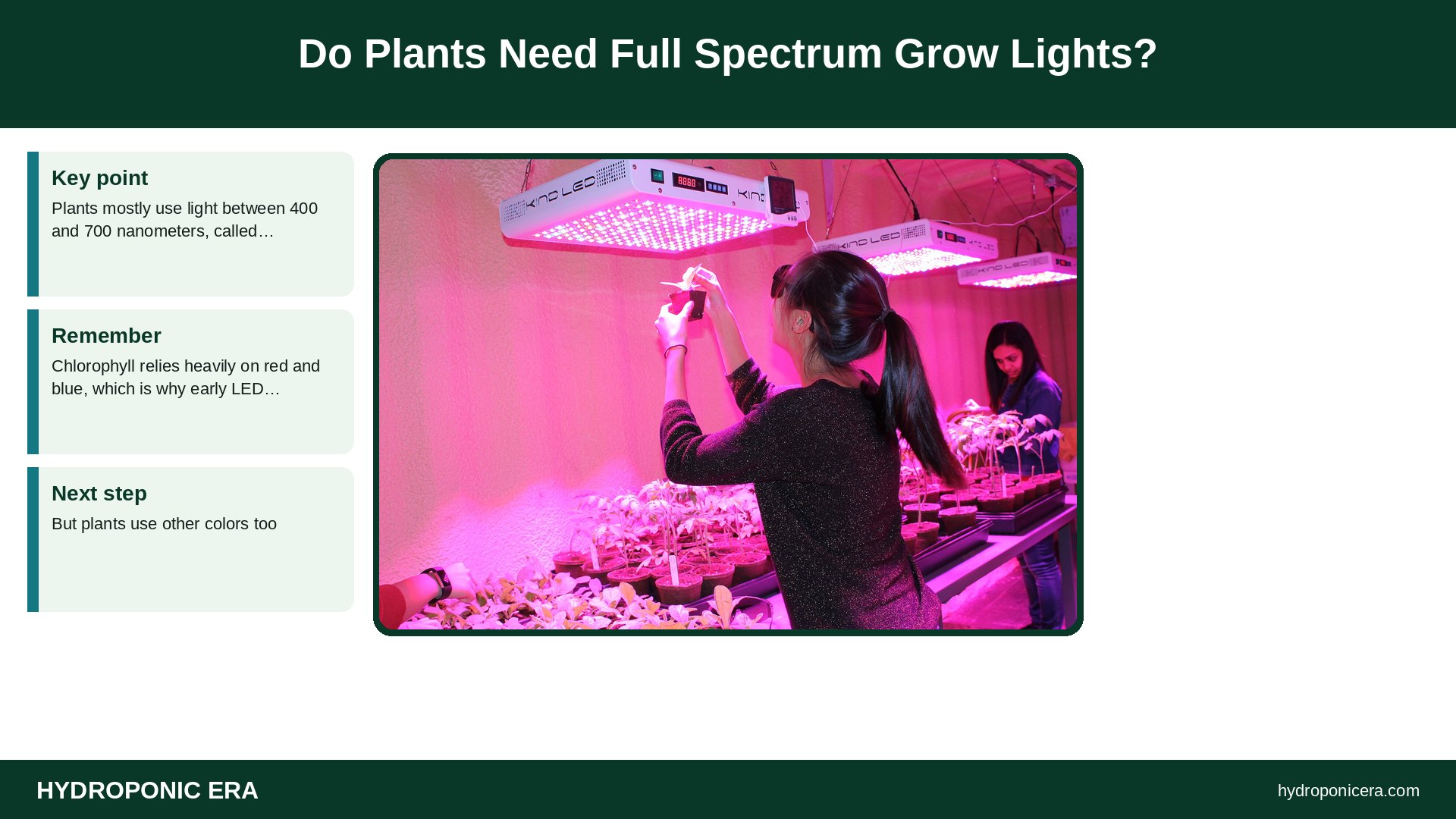
Plants mostly use light between 400 and 700 nanometers, called photosynthetically active radiation (PAR). Chlorophyll relies heavily on red and blue, which is why early LED grow lights used only those colors. But plants use other colors too. Kusuma, Pattison and Bugbee (2020) note that green photons have long been known to be effective for photosynthesis. Green photons are up to 10% less efficient than the most common 660 nm red, but they penetrate deeper into the plant canopy than blue or red.
Their review also says broad-spectrum light is useful for diagnosing plant disorders but isn’t necessarily better for photosynthesis or growth. In short, plants grow well under both, so choose full spectrum grow lights for the human benefits and buy on output.
Why Lumens Don’t Tell You Much
Maryland Grows uses the rhyme “lumens are for humans”: lumens measure brightness as human eyes perceive it, weighted toward yellow-green. Two lamps can have similar lumens yet very different amounts of red and blue. For plants, look at PPFD, measured in µmol/m²/s, which counts photosynthetic photons reaching a surface. See PPFD and DLI explained.
How to Compare Full Spectrum Grow Lights
| Spec | What it means | What to look for |
|---|---|---|
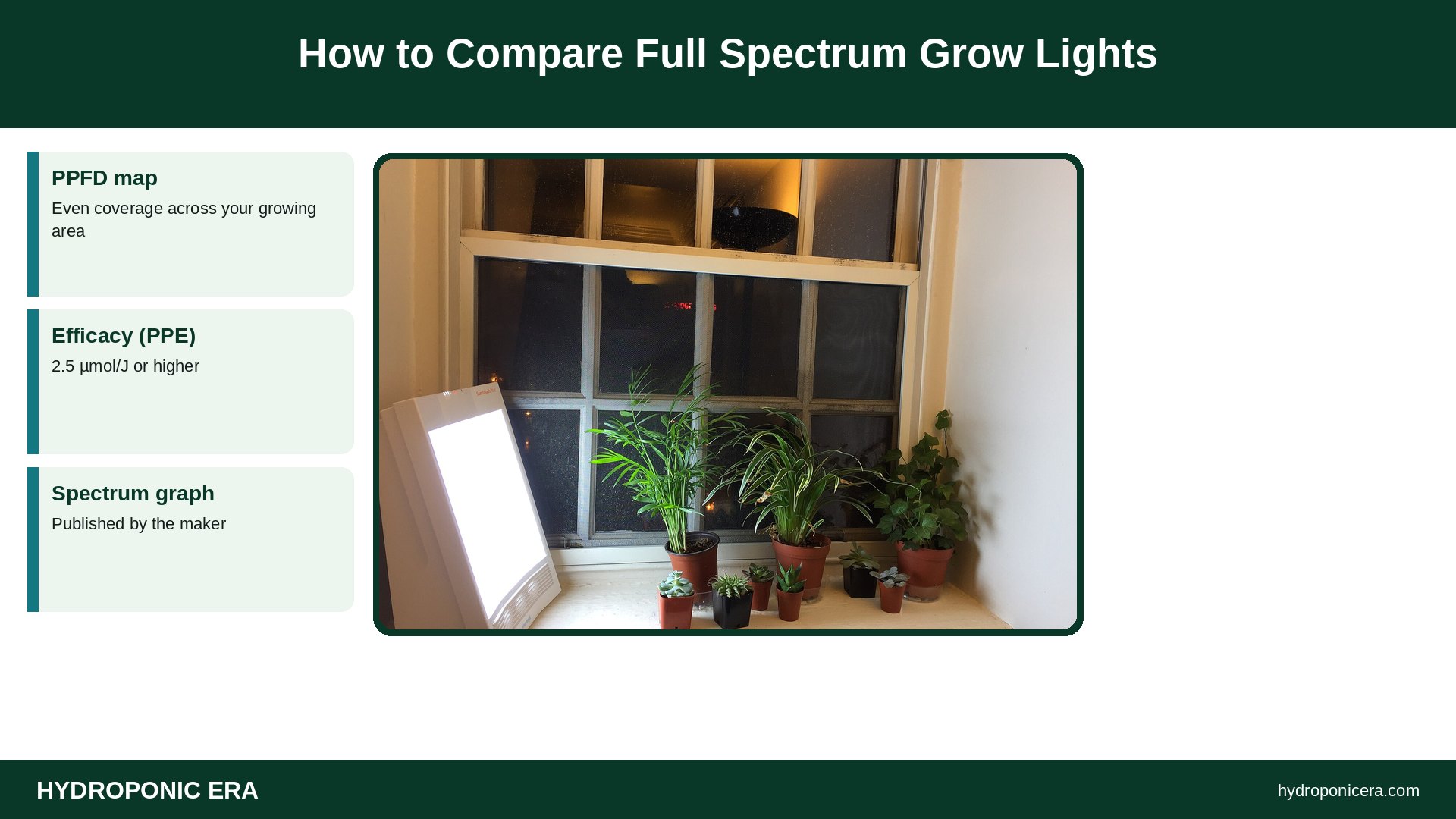
| PPFD map | µmol/m²/s at points under the light at a set height | Even coverage across your growing area |
| Efficacy (PPE) | µmol of photons per joule of electricity | 2.5 µmol/J or higher |
| Spectrum graph | Relative output by wavelength | Published by the maker |
| Wattage (true draw) | Actual power from the wall | Not “equivalent” watts |
| Color temperature | Warm (about 3000 K) to cool (about 6500 K) look | Personal preference |
| CRI | How true colors look, 0–100 | 80s and above for display areas |
| Safety listing | UL, ETL or similar | Required for indoor home use |
The DesignLights Consortium’s Horticultural Technical Requirements V4.0 set a minimum photon efficacy of 2.5 µmol/J for LED grow lights on its Qualified Products List, an 8.7% increase over the previous version. A DLC listing is a quick way to find efficient fixtures, and some utilities offer rebates for listed products.
Color Temperature and CRI
Maryland Grows explains that a lower Kelvin rating looks warmer: warm-white fluorescents are around 2700 K, direct sunlight about 5000 K and cool-white about 6500 K. CRI rates how accurate colors look from 0 to 100, with the 80s and above ideal and the 90s considered high CRI. These numbers affect how your plants look more than how they grow. Kusuma et al. note that white LEDs with a higher color temperature contain a larger share of blue photons, and that warm-white phosphors cost some efficiency, so cooler whites can be slightly more efficient.
How Much Light Should Full Spectrum Grow Lights Deliver?
| Crop group | Typical DLI target | PPFD for 16 hours |
|---|---|---|
| Microgreens | 9–16 mol/m²/day (Virginia Tech) | About 150–280 µmol/m²/s |
| Lettuce and leafy greens | About 12–17 mol/m²/day | About 200–300 µmol/m²/s |
| Fruiting crops (tomato, pepper) | Higher; often 20 or more | About 350 or more |
DLI equals PPFD × hours × 0.0036. For example, 250 µmol/m²/s for 16 hours gives about 14.4 mol/m²/day. See grow lights for hydroponic lettuce and microgreens light requirements.
Hanging Height for Full Spectrum Grow Lights
Light intensity drops quickly as you move a fixture away from plants, Maryland Grows notes, so you can control intensity by raising or lowering the light. Use the maker’s PPFD chart at different heights to set it. For seedlings and microgreens, Maryland Extension says 6–12 inches (15–30 cm) above the foliage is typical; stronger fixtures hang higher. See light distance by stage.
Common Mistakes With Full Spectrum Grow Lights
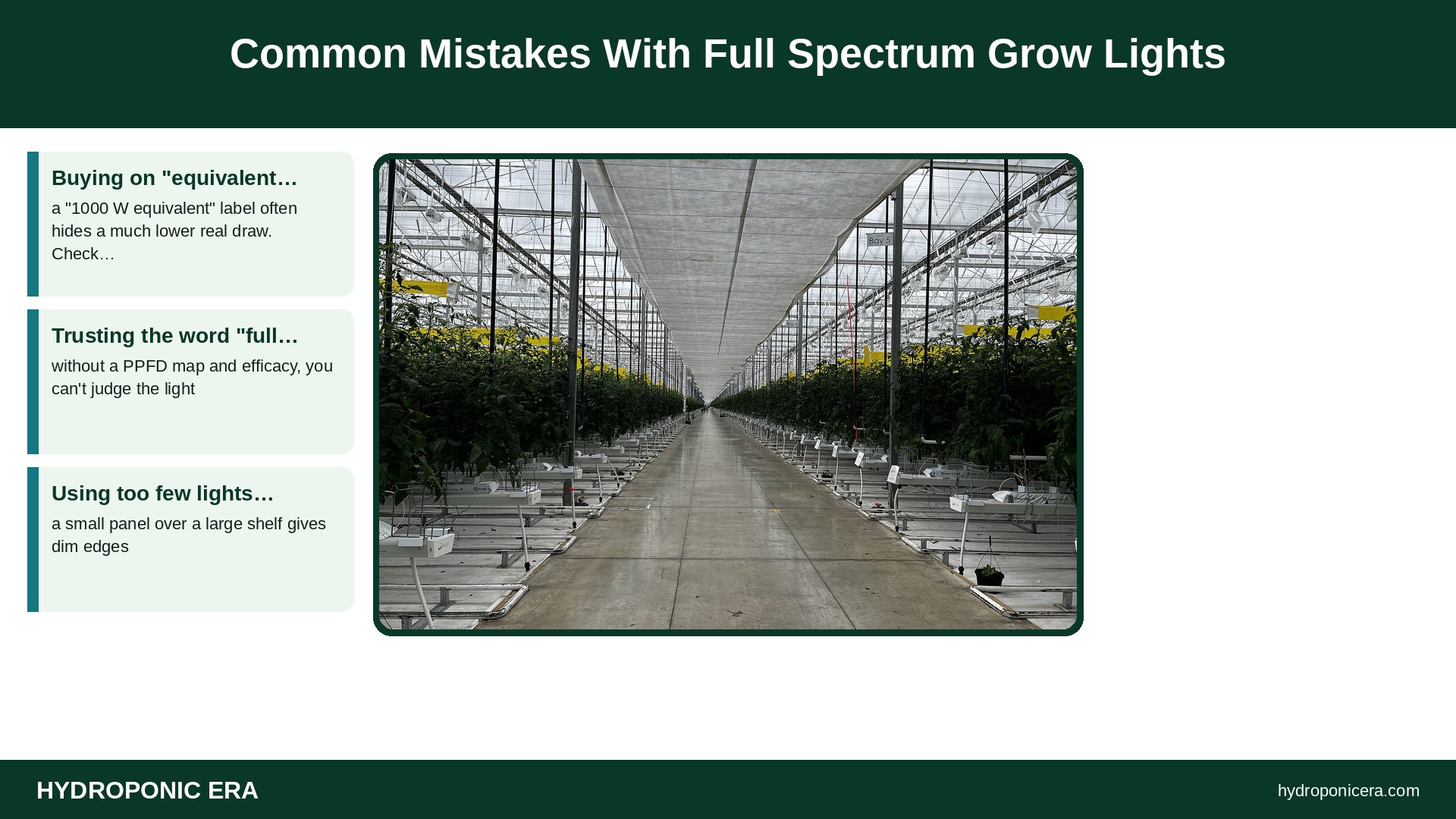
- Buying on “equivalent watts”: a “1000 W equivalent” label often hides a much lower real draw. Check the actual watts.
- Trusting the word “full spectrum”: without a PPFD map and efficacy, you can’t judge the light.
- Using too few lights for the area: a small panel over a large shelf gives dim edges.
- Running lights 24 hours a day: most crops do well with 12–18 hours. See light leaks and night interruption.
- Skipping safety: use listed fixtures and a drip loop on cords near water.
What to Check Before You Buy
Before buying a full spectrum grow light, look for a published PPFD map at a stated hanging height, a rated efficacy in µmol/J, and the actual wattage drawn. The DesignLights Consortium keeps a Horticultural Qualified Products List of lights that meet its efficacy and reporting rules, which is a useful filter for larger fixtures.
FAQs
Are full spectrum grow lights better than red-blue LEDs?
For homes, yes, because plants look natural; growth is similar to good red-blue LEDs.
Is a full spectrum light the same as sunlight?
No; it mimics the visible color mix, usually without the full UV and far-red range.
Can I use a full spectrum LED bulb for plants?
Yes for low-light plants, but check its PPFD.
What efficacy should I look for?
About 2.5 µmol/J or more, the DLC V4.0 minimum.
What color temperature is best?
Any from about 3000–6500 K works; choose what looks best.
Do full spectrum grow lights use more electricity?
Not necessarily; efficient white LEDs reach 2.5–2.8 µmol/J.
Sources
- Maryland Grows, University of Maryland Extension — Fine-Tuning Your Indoor Plant Lighting Choices
- Maryland Grows, University of Maryland Extension — Indoor Lighting Options: Terms, Types and Measurements
- Kusuma, Pattison and Bugbee (2020), Horticulture Research — From Physics to Fixtures to Food: Current and Potential LED Efficacy
- DesignLights Consortium — Horticultural Technical Requirements V4.0
- Virginia Cooperative Extension — Introduction to Microgreen Production
- University of Maryland Extension — Growing Microgreens and Baby Greens Indoors
- Photo credits (Wikimedia Commons, edited with titles): Aspect Black 20W Growlight over Bonsai by Hotmilk400 (CC BY-SA 4.0); Terramera scientists working in a climate-controlled growth chamber located in Vancouver, BC. The space uses LED lighting, which supports plant growth. (50188965171) by Simon Fraser University – Communications & Marketing (CC BY 2.0); Potted plants succulents under grow light Nov 2016 by Asdfjrjjj (CC BY-SA 4.0); Led digital visuals-leds in grow box PNr°0082 by D-Kuru (CC BY-SA 3.0 at); U.S. Department of Agriculture (USDA) Rural Development (RD) Ohio business program staff visited Mucci Farms, a 75-acre greenhouse production farm in Huron, Ohio on September 25, 2024 – 2 by USDAgov (Public domain)