
Peat pellets hydroponics means starting seeds in compressed peat discs, often sold as Jiffy pellets, and then moving the rooted pellet into a hydroponic system. It works well. Pellets swell in water in about 10 minutes, hold moisture without drowning seeds and let you transplant with almost no root disturbance. A University of Georgia study in deep water culture even found peat-based plugs outgrew rockwool for lettuce and arugula. The main risk is loose peat breaking off into the water, so contain the pellet in a net cup and keep the mesh on.
Key takeaway: Soak pellets in warm water, sow 2 seeds each, and transplant into net cups once roots poke through the mesh. Leave the netting on, top the cup with clay pebbles and watch for clogged pumps or filters.
| Starter | Starting pH | Prep needed | Mess in water | Best for |
|---|---|---|---|---|
| Peat pellets | About 5.3 (USask) | Soak to expand | Some, if mesh tears | DWC, Kratky, NFT, ebb and flow |
| Rockwool cubes | High; pre-soak to lower | Pre-soak and adjust pH | Little | All systems |
| Foam or plant-based sponges | Near neutral | Wet only | Little | Countertop and DWC |
| Coir plugs | Near neutral | Rinse and soak | Some | Drip and ebb and flow |
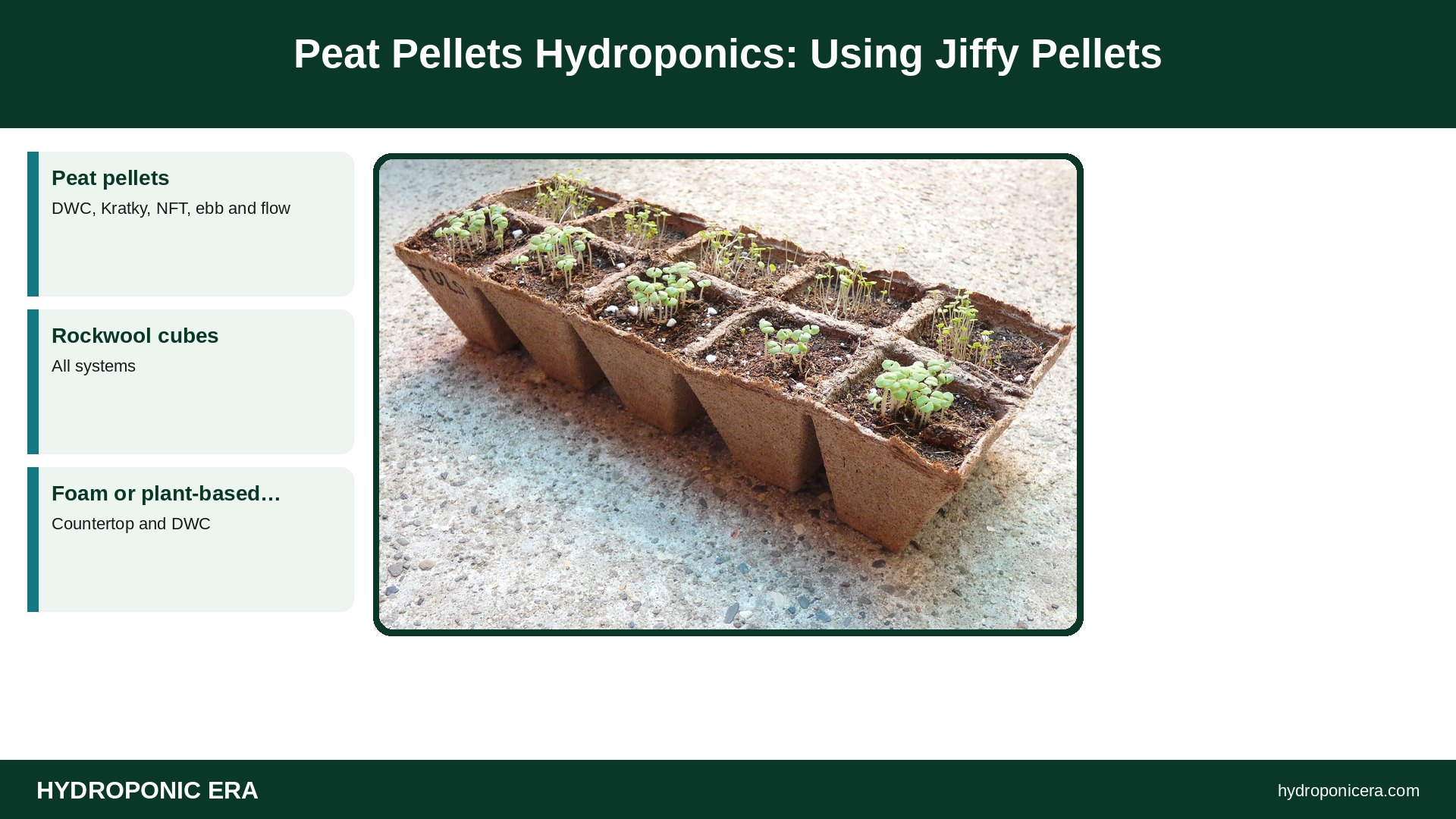
What Are Peat Pellets?
Gardening at USask, from the University of Saskatchewan, explains that pellets come as compact discs that swell when soaked. They’re made from sphagnum peat or coconut coir, with lime and a low-ammonium fertilizer added to stimulate growth. The pellets have a pH of about 5.3 and are wrapped in a thin, degradable net.
USask lists the benefits: pellets hold enough moisture to germinate seeds but drain well enough not to drown them, the netting lets air reach the root ball, and transplant shock is low because roots are barely disturbed. Clemson Cooperative Extension’s Home & Garden Information Center also lists peat pellets among standard seed-starting containers.
Do Peat Pellets Work in Hydroponics?
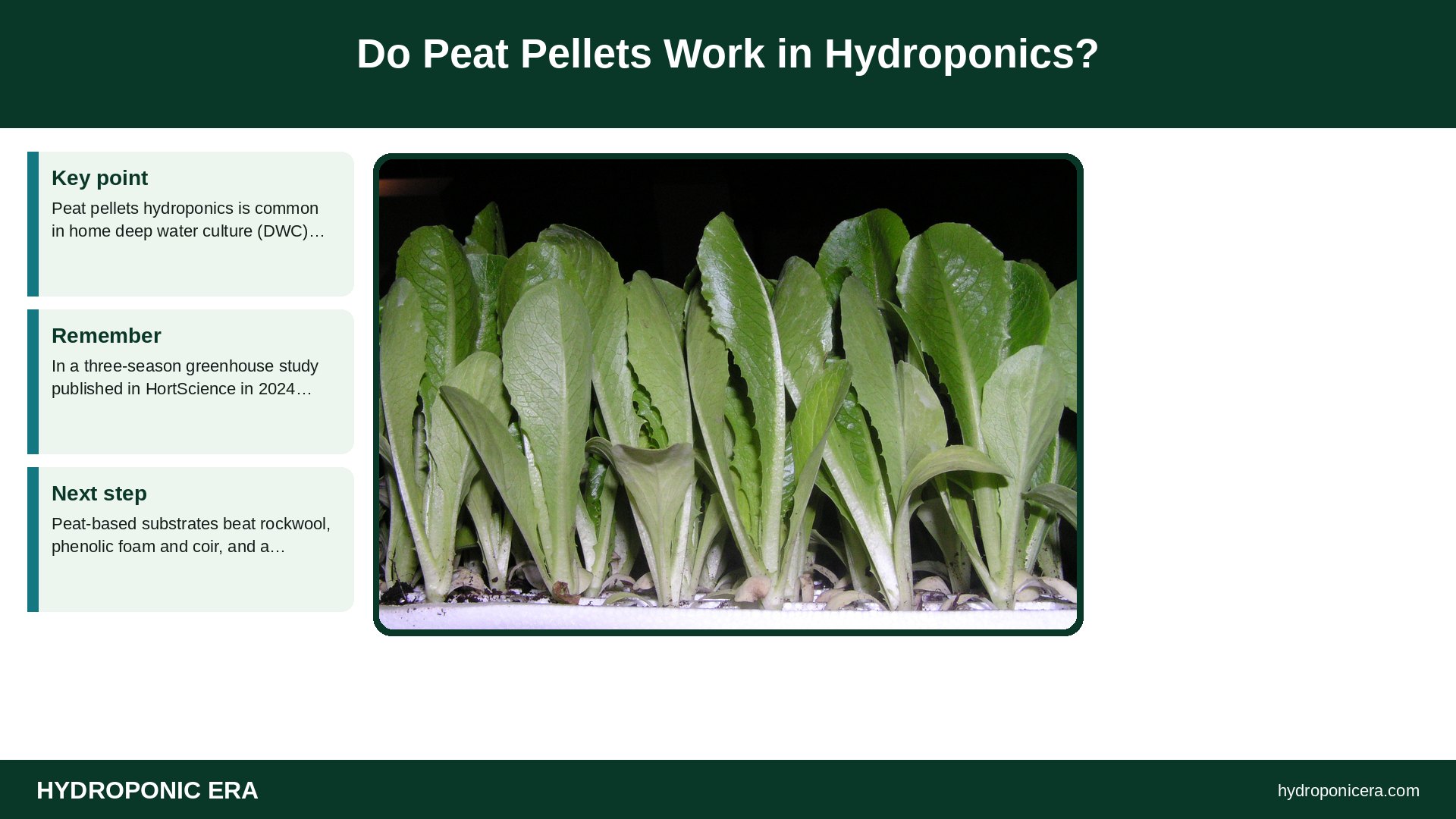
Yes. Peat pellets hydroponics is common in home deep water culture (DWC), Kratky jars and NFT channels. Research supports it. In a three-season greenhouse study published in HortScience in 2024, University of Georgia researchers grew arugula and lettuce in DWC using several starter substrates. Peat-based substrates beat rockwool, phenolic foam and coir, and a mix of 75% peat and 25% fine coir gave the greatest height, leaf area and biomass. Rockwool generally produced the lowest growth.
The trade-offs are practical. Peat is organic, so it slowly breaks down. Loose peat can cloud water, coat roots and clog small pumps, emitters and filters. The netting holds it together, which is why you leave it on.
How to Start Seeds for Peat Pellets Hydroponics
- Arrange pellets. USask advises placing them flat side down, with the small dent facing up, in a 10×20 inch (25×51 cm) tray.
- Expand them. Pour warm water over the pellets until submerged. They take about 10 minutes to swell fully. Pour off extra water and give each a gentle squeeze if needed.
- Sow. Tear the top of the netting slightly, make a small well and plant 2 seeds per pellet in case one fails. Cover lightly with peat.
- Cover. Use a humidity dome and keep the tray warm. Seeds don’t need light until they sprout. See seedling heat mats and humidity domes.
- Light and thin. Once sprouted, remove the dome, move under lights and snip extra seedlings at the base rather than pulling them, so you don’t disturb the keeper’s roots.
- Water lightly. USask notes pellets dry out quickly under grow lights, so check them daily and keep them damp, not soggy.
If you’d rather use pH-neutral starters, compare hydroponic starter sponges and rockwool for hydroponics.
Transplanting for Peat Pellets Hydroponics
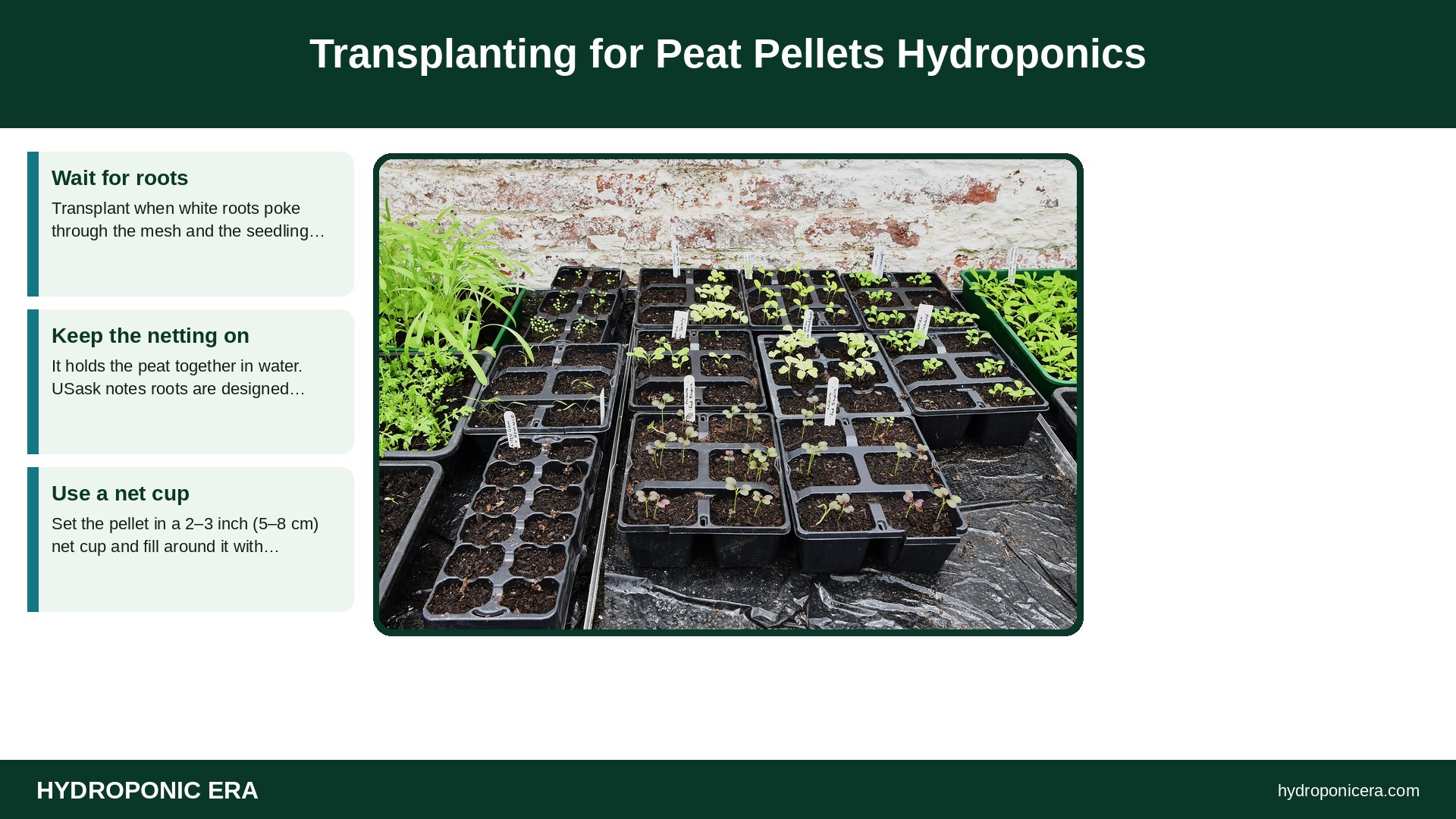
- Wait for roots. Transplant when white roots poke through the mesh and the seedling has its first true leaves.
- Keep the netting on. It holds the peat together in water. USask notes roots are designed to push through the fine mesh, though for soil pots they find it helps to cut one side; in hydroponics, a small slit is enough.
- Use a net cup. Set the pellet in a 2–3 inch (5–8 cm) net cup and fill around it with rinsed clay pebbles. The pebbles hold the pellet in place and keep light off the peat.
- Set the water level. In DWC or Kratky, keep the solution touching the bottom of the net cup at first so the pellet wicks moisture, then let the gap widen as roots grow.
- Rinse loose peat. If the pellet sheds, dip it gently in clean water before placing it.
For a full walkthrough, see transplanting hydroponic seedlings.
Managing pH and Water Quality in Peat Pellets Hydroponics
Peat is acidic, though the lime in pellets buffers it to about pH 5.3, and in a big reservoir a few pellets barely shift pH, but check readings for the first days after transplanting and adjust to your crop’s range. Watch for these issues in peat pellets hydroponics:
- Brown, tea-colored water: Tannins from peat. It’s mostly cosmetic but can hide root problems.
- Slimy roots or a sour smell: Possible root rot. Improve aeration, cool the water and see Pythium root rot.
- Clogged pump or emitters: Add a filter sock or screen in drip and NFT systems.
- Mold on the pellet top: Too wet and too dark. Increase airflow and cover with clay pebbles.
Best Systems for Peat Pellets Hydroponics
- Deep water culture and Kratky: The best fit; the pellet sits in a net cup and roots hang into the solution.
- Ebb and flow: Works when pellets sit in pots of clay pebbles so floods don’t wash peat away.
- NFT: Works with a filter, since channels and small pumps can clog.
- Aeroponics and misters: Least ideal; peat particles can block nozzles.
Peat Pellets Hydroponics Pros and Cons
| Pros | Cons |
|---|---|
| Cheap and easy to find | Organic media slowly breaks down |
| No pre-soaking pH adjustment needed | Can shed peat into the water |
| Low transplant shock | Dries quickly under lights |
| Strong growth in UGA DWC trials | Single use |
Best Crops for Peat Pellets Hydroponics
Peat pellets hydroponics suits crops you start from seed and grow for weeks in net cups. Lettuce, arugula, kale, Swiss chard, basil and other herbs do especially well, and the University of Georgia trials used lettuce and arugula. USask notes that you can leave 2 herb sprouts or 2–3 chard or kale sprouts together in one pellet. Tomatoes and peppers also start well in Jiffy pellets but need a larger net cup and more support later. Peas and beans are a poor fit: USask recommends direct seeding them because their roots dislike being disturbed. For more crop ideas, see best lettuce varieties for hydroponics.
FAQs
Is peat pellets hydroponics good for beginners?
Yes; it’s cheap and simple. Place the rooted pellet in a net cup with clay pebbles and keep the mesh on.
Do I remove the netting from Jiffy pellets?
Not in hydroponics; it holds the peat together. A small slit helps roots.
How long do peat pellets take to expand?
About 10 minutes in warm water.
What pH are peat pellets?
About 5.3, according to the University of Saskatchewan.
Are peat pellets better than rockwool?
In UGA trials, peat-based plugs produced more lettuce and arugula growth than rockwool.
Will peat pellets clog my system?
They can in NFT, drip and aeroponics; use filters and keep pellets contained.
Sources
- Gardening at USask, University of Saskatchewan — Starting Seeds for Indoor Growing
- HortScience (2024), University of Georgia — Multi-season Evaluation of Substrates for Optimized Arugula and Lettuce Production in Hydroponics
- Clemson Cooperative Extension, Home & Garden Information Center — Starting Seeds Indoors
- Photo credits (Wikimedia Commons, edited with titles): Biodegradable Seed Starting Peat Cells by Stilfehler (CC BY-SA 4.0); Lettuce Plugs by Apapac at English Wikipedia (Public domain); Temple Sowerby, Acorn Bank, Mizuna and lettuce seedlings – geograph.org.uk – 7625183 by Michael Garlick (CC BY-SA 2.0); Maize seed germination 3 by TheMbgold (MBart) (CC BY-SA 4.0); Hydroponic lettuce @ Plaine des Cafres 03 by Rémih (CC BY-SA 4.0)