
Hydroponic artichoke growing is possible, but it’s a big-plant project. A globe artichoke can grow 4–5 feet (1.2–1.5 m) tall and over 3 feet (91 cm) wide, so it needs a large container, such as a 5-gallon (19-liter) bucket or bigger, fed by drip or a Dutch bucket system. The key step most growers miss is vernalization: young plants need about 500 hours (roughly 3 weeks) of temperatures between 35 and 50°F (2–10°C) to form buds in the first year, according to University of Maine Cooperative Extension. Choose an annual variety like Imperial Star and plan on 4–5 months from seed to harvest.
Key takeaway: Start seeds 6–12 weeks before your outdoor season, chill 4–6 leaf seedlings below 50°F (10°C) for 3 weeks, then grow one plant per 5-gallon (19-liter) or larger bucket in an inert mix with drip feeding and full sun or strong lights.
| Need | Hydroponic artichoke target |
|---|---|
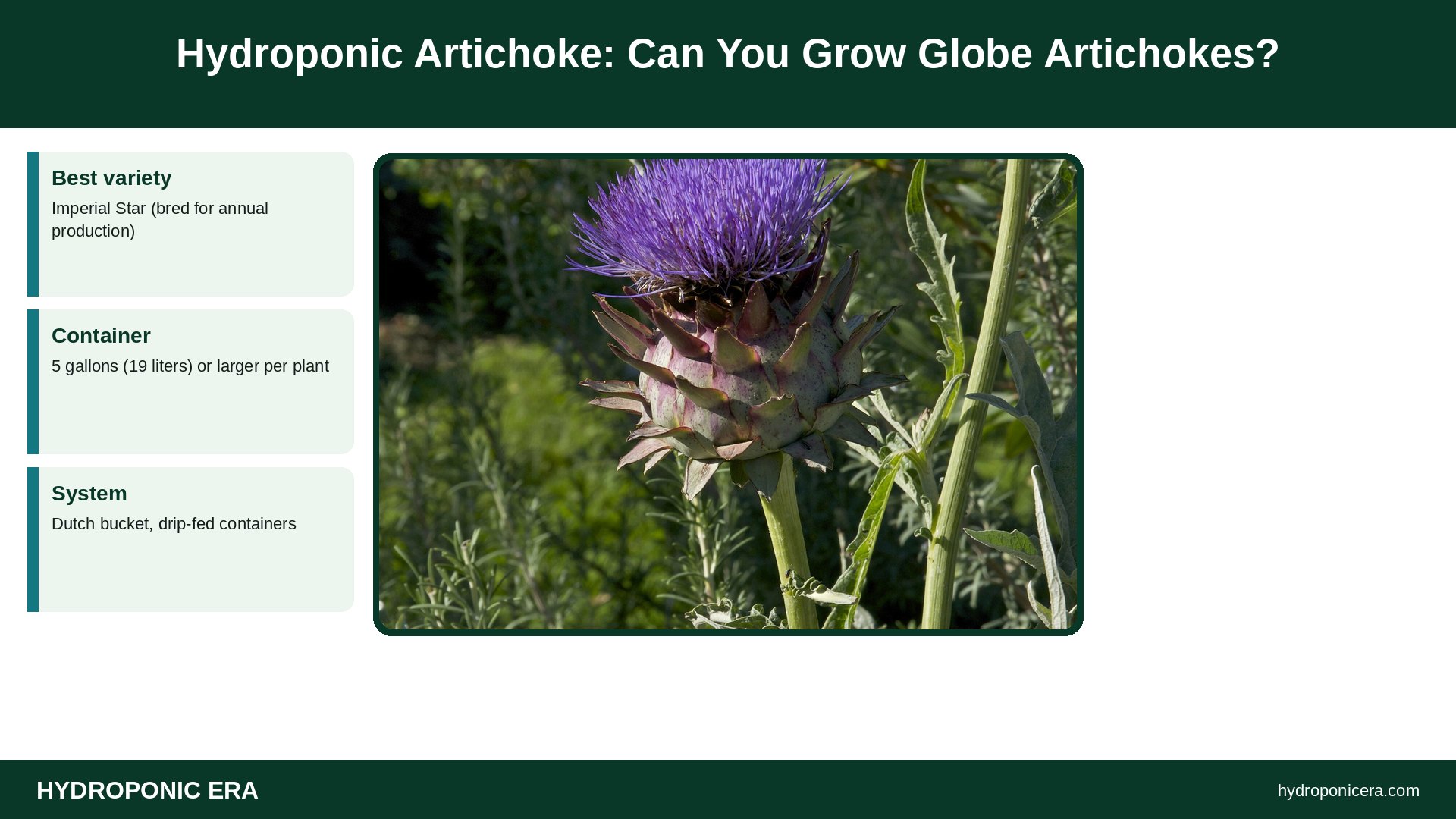
| Best variety | Imperial Star (bred for annual production) |
| Container | 5 gallons (19 liters) or larger per plant |
| System | Dutch bucket, drip-fed containers |
| Seedling temperature | 75°F (24°C) day, 65°F (18°C) night |
| Vernalization | About 500 hours at 35–50°F (2–10°C) |
| Avoid | Temperatures above 80°F (27°C) on seedlings |
| Harvest | Firm buds before bracts open |
Can You Grow a Hydroponic Artichoke?
Yes. The plant doesn’t need soil, only a well-drained root zone, steady moisture and complete nutrition. University of Maine Extension notes that artichokes do well in most soils provided they’re well drained, and that they can be grown in large containers like 5-gallon pails filled with a lightweight soilless medium. That’s essentially a drip hydroponic setup.
Researchers have also grown artichoke in a hydroponic floating system. A 2012 HortScience study by Rouphael and colleagues grew artichoke and its close relative cardoon in floating rafts to harvest leaves and found nutrient solution concentration changed both leaf growth and levels of phenolic acids and flavonoids. For edible buds, though, you need a full-size plant, so a container system is the practical choice.
Understanding the Hydroponic Artichoke Plant
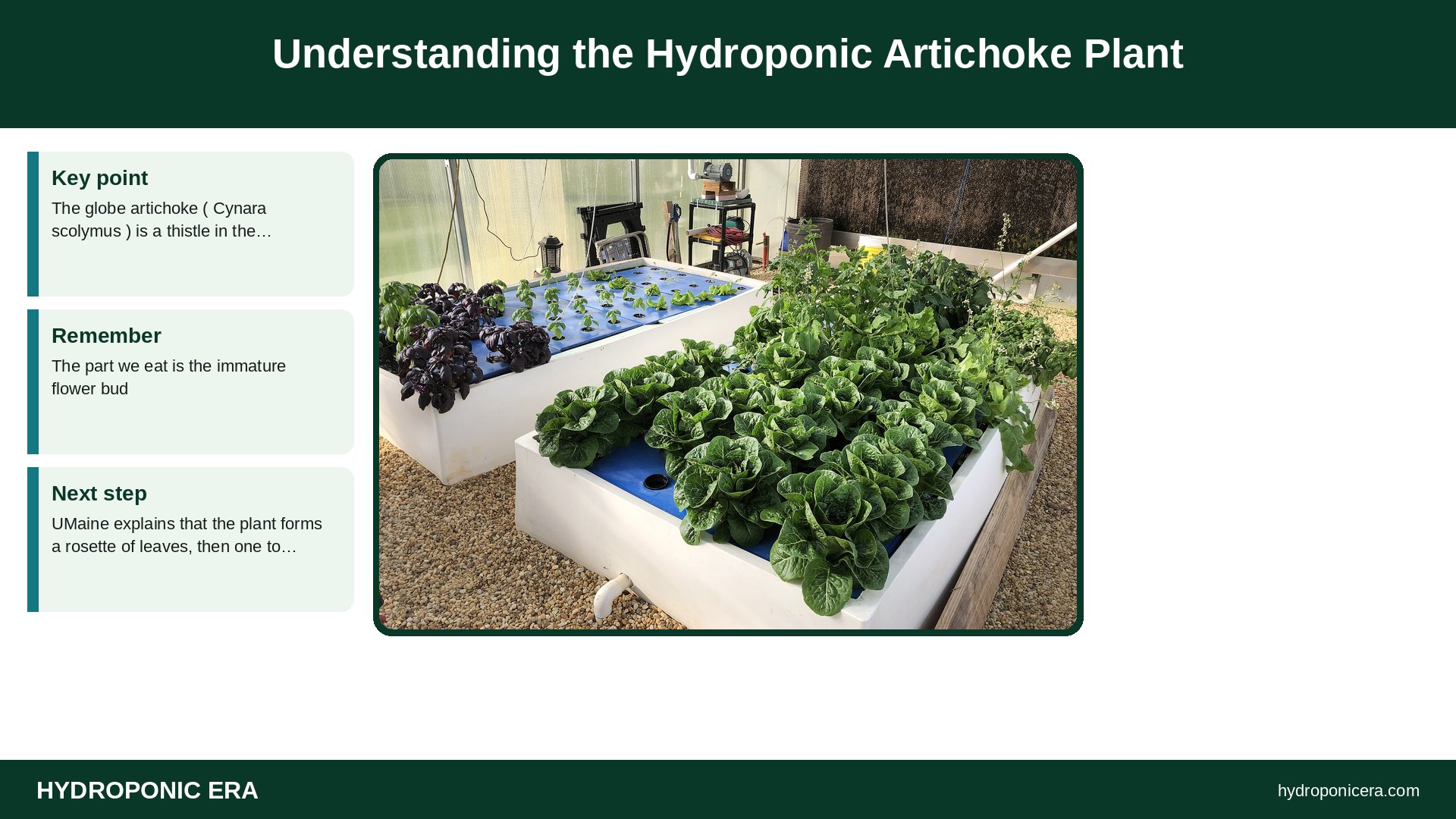
The globe artichoke (Cynara scolymus) is a thistle in the Asteraceae family. The part we eat is the immature flower bud. UMaine explains that the plant forms a rosette of leaves, then one to several flower stalks. Each stalk produces one large terminal bud, two or three smaller secondary buds and several still smaller tertiary buds. In Maine trials, plants often made 10–20 buds, but most were smaller than the 3–4 inch (8–10 cm) buds sold in stores.
Artichoke is a perennial hardy in USDA zones 7 and warmer. Commercial US production is centered in California, particularly Monterey County. Elsewhere, home growers treat it as an annual, which is how most hydroponic artichoke growers handle it too.
Vernalization: The Step That Makes Buds
Without enough cold, the plant stays leafy and never flowers in its first year. UMaine says most varieties need about 500 hours at 35–50°F (2–10°C) for reliable bud production. Home growers can meet this three ways:
- Seed stratification: Soak seeds for 2 days, pack them in moist sphagnum moss in an unsealed bag and refrigerate for 4 weeks. UMaine warns that fine peat moss doesn’t allow enough ventilation and leads to seed rot.
- Controlled chilling: Place seedlings in a refrigerator or cool chamber below 50°F (10°C) for at least 3 weeks, roughly 500 hours. UMaine adds that 12–13 hours of light a day from grow lights may improve vernalization and seedling health.
- Natural chilling: Move seedlings outdoors in early spring when you can expect 500 continuous hours at 35–50°F (2–10°C), protecting them below 35°F (2°C). This is riskier.
Heat undoes vernalization. UMaine advises keeping seedlings below 80°F (27°C), because high temperatures can de-vernalize the plant and keep it vegetative. In a warm greenhouse or grow room, that’s the biggest hydroponic artichoke risk.
How to Grow a Hydroponic Artichoke
1. Start seeds
Sow seeds 6–12 weeks before the planned move outdoors. UMaine suggests heat mats at 70–80°F (21–27°C) to speed germination, then growing at 75°F (24°C) days and 65°F (18°C) nights in full sun. Expect 6–8 weeks after germination to reach 4–6 true leaves, the stage for chilling. For starters, see peat pellets hydroponics or rockwool.
2. Choose the system
Artichokes have a taproot and a mostly shallow, spreading root mass. Use one plant per 5-gallon (19-liter) or larger bucket filled with perlite, coco coir or a coco-perlite blend. A Dutch bucket drip system is ideal because it drains well and recirculates solution.
3. Feed and water
UMaine says artichokes prefer evenly moist roots and don’t tolerate drought, and container plants may need daily watering and weekly feeding. In hydroponics, run several short drip cycles a day so the medium never dries out. A general-purpose vegetable nutrient works. In the field, UMaine notes artichokes benefit from a high-nitrogen side-dressing, so keep nutrient strength steady during leafy growth.
4. Space and light
In the field, UMaine spaces plants 2 feet (61 cm) apart in rows at least 4 feet (1.2 m) apart. Give buckets similar room. Artichokes want full sun; indoors, that means strong fixtures. See LED vs HPS grow lights.
5. Keep roots cool
UMaine suggests light-colored containers and limited midday sun to keep container root zones from overheating, since heat can trigger de-vernalization.
Harvesting Hydroponic Artichoke Buds
Harvest firm buds before the bracts start to open; softening, loosening buds mean eating quality is dropping. Cut with sharp clippers, leaving 2–3 inches (5–8 cm) of stem, and angle the cut to help reduce disease. Wear gloves to protect against spines and sticky sap. UMaine says harvested buds keep 2–3 weeks in the refrigerator, but temperatures below 32°F (0°C) cause bract browning. Small tertiary buds rarely form chokes and are great for marinating.
Hydroponic Artichoke Pests and Problems
- Aphids and thrips: UMaine reports both build up fast; scout leaf undersides and use insecticidal soap if needed.
- Gray mold (Botrytis): The most common disease in UMaine trials; improve airflow and remove damaged leaves.
- Verticillium wilt: Can also infect lettuce and strawberry, so sanitize media and buckets between crops.
- No buds: Not enough chilling, or heat above 80°F (27°C) after chilling.
FAQs
Can artichokes grow hydroponically?
Yes, in large drip-fed containers or Dutch buckets with an inert medium.
How big a container does a hydroponic artichoke need?
At least 5 gallons (19 liters) per plant.
Why won’t my artichoke make buds?
It likely missed its 500 hours of chilling or got too hot afterward.
Which artichoke variety is best for hydroponics?
Imperial Star, the first variety bred for annual production.
How long until harvest?
Roughly 4–5 months from seed, depending on chilling and conditions.
Can I overwinter a container artichoke?
UMaine suggests cutting it back after frost and storing it dark at 32–35°F (0–2°C).
Sources
- University of Maine Cooperative Extension — Bulletin #2075, Growing Globe Artichokes (Cynara scolymus L.) in Maine
- Rouphael et al. (2012), HortScience — Nutrient Solution Concentration Affects Growth, Mineral Composition, Phenolic Acids, and Flavonoids in Leaves of Artichoke and Cardoon
- Photo credits (Wikimedia Commons, edited with titles): Cynara cardunculus var. scolymus in Jardin des Plante de Paris by Jebulon (CC0); Deepwater Aquaponics Floating Rafts Growing Lettuce, Basil and Arugula by Alabama Extension (CC0); White plastic bucket by Santeri Viinamäki (CC BY-SA 4.0); 5670Farm Ready Seedling Facility East West Seed Philippines 20 by Judgefloro (CC0); Striped ladybird with aphids (4560537745) by Ton Rulkens from Mozambique (CC BY-SA 2.0)