
Are microgreens healthy? Yes. A USDA Agricultural Research Service study of 25 microgreens found they contained, on average, about five times more vitamins and carotenoids than the mature plants, and University of Maryland Extension says they’re higher in vitamins and phytochemicals. Levels vary widely by crop, and like sprouts they carry some food-safety risk, so buy clean seed and handle them carefully.
Key takeaway: So, are microgreens healthy? Yes, they’re nutrient-dense greens, but they’re eaten in small amounts. Treat them as a boost to a vegetable-rich diet, not a replacement, and store them cold.
| Question | Short answer | Source |
|---|---|---|
| More nutrients than mature greens? | About 5× more vitamins and carotenoids on average | USDA ARS |
| Vitamin C range | 20–147 mg per 100 g fresh weight, by species | USDA ARS |
| Top performers | Red cabbage (vitamin C), cilantro (carotenoids), garnet amaranth (vitamin K), green daikon radish (vitamin E) | USDA ARS |
| Food-safety risk | Lower than sprouts, but not zero | UF/IFAS; FDA |
| Storage | Rinse, pat dry, refrigerate up to 10 days | Univ. of Maryland |
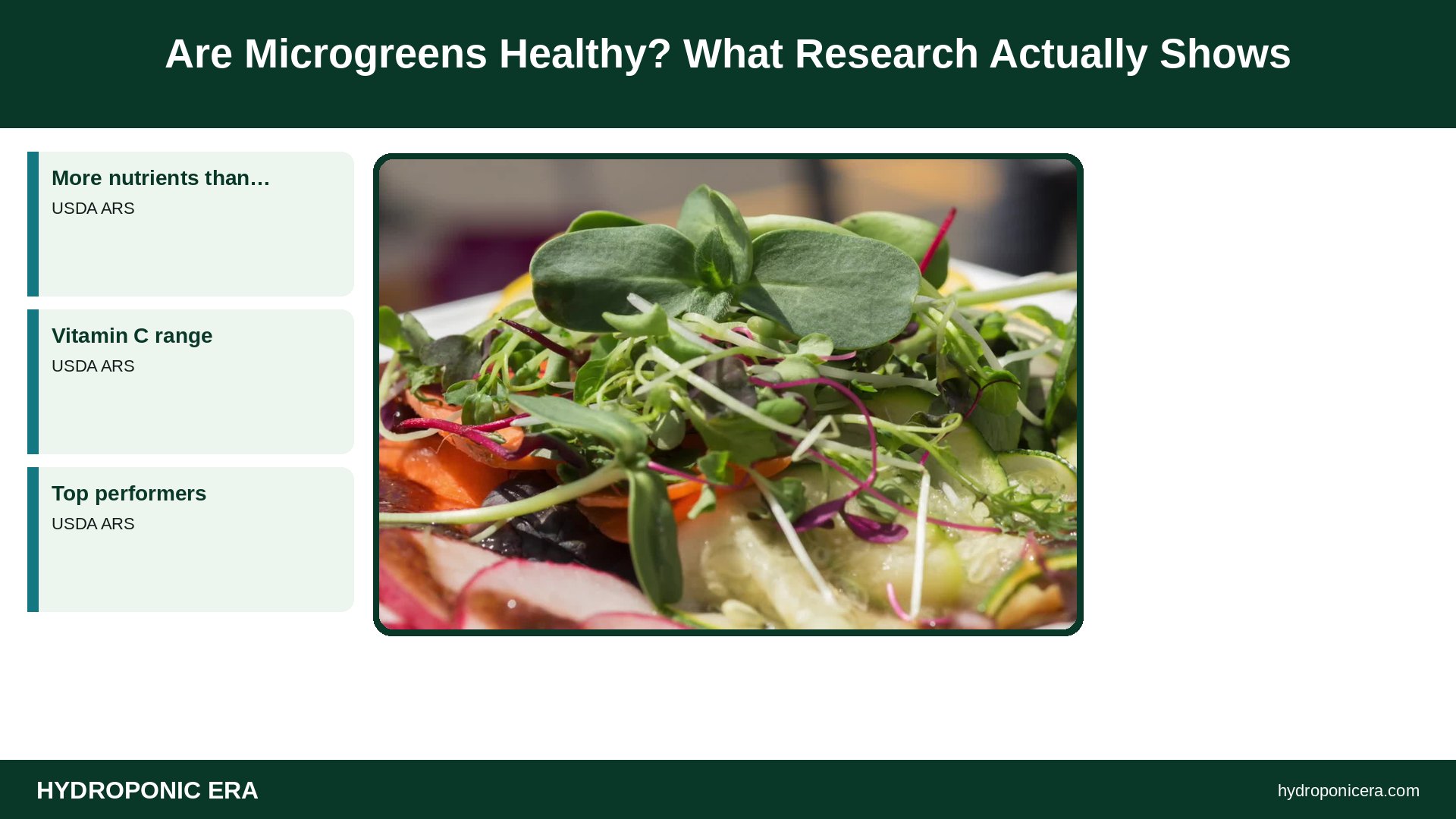
Are Microgreens Healthy Compared With Mature Vegetables?
The best-known evidence comes from a USDA Agricultural Research Service team led by plant physiologist Gene Lester at Beltsville, Maryland. They measured vitamin C, vitamin E, vitamin K, beta-carotene and related carotenoids in 25 commercial microgreens. In general, the microgreens had considerably higher levels of vitamins and carotenoids, about five times greater than their mature plant counterparts. The study was published in the Journal of Agricultural and Food Chemistry in 2012.
University of Maryland Extension summarizes newer work the same way: researchers at UMD and elsewhere have learned that microgreens are higher in vitamins and phytochemicals than their mature counterparts. Mississippi State University Extension likewise describes them as packed with high concentrations of vitamins C and E and beta-carotene.
Which Microgreens Are the Most Nutritious?
Are microgreens healthy across the board? Not equally. Nutrition varies a lot by species. In the USDA study, total vitamin C ranged from 20 to 147 mg per 3.5 oz (100 g) of fresh weight, and carotenoids from about 0.6 to 12.1 mg per 100 g.
| Nutrient | Highest of 25 microgreens tested (USDA ARS) |
|---|---|
| Vitamin C | Red cabbage |
| Carotenoids | Cilantro |
| Vitamin K | Garnet amaranth |
| Vitamin E | Green daikon radish |
Mixing several types is the simplest way to spread your bets. Radish and broccoli are easy starters; see our guides to radish and broccoli.
What Affects How Healthy Microgreens Are?
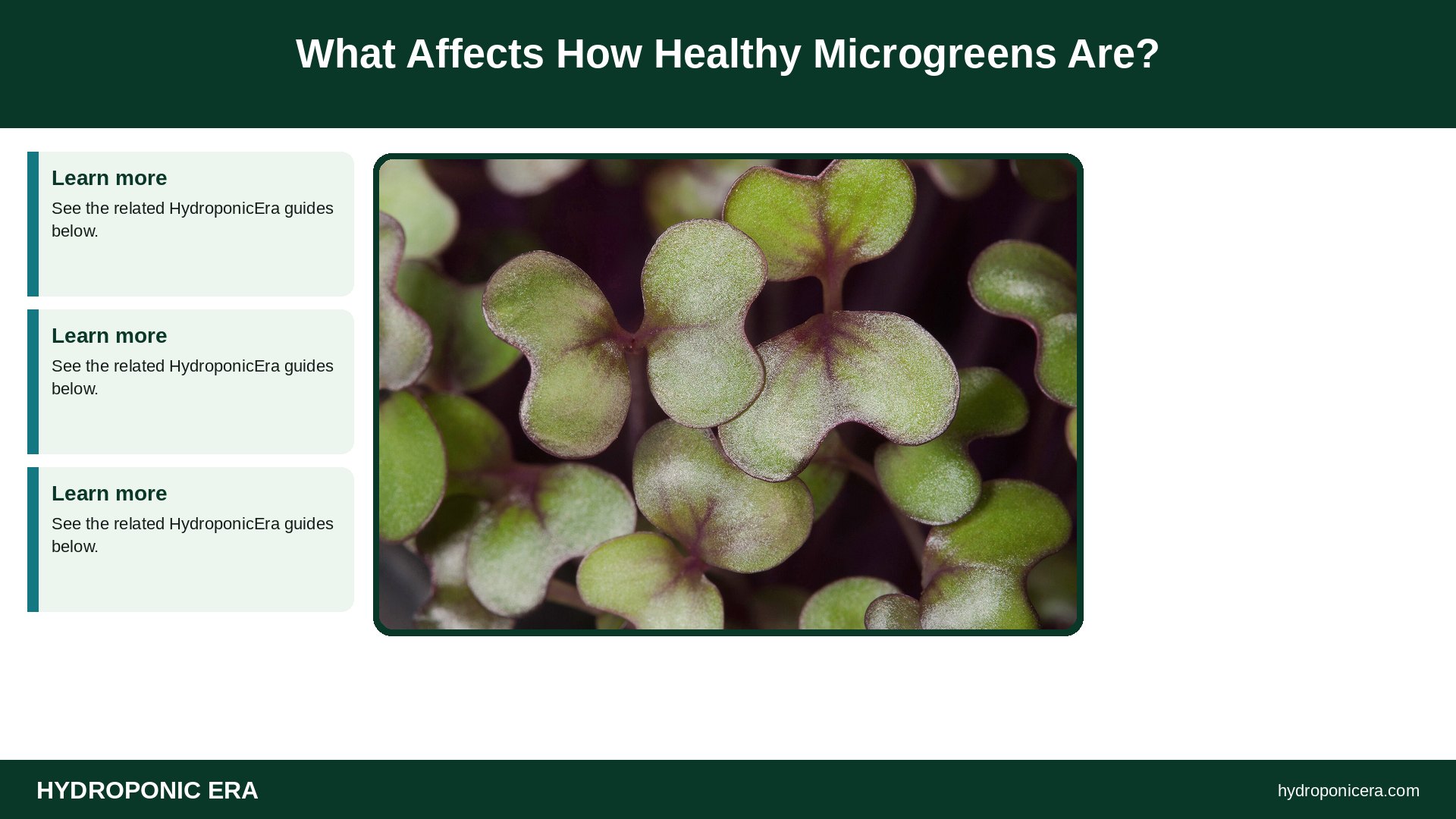
So are microgreens healthy no matter how they’re grown? Not equally. USDA ARS notes that growing, harvesting and handling conditions may have a considerable effect on nutrient content. University of Maryland Extension lists light intensity, the nutrient content of the growing mix, and storage conditions as factors, and gives one clear example: higher light intensity increases phenolic compounds. That’s a good reason to grow under adequate light; see our grow light guide.
Are Microgreens Healthy and Safe to Eat?
Mostly, yes, with sensible care. Safety is part of any honest answer to “are microgreens healthy?” UF/IFAS training material classes sprouts as the highest microbial-contamination risk of the three young-green types: sprouts are germinated seeds eaten whole, roots and all, and are heavily regulated. Microgreens are cut above the growing medium, so you don’t eat the roots or seed bed.
Still, risk isn’t zero, and seed is the weak point. In October 2026, FDA and CDC reported a multistate Salmonella outbreak linked to broccoli sprouts and microgreens grown from a contaminated seed lot; FDA reported 32 illnesses and 3 hospitalizations across six states. Recalled seed lots should not be used.
How Can You Make Homegrown Microgreens Safer?
- Buy seed from reputable suppliers and check FDA recall notices for seed lots.
- Use clean trays and fresh media; University of Maryland advises washing trays between batches.
- Harvest with clean, sharp scissors above the media.
- Rinse, pat dry and refrigerate; University of Maryland says they keep up to 10 days.
- Keep airflow up; Virginia Tech notes humidity and airflow help discourage pathogen infection.
- Discard anything slimy or moldy.
Our home hydroponic food safety guide covers sanitation in more depth.

Are Microgreens Healthy if Grown From Treated Seed?
No. UF/IFAS microgreen guidance says to start with healthy seed and not to use treated seeds. Garden seed is sometimes coated with fungicide for planting outdoors, which isn’t meant for eating at the seedling stage. Buy untreated seed sold for sprouting or microgreens, and store extra seed in the refrigerator in a zip-top bag, as UF suggests.
Are Microgreens Healthy After Days in the Fridge?
Storage matters. University of Maryland Extension lists storage conditions among the factors that change nutrient and phenolic content, and USDA ARS notes handling can have a considerable effect. The practical answer: cut what you’ll eat soon, refrigerate promptly, and use within the 10-day window Maryland gives. Growing your own lets you harvest minutes before a meal.
Are Microgreens Healthy for Everyone?
FDA notes children under five, older adults and people with weakened immune systems are more likely to have severe Salmonella infections. These groups should be especially strict about seed source, hygiene and refrigeration, and may prefer cooked greens. If you take a blood thinner such as warfarin, ask your clinician about vitamin K-rich foods; microgreens like amaranth can be high in vitamin K.
Are Microgreens Healthier Than Sprouts?
They’re different, which is why “are microgreens healthy?” often comes up alongside sprouts. Sprouts are harvested a few days after germination, before true leaves form, while Virginia Tech notes microgreens are harvested later, at the first true-leaf stage, and baby greens at 3–4 weeks. Microgreens grow in light, so they develop green leaves. The bigger difference for most people is safety, where UF/IFAS ranks sprouts as higher risk. If you sprout at home, read our sprouts in a jar guide.
Are Microgreens Healthy for Kids Too?
For most children, yes, and growing them is half the fun. University of Maryland Extension calls microgreens fun and easy to grow and a good way to introduce kids to gardening. Because FDA lists children under five as a higher-risk group for Salmonella, use clean seed, wash hands and trays, and refrigerate the harvest.
How Much Microgreens Should You Eat?
There’s no official serving size for microgreens. Most people use a handful as a garnish, in salads, sandwiches or smoothies, as Virginia Tech notes. Because portions are small, they add nutrients and flavor but don’t replace regular vegetables. For context on hydroponic produce overall, see are hydroponic vegetables healthy.
FAQ About Whether Microgreens Are Healthy
Are microgreens healthy enough to replace vegetables?
No. USDA ARS found about five times more vitamins and carotenoids on average, but portions are small.
Are microgreens healthy to eat every day?
Yes for most people, as part of a varied diet with good hygiene.
Which microgreen has the most vitamin C?
Red cabbage, among the 25 USDA tested.
Are hydroponic microgreens as healthy as soil-grown?
Both can be. Virginia Tech notes the substrate can affect yield and nutritional quality.
Can microgreens make you sick?
Rarely, but contaminated seed has caused outbreaks.
Should you wash microgreens?
Yes; University of Maryland says rinse and pat dry.
Sources
- USDA Agricultural Research Service — Specialty Greens Pack a Nutritional Punch (2014)
- Xiao Z, Lester GE, et al. — Assessment of Vitamin and Carotenoid Concentrations of Emerging Food Products: Edible Microgreens, J. Agric. Food Chem. (2012)
- University of Maryland Extension — Growing Microgreens and Baby Greens Indoors
- FDA — Outbreak Investigation of Salmonella: Sprouts (September 2026)
- Virginia Cooperative Extension — Microgreens Production (SPES-756)
- Mississippi State University Extension — Microgreen Varieties for the Mississippi Gardener
- UF/IFAS Extension Duval County (T. DelValle) — Grow Your Own Microgreens
- Photo credits (Wikimedia Commons, edited with titles): 20160617-AMS-LSC-9000 (61-sec.) (27334710733) by U.S. Department of Agriculture (Public domain); Red Cabbage Microgreens by Peggy Greb (Public domain); Liping Kou observes microgreens by Peggy Greb (Public domain); Veteran New Farmer Green Bexar Farm (20201021-NRCS-LSC-0456) by USDAgov (Public domain); 20170404-AMS-PJK-0484 (33725727291) by U.S. Department of Agriculture Preston Keres/Office of Communications-Photograph (Public domain)