
How do you grow fenugreek microgreens? Sow untreated fenugreek (methi) seed densely on moist potting mix or a grow mat, cover until it sprouts, then give 12–16 hours of light and harvest when the first true leaves appear. UConn Extension says most microgreens are ready 7–10 days after sowing. Buy seed from a reputable supplier, since seed is the main food-safety risk.
Key takeaway: Fenugreek microgreens are among the easiest legume greens to grow, but seed hygiene matters more than with most crops. A contaminated lot of fenugreek seed caused a deadly sprout outbreak in Europe in 2011.
| Factor | Fenugreek microgreens | Source |
|---|---|---|
| Plant | Trigonella foenum-graecum, a clover-like herb | NIH NCCIH |
| Flavor | Seeds smell and taste like maple syrup | NIH NCCIH |
| Days to harvest | About 7–10 days after sowing for most microgreens | UConn Extension |
| Light | 12–16 hours per day | UConn Extension |
| Germination temperature | Soil around 75°F (24°C) is ideal for microgreens | Illinois Extension |
| Storage | Refrigerate 5–7 days | UConn Extension |
What Are Fenugreek Microgreens?
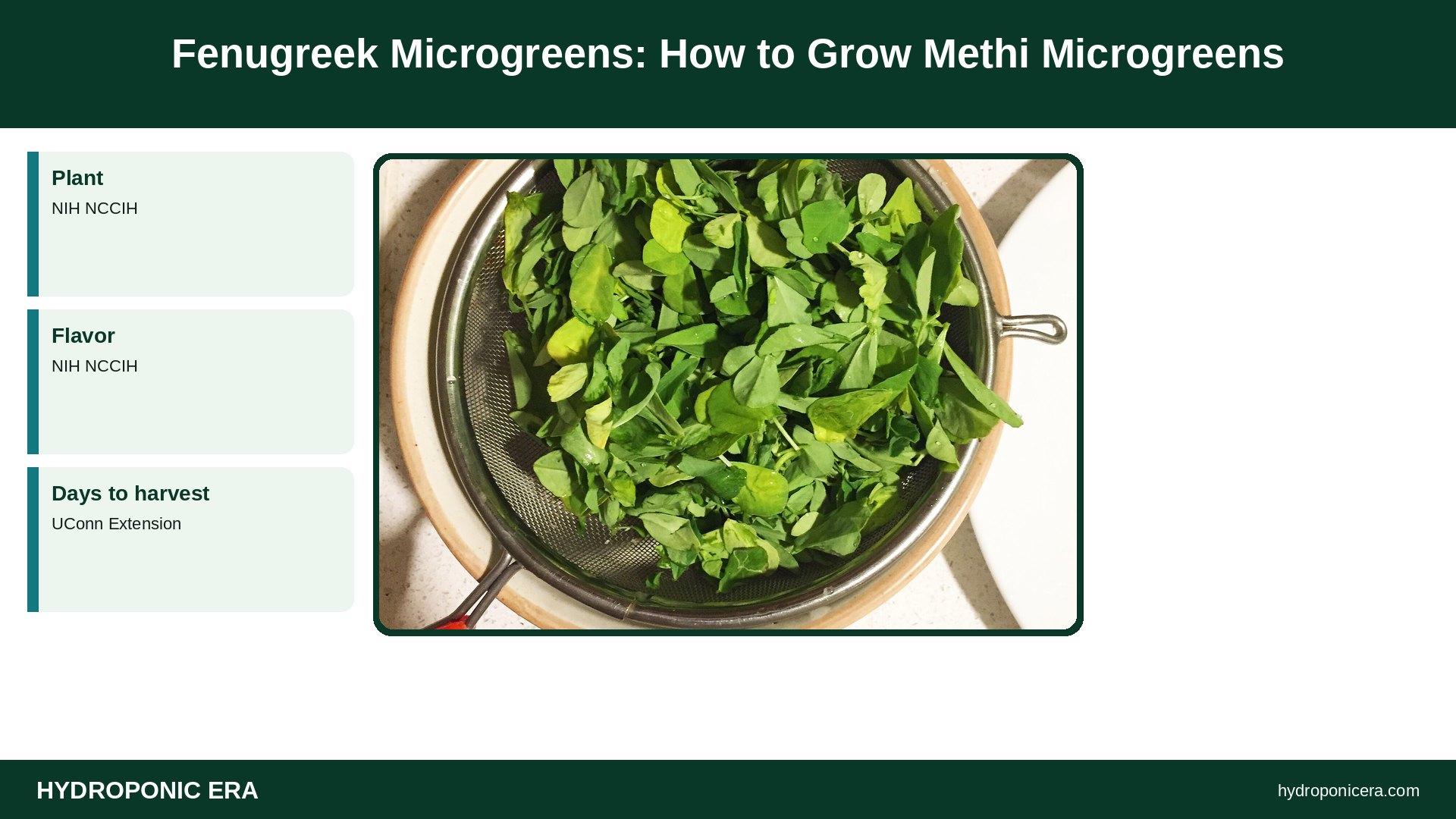
Fenugreek microgreens are young seedlings of Trigonella foenum-graecum, the herb known as methi in South Asian cooking. The NIH National Center for Complementary and Integrative Health (NCCIH) describes fenugreek as a clover-like herb native to the Mediterranean, southern Europe and western Asia, whose seeds smell and taste like maple syrup. As microgreens, they’re cut at the seedling stage, after the seed leaves open and as the first true leaves emerge, which UConn Extension says is usually 7–21 days after germination.
How Do You Grow Fenugreek Microgreens Step by Step?
- Buy untreated seed from a reputable supplier; UF/IFAS says not to use treated seed for microgreens.
- Rinse the seed; UConn Extension lists rinsing as a food-safety step.
- Fill a shallow tray with moist potting mix or a microgreen mat, without packing it down.
- Sprinkle seed evenly across the surface and press lightly.
- Mist and cover with a lid to hold humidity.
- Keep it warm, around 75°F (24°C) at the soil, per Illinois Extension.
- Remove the cover a couple of days after germination and give 12–16 hours of light.
- Water daily from the bottom or by misting.
- Harvest at 7–10 days with clean scissors, above the medium.
Our hydroponic microgreens guide covers trays, mats and lighting in more detail, and our heat mat and humidity dome guide helps in a cool room.
Should You Soak Fenugreek Microgreens Seed?
It’s optional. University of Maryland Extension recommends a 6–12 hour soak for large seeds such as pea, sunflower, chickpea and mung bean, but fenugreek isn’t on its list. Fenugreek seed is small, so a dry sowing on moist media works. If you do soak, rinse well and sow promptly so the seed doesn’t sit wet and sour.
How Long Do Fenugreek Microgreens Take to Grow?
| Stage | Typical timing | Source |
|---|---|---|
| Germination | Many microgreens germinate in about 2 days | UF/IFAS |
| Uncover | A couple of days after germination | UConn Extension |
| Harvest | 7–10 days after sowing | UConn Extension |
| Microgreen window | 7–21 days after germination | UConn Extension |
Taste a few stems from day 7 and cut when you like the flavor and size.
Can You Grow Fenugreek Microgreens Hydroponically?
Yes. Virginia Tech notes microgreens are often grown in propagation trays or hydroponic systems such as aeroponics, nutrient film technique (NFT) and ebb-and-flow. For hydroponic microgreens, it says a standard leafy-green fertilizer works, with typical recommendations of at least 1.0 mS/cm electrical conductivity and pH 5.5–6.0. At home, a fiber grow mat in a tray with plain water until the seedlings green up, then a weak nutrient solution, is the simplest setup.
How Are Fenugreek Microgreens Different From Methi Leaves?
It’s mostly a matter of age. Virginia Tech defines microgreens as harvested soon after the first true leaves emerge, while baby greens are cut 3–4 weeks after germination. Methi leaves sold for cooking are older still. Microgreens are tender enough to eat raw; older leaves are usually cooked.
Are Fenugreek Microgreens Safe to Eat?
For most people, in food amounts, yes. NCCIH says fenugreek is believed to be safe for adults and children in the amounts commonly found in foods. But it adds important cautions:
- Pregnancy: fenugreek isn’t safe in amounts greater than those found in food; it’s been linked to birth defects.
- Allergies: fenugreek can cause allergic reactions, including serious ones.
- Medicines: large doses can drop blood sugar, and herbs can interact with drugs, so talk with your provider if you take medication.
Why Does Seed Safety Matter So Much With Fenugreek?
History. In 2011, an outbreak of Shiga toxin-producing E. coli O104:H4 in Germany and France was traced to sprouts. The European Food Safety Authority’s task force concluded that one lot of fenugreek seeds imported from Egypt was the most likely common link. At the time EFSA reported 4,178 cases and 49 deaths. EFSA also warned that negative lab tests on seed can’t prove a lot is clean.
Microgreens are lower risk than sprouts, since UConn notes bacteria have much less potential to grow, and you cut above the roots. Still, buy seed from reputable companies, rinse it, keep trays clean and rinse the harvest. See our home hydroponic food safety guide.

How Nutritious Is Fenugreek at the Microgreen Stage?
Microgreens in general are nutrient-dense. A USDA ARS study of 25 microgreens found about five times more vitamins and carotenoids than in mature plants, though fenugreek wasn’t among those tested. NCCIH notes there isn’t enough high-quality evidence that fenugreek treats diabetes or other conditions, so enjoy it as food, not medicine. For context, read are hydroponic vegetables healthy.
How Do You Use Fenugreek Microgreens?
Use them raw in small amounts: on dal, curries, flatbreads, salads, sandwiches or eggs. UConn Extension suggests microgreens as garnishes for soups, omelets and curries. For a different crunch, sprout fenugreek in a jar instead; see sprouts in a jar.
Why Is My Methi Tray Moldy or Leggy?
- Fuzzy mold: too wet and still air; uncover after germination and improve airflow.
- Leggy, pale stems: too little light; aim for 12–16 hours.
- Patchy germination: old seed or a cold tray; Illinois suggests a heat mat.
- Sour smell: over-soaked seed; rinse and drain well.
- Seed hulls stuck to leaves: UConn suggests removing hulls once the greens grow; a gentle rinse at harvest helps.
FAQ About Fenugreek Microgreens
How long do fenugreek microgreens take to grow?
Typically 7–10 days, per UConn’s general microgreen timing.
Do fenugreek microgreens regrow after cutting?
No; UConn and Maryland say microgreens won’t regrow.
Can fenugreek microgreens grow on a mat without soil?
Yes; UConn lists microgreen grow mats as an option.
Can I eat fenugreek microgreens while pregnant?
Ask your clinician; NCCIH warns against more than food amounts.
How should I store the harvest?
Refrigerated for 5–7 days, per UConn.
Sources
- NIH NCCIH — Fenugreek: Usefulness and Safety
- UConn Extension — The Amazing Power of Microgreens (EXT116, 2025)
- EFSA — Task Force report on the E. coli O104:H4 outbreaks (2011)
- University of Maryland Extension — Growing Microgreens and Baby Greens Indoors
- University of Illinois Extension — Growing Microgreens
- UF/IFAS Extension Duval County (T. DelValle) — Grow Your Own Microgreens
- Virginia Cooperative Extension — Microgreens Production (SPES-756)
- USDA ARS — Specialty Greens Pack a Nutritional Punch
- Photo credits (Wikimedia Commons, edited with titles): Washed fenugreek leaves for cooking methi-chadachadi by Subhashish Panigrahi (CC BY-SA 4.0); Lufa Farms Microgreens in Trays by Lufa Farms (CC BY-SA 2.0); Fleece lined greenhouse potting tray and seed pots – Flickr – peganum by peganum from Small Dole, England (CC BY-SA 2.0); Liping Kou observes microgreens by Peggy Greb (Public domain); 20160617-AMS-LSC-9000 (61-sec.) (27334710733) by U.S. Department of Agriculture (Public domain)