
How do you grow lentil microgreens? Soak whole lentils, sow them about 3 seeds per sq cm (roughly 19 per sq in) on moist media, keep them covered until they sprout, then give bright light. A 2022 Indian greenhouse study found lentil microgreens were best harvested on day 9 after sowing. They’re mild, crunchy and cheap, but use whole, untreated lentils, not split ones.
Key takeaway: Lentil microgreens are a low-cost legume crop ready in about 9 days. Seed density, a soak and clean handling matter more than fancy equipment.
| Factor | Lentil microgreens | Source |
|---|---|---|
| Best harvest day | Day 9 after sowing | Priti et al., PLOS ONE 2022 |
| Optimum seeding density | 3 seeds per sq cm (about 19 per sq in) | Priti et al., 2022 |
| Best soak in one trial | 48 hours (72 hours slightly worse) | Altunbay et al., 2025 |
| Microgreen window | 7–21 days after germination | UConn; Mississippi State |
| Light | 12–16 hours per day | UConn Extension |
| Storage | Under 41°F (5°C) for about a week | Priti et al., 2022 |

Can You Grow Lentil Microgreens From Grocery Store Lentils?
Often, yes, if they’re whole lentils. Split or hulled lentils, such as most red lentils sold for dal, won’t sprout because the embryo is damaged. Whole green or brown lentils usually will. Do a quick test: soak a spoonful and see whether most show a root tip in a couple of days. UConn Extension notes legumes such as chickpeas and lentils are sometimes grown as microgreens, and it advises buying seed from reputable companies to reduce the risk of E. coli, Listeria or Salmonella. Seed sold for sprouting is the safer choice.
How Do You Grow Lentil Microgreens Step by Step?
- Rinse whole lentils and discard broken or discolored seeds.
- Soak in clean water; one 2025 trial found 48 hours in the dark gave the best results, but even an overnight soak helps start germination.
- Prepare a tray of moist potting mix, coco coir, vermiculite or a grow mat.
- Spread seed evenly at about 3 per sq cm (19 per sq in), the optimum in the 2022 PLOS ONE study.
- Cover with a dome or second tray until roots anchor.
- Uncover after a few days and give 12–16 hours of light.
- Bottom-water daily, keeping media moist but not soggy.
- Harvest around day 9 with clean scissors above the media.
New to trays and lights? Start with our hydroponic microgreens guide.

How Long Should You Soak Lentil Microgreens Seed?
A 2025 study from Türkiye soaked untreated green lentils in the dark for 0, 12, 24, 48 and 72 hours, then grew them on vermiculite under white LEDs with a 16-hour day. On day 9, seeds soaked 48 hours had the best germination (90.7%), tallest shoots, about 3.9 in (9.85 cm), and longest roots. Soaking 72 hours caused a slight decline. Rinse soaking seeds at least once a day so the water doesn’t sour.
| Soak time | Result in the 2025 green lentil trial |
|---|---|
| 0 hours | Control (lower than soaked) |
| 12–24 hours | Improved over control |
| 48 hours | Best: 90.7% germination, 3.9 in (9.85 cm) shoots |
| 72 hours | Slight decline |
How Thick Should You Sow Lentils for Microgreens?
Yield climbs with density up to a point. In the 2022 PLOS ONE study of 20 lentil genotypes, yield at 2 seeds per sq cm ranged from roughly 2.9–4.0 oz per sq ft (899–1,223 g per sq m), and at 4 seeds per sq cm about 3.7–4.6 oz per sq ft (1,129–1,418 g per sq m). But past the optimum, marketable quality got worse, so the authors chose 3 seeds per sq cm. They also found bigger seeds gave higher yields.
When Are Lentil Microgreens Ready to Harvest?
The same study set the optimal harvest for lentils on day 9 after sowing, versus day 7 for mung bean. That fits the general window: Mississippi State and UConn define microgreens as harvested 7–21 days after germination, once the first true leaves appear. Lentil shoots are thin, so harvest before they get stringy, and cut above the seed so you don’t eat hulls or roots.
Are Lentil Microgreens Safe to Eat Raw?
In the 2022 study, Salmonella and Listeria weren’t detected in lentil or mung bean microgreens, and other microbes were within safe limits. The authors credit good practices: fresh seed, seed treatment, sterilized growing media and alcohol-cleaned scissors. A two-minute wash in distilled water reduced the microbial load. They concluded microgreens are generally safe if grown and stored properly. At home, follow our hydroponic food safety guide.
How Do You Store Lentil Microgreens?
Wash and cool them right after harvest. The PLOS ONE authors note microgreens are very tender, respire quickly and keep for nearly a week below 41°F (5°C). University of Maryland Extension suggests rinsing, patting dry and refrigerating for up to 10 days. Store them in a container lined with a dry paper towel. In the 2022 trial, lentil microgreens stayed usable until day 6 at 39°F (4°C), longer than mung bean or mustard at about 4 days.
Are Lentil Microgreens Nutritious?
Microgreens as a group are nutrient-dense; a USDA ARS study of 25 types found about five times more vitamins and carotenoids than mature plants, though lentils weren’t in that set. Enjoy them as a fresh vegetable, and see are hydroponic vegetables healthy for context.
How Much Light Does a Lentil Tray Need?
UConn Extension recommends 12–16 hours of light a day, and the 2025 soak trial used a 16-hour LED day. University of Maryland says lights are typically 6–12 in (15–30 cm) above the foliage. Too little light gives pale, floppy stems; see our light distance guide to set yours.
Why Is My Lentil Tray Moldy or Uneven?
- Sour or moldy seed: over-long soak or no rinsing; drain and rinse daily.
- Patchy stand: split or old lentils; test germination first.
- Crowded, yellow stems: sowing past the optimum density.
- Stringy, tough shoots: harvested too late; cut nearer day 9.
- Seedlings lifting off the media: roots haven’t anchored; keep the cover or a light weight on for the first days.
Lentil Microgreens vs Lentil Sprouts
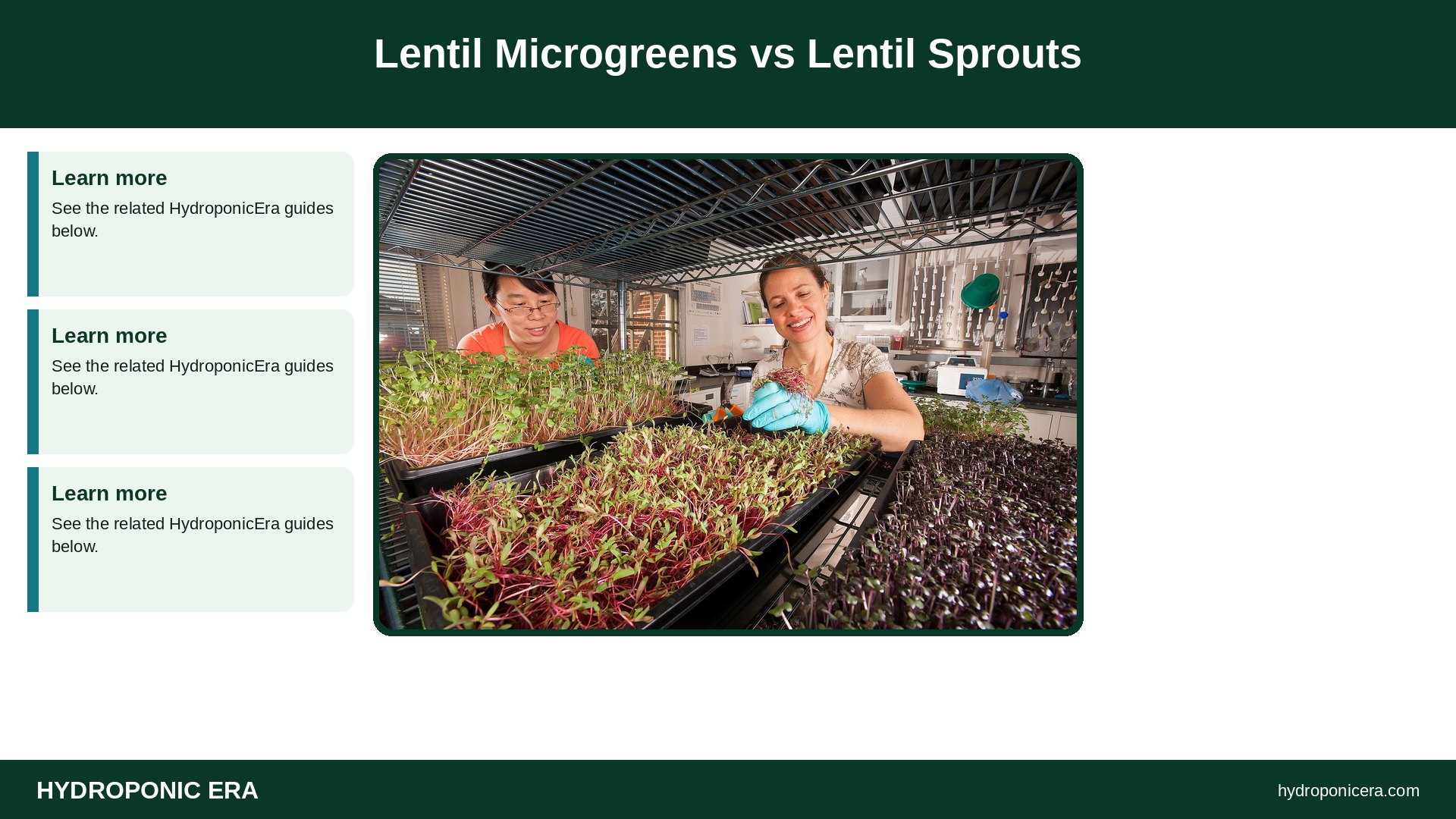
Sprouts are eaten whole, seed and root, after a few days in a jar; microgreens grow in light and you cut only the stem and leaves. Mississippi State draws the same line. Sprouts are faster, but UF/IFAS rates them as the higher contamination risk. For the jar method, see sprouts in a jar.
FAQ About Lentil Microgreens
Do red lentils grow as microgreens?
Only whole ones; split red lentils won’t sprout.
How long do lentil microgreens take?
About 9 days, per the 2022 PLOS ONE study.
Do you need to soak lentils for microgreens?
It helps; 48 hours was best in one trial.
Will they regrow after cutting?
Generally no; sow a new tray.
Can I grow lentil microgreens without soil?
Yes, on vermiculite, coir or a grow mat.
Sources
- Priti, Sangwan S, et al. — Yield optimization, microbial load analysis, and sensory evaluation of mungbean, lentil, and Indian mustard microgreens, PLOS ONE (2022)
- Altunbay M, Doğan M, Emsen B — Effects of Different Pre-Soaking Durations on Germination and Growth of Green Lentil Microgreens, NATURENGS (2025)
- UConn Extension — The Amazing Power of Microgreens
- Mississippi State University Extension — Growing Microgreens for the Mississippi Gardener
- University of Maryland Extension — Growing Microgreens and Baby Greens Indoors
- USDA ARS — Specialty Greens Pack a Nutritional Punch
- Photo credits (Wikimedia Commons, edited with titles): Lentil sprouts 01 by L Maule (CC0); Lufa Farms Microgreens in Trays by Lufa Farms (CC BY-SA 2.0); Fleece lined greenhouse potting tray and seed pots – Flickr – peganum by peganum from Small Dole, England (CC BY-SA 2.0); Liping Kou observes microgreens by Peggy Greb (Public domain); 20160617-AMS-LSC-9000 (61-sec.) (27334710733) by U.S. Department of Agriculture (Public domain)