
How do you grow mung bean microgreens? Soak mung beans 6–12 hours, as University of Maryland Extension advises, then sow about 3 seeds per sq cm (roughly 19 per sq in) on moist media, cover until rooted and give bright light. A 2022 PLOS ONE study found mung bean microgreens were best harvested on day 7 after sowing, the fastest of the crops it tested.
Key takeaway: Mung bean microgreens are fast, high-yielding and inexpensive. Their main limits are a short shelf life of about 4 days in the fridge and the need for clean seed.
| Factor | Mung bean microgreens | Source |
|---|---|---|
| Soak | 6–12 hours speeds germination | Univ. of Maryland |
| Best harvest day | Day 7 after sowing | Priti et al., PLOS ONE 2022 |
| Optimum seeding density | 3 seeds per sq cm (about 19 per sq in) | Priti et al., 2022 |
| Yield at 2–4 seeds per sq cm | About 6.1–8.4 oz per sq ft (1,854–2,572 g per sq m) | Priti et al., 2022 |
| Shelf life at 39°F (4°C) | Nearly 4 days | Priti et al., 2022 |
| Light | 12–16 hours per day | UConn Extension |
What Are Mung Bean Microgreens?
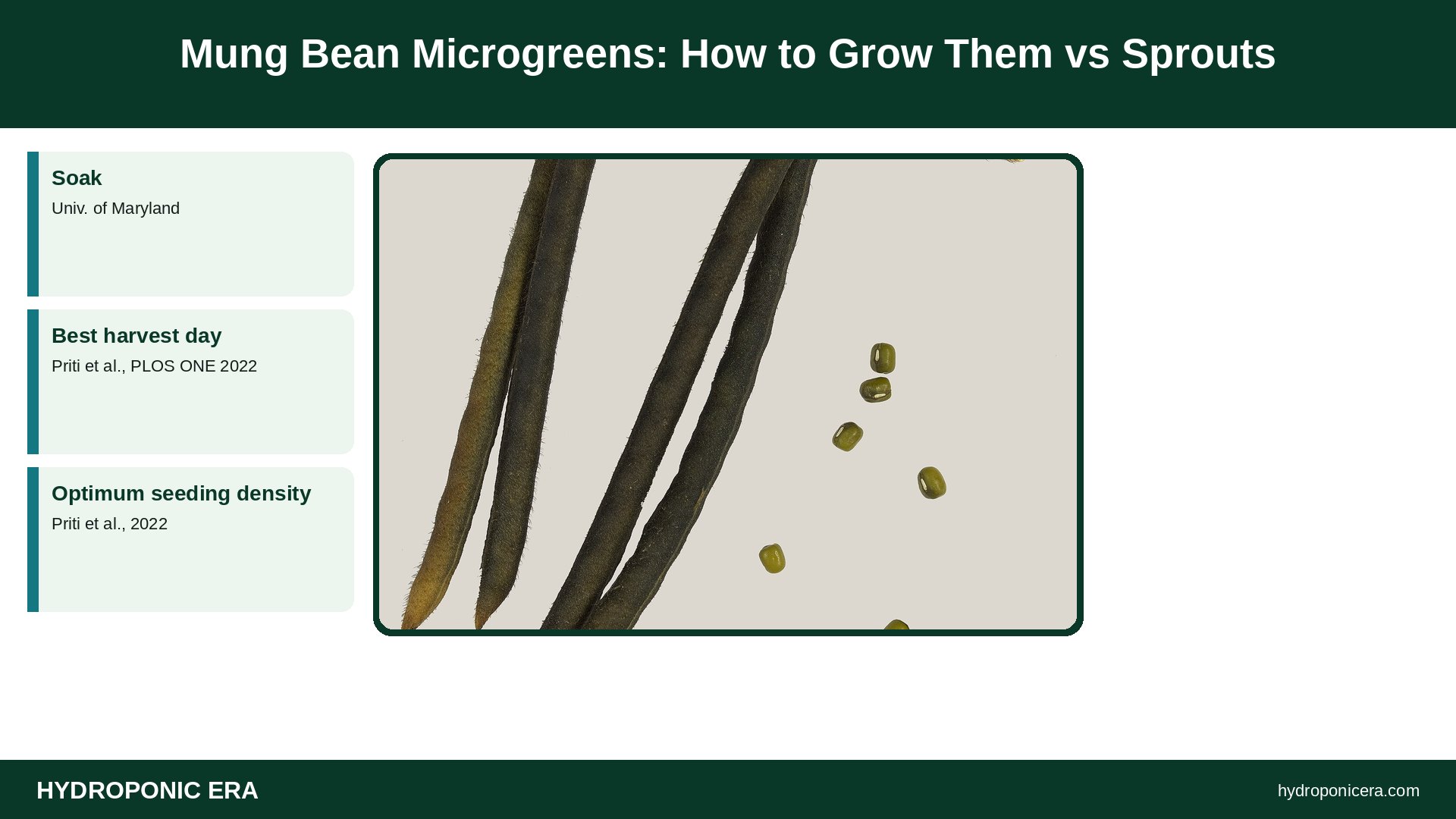
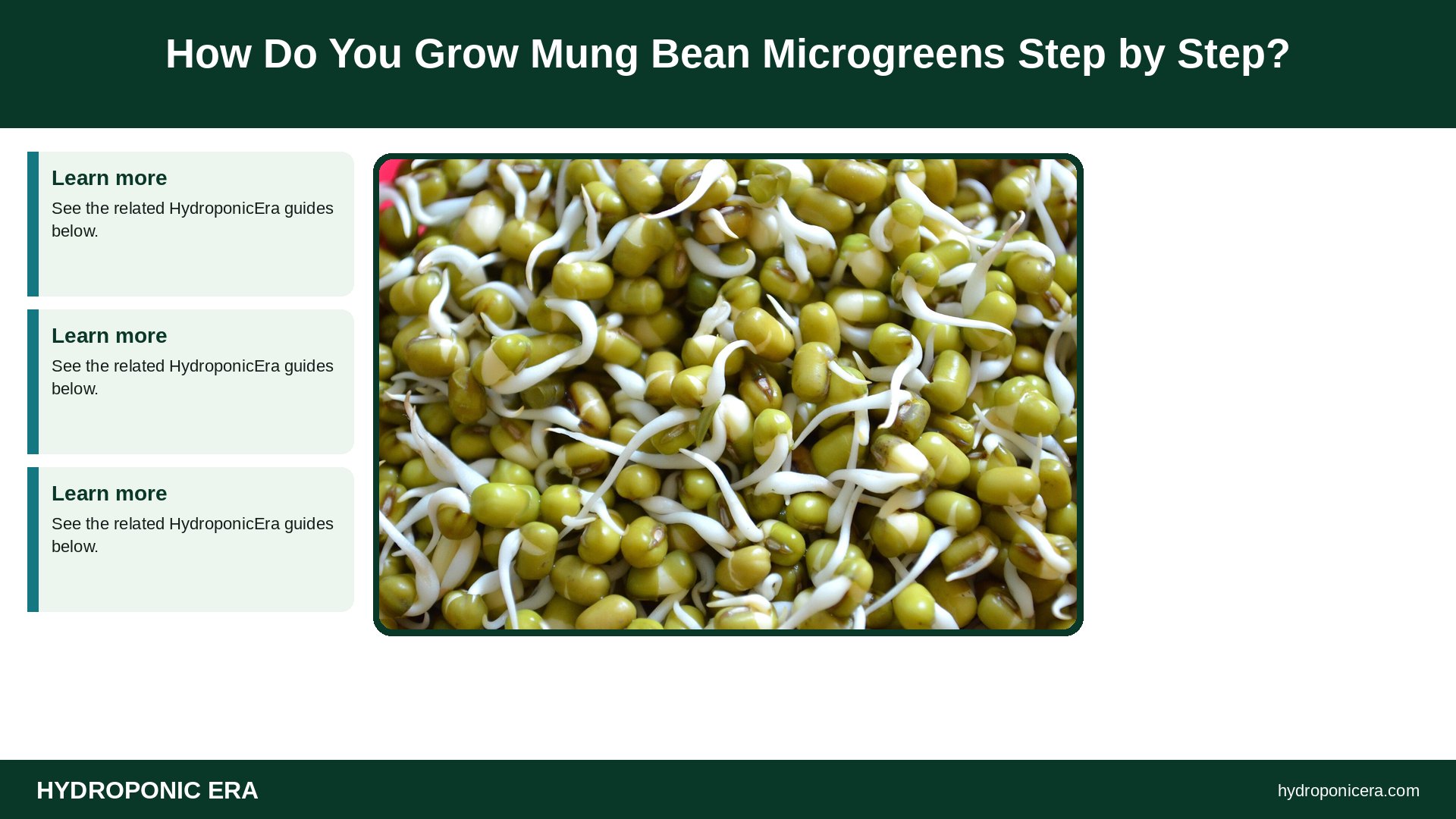
Mung bean microgreens are young shoots of Vigna radiata, the small green bean best known for bean sprouts. Sprouts are grown in the dark and eaten whole, roots and all. Microgreens grow in light, develop green seed leaves and are cut above the medium. Mississippi State Extension draws the same line: sprouts are germinated in a high-humidity system and eaten whole, while only the stems and leaves of microgreens are harvested.
How Do You Grow Mung Bean Microgreens Step by Step?
- Buy clean, untreated seed sold for sprouting or microgreens.
- Rinse and soak 6–12 hours, per University of Maryland Extension.
- Drain and spread evenly on moist potting mix, coir or a grow mat.
- Sow about 3 seeds per sq cm (19 per sq in), the optimum in the PLOS ONE study.
- Cover or weight lightly until roots anchor, usually a couple of days.
- Uncover and give 12–16 hours of light, per UConn Extension.
- Bottom-water daily so seedlings stay upright.
- Harvest around day 7 with clean scissors above the media.
Our hydroponic microgreens guide covers trays, mats and lights in detail.
How Much Does a Mung Bean Tray Yield?
A lot for a small tray. In the 2022 PLOS ONE study of 20 mung bean genotypes from the Indian Agricultural Research Institute, yield at 2 seeds per sq cm ranged from about 6.1 to 7.1 oz per sq ft (1,854–2,168 g per sq m). At 4 seeds per sq cm it was about 7.0–8.4 oz per sq ft (2,123–2,572 g per sq m). Past the optimum, quality declined, so the authors settled on 3 seeds per sq cm. That’s roughly double the lentil yields in the same study.
| Seeding density | Mung bean yield (Priti et al., 2022) |
|---|---|
| 2 seeds per sq cm | 6.1–7.1 oz per sq ft (1,854–2,168 g per sq m) |
| 3 seeds per sq cm | Chosen as optimum for quality |
| 4 seeds per sq cm | 7.0–8.4 oz per sq ft (2,123–2,572 g per sq m) |
The same study found larger seeds gave higher yields, so choose plump, uniform beans.
Can You Grow Mung Beans Hydroponically as Microgreens?
Yes. Mississippi State Extension describes growing microgreens on a water-holding hydroponic pad in a trough or tray without holes; roots grow into the pad, and you check moisture daily without overwatering or dislodging seeds. Virginia Tech notes commercial microgreens are grown in aeroponic, NFT and ebb-and-flow systems, with a standard leafy-green fertilizer at about 1.0 mS/cm and pH 5.5–6.0. Because mung beans are cut so young, the seed itself supplies much of what they need early on, so plain water works for the first days.
When Should You Harvest Mung Bean Microgreens?
Day 7 after sowing was optimal in the PLOS ONE study, compared with day 8 for Indian mustard and day 9 for lentil. Look for open seed leaves on firm stems. Mississippi State and UConn define the general microgreen window as 7–21 days after germination, but mung beans move fast, so check daily from day 5.
Are Mung Bean Microgreens Safe to Eat Raw?
The 2022 study did not detect Salmonella or Listeria in mung bean microgreens, and other microbes stayed within safe limits. The authors credit fresh seed, seed treatment, sterilized media and alcohol-cleaned scissors, and found a two-minute rinse cut the microbial load. They concluded microgreens are generally safe if grown and stored properly. UConn Extension adds that bacteria have much less potential to grow on microgreens than on sprouts. Follow our home food safety guide.
How Long Does the Harvest Last in the Fridge?
Not long. Stored in zip-top bags at 39°F (4°C), mung bean microgreens kept good quality for nearly 4 days in the PLOS ONE trial; by day 6, sensory scores dropped sharply. Lentil microgreens lasted until day 6. Harvest only what you’ll eat in a few days, rinse, pat dry and chill right away. University of Maryland’s general 10-day guideline is too long for this crop.
How Are Mung Bean Microgreens Different From Bean Sprouts?
| Feature | Mung bean sprouts | Mung bean microgreens |
|---|---|---|
| Grown in | Jar or high-humidity system, often dark | Tray of media or mat, in light |
| Eaten | Whole, including seed and root | Stem and leaves only |
| Ready in | A few days | About 7 days |
| Contamination risk | Highest (UF/IFAS) | Lower (UConn) |
For crunchy sprouts instead, see how to grow sprouts in a jar.
Why Is My Mung Bean Tray Moldy or Uneven?
- Sour smell: over-soaked or unrinsed seed; stick to 6–12 hours.
- Seeds not rooting in: no cover or weight in the first days.
- Thin, pale stems: too little light; lower lights to 6–12 in (15–30 cm), per Maryland; see our light distance guide.
- Hulls on leaves: rinse at harvest; UConn suggests removing hulls.

Are Mung Bean Microgreens Nutritious?
Microgreens are nutrient-dense as a group; USDA ARS found about five times more vitamins and carotenoids than mature plants across 25 types, though mung bean wasn’t tested. UConn Extension adds that sprouts and microgreens tend to be higher in minerals such as potassium, iron and zinc, plus vitamins C and A. Use them fresh in salads, wraps and stir-fries added at the end. For the full-grown crop, see how to grow beans hydroponically.
FAQ About Mung Bean Microgreens
How long do mung bean microgreens take?
About 7 days, per the 2022 PLOS ONE study.
Should I soak mung beans for microgreens?
Yes; Maryland suggests 6–12 hours.
Can I use grocery store mung beans?
Whole beans may sprout, but seed sold for sprouting is safer.
Do they regrow after cutting?
Generally no; sow a fresh tray.
Can they grow on a mat without soil?
Yes, on a mat or in a tray system.
Sources
- Priti, Sangwan S, et al. — Yield optimization, microbial load analysis, and sensory evaluation of mungbean, lentil, and Indian mustard microgreens, PLOS ONE (2022)
- University of Maryland Extension — Growing Microgreens and Baby Greens Indoors
- UConn Extension — The Amazing Power of Microgreens
- Mississippi State University Extension — Growing Microgreens for the Mississippi Gardener
- UF/IFAS Extension Duval County (T. DelValle) — Grow Your Own Microgreens
- USDA ARS — Specialty Greens Pack a Nutritional Punch
- Photo credits (Wikimedia Commons, edited with titles): Vigna radiata MHNT.BOT.2009.17.4 by Roger Culos (CC BY-SA 3.0); Mung bean sprouts, close-up by pics_pd (CC0); Lufa Farms Microgreens in Trays by Lufa Farms (CC BY-SA 2.0); Liping Kou observes microgreens by Peggy Greb (Public domain); Fleece lined greenhouse potting tray and seed pots – Flickr – peganum by peganum from Small Dole, England (CC BY-SA 2.0)