
How do you grow dill microgreens? Scatter dill seed on moist, fine potting mix, barely cover it or leave it uncovered because dill needs light to germinate, and keep it at 65–75°F (18–24°C). UF/IFAS lists 7–21 days just to germinate, so dill microgreens are a slow crop: plan on cutting about 2–4 weeks after sowing, once the threadlike seed leaves and first feathery true leaves appear.
Key takeaway: Dill microgreens taste like mild, fresh dill weed, but they need patience. Use fresh seed, surface-sow in light, keep the mix evenly moist and don’t mix dill with fast crops in one tray.
| Factor | Dill microgreens | Source |
|---|---|---|
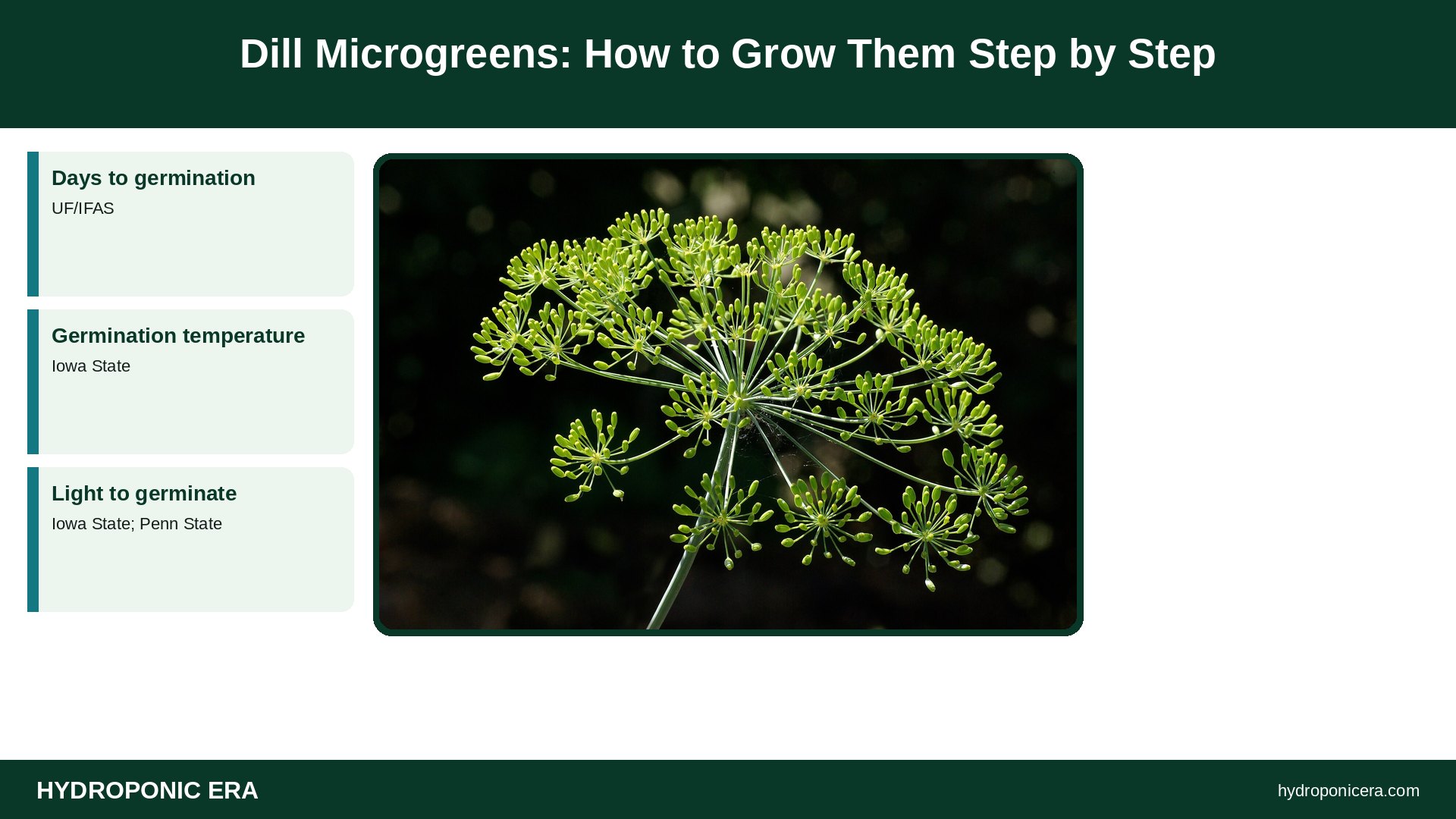
| Days to germination | 7–21 (dill and fennel) | UF/IFAS |
| Germination temperature | 65–70°F (18–21°C) | Iowa State |
| Light to germinate | Required; barely cover seed | Iowa State; Penn State |
| Microgreen harvest window | 7–21 days after germination | Mississippi State; UConn |
| Light while growing | 12–16 hours per day | UConn Extension |
| Family | Carrot family (Apiaceae) | Univ. of Minnesota |
Why Are Dill Microgreens Slower Than Other Microgreens?
Dill is in the carrot family (Apiaceae), and like carrots and parsley it germinates slowly. UF/IFAS microgreen training material lists 7–21 days to germinate for dill and fennel, compared with 3–7 days for radish, broccoli and sunflower. NC State Extension and Penn State Extension both give 10–14 days for dill outdoors. That’s why Mississippi State’s microgreen variety guide puts carrot, cilantro, parsley and basil in its slowest, 16–25 day group. Expect dill to sit in that slow lane too.
| Crop | Days to germination (UF/IFAS) |
|---|---|
| Radish | 3–7 |
| Broccoli | 3–7 |
| Cilantro | 7–14 |
| Parsley | 10–21 |
| Dill and fennel | 7–21 |
How Do You Grow Dill Microgreens Step by Step?
- Buy fresh, untreated seed; UF/IFAS advises against treated seed for microgreens.
- Fill a shallow tray with moist, fine-textured seed-starting mix; UF says media particle size should match seed size.
- Sow thickly and evenly on the surface.
- Barely cover or press in; Iowa State and Penn State say dill needs light to germinate.
- Cover with a clear dome to hold humidity while still letting light in.
- Hold at 65–70°F (18–21°C), Iowa State’s germination range; a heat mat helps in a cold room.
- Remove the dome once most seeds are up and give 12–16 hours of light.
- Bottom-water to keep the surface moist without washing seed away.
- Harvest when true leaves appear, typically 2–4 weeks after sowing.
Our heat mat and humidity dome guide covers keeping slow seeds warm and moist.
Which Dill Varieties Work Best for Microgreens?
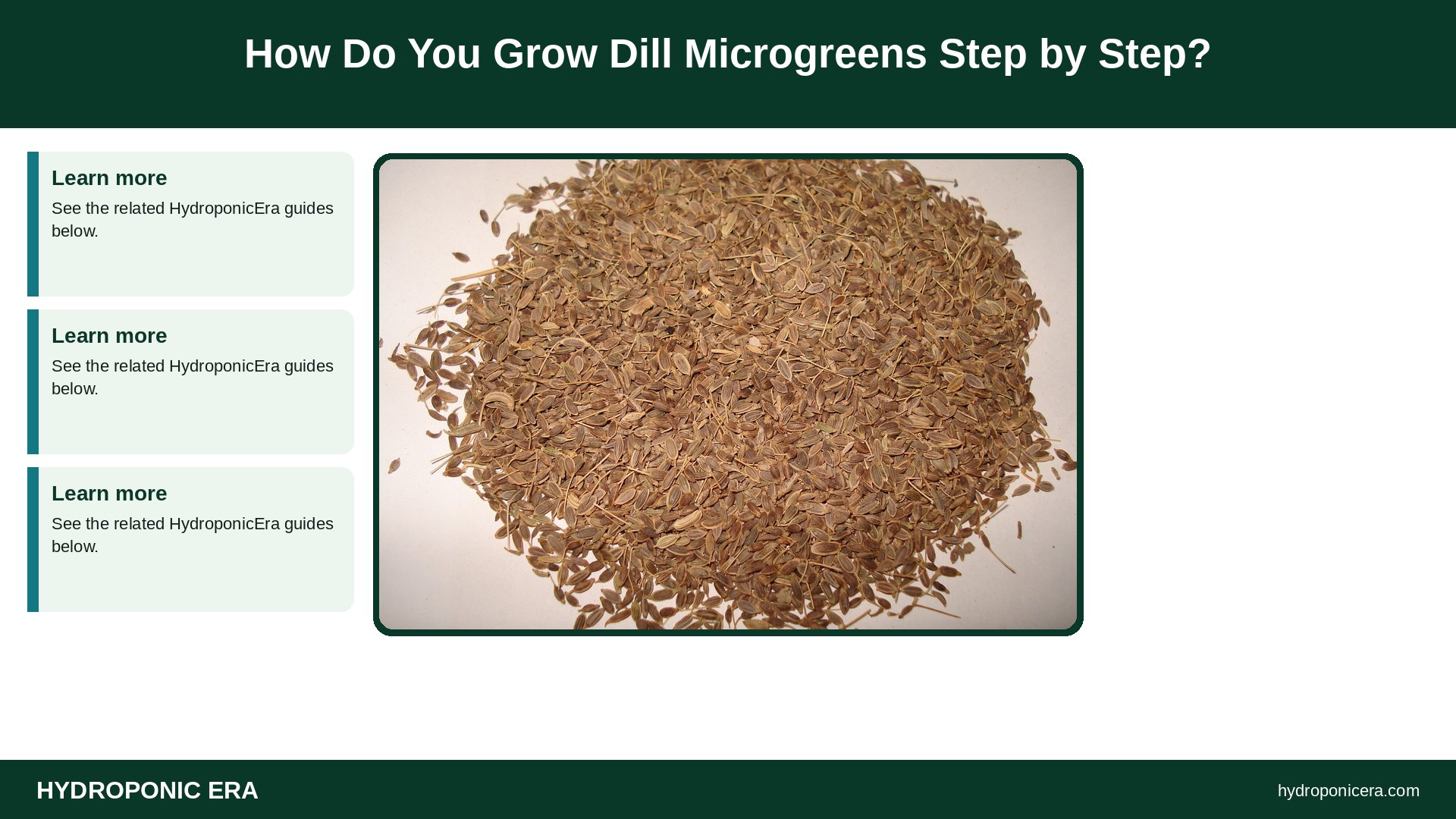
At the microgreen stage, variety matters less than seed freshness, but leafy types are a sensible pick. Penn State Extension describes ‘Dukat’ as producing abundant, flavorful dill weed, ‘Fernleaf’ as compact, slow to bolt and blue-green with superior flavor, and ‘Tetra’ as bushy and good for dill weed. NC State lists ‘Delikat’ for dense foliage and ‘Hera’ as a bunching type. Tall seed types such as ‘Long Island Mammoth’ and ‘Bouquet’ also sprout fine; they’re just bred for seed heads.
Do You Need to Soak Dill Seed for Microgreens?
Not usually. University of Maryland Extension’s soak list covers large seeds such as pea, sunflower and mung bean; dill isn’t on it. Dill seed is small and flat, and soaked seed clumps and is hard to spread. Mississippi State suggests a priming method for small seeds instead: mix seed with ½ cup of moist vermiculite in a lidded container, keep it warm for a couple of days, then spread the mix on the tray once root tips appear. Because dill germinates slowly and unevenly, that can help.
How Much Light Do Dill Microgreens Need?
Light matters twice: dill needs light to germinate, and seedlings stretch in dim conditions. UConn Extension recommends 12–16 hours of light a day for microgreens. University of Minnesota notes indoor dill needs at least 5–6 hours of direct sun or 12 hours of fluorescent light. University of Maryland says grow lights are typically 6–12 in (15–30 cm) above the foliage. See our light distance guide.
When Should You Harvest Dill Microgreens?
Cut once the narrow seed leaves are fully open and the first feathery true leaves show, usually about 2–4 weeks after sowing given dill’s slow start. Mississippi State and UConn define microgreens as harvested 7–21 days after germination. Use sharp, clean scissors and cut just above the media. The University of Minnesota notes dill loses its flavor quickly after picking, so harvest right before you use it.
Why Is My Dill Microgreen Tray Patchy or Leggy?
- Few seeds came up: old seed, cold mix or seed buried too deep; dill needs light.
- Tray looks empty after a week: normal; UF lists up to 21 days to germinate.
- Thin, floppy stems: too little light; lower lights or add hours.
- Mold on the surface: too wet for too long; vent the dome and improve airflow.
- Uneven stand in mixed trays: UF warns to match seeds with similar germination rates.
Can You Grow Dill Microgreens Hydroponically?
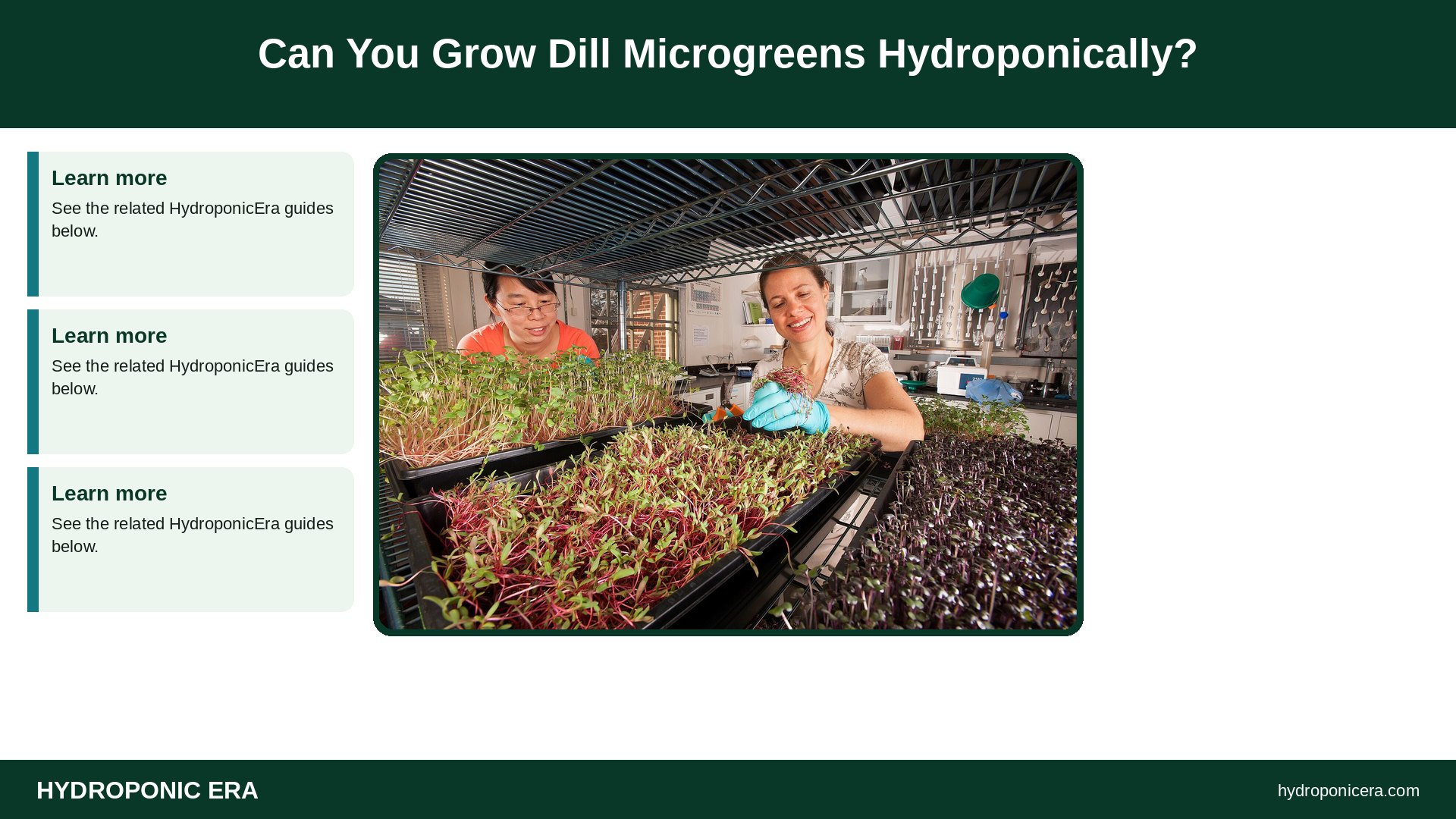
Yes, on a fine grow mat, though the small seed can dry out on a mat surface, so keep the dome on until it sprouts. Our hydroponic microgreens guide covers mats and trays. Virginia Tech notes microgreens are grown commercially in NFT, ebb-and-flow and aeroponic systems, with a leafy-green fertilizer at about 1.0 mS/cm and pH 5.5–6.0. To grow full dill plants, see our hydroponic dill guide.
Are Dill Microgreens Healthy?
Microgreens in general are nutrient-dense. A USDA ARS study of 25 microgreens found about five times more vitamins and carotenoids than mature plants, with cilantro, a close relative of dill, highest in carotenoids. Dill itself wasn’t tested, so treat it as a flavorful, healthy garnish rather than a supplement.
How Do You Use Dill Microgreens?
Use them like fresh dill weed: on salmon and other fish, potato salad, eggs, yogurt dips, soups and pickles. NC State notes dill leaves are used for pickling and with fish, borscht and soups. Add them at the end so the delicate flavor stays bright. Rinse before eating and store chilled; read our home food safety guide for handling tips.
How Do You Store Dill Microgreens?
University of Maryland Extension says to rinse harvested microgreens, pat them dry and use them right away or refrigerate them for up to 10 days. With dill, sooner is better, since Minnesota notes its flavor fades quickly and drying loses most of it. Store in a lidded container lined with a dry paper towel.
FAQ About Dill Microgreens
How long do dill microgreens take to grow?
About 2–4 weeks; germination alone can take 7–21 days.
Does dill seed need light to germinate?
Yes; Iowa State and Penn State say barely cover it.
What temperature is best for dill microgreens?
About 65–70°F (18–21°C) for germination.
Will dill microgreens regrow after cutting?
Not reliably; sow a fresh tray.
Are dill microgreens the same as dill weed?
Same plant, harvested much younger.
Sources
- UF/IFAS Extension Duval County (T. DelValle) — Grow Your Own Microgreens
- Iowa State University Extension — Germination Requirements for Annuals and Vegetables
- Penn State Extension — Herb Garden Plants: Dill
- NC State Extension — Anethum graveolens
- University of Minnesota Extension — Growing Dill in Home Gardens
- University of Maryland Extension — Growing Microgreens and Baby Greens Indoors
- Mississippi State University Extension — Growing Microgreens for the Mississippi Gardener
- USDA ARS — Specialty Greens Pack a Nutritional Punch
- Mississippi State University Extension — Microgreen Varieties for the Mississippi Gardener
- UConn Extension — The Amazing Power of Microgreens
- Photo credits (Wikimedia Commons, edited with titles): Aneth FR 2012 by JLPC (CC BY-SA 3.0); Dill seed by Miansari66 (Public domain); Fleece lined greenhouse potting tray and seed pots – Flickr – peganum by peganum from Small Dole, England (CC BY-SA 2.0); Liping Kou observes microgreens by Peggy Greb (Public domain); 20160617-AMS-LSC-9000 (61-sec.) (27334710733) by U.S. Department of Agriculture (Public domain)