
Quick Answer: grow dill hydroponically
grow dill hydroponically. How to grow dill hydroponically: use cool-to-moderate temperatures, succession sowing, mild leafy nutrients, and acceptance of a shorter plant life cycle. Dill often bolts in heat—plan multiple small plantings instead of one eternal plant.
Use HydroponicEra cluster links for pH, nutrients, lights, system choice, and seedlings so this crop page stays practical rather than isolated.
Key Takeaways
- Wisconsin Horticulture: dill is an annual—plan succession, not immortality.
- Cooler rooms lengthen the soft-leaf harvest window.
- Match dill to a system that fits its root and climate habits—do not copy a lettuce recipe blindly.
- Oklahoma State soilless hydroponic guidance typically places solution pH near a plant-available band around 5.5–6.5 (verify with a calibrated meter).
- Use a complete hydroponic nutrient at a strength matched to crop stage—start milder than fruiting-crop bottles suggest for tiny plants.
- Strong, measured light matters as much as fertilizer—see PPFD/DLI thinking and the grow-lights guide.
- Root oxygen and reservoir hygiene prevent many “mystery” failures (dissolved oxygen, brown roots, cleaning guides).
- Harvest style should match the crop: cut-and-come-again herbs differ from heading broccoli or fruiting eggplant.
- When leaves yellow, check pH and EC before assuming a single element is missing (lockout + yellow-leaves guides).
Related HydroponicEra guides
- Cilantro
- Best herbs
- Best herbs for hydroponics
- Basil hydroponics
- Lettuce hydroponics
- DWC vs NFT vs Dutch bucket
- Growing media
- Grow lights
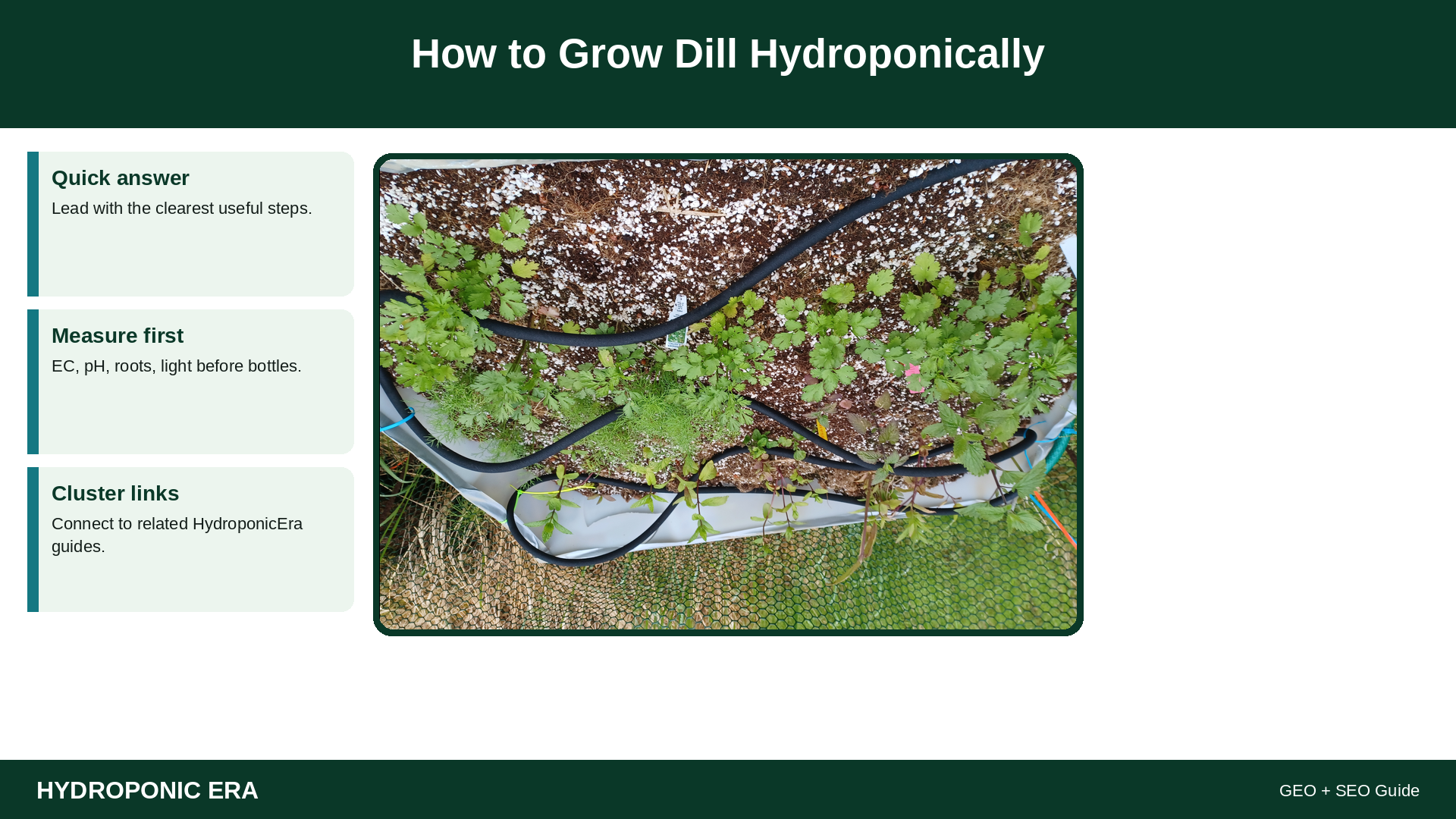
Why Dill Belongs in a Hydroponic Plan

Wisconsin Horticulture’s dill page describes dill as an annual herb grown for foliage and seed heads. Hydroponic growers usually want soft “dill weed” leaves. Heat and long stress shorten the leafy window.
UF/IFAS leafy and herb hydroponic publications help frame small-system culture; treat dill more like a cool leafy herb than like woody thyme.
Dill (Anethum graveolens) still follows plant physiology you can measure: light, root oxygen, solution chemistry, and harvest timing. Extension crop pages describe outdoor habits; hydroponics changes delivery of water and minerals, not the need for those fundamentals.
Choose a System for Hydroponic Dill

| System | Fit for Dill | Watch-outs |
|---|---|---|
| NFT / DWC | Good for leafy dill | Manage heat and stretch |
| Media drip | Good | Steady moisture |
| Dutch fruiting systems | Overkill | Unnecessary complexity for leafy dill |
| Kratky | Possible small | Watch oxygen as plants enlarge |
Compare hardware in DWC vs NFT vs Dutch, DWC, NFT, and Dutch bucket.
Step-by-Step: Dill in Hydroponics

- Start clean: use fresh seed or disease-free cuttings and sterile plugs.
- Germinate with even moisture and early light so seedlings do not stretch (see seedlings guide).
- Transplant when roots hold the plug into net pots with appropriate media.
- Choose the system from the table above rather than forcing every crop into one jar.
- Mix a complete nutrient and measure EC/TDS; set pH after strength.
- Provide crop-appropriate light using the lights and PPFD/DLI guides.
- Maintain aeration, temperature, and hygiene in the reservoir.
- Harvest with the crop’s biology in mind—do not strip plants beyond recovery.
- Reset solution when EC drifts oddly, roots smell, or you change crops.
- Keep notes on what changed (light height, EC, pH, symptoms) so you learn your room.
- Succession sow every 1–2 weeks if you cook with dill often.
- Harvest leaves before flower stalks dominate if soft foliage is the goal.
Important Growing Variables

| Variable | Practical guidance | Notes |
|---|---|---|
| Light | Match crop class (leafy vs fruiting) | PPFD/DLI, lights |
| pH | ~5.5–6.5 soilless band (OSU framing) | pH, fix pH |
| Nutrient strength | Start mild; raise with growth | EC/TDS, burn |
| Oxygen / flow | Never ignore roots | DO, air pumps |
| Temperature | Crop-specific comfort | reservoir temperature |
| Hygiene | Opaque reservoirs; scheduled changes | algae, cleaning |
| Bolting | Expect heat-triggered flowering | Succession plant; harvest early |
Penn State’s hydroponic nutrition principles remind growers that essential elements have functions—and that deficiency symptoms can be confused with lockout. Measure before you stack additives.
Common Mistakes

- Copying a lettuce feed/light recipe without adjusting for dill
- Hot nutrient strength on seedlings
- Ignoring pH drift until leaves look deficient
- Weak light blamed on “bad nutrients”
- Skipping root checks when plants wilt
- Overcrowding net pots or channels
- Clear reservoirs growing algae under LEDs
- Trying to keep one dill plant forever in a hot tent
- Crowding tall dill until it lodges
- Fruiting-strength nutrients on baby dill
Troubleshooting Dill Problems
| Symptom | Likely causes | What to do |
|---|---|---|
| Flower stalk early | Heat / age / stress | Harvest; restart cool cycle |
| Leggy plants | Low light | Closer/stronger light from day one |
| Yellow older leaves | N demand / aging / EC issues | Check EC/pH; mild feed |
| Tip burn | High EC / dry air | Lower strength |
| Bitter flavor | Heat / late harvest | Cooler room; younger leaves |
Also see wilting, slow growth, yellow leaves, and nutrient lockout when symptoms overlap.
What to Check Before You Change Nutrients
- Calibrated pH and EC readings today?
- Root color and smell normal?
- Light intensity/distance appropriate for this crop?
- Reservoir temperature in a safe band for oxygen?
- Harvest pressure vs plant recovery balanced?
- Irrigation leaving air in media (if media-based)?
- Any pests on leaf undersides?
Practical Decision Framework for Hydroponic Dill
Treat dill as a short-cycle leafy herb. Your decision is not “how do I keep one plant forever?”—it is “how do I sequence trays so the kitchen never runs out?” Cooler rooms lengthen the soft-leaf window; hot tents push flower stalks.
Light from germination prevents stretch that later lodges under its own weight. If seedlings are already leggy, improve light immediately and consider restarting rather than transplanting weak stems into expensive channels. See seedlings and the leggy-seedlings article in this batch.
Nutrition should stay in a mild leafy band. Dill does not need tomato-phase bloom boosters. When older leaves yellow, measure EC and pH before adding random nitrogen. Cross-check yellow leaves and lockout.
Wisconsin Horticulture’s dill overview is a reminder that this is an annual with foliage and seed uses—pick your goal and harvest accordingly. Pair with cilantro only if both share a cool climate zone.
For seed-head projects, give dill vertical space and accept a longer cycle than leafy dill weed. Most home hydro growers should prioritize foliage succession and cool air. Cross-link cilantro for similar bolt management habits.
Operator Checklist for This Topic
Before changing bottles, confirm meter calibration, write today’s EC and pH, note reservoir temperature, and inspect roots. If those four items are unknown, you are guessing. Use meter care, EC/TDS, reservoir temperature, and dissolved oxygen as supporting skills.
After any correction, wait for new growth signals. Changing five variables overnight creates stories you cannot learn from. Keep this page linked with pH, nutrients, water changes, and cleaning so your workflow stays consistent across the HydroponicEra cluster.
Honest scope note: university extension pages inform principles; your room’s meters confirm reality. Do not invent ROI, yield percentages, or unpublished lab results. Teach with checklists, tables, and clear conditions.
Grow Dill Hydroponically: Key Checks
Use this section as a practical checkpoint for grow dill hydroponically before changing bottles or hardware.
How to Improve Grow Dill Hydroponically Results
Stable meters, matching climate, and complete nutrition improve grow dill hydroponically outcomes more than random additives.
FAQs

Can I grow dill for pickles indoors?
Yes for foliage; seed-head production needs more time and space.
Why does dill bolt?
Heat, age, and stress—common for dill; succession sow.
DWC or NFT?
Both can work for leafy dill if light and cool temps are solid.
Share with cilantro?
Often compatible in cooler rooms.
Thin seedlings?
Yes—crowded dill stretches and weakens.
Extension tip?
Wisconsin Horticulture covers dill’s annual habit and culinary uses—plan for finite plant life.
Focus Checklist
- Confirm meters before diagnosing grow dill hydroponically.
- Inspect roots when troubleshooting grow dill hydroponically.
- Match light and climate as part of grow dill hydroponically success.
- Keep notes each time you work on grow dill hydroponically.
- Reset tired solution if grow dill hydroponically symptoms persist after climate checks.
- Link related HydroponicEra guides while learning grow dill hydroponically.
- Avoid stacking five changes during grow dill hydroponically troubleshooting.
- Judge new growth, not only old leaves, for grow dill hydroponically.
- Sanitize tools between sessions involving grow dill hydroponically.
- Re-read the Quick Answer after measuring for grow dill hydroponically.
- Opaque reservoirs support cleaner results around grow dill hydroponically.
- One-variable changes make grow dill hydroponically lessons clearer.
- Confirm meters before diagnosing grow dill hydroponically.
Length Boost Section: Grow Dill Hydroponically in Practice
Practical growers treat grow dill hydroponically as a workflow, not a one-time tip. Start with meters, then climate, then nutrition. If leaves look wrong, write EC, pH, reservoir temperature, and light distance before opening a new bottle. That habit alone prevents most false deficiency stories around grow dill hydroponically.
Next, inspect roots and hygiene. White, clean-smelling roots support uptake; foul slime explains pale or curling leaves even when charts look perfect. Clean reservoirs, keep lids opaque, and reset tired solutions when chemistry drifts. These basics support grow dill hydroponically whether you grow herbs, leafy greens, or fruiting crops.
Finally, keep expectations honest. Extension pages inform principles; your room confirms reality. Do not invent ROI or percentage yields. Use checklists, tables, and dated notes so grow dill hydroponically lessons compound across cycles. Link related HydroponicEra guides for pH, EC/TDS, nutrients, lights, water changes, and cleaning so advice stays consistent.
Sources
- Wisconsin Horticulture / Extension — Dill
- University of Minnesota Extension — Growing herbs in home gardens
- University of Florida IFAS — HS1421: Growing Herbs in Small Hydroponic Systems
- University of Florida IFAS — HS1279: Leafy Greens in Hydroponics and Protected Culture for Florida
- Oklahoma State University Extension — Electrical Conductivity and pH Guide for Hydroponics
- Virginia Cooperative Extension — SPES-720: Calculating and Using Daily Light Integral (DLI)
- Penn State Extension — Hydroponics Systems and Principles of Plant Nutrition
- Michigan State University Extension — Hydroponics as an agricultural production system