
Do grow lights for succulents work? Yes. Full-spectrum LED or high-output fluorescent grow lights for succulents work well indoors when you run them 12–16 hours a day. University of Minnesota Extension suggests fluorescent tubes 6–12 in (15–30 cm) above plants for 14–16 hours, while Iowa State notes LEDs often sit 12–24 in (30–60 cm) away.
Key takeaway: Succulents stretch and fade when light is weak. Pick a full-spectrum fixture, put it on a timer, start at the distance the maker suggests, and adjust by watching the plants: stretching means more light, bleaching means less.
| Setting | Starting point | Source |
|---|---|---|
| Hours of light | 12–16 hours a day; 14 is a practical default | UMN, Iowa State |
| Fluorescent distance | 6–12 in (15–30 cm) above foliage | UMN, Iowa State |
| LED distance | About 12–24 in (30–60 cm), per fixture output | Iowa State |
| Shop LED (not a grow light) | 4 ft (1.2 m) full-spectrum, 3,000+ lumens, 18 in (46 cm) away | Iowa State |
| Dark period | At least 8 hours; use a timer | Iowa State |

Why Do Succulents Need Grow Lights Indoors?
Most succulents evolved in bright, open places, and a typical room is far dimmer than outdoors. Iowa State Extension says indoor succulents need 10 or more hours of bright, indirect light, and that low light causes tall, pale, lanky growth. Grow lights for succulents fill that gap during short winter days or in rooms without a sunny window.
Signs your plants need grow lights for succulents:
- Etiolation: stems stretch and leaves spread out with gaps between them.
- Rosettes flatten: Echeveria and similar plants open up to catch light.
- Leaning: plants tilt hard toward the window.
- Fading color: reds and purples turn green or pale.
What Type of Grow Light Is Best for Succulents?
For most homes, the best grow lights for succulents are full-spectrum LED fixtures, because they are efficient, run cool and last long. High-output T5 fluorescent tubes also work. UMN notes even cool white or daylight fluorescent tubes give good results. Skip colored novelty bulbs and incandescent lamps, which waste energy as heat.
| Light type | Pros | Cons |
|---|---|---|
| Full-spectrum LED panel or bar | Efficient, low heat, natural-looking light | Quality varies; check PPFD data |
| LED grow bulb in a lamp | Cheap, fits one or two pots | Small footprint; uneven coverage |
| T5 HO fluorescent | Even light, proven for seedlings | Tubes fade; must hang close |
| Incandescent or halogen | None for growing | Hot and weak in useful light |
Our grow light buying guide explains how to read spec sheets before you buy.
How Many Hours Should Grow Lights for Succulents Run?
Run grow lights for succulents about 12–16 hours a day, and give plants at least 8 hours of darkness. UMN suggests 14–16 hours under fluorescent tubes, and Iowa State recommends 12–16 hours with plants within about 12 in (30 cm) of the light. A cheap plug-in timer keeps the schedule steady.
If your succulents also get some window light, you can start near 12 hours. In a dark basement, 14–16 hours is a better start. For more on schedules, read our light schedule guide.

How Far Should Grow Lights Be From Succulents?
Distance depends on the fixture’s strength. Iowa State suggests fluorescent lights 6–12 in (15–30 cm) from foliage and most LEDs 12–24 in (30–60 cm) away. Start at the farther end, then move the light closer about 2 in (5 cm) a week until growth is compact and colors return, stopping if leaves bleach.
- Read the manual: many LED makers list a hanging height.
- Start high: hang 18–24 in (46–60 cm) above the tallest plant.
- Watch for one to two weeks: new growth tells you more than old leaves.
- Lower slowly: move in small steps if stretching continues.
- Back off if you see tan, bleached or crispy patches.
See our light distance chart for other crops.
How Much Light Intensity Do Succulents Need?
Succulents want strong light, but exact targets vary by species, so extension guides describe light by distance and hours instead of a single number. If you own a PAR meter or phone app, measure at the leaf level and compare readings over time. Daily light integral, or DLI, combines intensity and hours.
A practical approach with grow lights for succulents is to pick a fixture that publishes a PPFD map, set it at the suggested height, and judge by plant response. Our PPFD and DLI guide explains the math, and the phone meter guide shows how to log readings.
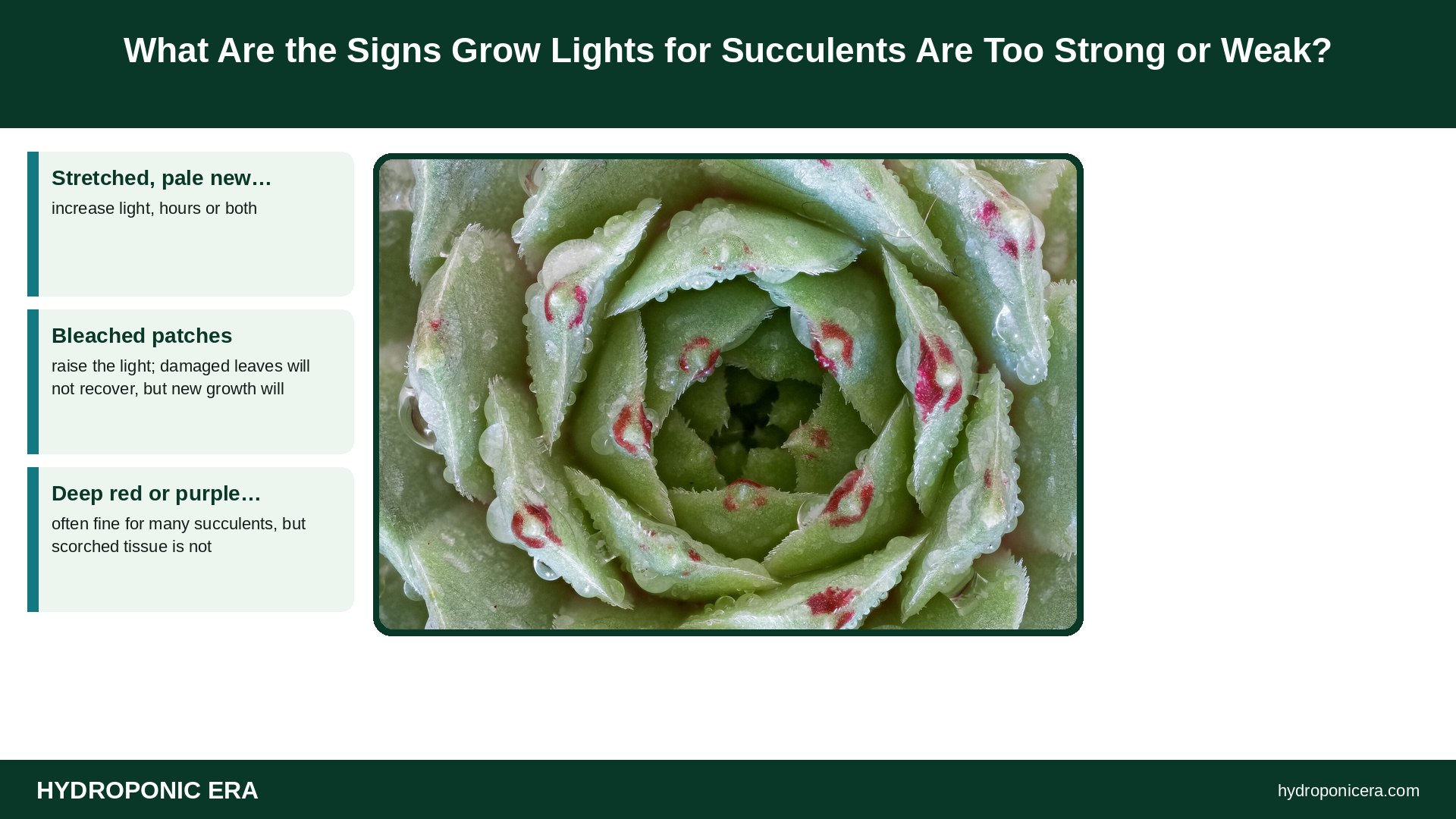
What Are the Signs Grow Lights for Succulents Are Too Strong or Weak?
Too little light shows as stretching, pale color and leaning. Too much shows as bleached, tan or scorched leaves, extra reddening and very compact growth. Iowa State’s troubleshooting table lists these same symptoms and the fix: move the light closer for stretching and farther away for scorch or bleaching.
- Stretched, pale new growth: increase light, hours or both.
- Bleached patches: raise the light; damaged leaves will not recover, but new growth will.
- Deep red or purple stress color: often fine for many succulents, but scorched tissue is not.
- Soft, mushy leaves: that is usually overwatering, not light.
How Do You Set Up Grow Lights for Succulents on a Shelf?
For grow lights for succulents, a wire shelf with an LED bar or tube on each level is the easiest setup. Hang lights on adjustable chains, put plants with similar needs together, and plug every fixture into one timer. Rotate pots weekly so they grow evenly, and leave space between plants for airflow.
- Group by height: keep tall cacti and low rosettes on separate shelves.
- Use reflective backing: white or reflective surfaces bounce light back.
- Mind the edges: light is weakest at shelf ends.
- Keep it dry and safe: water away from cords and plugs.
Our grow light shelf guide walks through a full build, and succulents in hydroponics covers soil-free options.
Do Grow Lights Help Succulents Flower?
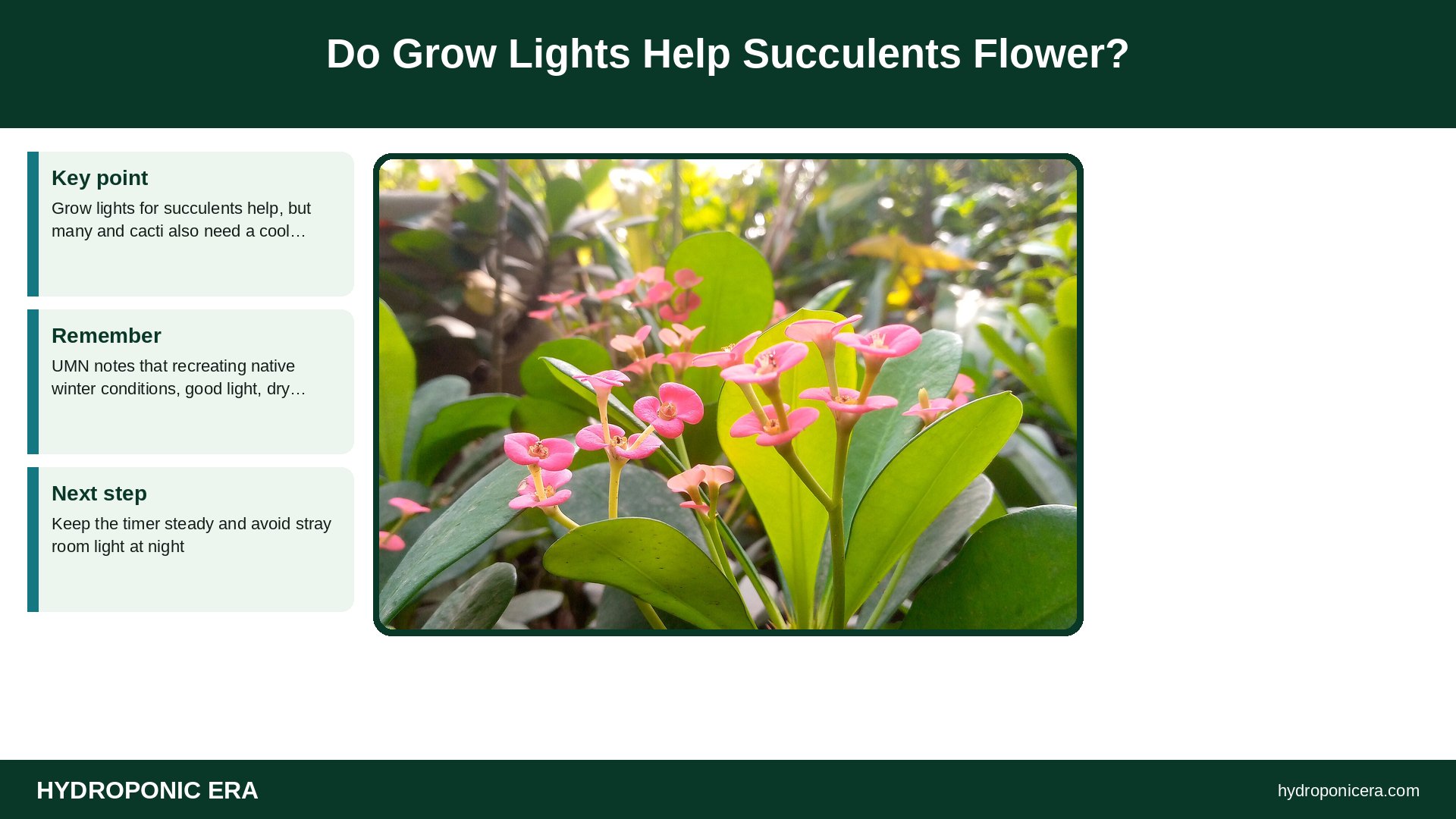
Grow lights for succulents help, but many and cacti also need a cool, dry rest to bloom. UMN notes that recreating native winter conditions, good light, dry soil and cool nights, can bring some cacti into flower indoors. Keep the timer steady and avoid stray room light at night.
FAQ About Grow Lights for Succulents
Can I use a regular LED bulb?
A bright full-spectrum “daylight” LED can help, but it must sit close and cover a small area. A true grow light is easier.
Should grow lights for succulents stay on 24 hours?
No. Give at least 8 hours of darkness each day.
Do succulents need red and blue light?
White full-spectrum LEDs contain both and look natural, so special colors are not required.
How do I know the light is strong enough?
New growth stays compact, colorful and tight with short gaps between leaves.
Can succulents get sunburned under LEDs?
Yes, if the light is too close. Raise it when leaves bleach.
Sources
- University of Minnesota Extension — Cacti and Succulents
- Iowa State University Extension and Outreach — Growing Succulents Indoors
- Iowa State University Extension and Outreach — Common Problems and Issues of Succulents
- Iowa State University Extension and Outreach — How to Set Up Supplemental Lights for Indoor Plants
- Photo credits (Wikimedia Commons, edited with titles): Rosa de alabastro (Echeveria elegans), jardín del molino, Sierra de San Felipe, Setúbal, Portugal, 2012-05-11, DD 01 by Diego Delso (CC BY-SA 3.0); Terramera scientists working in a climate-controlled growth chamber located in Vancouver, BC. The space uses LED lighting, which supports plant growth. (50188965171) by Simon Fraser University – Communications & Marketing (CC BY 2.0); Echeveria A7CR 02866-90 zsp by This Photo was taken by Timothy A. Gonsalves. Feel free to use my photos, but pl (CC BY-SA 4.0); Euphorbia milii ( crown of thorns) 001 by Jeremyida002 (CC BY-SA 4.0)