
Are mosquito fish good for ponds and aquaponics? Mosquito fish are small livebearers that eat mosquito larvae at the water’s surface, so they can help in closed tubs, stock tanks and backyard ponds that never drain into wild water. They are also aggressive and invasive outside their native range, so never release them, and check state rules first.
Key takeaway: Use them only in enclosed water. USGS reports introduced populations have harmed native fish and frogs, and the US Fish and Wildlife Service rates the western species high risk.
| Fact | Western mosquitofish (USGS) |
|---|---|
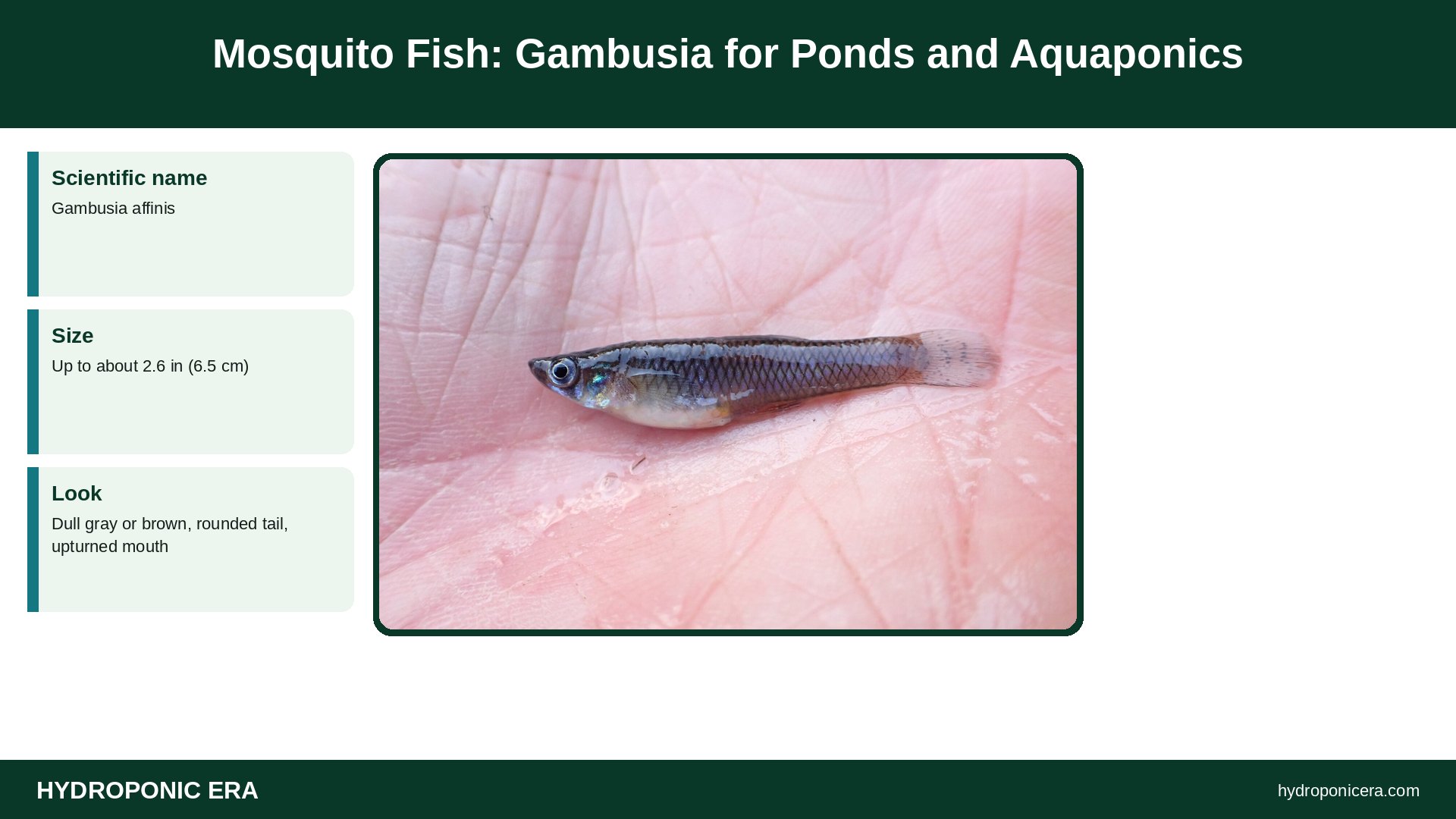
| Scientific name | Gambusia affinis |
| Size | Up to about 2.6 in (6.5 cm) |
| Look | Dull gray or brown, rounded tail, upturned mouth |
| Reproduction | Livebearer |
| Native range | Mississippi River basin and Gulf Slope drainages |
| Risk rating | High risk (USFWS) |
What Are Mosquito Fish?
Mosquito fish are small freshwater livebearers in the genus Gambusia. The western species, G. affinis, is native from central Indiana and Illinois south to the Gulf and west into Mexico. A close relative, the eastern mosquitofish (G. holbrooki), lives along the Atlantic and eastern Gulf coasts. Both feed near the surface on small invertebrates.
USGS notes females can store sperm, and adult populations usually hold far more females than males. That helps explain how quickly a few fish can fill a pond.
Do Mosquito Fish Really Control Mosquitoes?
Yes, they eat mosquito larvae, and USGS cites studies showing they can eat 42–167% of their body weight per day. But USGS also notes reviews have not found them especially effective at reducing mosquito populations or disease in open waters, partly because they also eat the insects and zooplankton that compete with or prey on mosquitoes.
They work best in small, simple, enclosed water like a tub or stock tank. For other options, see our guide to mosquito larvae in hydroponics.

Why Are Mosquito Fish Considered Invasive?
These fish are considered invasive because they spread easily and attack other species. USGS says introduced mosquitofish have had the greatest ecological impact of any introduced livebearer, helping eliminate endangered fish in the American West and preying on fish eggs, frog tadpoles and newt larvae. They also shred fins of larger fish.
- Predation: eggs, larvae and juveniles of other fish.
- Aggression: fin nipping, even toward bigger fish.
- Amphibians: documented feeding on tadpoles and newt larvae.
- Algae: eating grazers can trigger algae blooms.
Which Plants Make a Good Tub Habitat for Mosquito Fish?
A good tub habitat mixes floating plants for shade, submerged plants for cover, and some open water so larvae near the surface stay within reach. Plants also soak up waste and help keep algae down. Avoid covering the whole surface, which can lower oxygen at night.
- Floating cover: a small, contained patch of duckweed or another legal floater.
- Submerged cover: native oxygenating plants from a local nursery.
- Edge plants: potted marginals that like wet feet.
- Air: a small air stone in crowded or very warm tubs.
Our list of plants that grow in water has more ideas. Keep the tub in partial shade in hot climates so the water does not overheat, and top it up with treated water as it evaporates.
Check the tub weekly. Healthy fish cruise near the surface and dart at movement; fish gasping at the top often point to low oxygen or fouled water.
Is It Legal to Keep Mosquito Fish?
Rules vary by state and sometimes by county. Oregon allows releases only into isolated artificial waters without a permit, and Wyoming prohibits stocking them for mosquito control. Some local vector control districts give them out for enclosed backyard ponds. Ask your state fish and wildlife agency before buying, stocking or moving them.
Never move fish between ponds that might connect to streams, and never dump an aquarium or tub into wild water.
How Do You Use Mosquito Fish in a Tub or Stock Tank?
To use mosquito fish in a tub or stock tank, add a few fish to dechlorinated water with plants for cover, place the container where it cannot overflow into a ditch or stream, and let them graze on larvae. They need little feeding when insects are plentiful, but offer a pinch of flake food during lean times.
- Check local rules with your state agency.
- Choose a closed container with no outlet to wild water.
- Treat tap water to remove chlorine.
- Add plants for shade and hiding spots.
- Stock a few fish; they breed quickly.
- Feed lightly only when larvae are scarce.
- Remove extras humanely instead of releasing them.
Our guide to chlorine and chloramine explains water treatment.
Can They Live in an Aquaponics System?
They can live in a small aquaponics tank, but they make a poor main fish. Their tiny size means little waste and little food value, and their aggression rules out mixing them with guppies, fry or slow fish. They are best used as an add-on for larvae control in a sump or open tub that is separate from your main fish.
For better beginner choices, see our aquaponics for beginners guide.
How Do Mosquito Fish Handle Cold Winters?
Most populations are not cold tolerant. USGS notes northern populations often need spring-fed water to survive winter, and one Nebraska population suffered up to 99% winter mortality. In small outdoor tubs, bring a few fish indoors to an aquarium for winter, or let the tub sit empty until spring.
Mosquito Fish vs Guppies: What Is the Difference?
Both are small livebearers, but they behave differently. Mosquitofish are dull gray, hardier in cool water, and far more aggressive. Guppies are colorful and peaceful, but less tolerant of cold. Both eat larvae, and both should stay out of wild waters.
| Trait | Mosquitofish | Guppy |
|---|---|---|
| Color | Dull gray-brown | Often bright |
| Temperament | Aggressive fin nipper | Peaceful |
| Cool water | More tolerant | Less tolerant |
| Community tanks | Poor fit | Good fit |
FAQ About Mosquito Fish
How many do I need for a tub?
Start with a few; they multiply quickly.
Do they need a filter?
Not in a planted tub with light stocking.
Will they eat my fish eggs?
Yes. USGS notes they prey on fish eggs and fry.
Can I put them in a koi pond?
They may nip fins and add little benefit.
Where do I get them?
Some vector control districts offer them; ask locally.
Sources
- US Geological Survey Nonindigenous Aquatic Species — Western Mosquitofish Species Profile
- US Fish and Wildlife Service — Ecological Risk Screening Summary: Western Mosquitofish
- Oregon Department of Fish and Wildlife — Gambusia and West Nile Virus Backgrounder
- Kansas State University Research and Extension — Water Gardening: Biological Balance (MF2911)
- Photo credits (Wikimedia Commons, edited with titles): Gambusia affinis 453169875 by Fishes of Texas team (CC BY-SA 4.0); Culex nigripalpus larvae ARS K9399-1 by Peggy Greb (Public domain); Guppy Poecilia reticulata by Holger Krisp (CC BY 3.0); Pond-edge plants at Achamore Garden – geograph.org.uk – 5446824 by M J Richardson (CC BY-SA 2.0)