
What is the difference in cotyledon vs true leaves? Cotyledons are the seed leaves that emerge first and live off stored food in the seed, while true leaves grow next and make food by photosynthesis. Knowing cotyledon vs true leaves tells you when to start feeding, when to raise light and when to transplant seedlings.
Key takeaway: Cotyledon vs true leaves is a timing guide, not just a vocabulary lesson. Start very light fertilizer once the cotyledons open, step up when the first true leaves appear, and transplant when seedlings have two or three true leaves and a healthy root mass.
| Feature | Cotyledons (seed leaves) | True leaves |
|---|---|---|
| Appear | First, as the seedling emerges | After the cotyledons, from the growing tip |
| Shape | Usually smooth, simple, often rounded or oval | Species-specific, with the shape and edges you expect |
| Job | Use stored seed food and begin photosynthesis | Main long-term photosynthesis and growth |
| Lifespan | Fade and drop within weeks | Stay for the life of the plant |
| Feeding cue | Begin very dilute feed | Increase feed gradually |
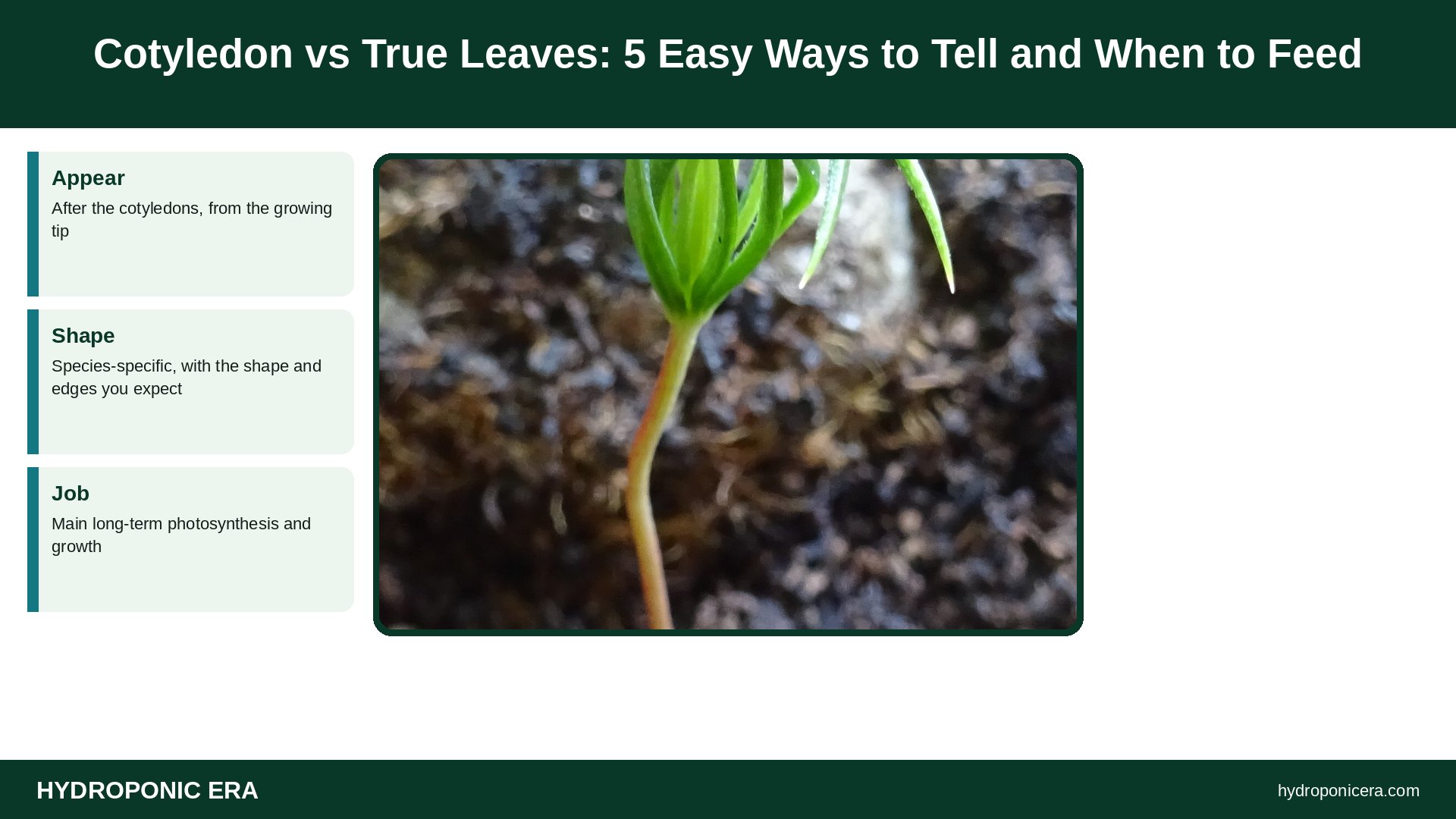
How Do You Tell Cotyledon vs True Leaves Apart?
To tell cotyledon vs true leaves apart, look at the order and shape. Cotyledons appear first and look plain, often like two matching paddles. True leaves emerge from the center between them and look like a tiny version of the adult plant’s foliage, with the typical lobes, serrations or hairs.
Tomato seedlings show cotyledon vs true leaves clearly. The first pair are long, narrow, smooth seed leaves. The next growth is a feathery, toothed true leaf with the familiar tomato smell. Squash and cucumber cotyledons are fat and oval, while basil and lettuce seed leaves are small and rounded. Corn and other grasses are different, since they have one seed leaf and are monocots.
- Count the pairs: two matching leaves at the base are almost always cotyledons.
- Check the center: the growing point between them produces the true leaves.
- Look for texture: hairs, lobes and veins usually show up only on true leaves.
- Compare to the packet: for cotyledon vs true leaves, a photo of the mature plant helps you recognize true-leaf shape.
Why Does Cotyledon vs True Leaves Matter for Feeding?
Cotyledon vs true leaves matters for feeding because seedlings live on seed reserves until they have working roots and true leaves. Fertilizing too early adds salt stress to tiny roots. University guidance for bedding plant seedlings suggests starting once the cotyledons open, then raising the strength when true leaves appear.
UMass Extension recommends about 25–50 ppm nitrogen after the cotyledons open and roughly 50–100 ppm nitrogen once the first true leaves have formed. In hydroponics, this means a quarter- to half-strength nutrient solution at first, increasing as growth speeds up. Our guide to hydroponic nutrients for seedlings explains the practical mixing, and EC and TDS in hydroponics shows how to confirm the strength.
| Stage | Nitrogen guide (UMass) | Typical action |
|---|---|---|
| Seed sown, no leaves yet | None | Plain water or moisture only |
| Cotyledons open | About 25–50 ppm N | Very dilute feed |
| First true leaves | About 50–100 ppm N | Step up gradually |
| Two to three true leaves | Normal seedling feed | Prepare to transplant |
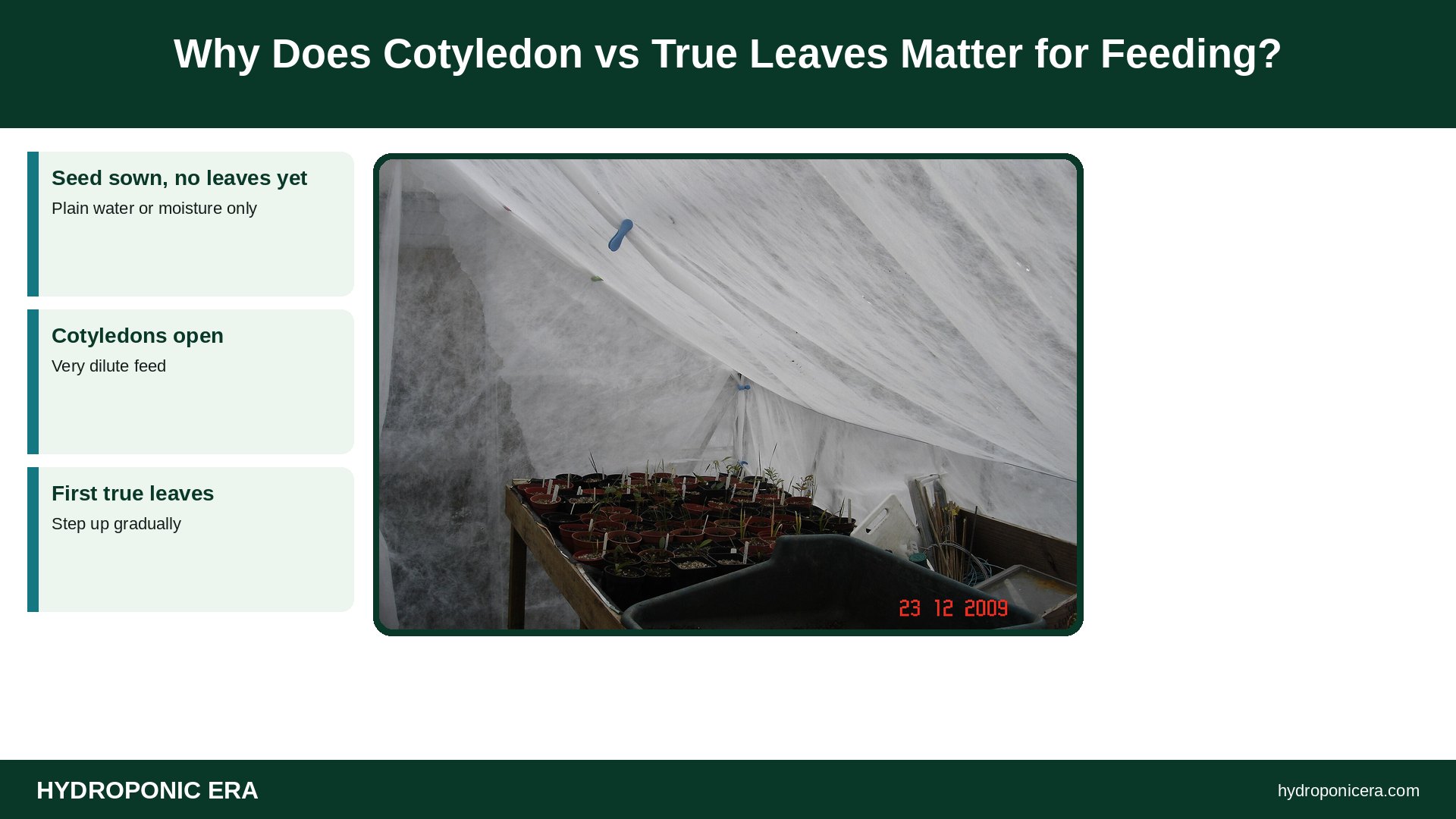
When Should You Move Seedlings After the True Leaves Appear?
Transplant when seedlings have their first true leaves, ideally two or three, and a healthy root mass. Moving them at the cotyledon stage works for some crops but leaves roots fragile. Wait for steady growth, then move them into the final system with minimal root disturbance.
Penn State, Clemson and Ohio State farm-to-school materials all describe potting up or hardening off after true leaves form. Handle seedlings by a cotyledon or leaf edge rather than the stem, because the stem is easily crushed and cannot regrow. Read our guide to transplanting hydroponic seedlings before you move them.
- Water the tray an hour before moving so roots hold together.
- Lift the plug or cube whole, never pulling by the stem.
- Place it at the same depth as before, with cotyledons above the medium.
- Keep light gentle and the solution dilute for the first few days.
What Do Cotyledons Tell You About Seedling Health?
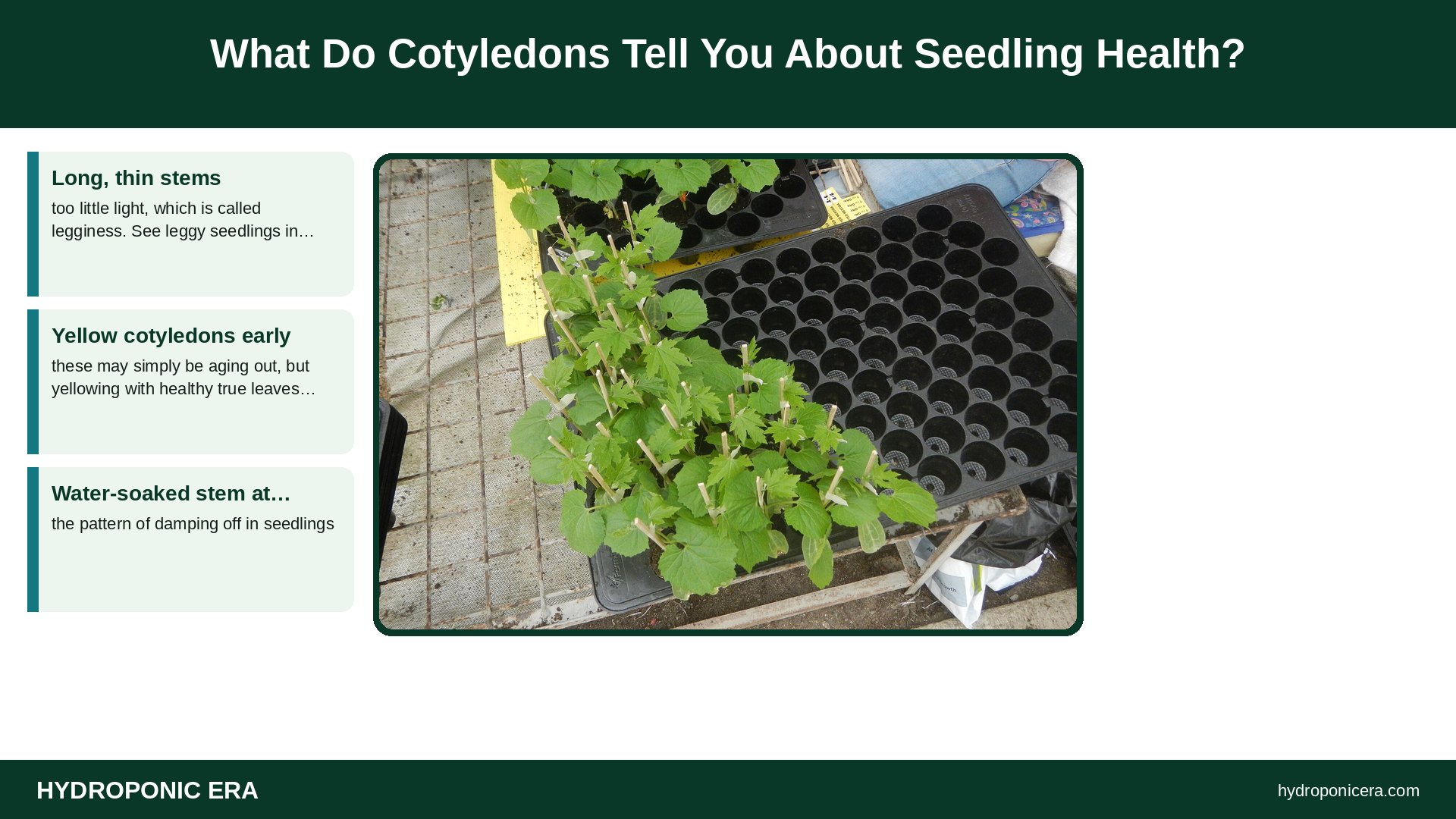
In cotyledon vs true leaves checks, healthy cotyledons are green, firm and symmetrical. Pale, folded or spotted seed leaves point to a problem with light, moisture or disease. Because the first leaves carry the plant until true leaves develop, damage here often shows up as a weak start.
- Long, thin stems: too little light, which is called legginess. See leggy seedlings in hydroponics.
- Yellow cotyledons early: these may simply be aging out, but yellowing with healthy true leaves is normal.
- Water-soaked stem at the base: the pattern of damping off in seedlings.
- Cotyledons stuck in the seed coat: raise humidity and gently moisten the coat, but do not pull it off by force.
How Many True Leaves Follow the Cotyledon vs True Leaves Stage?
Most vegetables do well with two to three true leaves before moving to final spacing or a stronger solution. At this stage roots hold the medium together and the plant can photosynthesize on its own. Leafy greens can move earlier, while fruiting crops benefit from a little more time.
In the cotyledon vs true leaves sequence, seed leaves of some crops stay for weeks, while others drop quickly. Dropping cotyledons are not a problem when the true leaves are growing. Do not remove cotyledons yourself unless they are rotting, since they still contribute to photosynthesis.
| Crop | Cotyledon note | When to transplant |
|---|---|---|
| Lettuce | Small, rounded seed leaves | After 2 true leaves |
| Tomato | Long, narrow seed leaves | After 2–3 true leaves |
| Basil | Rounded, thick seed leaves | After 2 true leaves |
| Cucumber | Large, oval seed leaves | After 1–2 true leaves |
Can Cotyledon vs True Leaves Help You Spot Mistakes Early?
Yes. Comparing cotyledon vs true leaves helps you find mistakes while they are still easy to fix. If cotyledons look fine but true leaves are small, pale or twisted, the cause is usually light, feed or temperature after the seed reserves ran out, not the seed itself.
Use that timing for cotyledon vs true leaves checks. Poor germination or weak cotyledons usually point to seed quality, moisture or temperature, which is covered in our post on hydroponic seeds not germinating. Problems that start at the true-leaf stage usually relate to nutrition, water or light. Keep notes on the day each stage appears, because they make the next sowing more predictable.
FAQ About Cotyledon vs True Leaves
Do cotyledons count as leaves?
They are leaves, but they are seed leaves. When a guide asks for two true leaves, it means leaves after the cotyledons.
Why are my cotyledons falling off?
Dropping cotyledons are normal once true leaves take over. Concern only arises if the whole seedling is declining.
Should I fertilize before true leaves appear?
Begin very dilute feed once cotyledons open, and increase when true leaves show.
Do all plants have two cotyledons?
No. Dicots such as tomato have two, while monocots such as corn and grasses have one.
Can I transplant at the cotyledon stage?
You can for some crops, but waiting for true leaves gives roots time to develop and reduces transplant shock.
Sources
- UMass Extension — Fertilizing Bedding Plant Seedlings
- University of Maryland Extension — Care of Vegetable Seedlings
- Clemson HGIC — Starting Seeds Indoors
- Ohio State Farm to School — Transplanting Seedlings
- Photo credits (Wikimedia Commons, edited with titles): Picea sitchensis. Sitka Spruce. A seedling with cotyledons and juvenile leaves developing by Rosser1954 (CC BY-SA 4.0); Fleece lined greenhouse potting tray and seed pots – Flickr – peganum by peganum from Small Dole, England (CC BY-SA 2.0); 5670Farm Ready Seedling Facility East West Seed Philippines 20 by Judgefloro (CC0); Pepper and tomato seedling trays at Boğaziçi University 2026 by Furkan Akkurt (CC BY-SA 4.0)