
How should you do seed storage at home? Good seed storage keeps seeds dry, cool, dark and sealed. Put them in labeled airtight containers, keep them around 40–50°F (4–10°C) for the short term, and freeze fully dried seed for long-term seed storage. Heat and moisture shorten seed life faster than age does.
Key takeaway: Seed storage works because seeds are alive and slowly use up their reserves. Lower moisture and lower temperature slow that process. Store only dry seed, avoid repeated warming and cooling, and test old packets before you plant a whole tray.
| Goal | Short term (1–3 years) | Long term (many years) |
|---|---|---|
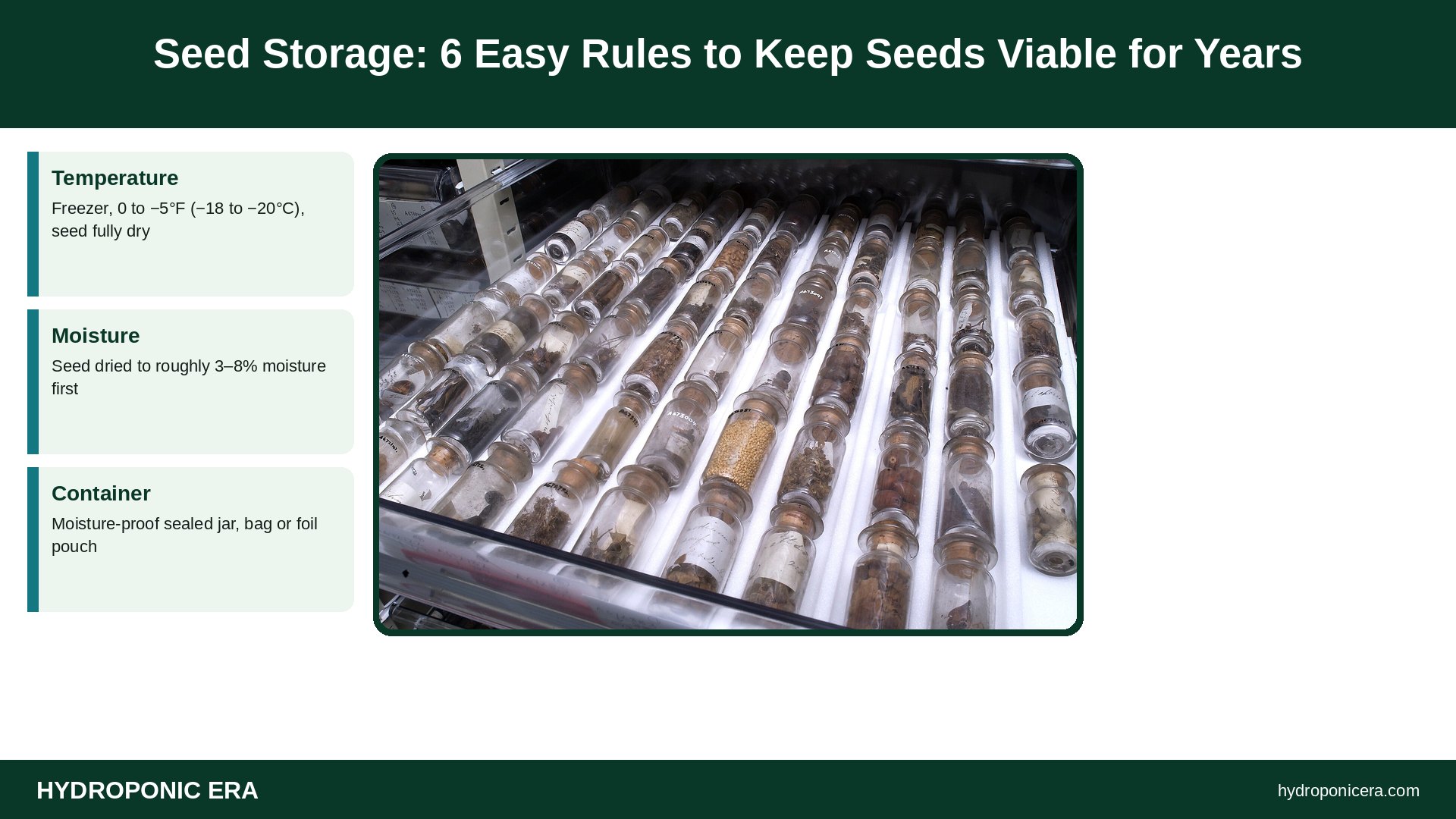
| Temperature | Cool room or refrigerator, about 40–50°F (4–10°C) | Freezer, 0 to −5°F (−18 to −20°C), seed fully dry |
| Moisture | Kept dry, packet sealed | Seed dried to roughly 3–8% moisture first |
| Container | Airtight jar or zip bag | Moisture-proof sealed jar, bag or foil pouch |
| Light | Dark | Dark |
| Before opening | Normal | Let the container warm to room temperature |
What Are the Basic Rules of Seed Storage?
The basic rules of seed storage are dry, cool, dark and airtight. Moisture wakes seeds up or lets mold grow, heat speeds aging, and light can shorten life. Extension guides from Minnesota, Nebraska and Iowa State agree on this simple formula for garden seed.
- Dry first: let harvested seed air-dry on a screen or plate, not in sunlight.
- Seal it: use glass jars with tight lids, zip bags or foil seed envelopes inside a box.
- Label it: write the crop, variety and year on every container.
- Keep it cool and steady: a closet shelf away from stoves and windows beats a garage that swings between hot and cold.
- Protect from pests: tight lids stop weevils and mice.
Good seed storage is mostly habit. A small plastic bin with jars and a printed list stays organized for years, and is easy to carry to a seed swap.
How Cold Should Seed Storage Be?
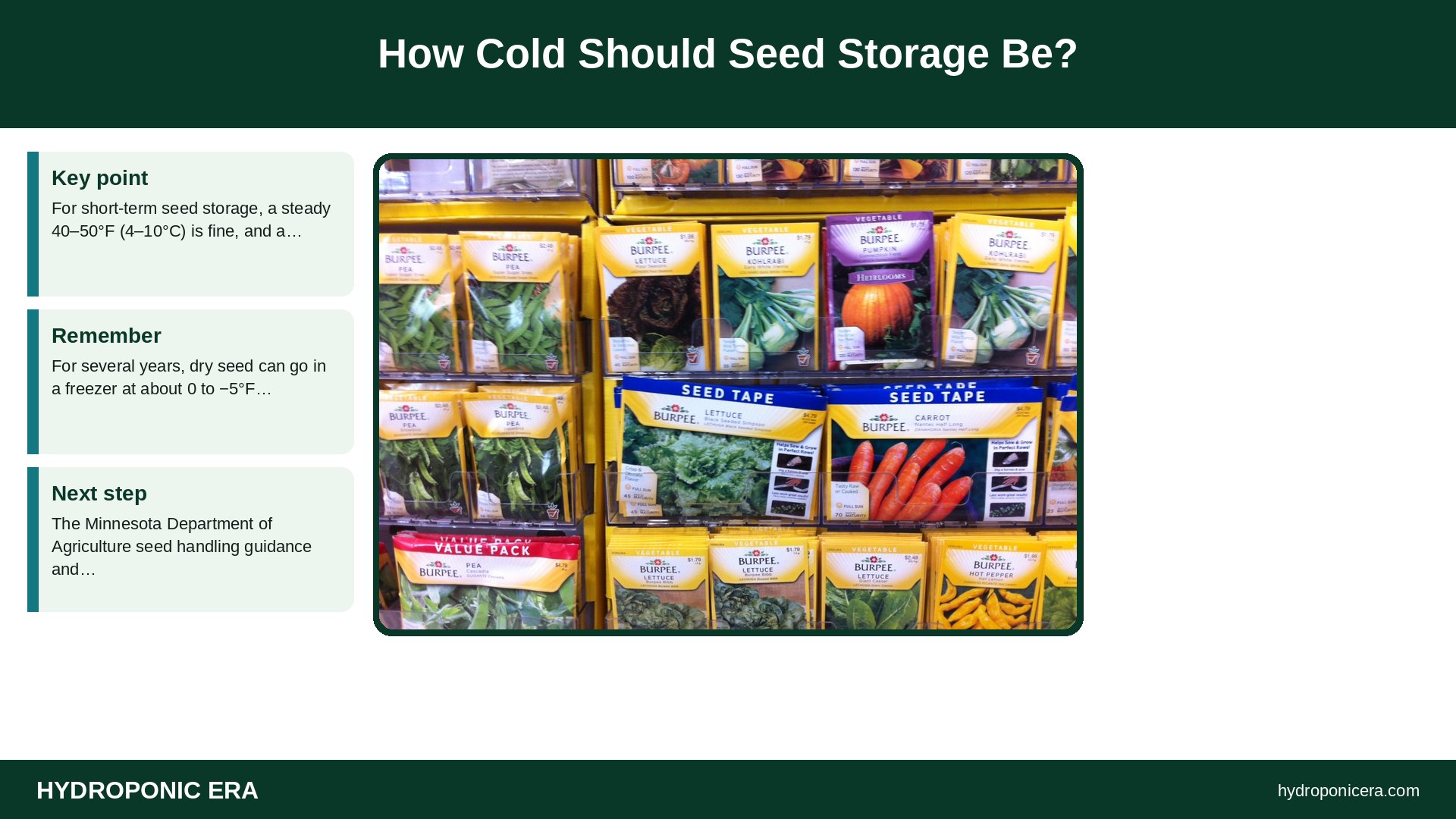
For short-term seed storage, a steady 40–50°F (4–10°C) is fine, and a refrigerator in a sealed container works well. For several years, dry seed can go in a freezer at about 0 to −5°F (−18 to −20°C), if the seed is truly dry and the container is moisture-proof.
The Minnesota Department of Agriculture seed handling guidance and University of Nebraska extension both note that humid seed freezes badly, because ice crystals can damage the embryo. Steady cool temperatures matter more than very cold ones. Keep seed out of a fridge door that opens often, and let sealed containers reach room temperature before opening so moisture does not condense on the seed.
Should You Use Silica Gel for Seed Storage?
Silica gel can help with seed storage, but mainly for the first drying step. Seeds bought in sealed packets are already dry. Home-saved seed from fruit, such as tomato or pepper, must be fermented or cleaned and fully dried before you seal it away.
Place seed and silica gel in a sealed jar for one to two weeks, then remove the gel so seed does not dry out too far. Dry seed should snap rather than bend, such as a bean breaking in half. The same drying principle applies to your sprouting seeds, which should be kept dry until you soak them.
How Long Does Seed Storage Keep Different Seeds Viable?
With sensible seed storage, onion, sweet corn, parsnip and pepper stay good for about 1–2 years, beans, carrots, peas and tomatoes for around 3, beets, pumpkins and squash for about 4, and brassicas, cucumbers, lettuce and spinach for about 5. These are averages, not guarantees.
| Seed life | Typical crops | Notes |
|---|---|---|
| 1–2 years | Onion, sweet corn, parsnip, pepper | Buy fresh or test each year |
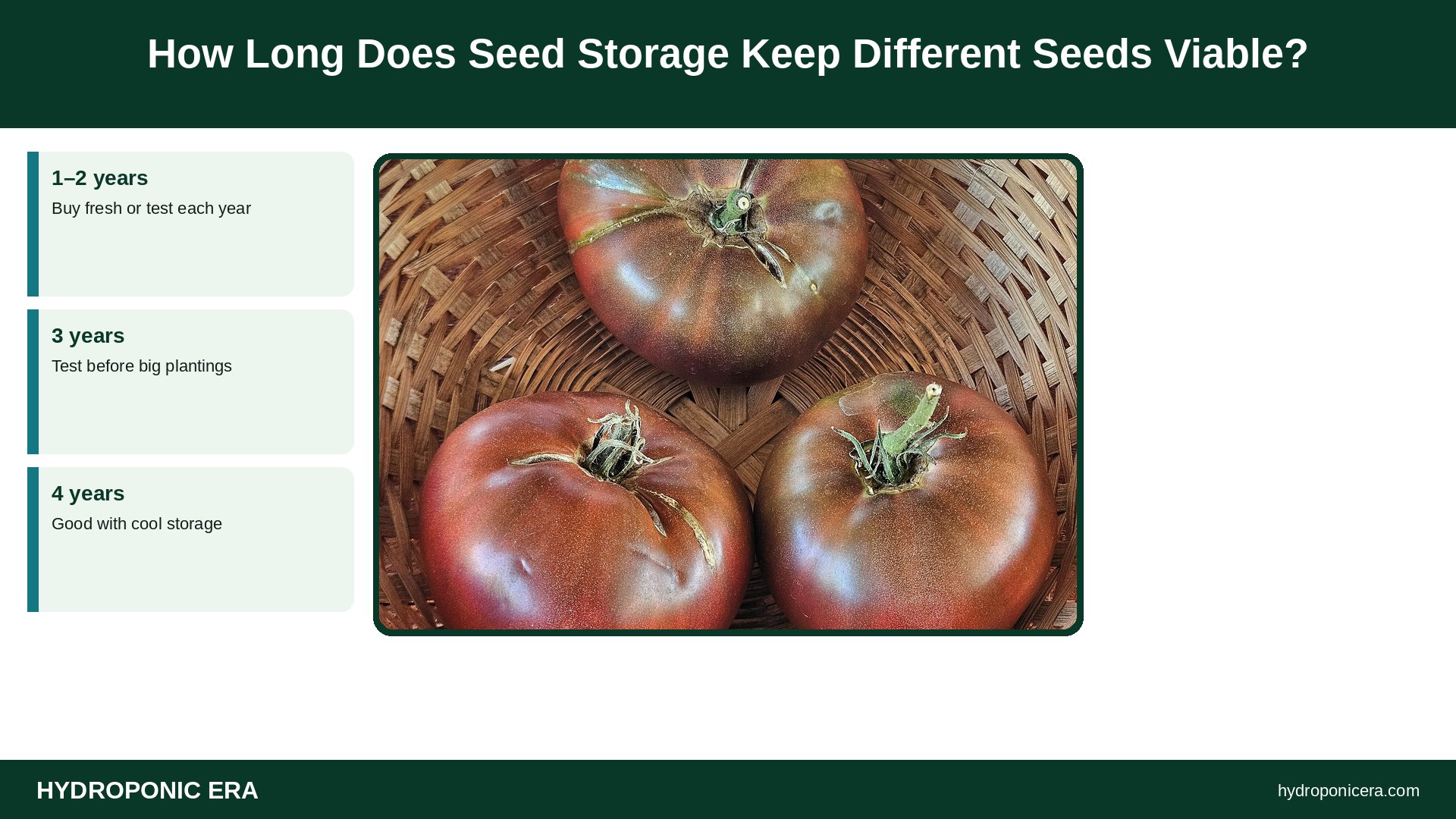
| 3 years | Bean, carrot, pea, tomato | Test before big plantings |
| 4 years | Beet, pumpkin, squash, watermelon | Good with cool storage |
| 5 years | Broccoli, cabbage, cucumber, lettuce, radish, spinach | Longest-lived garden seeds |
These numbers come from University of Illinois and Wisconsin extension tables and assume cool, dry seed storage. Properly frozen seed can last longer. For ordinary home growers, testing is better than guessing. A simple paper-towel germination test, covered below, is the best check once you have stored a packet for more than a year.
Why Does Seed Storage Fail?
Seed storage fails when moisture, heat or repeated warming gets in. Seed stored in an attic, a garage or a humid kitchen loses viability in a season or two. Seed that was never dry when sealed grows mold. Poor seed to begin with also cannot be saved by good storage.
- Humidity: open packets absorb water from the air. Reseal them with the opening folded and a rubber band, then place them in a jar.
- Heat swings: car trunks and sunny shelves cook seed.
- Condensation: opening a cold jar in a warm room fogs the seed with water.
- Pests: weevils lay eggs in legumes. Freeze beans and peas for a few days before sealing.
- Mixing varieties: labels fade, so use pencil or a permanent marker.
How Do You Organize Seed Storage for a Hydroponic Garden?
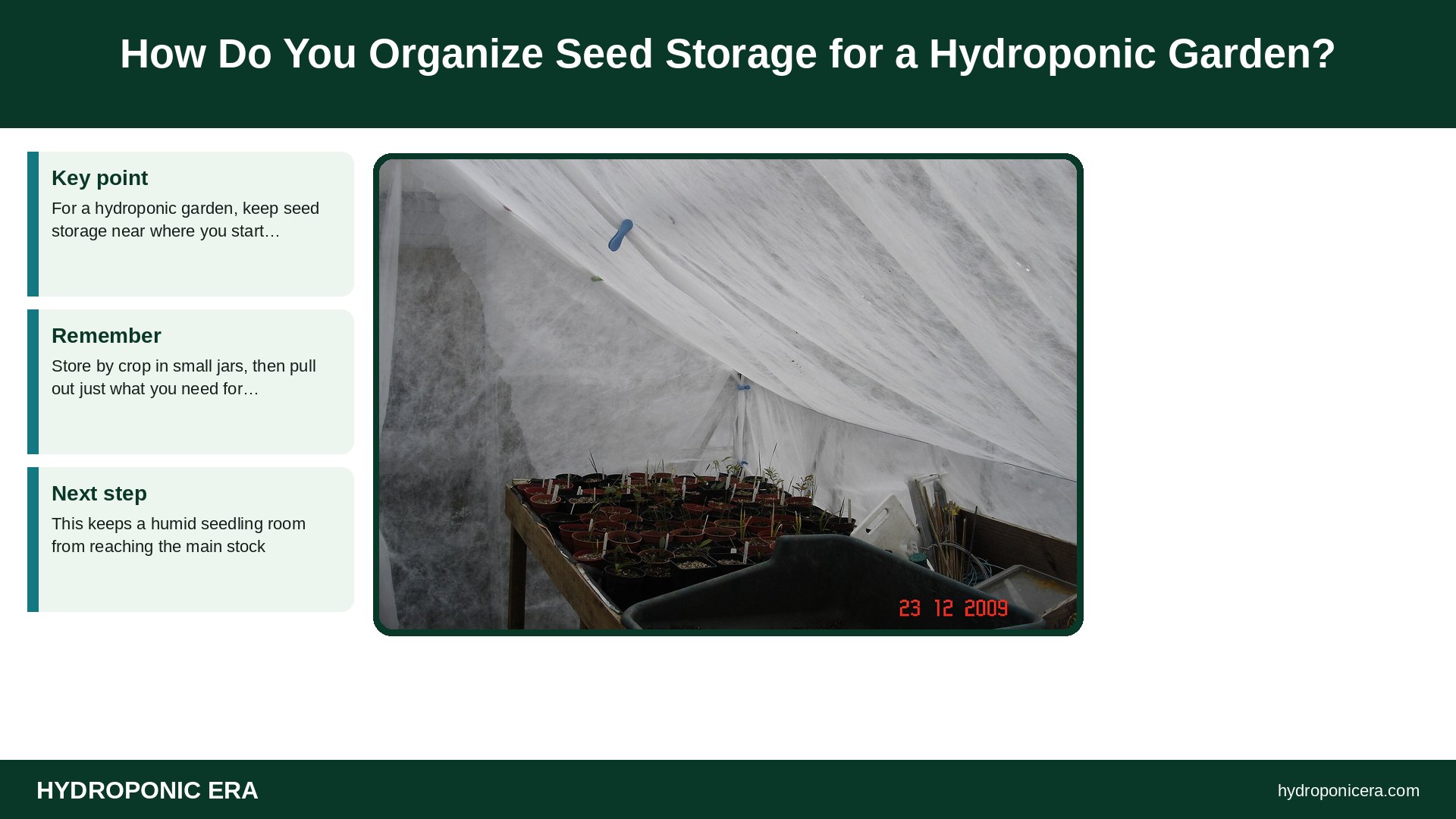
For a hydroponic garden, keep seed storage near where you start seedlings but not in the humid grow area. Store by crop in small jars, then pull out just what you need for each sowing. This keeps a humid seedling room from reaching the main stock.
Pair your jars with a notebook that logs sowing date and germination rate. If a variety performs poorly, check storage first and then look at problems covered in hydroponic seeds not germinating. A small stack of seed starting trays and a labeled tote makes the whole workflow tidy.
Can You Store Hybrid and Heirloom Seeds the Same Way?
Yes. Seed storage rules do not depend on the variety. The difference is what you plant later: heirloom and open-pollinated seed saved from your plants will grow true, while hybrid seed saved from your own crop usually will not. Store both the same and label which is which.
FAQ About Seed Storage
Can I store seeds in the refrigerator?
Yes, in a sealed container. Short-term seed storage at about 40–50°F (4–10°C) works well, as long as the seeds are dry and the container is airtight.
Is the freezer safe for seed storage?
It is safe for fully dry seed in a moisture-proof container. Let the container reach room temperature before opening.
Do I need silica gel?
Not for store-bought packets. It helps when drying seed you saved yourself, and should come out after one to two weeks.
How can I tell if stored seed is still good?
Run a paper-towel germination test with about 10 seeds. Seventy percent or more sprouting is a reasonable result.
Should I keep seeds in their paper packets?
Yes, then put the packets in a jar or box. The packet is labeled, and the outer container keeps moisture out.
Sources
- Minnesota Department of Agriculture — Seed Storage and Handling Guidelines
- University of Nebraska–Lincoln Extension — Seed storage publication
- Iowa State Extension — How to harvest and store seeds
- University of Illinois Extension — Seed viability to store leftover flower and vegetable seeds](https://yardandgarden.extension.iastate.edu/faq/what-best-way-store-left-over-flower-and-vegetable-seeds)
- University of Wisconsin Extension — Seed viability and storage
- Iowa State Extension — Best way to store leftover flower and vegetable seeds
- Photo credits (Wikimedia Commons, edited with titles): Seeds and roots in jars Wellcome L0036767 by Unknown (CC BY 4.0); Packets of Vegetable Seeds by ParentingPatch (CC BY-SA 3.0); Heirloom tomatoes at county fair by Eric Polk (CC BY-SA 4.0); Fleece lined greenhouse potting tray and seed pots – Flickr – peganum by peganum from Small Dole, England (CC BY-SA 2.0)