
What grow tent size do you need? Pick your grow tent size from the mature plant canopy you want, not today’s seedlings. A 2×2 ft (0.6×0.6 m) tent suits one compact plant or a seedling zone, a 4×4 ft (1.2×1.2 m) tent suits a small hydroponic garden, and tall crops need extra height. Match the light’s coverage to the footprint.
Key takeaway: Grow tent size is a two-part decision: floor area and height. Match the footprint to your light’s real coverage map, then subtract pots, light clearance and ducting from the tent height to see how tall plants can grow. Leave room outside the tent for doors, ducts and cords.
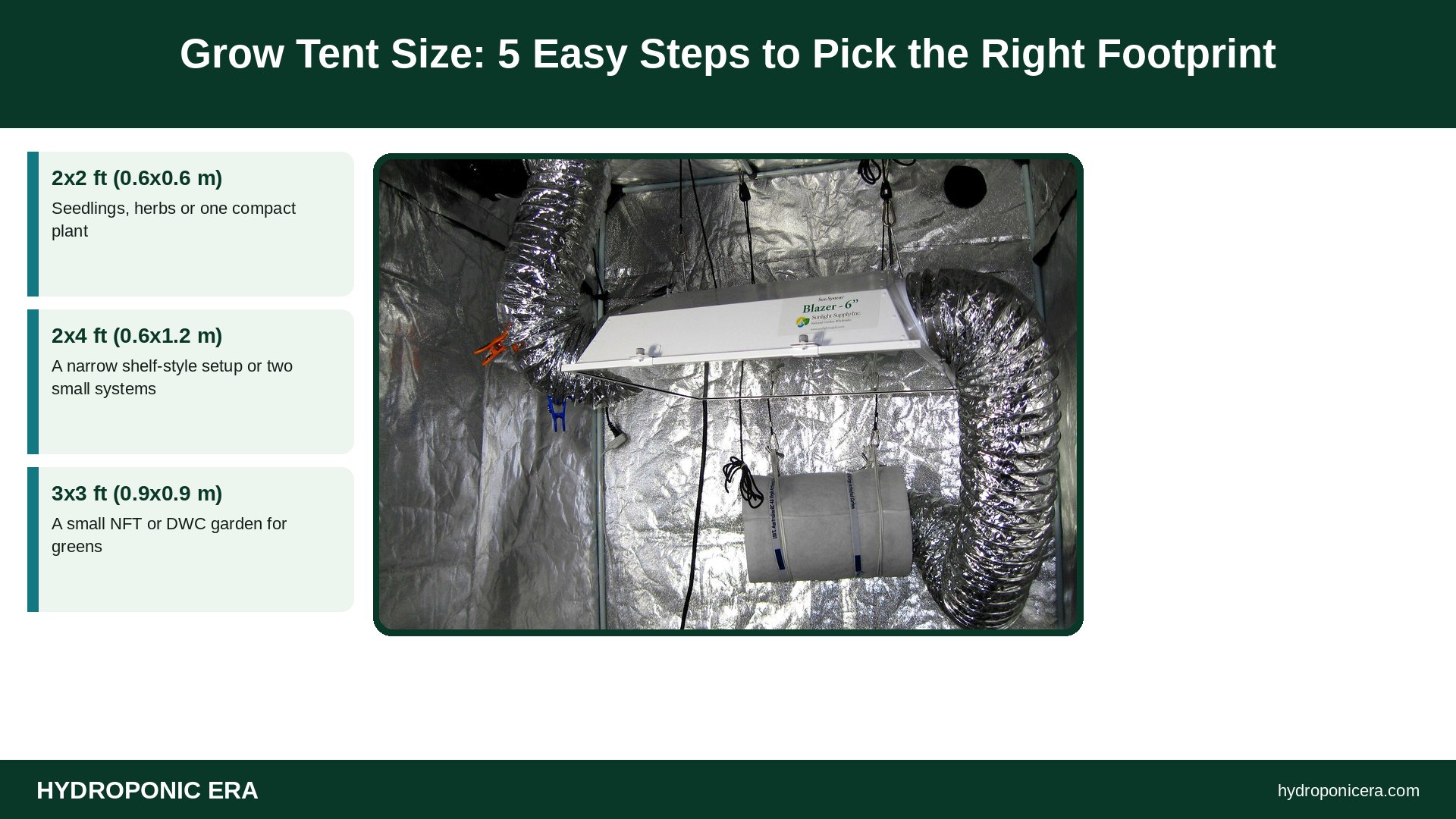
| Footprint | Floor area | Typical use for hydroponic growers |
|---|---|---|
| 2×2 ft (0.6×0.6 m) | 4 sq ft (0.4 sq m) | Seedlings, herbs or one compact plant |
| 2×4 ft (0.6×1.2 m) | 8 sq ft (0.7 sq m) | A narrow shelf-style setup or two small systems |
| 3×3 ft (0.9×0.9 m) | 9 sq ft (0.8 sq m) | A small NFT or DWC garden for greens |
| 4×4 ft (1.2×1.2 m) | 16 sq ft (1.5 sq m) | A popular mid-size footprint for hobby growers |
| 5×5 ft (1.5×1.5 m) | 25 sq ft (2.3 sq m) | More room for tall plants and equipment |
How Do You Choose a Grow Tent Size?
Choose the grow tent size by estimating the mature canopy width and depth, then fitting the light to that area. Retailers such as Garden Supply Guys advise defining the mature canopy first, since young plants mislead you. Then check that you can reach every plant, and that the room can handle the heat and humidity.
- Decide what you will grow and how big it gets at harvest.
- Measure the system footprint, including trays, reservoir and any stand.
- Pick the light first, and note its published coverage at your target intensity.
- Choose a tent whose floor area matches that coverage.
- Check ceiling height, delivery path and outlet access in the room.
For setup steps after you buy, read our grow tent hydroponics setup guide.
How Does Light Coverage Affect Grow Tent Size?
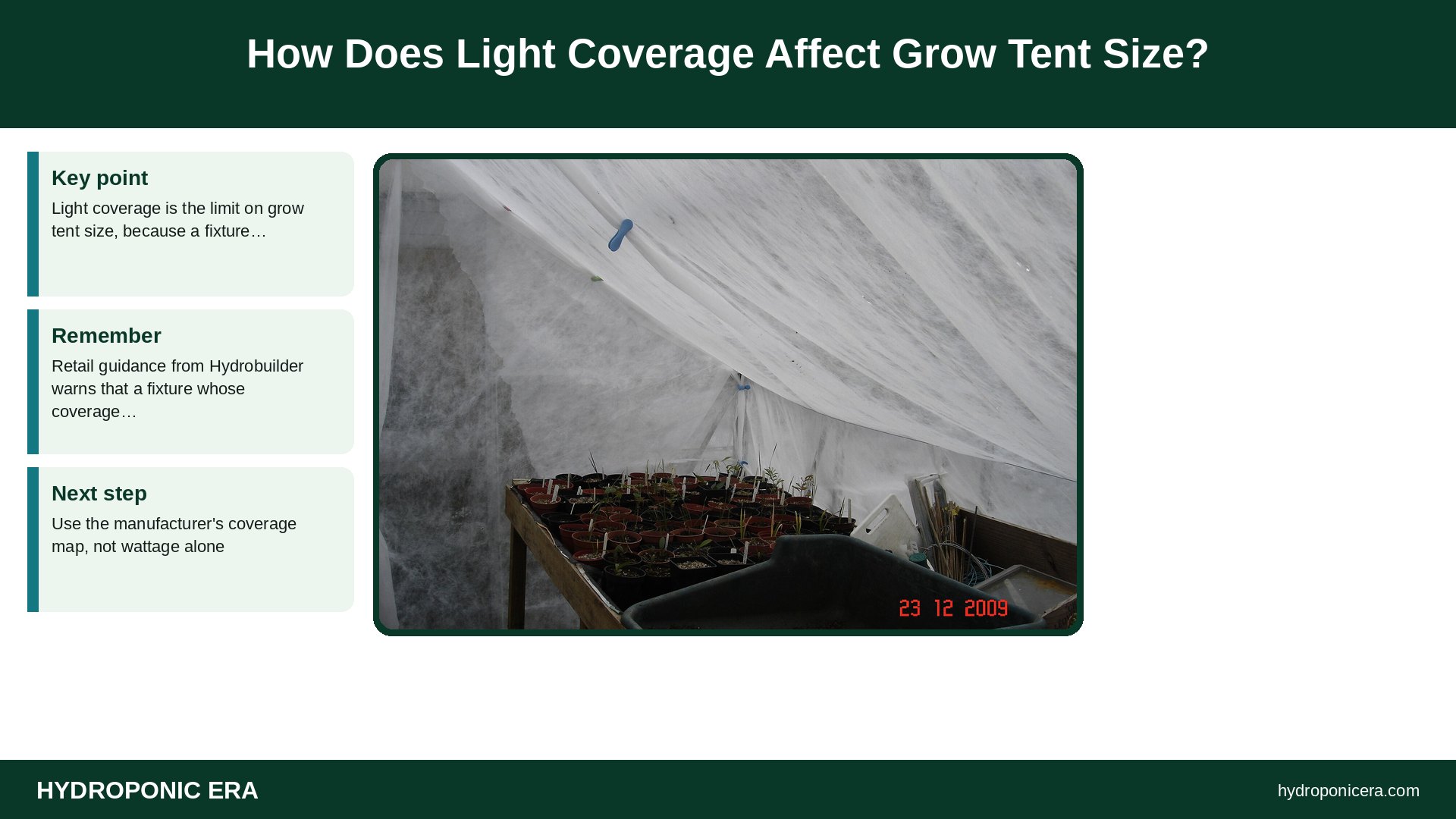
Light coverage is the limit on grow tent size, because a fixture lights only a certain area well. Retail guidance from Hydrobuilder warns that a fixture whose coverage is smaller than the tent leaves edges under-lit, and an oversized one can overheat a small tent. Use the manufacturer’s coverage map, not wattage alone.
A rough power check helps, as covered in our guide to LED grow light watts per square foot. Leafy greens need far less light than fruiting crops, so a smaller tent with a modest light can be enough for lettuce and herbs. Fruiting tomatoes and peppers need stronger lights and more height.
How Tall Should Your Grow Tent Be?
Height matters as much as floor space. Use this formula: usable plant height equals tent height minus container or system height, light and hangers, required light clearance, and room for fans and ducting. A 72–80 inch (1.8–2 m) tent gives most growers more room than a 48 inch (1.2 m) model.
| Item to subtract | Example allowance | Notes |
|---|---|---|
| Container or system height | 6–12 in (15–30 cm) | Reservoir, tray or pot stand |
| Light and hangers | 4–8 in (10–20 cm) | Varies by fixture |
| Light clearance above canopy | 12–24 in (30–60 cm) | Follow the light manufacturer |
| Fans, filter and ducting | 6–12 in (15–30 cm) | Often mounted at the top |
These are planning allowances, not rules, so use your own measurements. Tent makers also sell extension kits, and Gorilla lists a 4×4 model about 83 inches (2.1 m) tall at the base and rising to about 107 inches (2.7 m) with a 24 inch (0.6 m) extension.
How Many Plants Fit in Each Grow Tent Size?
Plant counts depend on plant size, container, spacing and training, so published numbers are rough. Retail charts give examples such as 1–2 plants in a 2×2 tent, 2–4 in a 3×3 tent and 4–6 in a 4×4 tent for large plants. Small crops like lettuce fit many more per square foot.
Plan by space per plant instead. Mature lettuce needs only a few inches between plants, herbs a little more, and tomatoes or peppers about a square foot or more each, depending on the variety and how you train them. Count mature spacing, then add aisle room so you can work.
What Ventilation and Room Space Does Your Grow Tent Size Need?
A bigger grow tent size means more heat, humidity and airflow demand. Read grow tent CFM and exhaust sizing to match the fan to the tent. Also leave space outside, since doors need room to unzip, and ducts, cords and controllers need to be reachable.
- Fan and filter: size to the tent volume and light heat.
- Door swing: keep space to open and fold the doors.
- Electrical: avoid long extension-cord chains.
- Water access: plan how you will fill and drain reservoirs.
Reflective interior walls help use the light well, as explained in reflective materials for a grow tent.
Is a Bigger Grow Tent Size Always Better?
No. A larger tent costs more, needs a stronger light and fan, and can be harder to heat and dehumidify. If the light does not cover the whole floor, the extra space is wasted. Choose the smallest tent that holds your mature plants and system comfortably, with a little room to grow later.
If you are unsure, a 4×4 footprint is a common mid-size choice, and a 2×4 or 3×3 tent suits tighter rooms. Starting a little small and adding a second tent later is often cheaper than buying one that is too big.
What Grow Tent Size Works for Seedlings and Propagation?
A small tent is ideal for starting seedlings or rooting cuttings. A 2×2 or 2×4 footprint holds several trays under a compact light, keeps humidity easier to manage and uses little power. Move plants to a larger space once roots fill their starter cubes. A compact grow tent size also costs less to heat and light.
Pair a small propagation tent with a heat mat and a thermometer-hygrometer, and keep the light close to the seedlings but not touching the dome. Our guide to humidity domes and tents for cuttings and clones explains the details.
FAQ About Grow Tent Size
What is the best grow tent size for beginners?
Many beginners pick a 2×4 or 3×3 tent for easy access, or a 4×4 tent for more room. Match it to your light.
How tall should a grow tent be?
A 72–80 inch (1.8–2 m) tent suits most plants, while 48 inch (1.2 m) models suit seedlings and short crops.
Can I use a bigger light than my grow tent size suggests?
It can overheat the space and stress plants, so match the light’s coverage to the tent.
How many plants fit in a 4×4 tent?
About 4–6 large plants by retail guidance, or many more small crops like lettuce.
Do I need extra space around the tent?
Yes, for doors, ducts, cords and maintenance.
Sources
- Hydrobuilder Learning Center (retailer) — Grow tent buying guide
- Garden Supply Guys (retailer) — What size grow tent do I need?
- Gorilla Grow Tent (manufacturer) — 4×4 Grow Tent Pro specifications
- Photo credits (Wikimedia Commons, edited with titles): An HPS grow light in grow tent, with carbon filter and exhaust system by Plantlady223 (CC BY-SA 4.0); Fleece lined greenhouse potting tray and seed pots – Flickr – peganum by peganum from Small Dole, England (CC BY-SA 2.0); 2008-09-20 Thermometer reading by Ildar Sagdejev (Specious) (CC BY-SA 4.0); Electrical conductivity meter by Nuno Nogueira (Nmnogueira) (CC BY-SA 2.5)