
What is olla irrigation? Olla irrigation waters plants from an unglazed clay pot buried in the soil with its neck above ground. You fill the pot, and water seeps slowly through the clay as the surrounding soil dries. University of Arizona Extension says it may save 60–70% of water compared with watering-can irrigation.
Key takeaway: Olla irrigation delivers water straight to the root zone from a buried, unglazed clay pot. Bury it with 1–2 inches (2.5–5 cm) above the soil, cover the opening, fill it often and space pots 2–3 feet (60–90 cm) apart for the best coverage.
| Item | Guideline | Source idea |
|---|---|---|
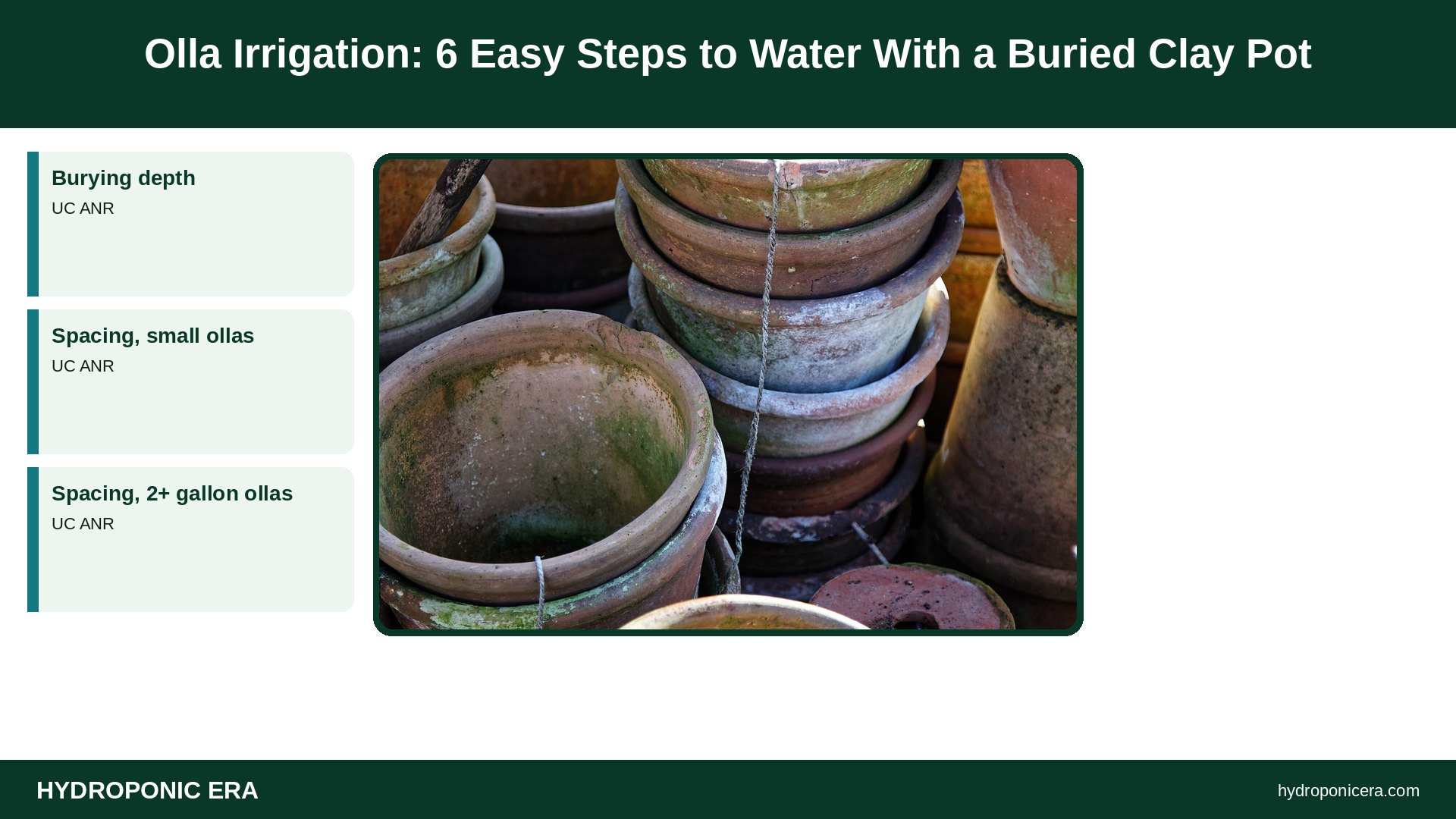
| Burying depth | Leave 1–2 in (2.5–5 cm) above soil | UC ANR |
| Spacing, small ollas | Every 2–3 ft (60–90 cm) | UC ANR |
| Spacing, 2+ gallon ollas | 3–4 ft (0.9–1.2 m) apart | UC ANR |
| Refill frequency | Every 2 to 7+ days, varies | UC ANR |
| Best soils | Coarse or sandy soil | UC ANR |
How Does Olla Irrigation Work?
An olla is a porous clay vessel. When it is buried and filled, water moves through the walls into dry soil until the soil and the pot reach balance. If the soil is already wet, little water leaves. University of Arizona Extension describes this as soil-moisture tension, and UC ANR notes that roots can pull water from the pot as needed.
This self-regulating action is why olla irrigation can keep moisture steady without a timer. Roots often grow toward the pot and wrap around it, taking water directly from the clay.
What Are the Benefits and Limits of Olla Irrigation?
Olla irrigation saves water, delivers it at the roots and keeps the soil surface drier, which can reduce weeds. UC ANR notes that steady moisture can help prevent cracking in tomatoes and melons. The limits are cost, refilling and coverage: it is inefficient for densely planted annual crops because many pots are needed.
- Water savings: University of Arizona Extension cites 60–70% savings versus a watering can.
- Steady moisture: reduces wet-dry swings.
- Fewer weeds: the surface stays drier.
- Limits: manual refills, pots can crack in freezes, and clay soils do not spread water well.
For other ways to deliver water, see our comparison of hydroponics vs soil.
Which Plants and Soils Suit Olla Irrigation?
Plants with fibrous roots, such as tomatoes, squash, melons and chiles, respond well, and young trees, vines and shrubs also work. Ollas suit coarse or sandy soil best, because heavy clay soil spreads water poorly. UC ANR advises against dense annual plantings, and warns that woody roots can break a pot.
Do not rely on a pot for new seeds. Plant seeds a few inches away from the opening, and surface-water until they germinate, since the top 2 inches (5 cm) may stay dry.
How Do You Make an Olla From Terracotta Pots?
You can make an olla from two unglazed terracotta pots. Plug the drain hole of one pot with a small tile or stone and waterproof sealant, then glue the rims of two pots together, leaving the top drain hole as your fill hole. Colorado State Extension in Pueblo used two 7-inch pots, which hold about a gallon together.
- Choose unglazed terracotta pots, with no sealant or glaze.
- Plug the drain hole of one pot with a flat stone or tile and waterproof caulk.
- Glue the two rims together with waterproof sealant, and let it cure fully.
- Test for leaks by filling the pot over a sink or tray.
- Keep the top hole open for filling, and prepare a lid to cover it.
Use food-safe sealant when possible. The University of Arizona suggests food-grade silicone for sealing a modified pot.
How Do You Install Olla Irrigation Step by Step?
- Dig a hole slightly larger than the pot, in the center of your planting area.
- Set the pot in the hole so 1–2 inches (2.5–5 cm) sits above the soil.
- Pack soil firmly around it so there are no air pockets.
- Plant 4 to 8 inches (10–20 cm) from the pot, with roots reaching toward it.
- Fill the pot with water and cover the opening with a lid, plate or upside-down saucer.
- Mark the location so nobody steps on it, then check water levels often.
Packing the soil firmly matters, since air pockets stop water from moving outward. If the soil is very deep, a saucer under the pot may help water spread sideways rather than downward.
How Often Do You Refill an Olla?
Refill frequency depends on soil, plants and weather. UC ANR says anywhere from every other day to once a week or more. Check the water level often at first, and keep the opening covered to slow evaporation and block mosquitoes. If you must refill much more often, check for a crack.
Rainwater barrels are a good source, and some gardeners connect ollas with tubing and a gravity-fed tank. Our guide to collected rainwater shows how to handle water quality. For tap water, see chlorine and chloramine.
Can You Use Olla Irrigation in Containers and Raised Beds?
Yes. Large containers and raised beds are good matches, because one pot can water a small, defined area. Colorado State Extension found ollas and raised beds a strong pair for thirsty tomatoes and squash during hot, windy summers. Use a loose, well-draining mix such as the ones in our guide to growing media or coco coir, and mulch the surface to slow evaporation.
In a small container, choose a small olla so it does not crowd the roots. Check that the pot is not so large that it leaves too little soil. A lid is still important, because open pots collect debris and breed mosquito larvae.
How Do You Protect an Olla From Winter?
If you live where soil freezes hard, dig the pot out and store it dry for winter. Water trapped in the clay can freeze and crack it underground. Empty, clean and dry the pot, store it indoors, and replant it in spring. Mark each location for easy reinstallation.
FAQ About Olla Irrigation
How much water does an olla hold?
Small DIY ollas made from two 7-inch pots hold about a gallon. Commercial sizes vary.
Can olla irrigation replace all watering?
Not always. Seeds and shallow-rooted crops may need surface watering at first.
Do ollas attract mosquitoes?
They can if left open, so cover the opening with a lid or saucer.
Does olla irrigation work in clay soil?
Poorly. It works best in coarse or sandy soil.
How far apart should ollas be?
UC ANR suggests every 2–3 feet for small ones, 3–4 feet for larger ones.
Sources
- University of Arizona Extension — Irrigating with ollas
- UC ANR Coastal Gardener — Olla irrigation
- Colorado State Extension, Pueblo County — Olla pots: an ancient irrigation technique
- Photo credits (Wikimedia Commons, edited with titles): Copped Hall kitchen walled garden, plant pot stack, Essex, England by Acabashi (CC BY-SA 4.0); Pepper and tomato seedling trays at Boğaziçi University 2026 by Furkan Akkurt (CC BY-SA 4.0); 5670Farm Ready Seedling Facility East West Seed Philippines 20 by Judgefloro (CC0); Fleece lined greenhouse potting tray and seed pots – Flickr – peganum by peganum from Small Dole, England (CC BY-SA 2.0)