
Does sugar water for plants work? Sugar water for plants does not work as a fertilizer. Plants make their own sugar through photosynthesis, and extra sugar mostly feeds soil microbes, which can attract pests and tie up nitrogen. University of Minnesota and Illinois extension guidance advises against it, and crop trials found no yield gain.
Key takeaway: Sugar water for plants is a myth for normal gardening. Leaves make sugar from light, water and carbon dioxide, so adding it to soil or hydroponic water does not feed plants. It can feed microbes, rot, ants and gnats instead, so skip it.
| Claim | What evidence shows | Verdict |
|---|---|---|
| Sugar feeds plants | Plants make their own sugar | Myth |
| Sugar boosts crop yield | No yield increase in crop trials (UNL CropWatch) | Myth |
| Sugar drench helps transplanted trees | One 2004 study saw better root vigor in some trees | Narrow, not for home use |
| Sugar feeds soil microbes | True, which can tie up nitrogen | Can backfire |
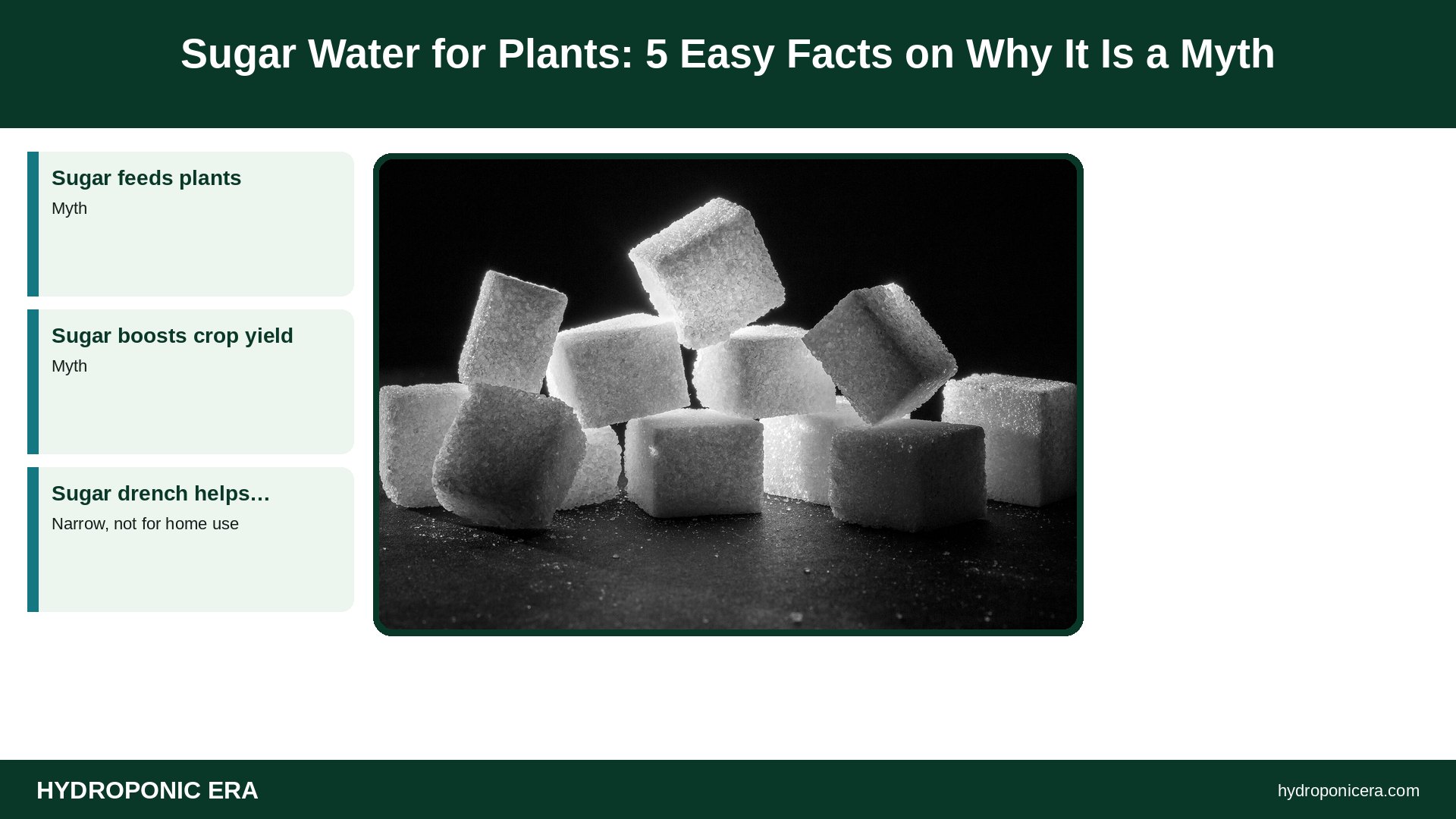
Why Do People Use Sugar Water for Plants?
People hope sugar water for plants works like energy for people: sweeter water, bigger growth. It seems logical, because sugar is the product of photosynthesis. But plants take in minerals and water through roots and make sugar in leaves. Adding sugar to the soil does not replace light or nutrients.
The idea spreads because it is cheap and easy. Cut flowers do use sugar in vase solutions, but that is a different case because cut stems have no roots or ongoing photosynthesis to support them.
What Does Research Say About Sugar Water for Plants?
Extension sources agree that sugar water for plants is not a fertilizer. University of Minnesota Extension, University of Illinois Extension and the Missouri IPM program all discuss sugar as a gardening myth or not-a-fertilizer. University of Nebraska CropWatch reports crop research with sugar applications found no yield increase.
One exception: a 2004 study in the Journal of Arboriculture and Urban Forestry found a sugar drench improved root vigor in some transplanted trees. That is a specialized setting, not a recommendation for lawns, vegetables or houseplants.
What Happens When You Use Sugar Water for Plants?
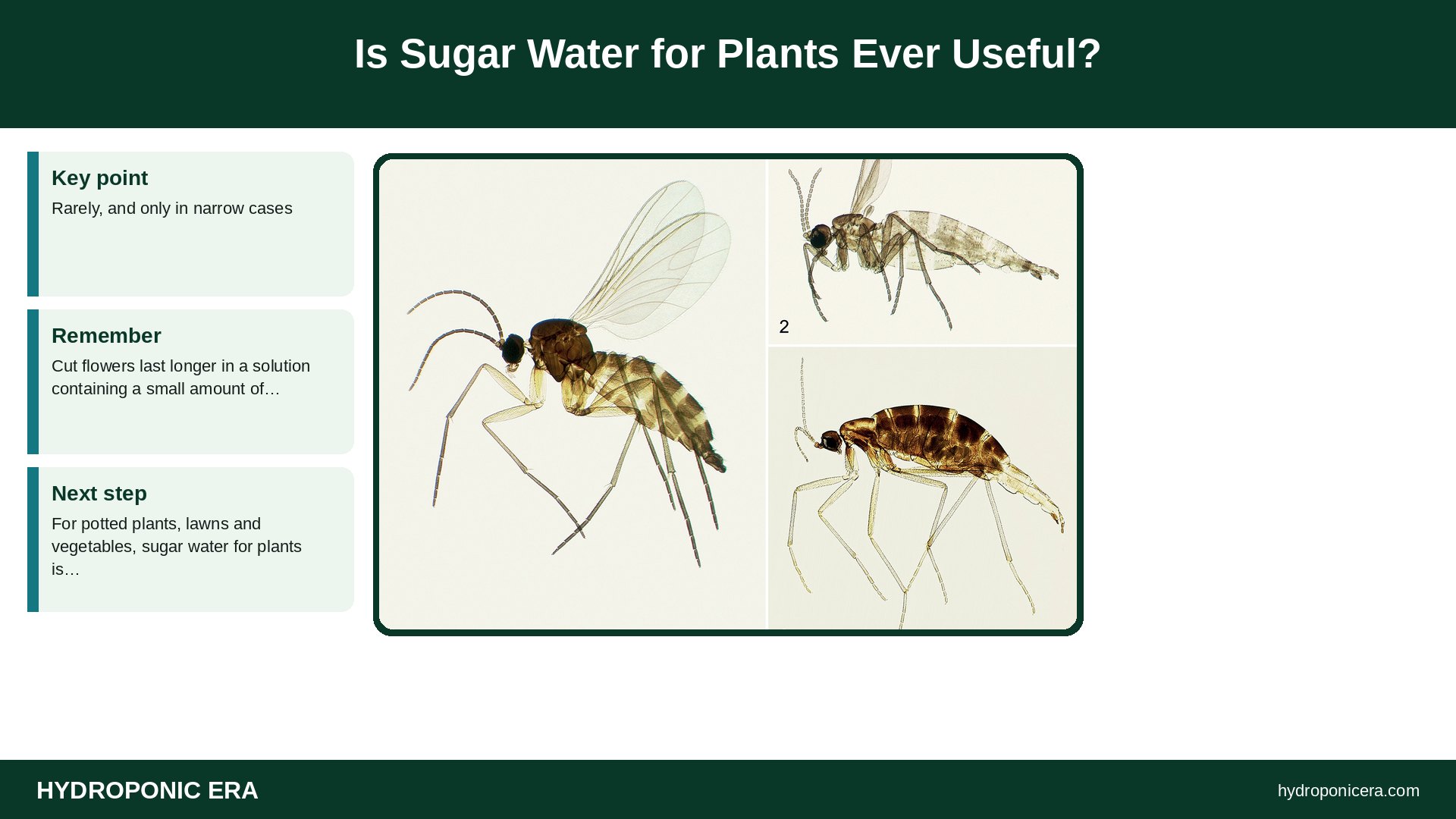
Sugar feeds microbes before it feeds plants. Soil bacteria and fungi grow quickly on sugar and use nitrogen as they do, which can leave less for roots. Sugar residue also attracts ants and flies and can encourage rot. In a pot or reservoir the effects show up faster than in a garden bed.
- Microbial blooms: bacteria and fungi multiply on sugar.
- Nitrogen tie-up: microbes use available nitrogen.
- Pests: ants, fungus gnats and flies are drawn to sweet residue.
- Odor and rot: sugary soil can sour in pots.
Sugar in a hydroponic reservoir is especially risky. Our guides to Pythium root rot and fungus gnats explain what happens when organic matter and moisture combine.
Is Sugar Water for Plants Ever Useful?
Rarely, and only in narrow cases. Cut flowers last longer in a solution containing a small amount of sugar and an acidifier, because stems no longer make sugar. For potted plants, lawns and vegetables, sugar water for plants is not a recommended practice.
What Should You Use Instead of Sugar Water for Plants?
Use real fertilizer, good light and the right water. A balanced fertilizer supplies nitrogen, phosphorus and potassium, and compost builds soil organic matter. In hydroponics, use a complete nutrient and track pH and EC. Our guide to EC and TDS explains how to measure strength.
- Check light first, since low light is the most common growth limit.
- Test soil or water pH and EC.
- Feed with a labeled fertilizer at label rates.
- Improve soil with compost rather than sugar.
- Change one thing at a time, and watch for results.
See hydroponic nutrients for seedlings for gentle starting feeds.
Does Sugar Water for Plants Help Cuttings or Wilted Plants?
No reliable evidence supports it. A wilted plant needs water, shade and time, not sugar. Cuttings root from stored energy in the stem and from light on the leaves. Extension answers on honey and sugar rooting say they are not rooting hormones. Use clean tools and clean water, and keep cuttings humid, as in our humidity dome guide.
How Does Sugar Water for Plants Affect Soil Microbes and Nitrogen?
Microbes use sugar as fast fuel. When you pour sugar water for plants onto soil, bacteria and fungi multiply and take up nitrogen to build their own bodies. That temporary tie-up leaves less nitrogen for roots, so plants can look pale or grow slowly. Over time microbes die back and release nitrogen again, but the plant may suffer in the meantime.
This is why sugar in pots and hydroponic reservoirs is a bad idea. Containers have little buffering, so a sugar-fed microbe bloom can foul the root zone in days. Smells, slime and gnats are common signs that something went wrong.
What Mistakes Should You Avoid With Sugar Water for Plants?
- Do not add sugar to hydroponic reservoirs or drip lines, where it can clog and spoil.
- Do not use sugar to revive a wilted plant. Check roots, water and light first.
- Do not mix sugar with fertilizer hoping to boost it.
- Do not leave sugary water in saucers, where it can sour and attract flies.
If you tried it and see mold, a sour smell or gnats, flush the pot with plain water, remove the top layer of soil if needed and let it dry between waterings. Replace the soil if the smell persists.
A better habit is to keep notes on what you feed and when, and to change only one thing at a time. That way, if a plant improves or declines, you know the reason.
FAQ About Sugar Water for Plants
Can I feed my houseplants sugar water?
No. It does not feed plants and may attract pests or cause rot.
Does sugar water make plants grow faster?
No evidence supports this. Crop trials found no yield increase.
Does sugar water help cut flowers?
A small amount of sugar in vase solution can help, because cut stems cannot make their own.
Can sugar water kill plants?
It can harm them indirectly by feeding microbes, tying up nitrogen and encouraging rot.
What is the best plant food?
A balanced fertilizer, used at label rates, with good light and the right pH.
Sources
- University of Minnesota Extension — Can sugar help my lawn or garden?
- University of Illinois Extension — Are you falling for these gardening myths?
- Missouri IPM — Gardening myths
- University of Nebraska CropWatch — Research on sugar application to crops
- Photo credits (Wikimedia Commons, edited with titles): Würfelzucker — 2018 — 3564 by Dietmar Rabich (CC BY-SA 4.0); Woman with watering can, Dent de Man by FBilula (CC BY-SA 4.0); Sciaridae (10.3897-zookeys.957.46528) Figures 1–3 by Menzel F, Gammelmo Ø, Olsen KM, Köhler A (2020) The Black Fungus Gnats (Diptera, (CC BY 4.0); 5670Farm Ready Seedling Facility East West Seed Philippines 20 by Judgefloro (CC0)