
Is vinegar for plants safe? Vinegar for plants is safe only as a weed killer on unwanted growth, not as a plant food or watering additive. Household vinegar is about 5% acetic acid and burns leaves on contact but rarely kills roots. Stronger horticultural vinegar is nonselective and can injure eyes, skin and desirable plants.
Key takeaway: Vinegar for plants works as a contact weed burner on small, young weeds, not as a fertilizer or a cure for pests. It burns any green tissue it touches, roots often regrow, and strong vinegar is hazardous to eyes and skin.
| Use | Verdict | Why |
|---|---|---|
| Household 5% vinegar on weeds | Weak, short-lived | Burns top growth, roots regrow |
| Horticultural vinegar 10–30% | Stronger, but hazardous | Nonselective, wear eye protection |
| Watering desirable plants | Do not | Acid injury to roots and leaves |
| Cleaning tools and pots | Reasonable | Rinse well afterward |
What Does Vinegar for Plants Actually Do?
Vinegar for plants works by burning leaf tissue with acetic acid. It is a contact herbicide, meaning it damages only the plant parts it touches. UC ANR describes vinegar as a nonselective contact herbicide that must touch the foliage, does not travel through the plant and breaks down quickly without leaving residue, so deep-rooted weeds often regrow.
It does not feed plants, cure fungus or reliably repel pests. Treat it as a spot treatment for young weeds in cracks and paths, not as a garden-wide solution.
Does Household Vinegar Kill Weeds?
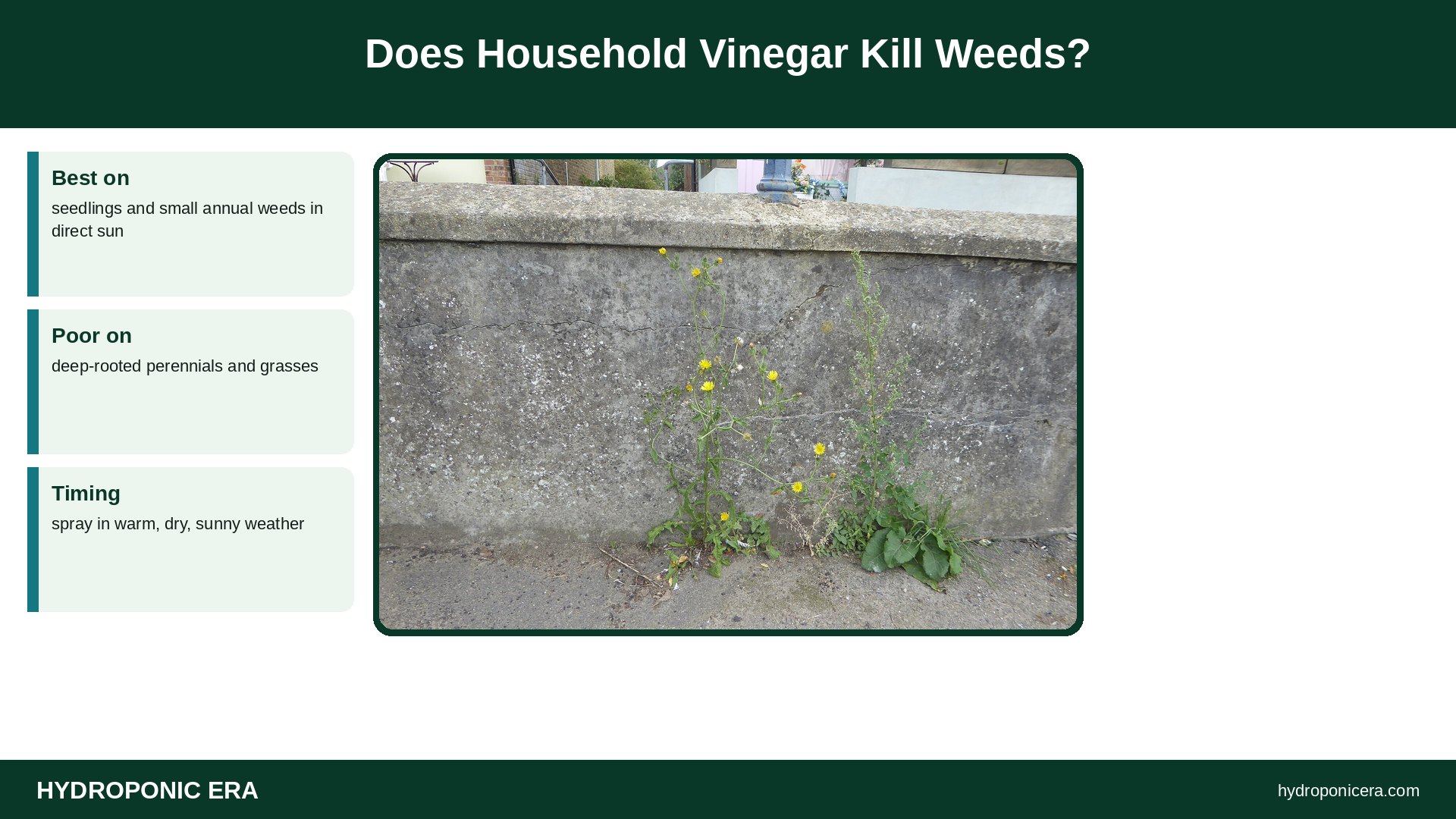
Household vinegar, about 4–8% acetic acid, burns small, young weeds but is often too weak for established ones. Because it only damages what it touches, perennial weeds can regrow from roots. Repeated applications may be needed, and results depend on sun, weed size and spray coverage.
- Best on: seedlings and small annual weeds in direct sun.
- Poor on: deep-rooted perennials and grasses.
- Timing: spray in warm, dry, sunny weather.
- Limits: it will also burn any plant it hits.
Is Horticultural Vinegar Better, and Is It Dangerous?
Horticultural vinegar (10–30% acetic acid per WSU, typically 20% or more per UC ANR) works faster than household vinegar but is hazardous. UC ANR and WSU warn that strong vinegar can permanently damage eyes and burn skin, and WSU notes it carries a danger label. Wear goggles, gloves and long sleeves, keep children and pets away, and read the product label, since it is regulated as a herbicide.
Even stronger vinegar rarely kills roots of perennial weeds. Check labels for allowed sites, and do not use it near vegetables or ornamentals you want to keep.
How Do You Use Vinegar for Plants as a Weed Spray?
- Pick a dry, sunny, calm day with no rain forecast.
- Put the vinegar in a dedicated sprayer, and label it.
- Wear eye protection and gloves.
- Spray only the weed, avoiding nearby plants and soil edges.
- Check after a day, and reapply to regrowth.
- Rinse the sprayer afterward.
Pulling weeds or mulching is often a better first choice. See our guide to growing media for soil and bed basics.
Can You Water Plants With Vinegar?
No. Using vinegar for plants as a watering additive can burn roots and leaves and disturb soil life. Some sources suggest tiny amounts to lower pH, but it is unreliable and hard to control. Test your water and soil, and use a proper pH adjuster if needed. Our guide to fixing high pH in hydroponics covers safer methods.
Does Vinegar for Plants Kill Pests or Fungus?
Not reliably. Vinegar appears in homemade spray recipes, but UConn’s guidance on homemade pesticides cautions that these recipes are unproven and can injure plants. For pests, use labeled products such as insecticidal soap or neem oil, and follow the label.
What Are Safer Alternatives to Vinegar for Plants?
Instead of vinegar for plants, use hand pulling, mulch, boiling water on cracks or a labeled herbicide. For plant care, use proper fertilizer and good water. For tool cleaning, vinegar is a reasonable rinse for mineral deposits on pots, but rinse thoroughly before planting. Always store vinegar sprayers away from edible crops and label them clearly.
Why Is Natural Not the Same as Safe With Vinegar for Plants?
Vinegar is food, but strong acetic acid is a corrosive chemical. UC ANR reminds gardeners that natural does not mean safe, and that the higher the concentration, the greater the risk. Concentrated vinegar can irritate the nose, throat and lungs if vapors are inhaled, so spray outdoors, in calm weather, and never leave a sprayer or bottle in an unlabeled container.
Horticultural vinegar is also sold as a pesticide, which means label directions are the rule. WSU notes that it is made industrially and carries a danger label, unlike kitchen vinegar. Store it away from children and pets, and keep a dedicated sprayer so no residue ends up on edible plants.
What Weeds Respond Best to Vinegar for Plants?
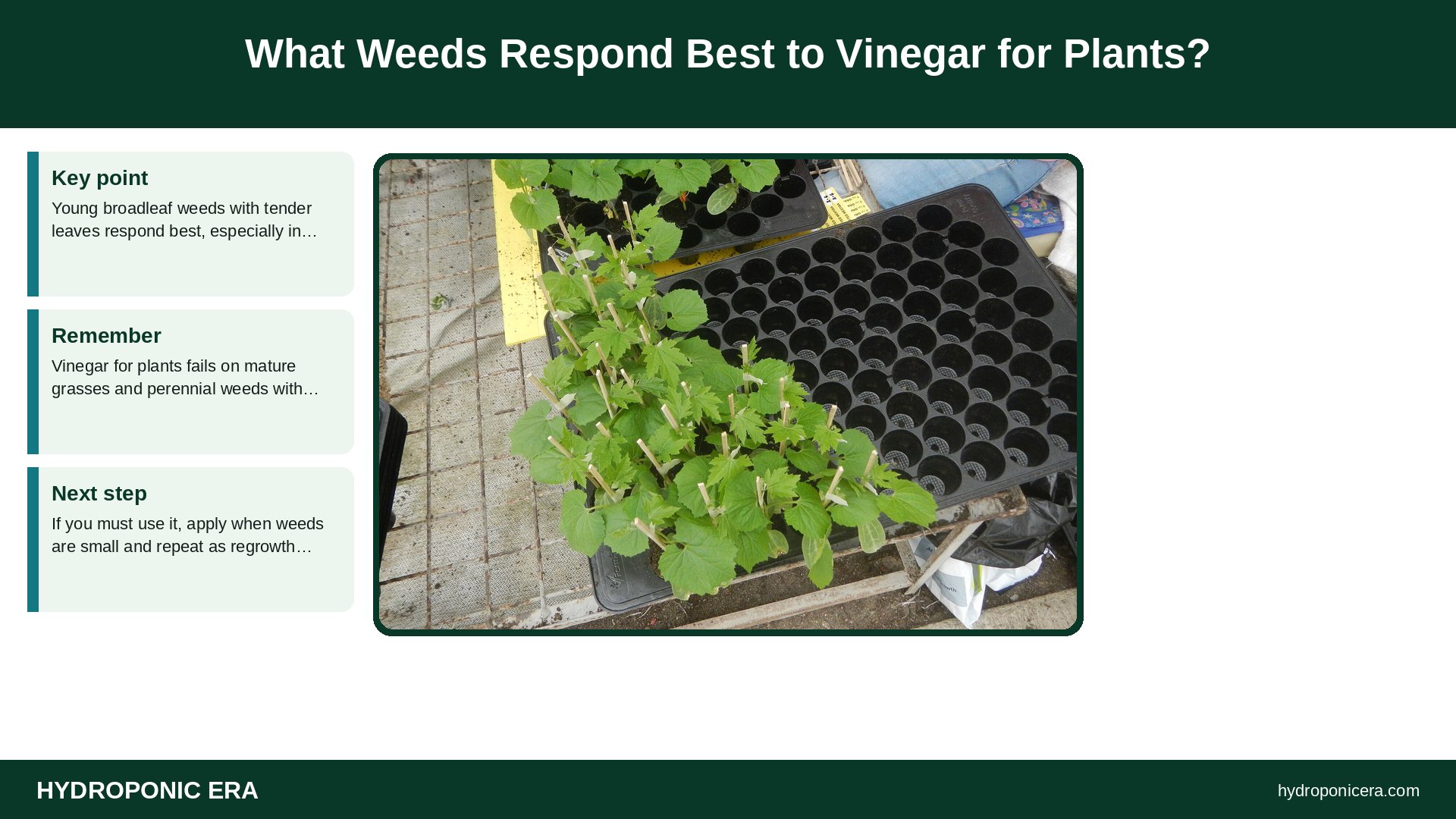
Young broadleaf weeds with tender leaves respond best, especially in cracks, gravel and paths in full sun. Vinegar for plants fails on mature grasses and perennial weeds with deep roots, such as bindweed or dandelion, which recover. If you must use it, apply when weeds are small and repeat as regrowth appears, or pull them out by hand after a rain when the soil is soft.
- Spot-spray weeds in pavement cracks and gravel.
- Avoid beds with desirable plants, since vinegar burns any green tissue.
- Do not use it to kill trees, shrubs or vines.
- Combine with mulch to prevent new weeds.
For lawn and garden beds, a thick layer of mulch and regular hoeing work better long term than vinegar for plants, with fewer risks. Simply put, vinegar for plants is a short-term spot tool, not a garden program.
FAQ About Vinegar for Plants
Will vinegar kill weeds permanently?
Usually not. It burns top growth, and many weeds regrow from roots.
Is vinegar safe around pets?
Wait until it dries, and keep pets away during spraying.
Can I spray vinegar on houseplants?
No. It can burn leaves and is not a pest or disease cure.
How strong is horticultural vinegar?
Typically 10–30% acetic acid, much stronger than the 5% kitchen type.
Does vinegar make soil acidic?
Any change is small and short-lived. Test your soil before adjusting.
Sources
- WSU Extension, Yakima County — Salt and vinegar
- UConn Extension — Homemade pesticides
- University of Maryland Extension — Vinegar: an alternative to glyphosate?
- UC ANR — Can I use vinegar to control weeds?
- Photo credits (Wikimedia Commons, edited with titles): Chris Makrenos, Vinegar and Oil Bottle, c. 1939, NGA 22972 by Chris Makrenos (CC0); Helminthotheca echioides pavement by Alex Lockton (CC BY-SA 4.0); Neem oil plant by Ayyuha Sideeq (CC0); 5670Farm Ready Seedling Facility East West Seed Philippines 20 by Judgefloro (CC0)