
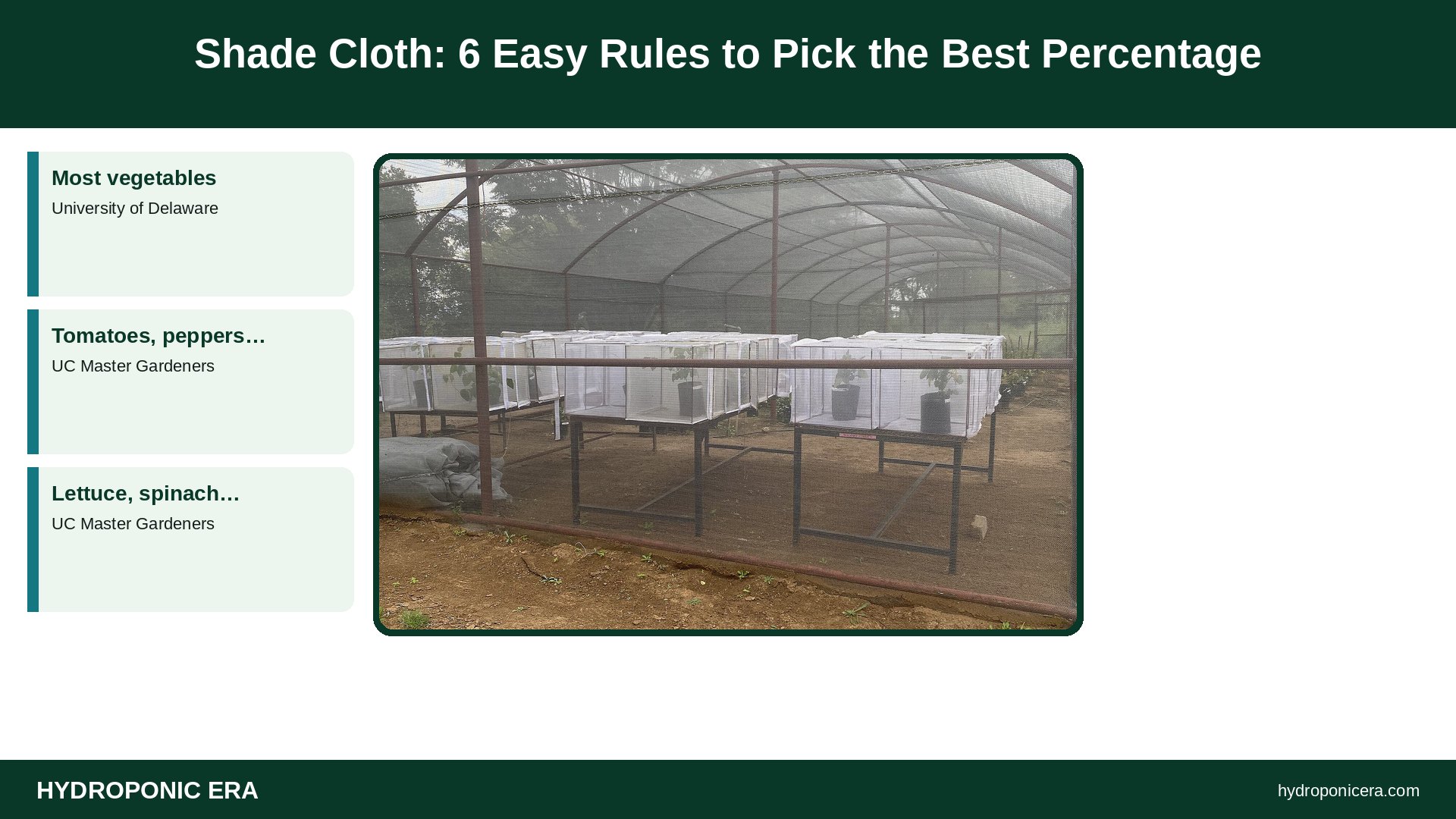
What shade cloth percentage is best for vegetables? For most vegetables, a 30% shade cloth is the best starting point. University of Delaware Extension recommends 20–40% for vegetable crops, with about 30% the most common choice. Lettuce, spinach and seedlings handle 50–60% in hot weather, while tomatoes and peppers do better with 20–40%. Use a frame.
Key takeaway: Shade cloth is a balance. Block enough sun to cut heat stress, bolting and sunscald, but not so much that growth slows. Pick the percentage by crop, support it on hoops with airflow underneath, and remove it in cool weather.
| Crop or use | Shade cloth % | Source |
|---|---|---|
| Most vegetables | 20–40% (about 30% common) | University of Delaware |
| Tomatoes, peppers, fruiting crops | 20–40% | UC Master Gardeners |
| Lettuce, spinach, seedlings | 50–60% | UC Master Gardeners |
| Very heat-sensitive lettuce | 50–70% | University of Delaware |
| Cool-season crops through summer | 30–50% | K-State Extension |
What Does Shade Cloth Do for Plants?
Shade cloth blocks part of the sunlight and heat reaching your crop. UC Master Gardeners of Contra Costa County say it can lower temperatures, reduce heat stress, prevent sunburn, cut evaporation and water needs, and extend the growing season. K-State Extension adds that it helps cool-season crops avoid scalding, bolting and bitter flavor in summer.
For hydroponic growers, shading also helps keep reservoirs and channels cooler, which protects dissolved oxygen around roots. Pair it with the tips in our hydroponics in hot climates guide and our article on heat stress and cold stress in indoor hydroponics.
What Do Shade Cloth Percentages Mean?
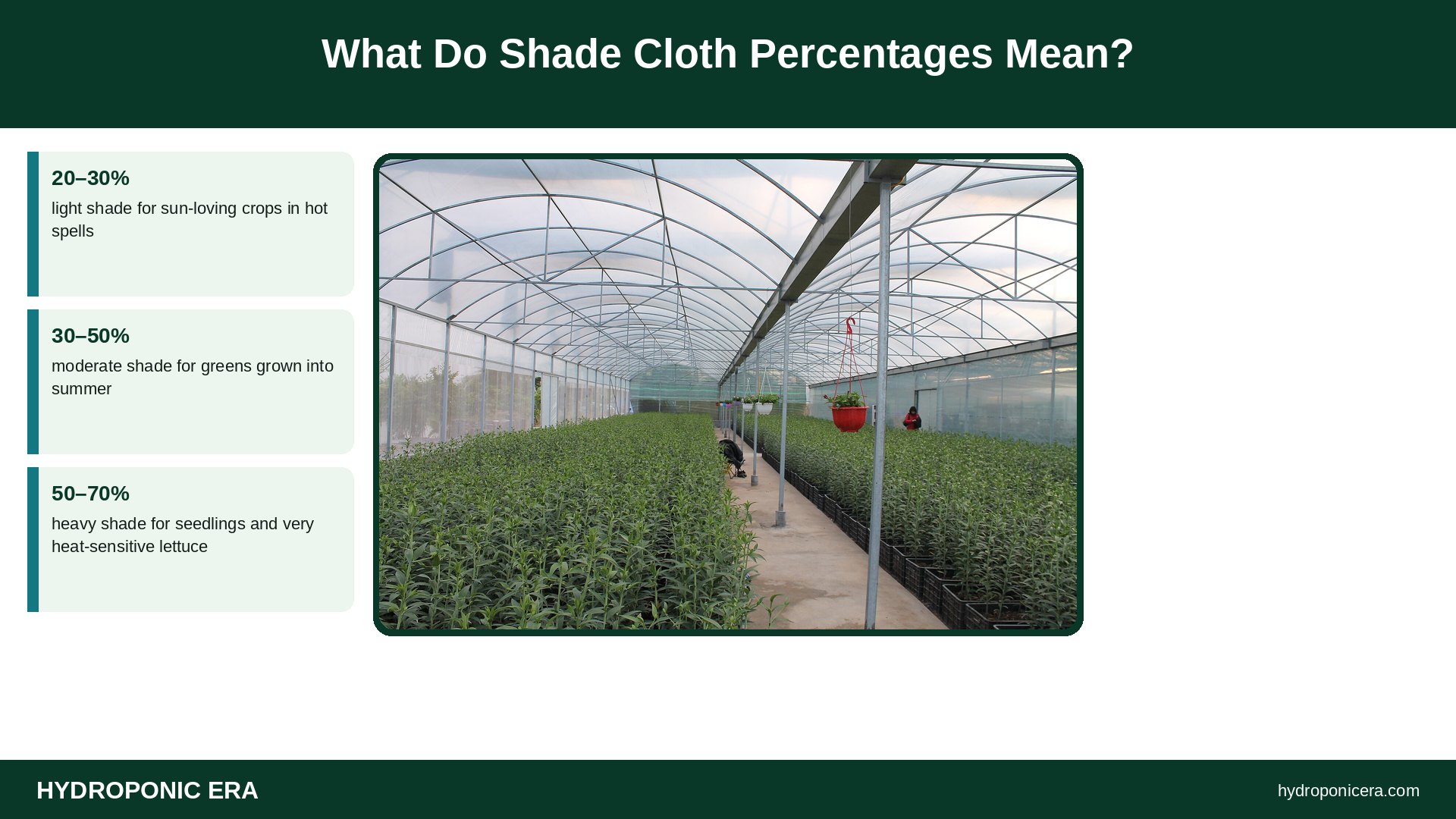
The percentage is how much sunlight the fabric blocks. UC Master Gardeners explain that a 30% cloth reduces sunlight by 30% and lets 70% of the sun’s rays through. Products range from about 20% to 90%. Higher numbers give deeper shade, but they also reduce light for photosynthesis, so more is not always better.
- 20–30%: light shade for sun-loving crops in hot spells.
- 30–50%: moderate shade for greens grown into summer.
- 50–70%: heavy shade for seedlings and very heat-sensitive lettuce.
- 70–90%: mostly for shade-loving ornamentals and people spaces.
Which Shade Cloth Percentage Is Best for Lettuce and Greens?
Lettuce, spinach and seedlings usually do best under 50–60% cloth in hot weather, according to UC Master Gardeners. University of Delaware Extension notes that 50–70% is sometimes used for very heat-sensitive crops like lettuce. K-State Extension suggests 30–50% for most cool-season crops carried through summer. Start lower in mild climates and higher where afternoons pass 90°F (32°C).
Shade alone will not stop bolting if the root zone overheats. Read our lettuce bitterness and bolting timeline and spinach bolting guide for variety and temperature tips.
Which Shade Cloth Percentage Is Best for Tomatoes and Peppers?
Use a 20–40% cover for tomatoes, peppers and other fruiting crops. UC Master Gardeners recommend that range for sun-loving plants, and University of Delaware Extension found that a 30% cloth gave adequate cooling without blocking too much light for most vegetables. Delaware’s Weekly Crop Update also notes research showing shade can improve pepper and tomato quality in hot periods.
Fruit crops need strong light to set and ripen fruit, so heavy shade often lowers yield. Use shade during heat waves, then roll it back when temperatures ease. A simple rule is to shade only during the hottest weeks, usually midsummer, and leave fruiting plants in full sun the rest of the season. Watch for flower drop, which often signals heat stress rather than too little light.
Does Shade Cloth Color Matter?
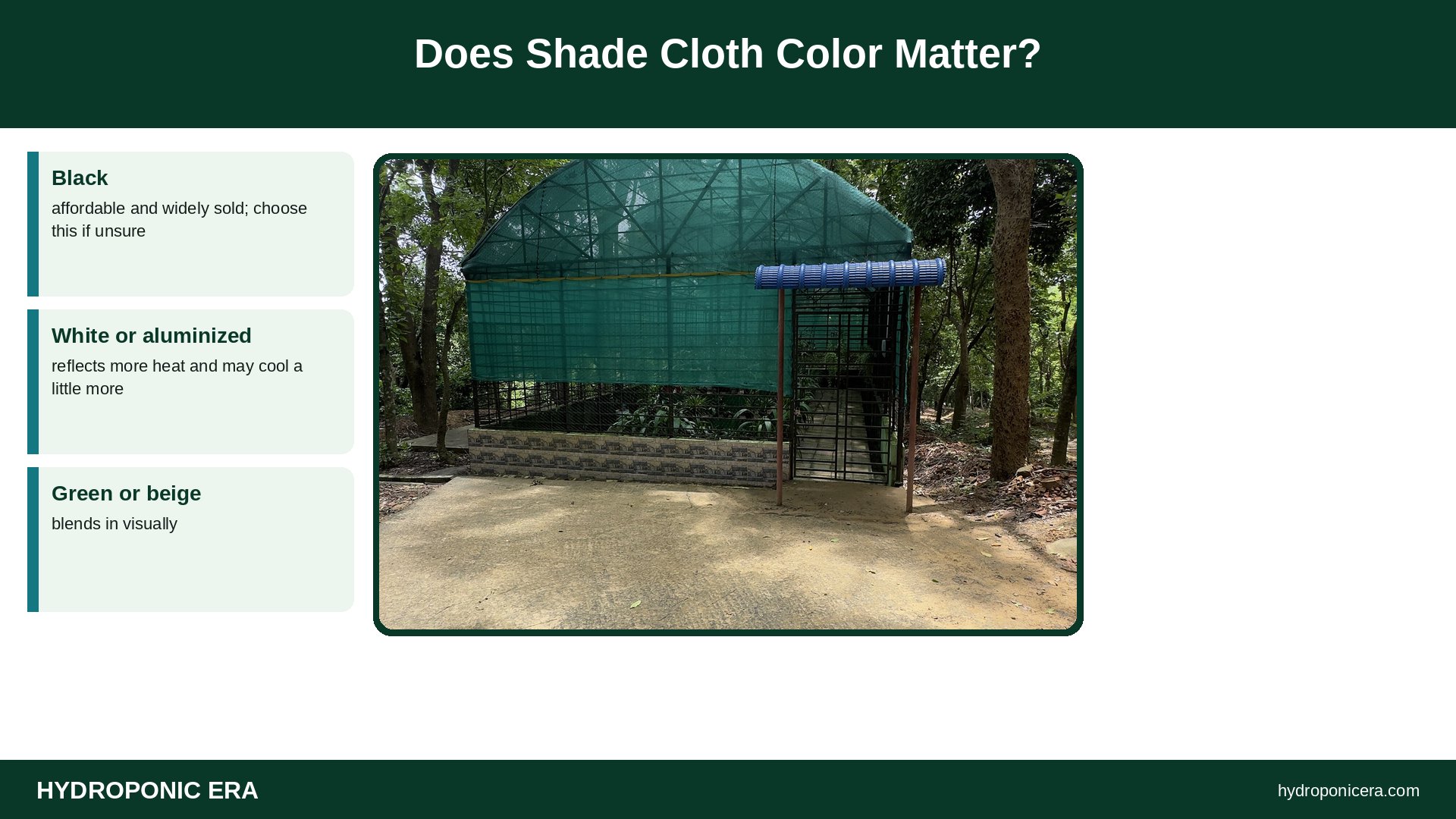
For most home vegetable growers, color matters less than percentage. University of Delaware Extension reports that in its experiments, red, silver, white and blue fabrics offered no advantages over black, which is usually the least expensive. Its Weekly Crop Update notes that white or aluminized fabric may offer additional cooling, and black and green are the most common colors.
- Black: affordable and widely sold; choose this if unsure.
- White or aluminized: reflects more heat and may cool a little more.
- Green or beige: blends in visually.
- Red or blue: marketed for specific crops, with limited home-garden benefit.
How Do You Install Shade Cloth Over Plants?
Hang shade cloth on a support, never directly on the plants. K-State Extension warns that cloth lying on plants can break limbs or smother them, and suggests low tunnel hoops. UC Master Gardeners describe PVC hoops, sails between poles or a frame made from fencing or cages. Secure the edges so the cloth cannot flap and damage plants.
- Measure the bed or system and add extra length for the sides.
- Build hoops or a frame high enough to keep cloth off the leaves.
- Drape the cloth and fasten it with clips, zip ties, twine or bungee cords.
- Leave the sides open or raised for airflow.
- Weigh edges with bricks or sandbags rather than tearing staples.
- Remove or open the cover for watering, harvest and cool days.
In a greenhouse, cloth can also go over the roof. Delaware’s Weekly Crop Update notes it can be placed over the plastic of a high tunnel in summer, and over cold frames or low tunnels too. See our hydroponic greenhouse for beginners guide.
Common Shade Cloth Mistakes
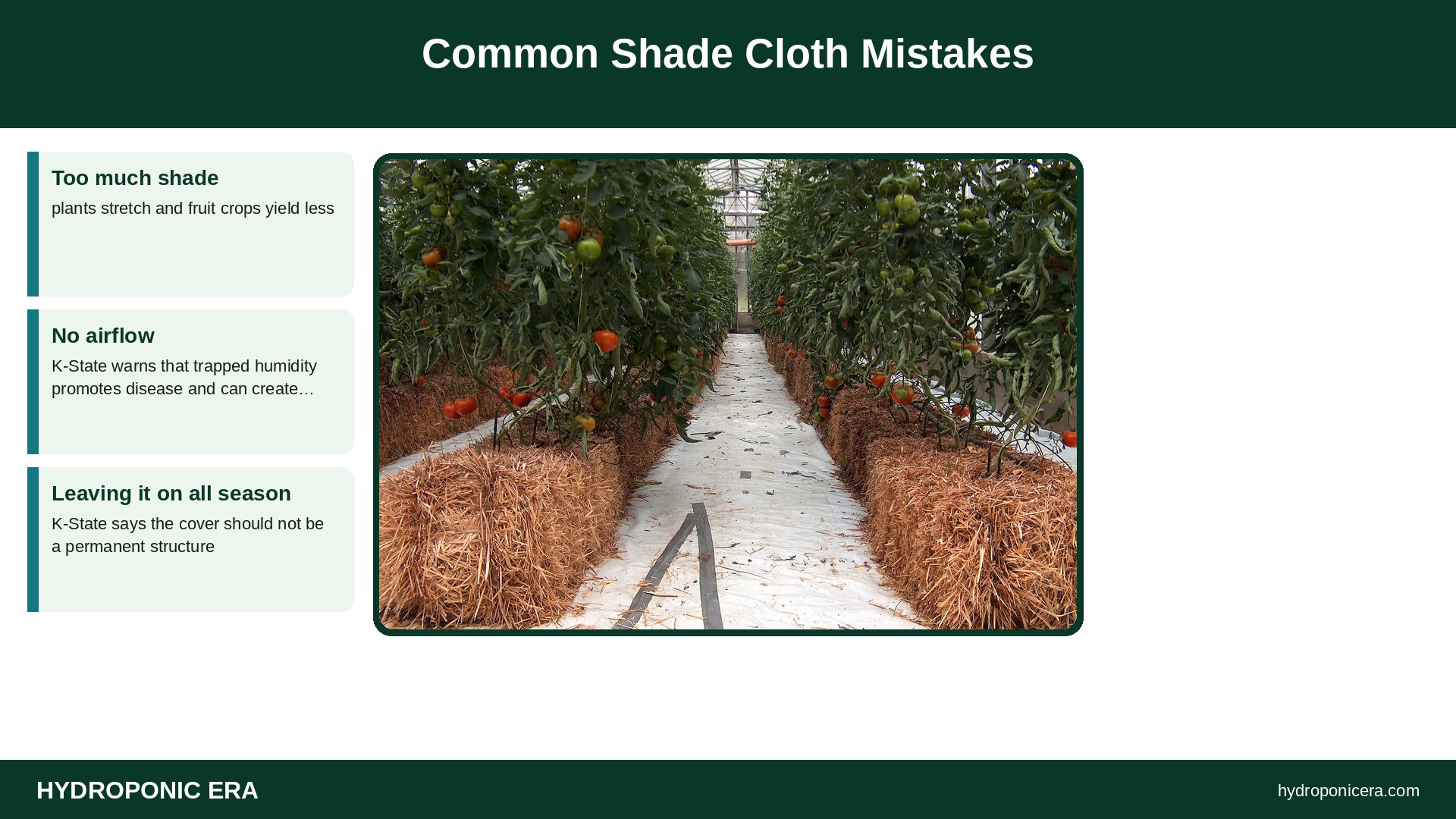
- Too much shade: plants stretch and fruit crops yield less.
- No airflow: K-State warns that trapped humidity promotes disease and can create sauna conditions.
- Leaving it on all season: K-State says the cover should not be a permanent structure.
- Loose edges: flapping fabric whips and damages leaves.
- Ignoring water temperature: shade the reservoir too, or use a hydroponic reservoir chiller.
Check plants under the cover every few days. If stems lengthen and leaves pale, switch to a lighter percentage.
FAQ About Shade Cloth
Is 50% shade cloth too much for tomatoes?
Usually yes. UC Master Gardeners suggest 20–40% for tomatoes and peppers.
What does 30% shade cloth mean?
It blocks 30% of sunlight and lets 70% through.
Is black or white shade cloth better?
Delaware found colors gave no advantage over black; white may cool slightly more.
Can shade cloth stop lettuce bolting?
It helps by lowering heat, but pick bolt-resistant varieties too.
When should I remove shade cloth?
When heat eases, and during watering and harvest, per K-State.
Sources
- University of Delaware Cooperative Extension — Protecting garden vegetables from heat stress
- UC Master Gardeners of Contra Costa County (UC ANR) — Beat the heat with shade cloth
- University of Delaware Weekly Crop Update — Shadecloth for hot season vegetable and fruit production
- K-State Research and Extension, Johnson County — Using shade cloth
- Photo credits (Wikimedia Commons, edited with titles): Net shade in Sebele by Chandapiwa Malema (CC BY-SA 4.0); Net house by vi:User:Goodmorninghpvn (CC BY-SA 3.0); Greenhouse orchid nursery shed, Sitakunda Eco Park by Sultan Sunnny (CC BY-SA 4.0); Hydroponic g12 by Giancarlo Dessì (CC BY-SA 3.0)