
Quick Answer: algae in hydroponic reservoirs
Algae in hydroponic reservoirs grows when nutrient-rich water meets light. It is usually more of a maintenance and oxygen problem than a “disease,” but heavy blooms can compete for nutrients, clog pumps and filters, swing pH, and reduce dissolved oxygen that roots need. The most reliable prevention is simple: block light from the reservoir and tubing, keep the system clean, manage nutrient strength and water changes, and maintain cool, well-aerated solution. Treat visible algae as a signal to fix light leaks and hygiene—not only to scrub the green film.
For algae in hydroponic reservoirs, pair light-proofing with calm reservoir change habits, steady pH management, and root checks from the brown roots troubleshooting guide.
Key Takeaways
- Algae needs light + water + nutrients. Remove light from the reservoir and you remove the main fuel for blooms.
- Green film on walls, cloudy green water, slippery tubing, and clogged air stones are common early signs.
- Heavy algae can raise daytime pH, lower nighttime oxygen, and make EC/pH readings harder to interpret.
- Opaque lids, light-proof reservoirs, covered channels, and dark tubing matter more than “algae killer” products for beginners.
- Clean on a schedule. Biofilm and leftover organic debris feed ongoing growth.
- Warm, stagnant, overfed solution makes algae worse—and also stresses roots.
- If roots smell foul or turn brown while algae is present, prioritize oxygen, temperature, and hygiene—not bleach shortcuts on living plants.
Related HydroponicEra guides
- How often to change hydroponic water
- How to control pH in hydroponics
- How to use hydroponic nutrients
- Why hydroponic roots turn brown
- Deep water culture for beginners
- Hydroponic system for beginners
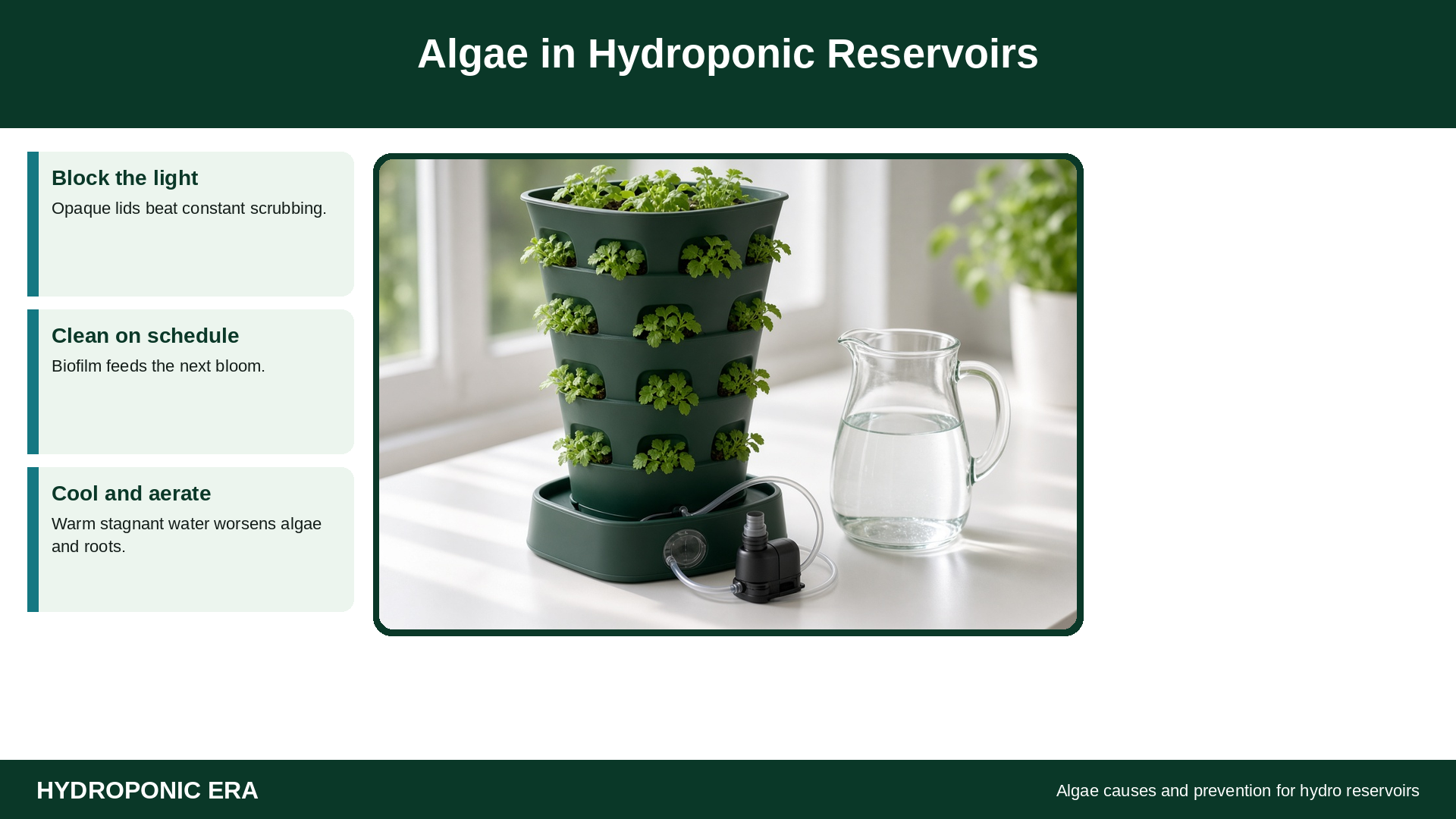
What algae in hydroponic reservoirs actually does
Algae in hydroponic reservoirs are simple photosynthetic organisms. In a hydroponic reservoir they behave like tiny green plants: when light reaches nutrient solution, they multiply. A thin green film on the waterline is common in beginner systems that use clear tubs, open lids, or translucent tubing under grow lights.
Algae itself is not the same as root rot. University of Florida IFAS notes that high solution temperature and low oxygen in hydroponic solution culture can contribute to serious root problems such as Pythium pressure in leafy greens. Algae blooms often show up in the same “warm, bright, nutrient-rich water” conditions that also stress roots—so treat algae as a systems warning light.
What algae can do in practice:
- Compete for nutrients and make EC trends noisier
- Clog air stones, filters, drip emitters, and pump intakes
- Create biofilm that harbors more organic mess
- Swing pH as photosynthesis and respiration change through day and night
- Reduce oxygen availability indirectly when biomass decays or when warm water already holds less oxygen
When algae in hydroponic reservoirs is present, Oklahoma State University Extension emphasizes that hydroponics allows closer control of nutrient content, pH, and the growing environment—and highlights faster growth when more oxygen is available in the root area. Keeping the reservoir dark and clean supports that oxygen-focused root zone.
8 causes of algae in hydroponic reservoirs

- Light reaching the nutrient solution — Clear reservoirs, open lids, gaps around net pots, translucent tubing, and uncovered NFT channels are the top cause.
- Grow lights or sunlight on the tank — Even a small gap under an indoor LED can “feed” algae all day.
- Overly strong or frequently topped-up nutrients without water changes — More dissolved fertilizer means more food for algae once light is present.
- Warm reservoir temperature — Warm water speeds biology. Oklahoma State lists about 72–75°F (22–24°C) as an optimal water temperature band for nutrient solution management in its EC and pH guide.
- Stagnant zones — Corners with poor mixing let films establish.
- Dirty surfaces and leftover organic debris — Dead leaves, media dust, and old biofilm create footholds.
- Transparent or light-leaking plumbing — Clear vinyl lines under lights often turn green first.
- Infrequent cleaning between crops — A system that never gets a full scrub keeps inoculum ready for the next fill.
How to Prevent Algae (Step by Step)
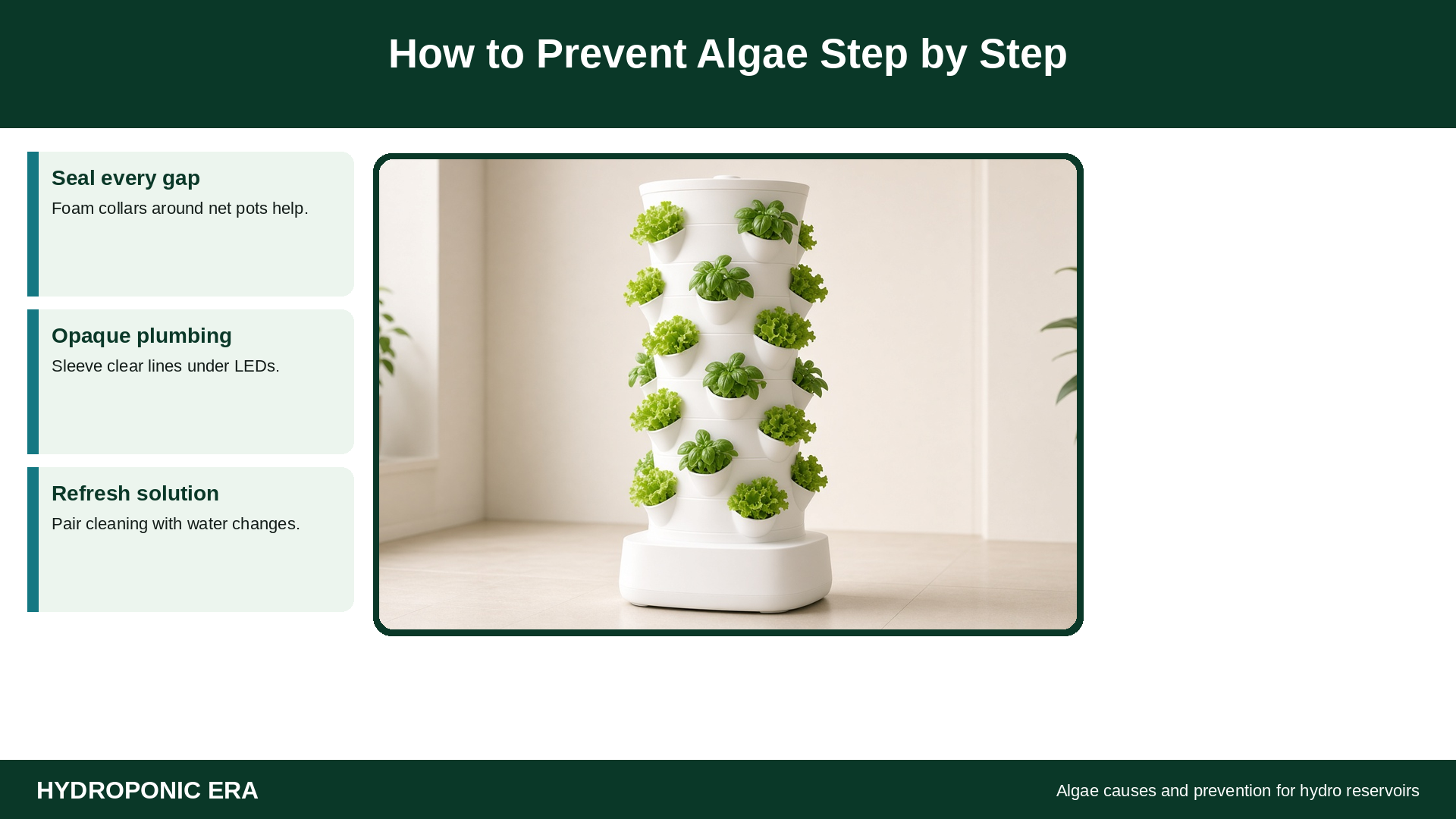
- Use an opaque reservoir with a tight, light-blocking lid. Paint or wrap clear bins if needed (food-safe exterior wrap; keep chemicals off the water).
- Cover every light gap around net pots, lids, and cable holes with foam collars, rubber grommets, or opaque tape on the outside.
- Switch to opaque tubing or sleeve clear lines where they pass under lights.
- Keep channels and towers shaded so nutrient films and return lines are not lit like a greenhouse aquarium.
- Mix and aerate so the solution stays moving. Oklahoma State describes water-culture systems that bubble nutrient solution to supply oxygen to roots.
- Feed at crop-appropriate strength. Follow your nutrient label and a calm nutrient mixing routine; avoid “more is better.”
- Change water on a schedule suited to reservoir size and crop demand—see the water-change guide.
- Clean between cycles: empty, scrub biofilm, rinse pumps and air stones, then refill with fresh solution.
Important Variables That Change Algae Risk
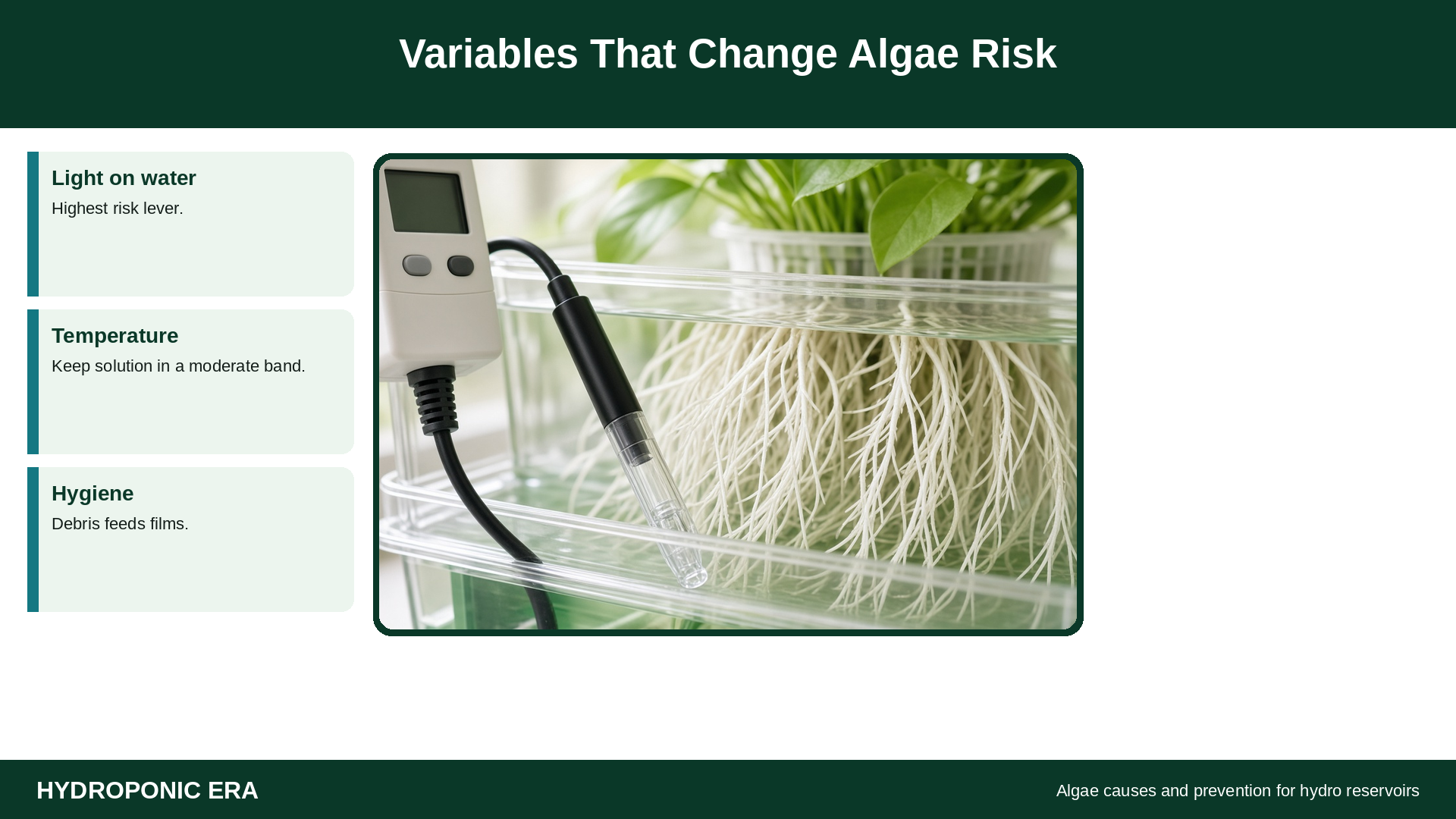
| Variable | Lower algae risk | Higher algae risk | What to check |
|---|---|---|---|
| Light on solution | Opaque tank + sealed lid | Clear bin, open top | Look for green under lids and in tubing |
| Reservoir temperature | Cooler band near ~72–75°F guidance | Warm room / uncooled tank | Thermometer in solution |
| Nutrient strength | Crop-appropriate EC | Chronic overfeeding | Meter + plant response |
| Hygiene | Regular scrub + rinse | Old biofilm left in place | Walls, air stone, pump intake |
| Circulation | Even mixing / aeration | Dead corners | Flow and bubble coverage |
| Organic debris | No fallen leaves in tank | Roots/leaves rotting in water | Skim and remove debris |
To prevent algae in hydroponic reservoirs, UF/IFAS guidance for small lettuce hydroponic systems recommends monitoring temperature, dissolved oxygen, and EC together—keeping solution roughly 65–80°F, aiming for about 5 mg/L dissolved oxygen, and an EC band around 1.2–1.8 mS/cm for that crop example. Those same monitoring habits help you notice algae-related swings early.
Algae Cleanup Checklist (When It Already Started)
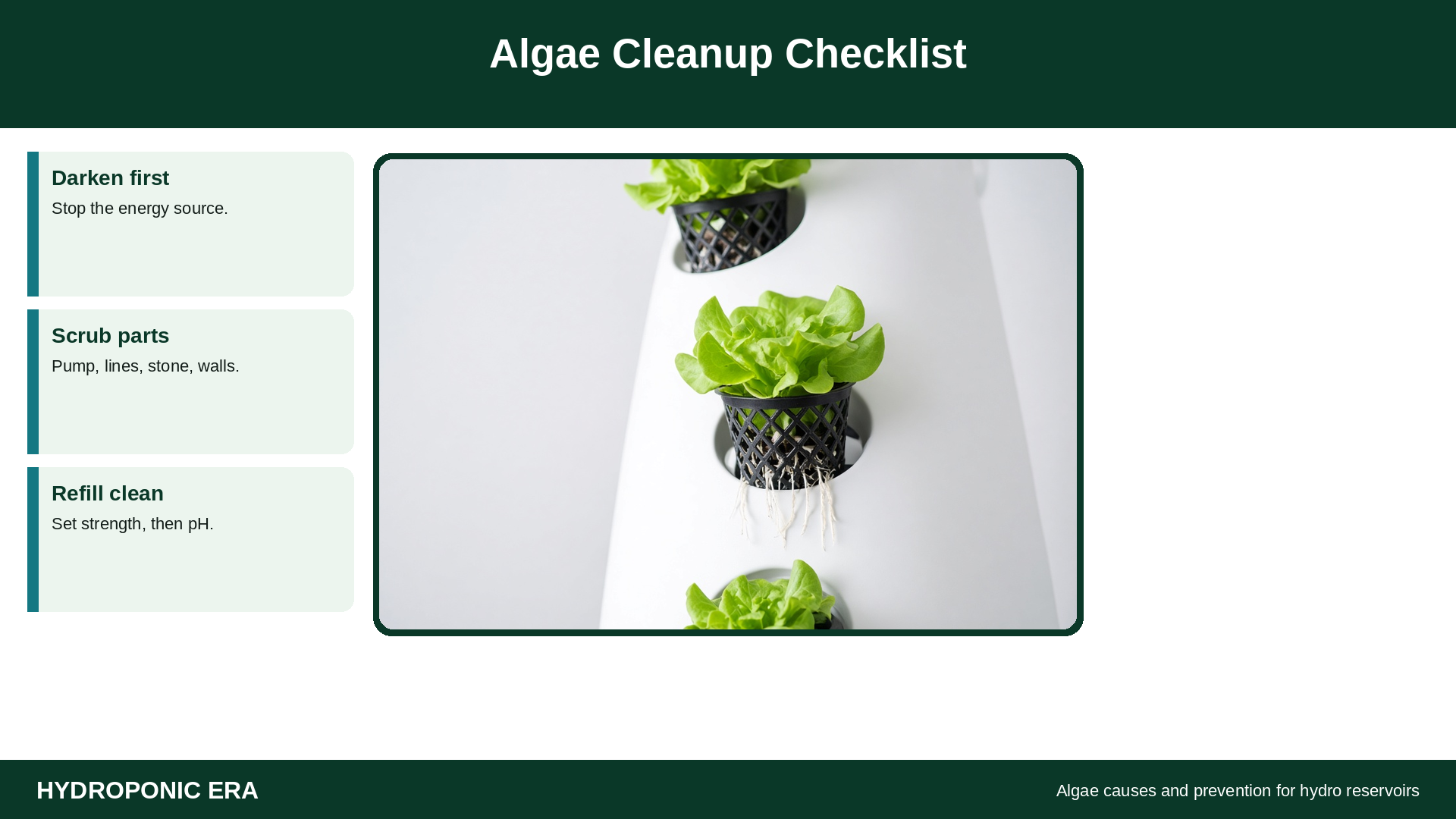
- Confirm plants are stable enough for a reservoir service (or plan a staged clean).
- Block light first so algae cannot rebound immediately after cleaning.
- Remove plants temporarily if you need a deep scrub (keep roots moist and shaded).
- Empty the reservoir and dispose of the old solution responsibly (do not pour concentrated nutrients into storm drains).
- Scrub walls, lid, pump, tubing, and air stones. Replace crumbling air stones.
- Rinse thoroughly so cleaner residue does not remain in the root zone.
- Refill with fresh water and nutrients, set strength, then set pH.
- Reinstall light-proofing and recheck for glowing gaps under your grow light.
Practical tip for algae in hydroponic reservoirs: For beginners, mechanical cleaning + light exclusion beats chasing specialty algaecides. If you ever use a sanitizer between crops, follow product directions and rinse completely before plants return.
Common Mistakes
- Clear “cute” reservoirs under bright LEDs — They turn into algae farms.
- Cleaning algae but leaving the light leak — The green returns in days.
- Dumping harsh chemicals on live roots — You can injure plants while chasing a cosmetic fix.
- Ignoring warm water — Algae and root pathogens both enjoy heat.
- Never replacing air stones — Clogged stones reduce oxygen and collect slime.
- Letting dead leaves sink — Organic debris feeds biofilm.
- Assuming algae means “add more nutrients” — Strength is rarely the first fix; light is.
Troubleshooting Table
| What you see | Likely issue | First checks | Calm next step |
|---|---|---|---|
| Green film on walls only | Light leak + biofilm | Lid gaps, translucent tank | Darken tank; scrub at next water change |
| Green water / cloudy bloom | Strong light on solution | Open top, clear tubing | Full clean + opaque covers |
| pH rises by day, falls at night | Photosynthetic activity | Algae presence, aeration | Remove light; increase monitoring |
| Clogged dripper / stone | Slime in plumbing | Lines, filter, air stone | Flush/replace parts; darken lines |
| Algae + brown/smelly roots | Low oxygen / heat / hygiene | Temp, aeration, root color | Follow brown-roots guide; cool and oxygenate |
| Algae after every refill | Persistent light or dirty parts | Same gaps each cycle | Fix hardware; sanitize between crops |
What to Check in Your Own System
For algae in hydroponic reservoirs, use this short evaluation before buying products:
- Lights out test: With the grow light on, look into the reservoir. Any glow on the water surface means algae still has an energy source.
- Plumbing check: Follow every clear line under the light path. Sleeve or replace sections that stay illuminated.
- Temperature check: Read solution temperature at the warmest time of day. If it runs hot, cool the room, raise the reservoir off a warm floor, or use a larger water volume for stability.
- Oxygen check: Confirm air pumps run continuously in DWC-style systems and that stones are not clogged with slime.
- Hygiene check: Note slime thickness on walls and whether fallen leaves are floating or sunk.
- Reading check: Log pH and nutrient strength for a few days. Wide daily swings plus green film often improve after light-proofing and a clean refill.
This checklist is a practical framework—not a laboratory diagnosis. If plants decline quickly (wilting, foul roots, sudden collapse), prioritize root oxygen and sanitation using the brown-roots guide while you correct algae conditions.
Prevention Hardware Upgrades Worth Doing Once
- Opaque reservoir + gasketed lid
- Foam collars on every net pot
- Black or wrapped return lines under lights
- In-line filter you can actually clean
- Spare air stone kept dry for swap-outs
- Simple notebook for clean/change dates
These upgrades help prevent algae in hydroponic reservoirs and cost less than repeatedly dumping ruined solution and replacing clogged pumps. They also support root oxygen goals because clean stones and dark tanks keep systems stable longer.
Field checklist: algae in hydroponic reservoirs this week
Use this short checklist to keep algae in hydroponic reservoirs from becoming a weekly scrub chore. Tick what you can verify with your eyes and hands—no lab required.
| Check | Pass looks like | Fail action |
|---|---|---|
| Reservoir light | No direct lamp/sun hit on nutrient surface or translucent walls | Add opaque lid, paint, or wrap; close gaps around net pots |
| Surface film | Clear water surface, no green slime on walls at waterline | Drain, scrub biofilm, rinse, refill with fresh solution |
| Aeration / movement | Visible ripple or bubbles; roots look pale/cream, not slimy | Verify air stone + pump; see dissolved oxygen guidance |
| Temperature feel | Solution not “bath warm” to the touch in a hot room | Shade tank, raise volume, or cool room/airflow |
| Filter / pump intake | No green clogging on strainer or airline | Clean intake; shorten dark hose runs if they grow film |
- Log date, what you scrubbed, and whether light leaks remain—patterns beat one-off panic cleans.
- Treat heavy blooms as a systems hygiene issue first, not as a random “disease spray” problem.
- If roots smell foul or look brown while algae is thick, prioritize root oxygen and a full clean over cosmetics.
algae in hydroponic reservoirs: habits that compound
These habits keep algae in hydroponic reservoirs practical between deep cleans and big changes.
- Keep notes when you work on algae in hydroponic reservoirs so small changes stay visible across weeks.
- Revisit algae in hydroponic reservoirs after any reservoir reset, media change, or heat wave.
- Teach one other person your algae in hydroponic reservoirs checklist—explaining it catches gaps.
- Photograph the system when algae in hydroponic reservoirs looks correct; compare when it does not.
- Do not chase products until the basic algae in hydroponic reservoirs habits are consistent.
- If results stall, re-read the troubleshooting section with algae in hydroponic reservoirs in mind.
algae in hydroponic reservoirs FAQs
Is algae harmful to hydroponic plants?
For algae in hydroponic reservoirs, light algae is often mostly a maintenance nuisance. Heavy blooms can compete for nutrients, clog equipment, destabilize pH, and appear alongside warm, low-oxygen conditions that stress roots. Fix light and hygiene early.
Does algae mean my nutrients are “organic” or contaminated?
Not necessarily. Standard mineral hydroponic nutrients plus light are enough for algae. Cleanliness still matters because debris makes films worse.
Can I use hydrogen peroxide for algae?
Some growers use dilute peroxide as a temporary tool, but strength and timing matter, and it is easy to overdo on living roots. For beginners, prioritize light-proofing and mechanical cleaning first.
Will a black reservoir stop algae completely?
It dramatically reduces risk if lids and plumbing are also dark. Any remaining light gap can still grow a local film.
Should I change water immediately when I see algae?
If the bloom is light, you can darken the system and clean at your next planned change. If water is pea-soup green, equipment is clogging, or roots look stressed, service the reservoir sooner.
Do NFT and DWC get algae equally?
Any system with lit nutrient surfaces can grow algae in hydroponic reservoirs. DWC reservoirs and uncovered NFT channels are common hotspots. Opaque covers help both.
A Simple Weekly Algae Audit
algae in hydroponic reservoirs — A weekly audit makes easier to prevent because small light leaks and cleaning problems are found before a bloom affects roots. Choose one day each week and record reservoir temperature, pH, EC, water level, and the condition of the lid, tubing, pump intake, and air stone. A short log turns vague worries into trends.
- Inspect in the dark: Look for glow through the tank, under net pots, around cable holes, or along return lines. Seal each leak from the outside with opaque, water-safe material.
- Check the solution: Measure temperature, pH, and EC with calibrated meters. Compare readings with crop stage. Sudden pH swings or unexplained EC changes deserve a light and hygiene check.
- Inspect circulation: Confirm pumps run reliably. Look for weak bubbles, clogged filters, slimy lines, and dead corners where water is not mixing. Clean worn parts between crop cycles.
Remove fallen leaves early, wipe accessible surfaces during a planned service, and review the log after each refill. If the same issue returns, fix the hardware or light path instead of repeatedly adding products. Prevention is usually cheaper and gentler than emergency treatment. If plants wilt, roots smell foul, or water turns cloudy, prioritize oxygen, temperature, sanitation, and a timely solution change; avoid untested chemicals on living roots.
Sources
- Oklahoma State University Extension — Electrical Conductivity and pH Guide for Hydroponics (solution temperature guidance; pH/EC management)
- Oklahoma State University Extension — Hydroponics (system types; oxygen in root area; pH 5.0–6.0 availability note)
- University of Florida IFAS — HS1279: Leafy Greens in Hydroponics and Protected Culture for Florida (high solution temperature and low oxygen concerns)
- University of Florida IFAS — HS1422: Growing Lettuce in Small Hydroponic Systems (monitor temperature, dissolved oxygen ≈5 mg/L, and EC)
- Penn State Extension — Hydroponics Systems and Principles of Plant Nutrition
14 thoughts on “Algae in Hydroponic Reservoirs: 8 Causes and How to Prevent Them”