
Is a bristlenose pleco good for aquaponics tanks? Yes, for small aquaponics or planted tanks. A bristlenose pleco (Ancistrus) is a small armored catfish that grazes algae and detritus, staying about 4–6 inches (10–15 cm) long. It needs warm, tropical water, driftwood or caves, and extra food. It is a cleanup fish, not a food fish.
Key takeaway: A bristlenose pleco is a hardy algae and detritus grazer for heated aquaponics and aquarium tanks. USGS gives the genus a size of about 6 inches (15 cm), and males guard eggs in caves. Feed it beyond leftover algae, give it hiding spots, and never release it, because armored catfish escape from the aquarium trade.
| Fact | Bristlenose pleco detail | Source |
|---|---|---|
| Genus | Ancistrus, about 50 described species | USGS |
| Size | About 6 in (15 cm); A. cirrhosus 3.6 in (9.1 cm) SL | USGS, FishBase |
| Diet | Algae and detritus | USGS, FishBase |
| Climate | Tropical freshwater, bottom-dwelling | FishBase |
| Breathing | Can gulp air in low oxygen | USGS |
| Breeding | Cave spawner; male guards eggs | USGS |
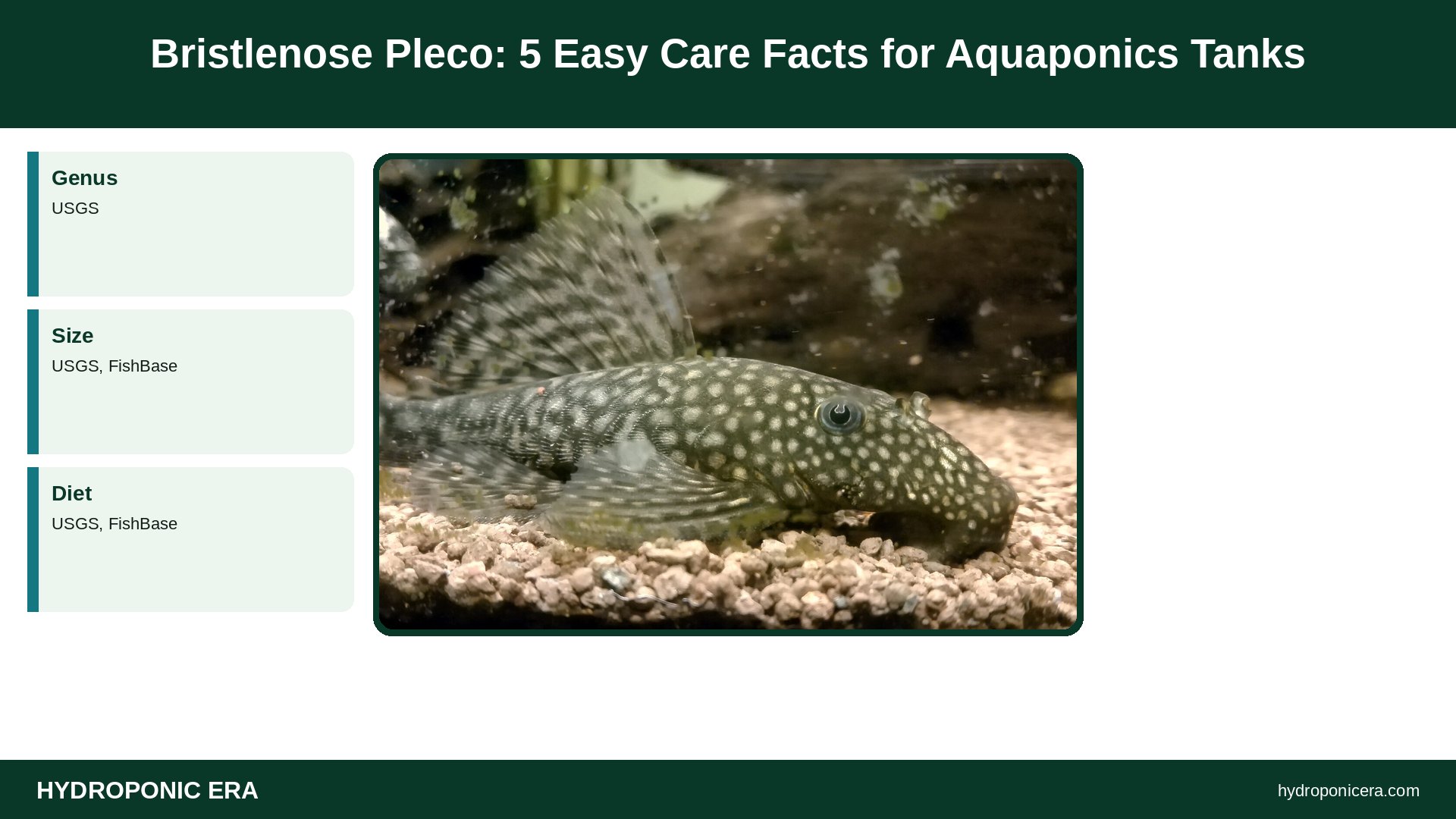
What Is a Bristlenose Pleco?
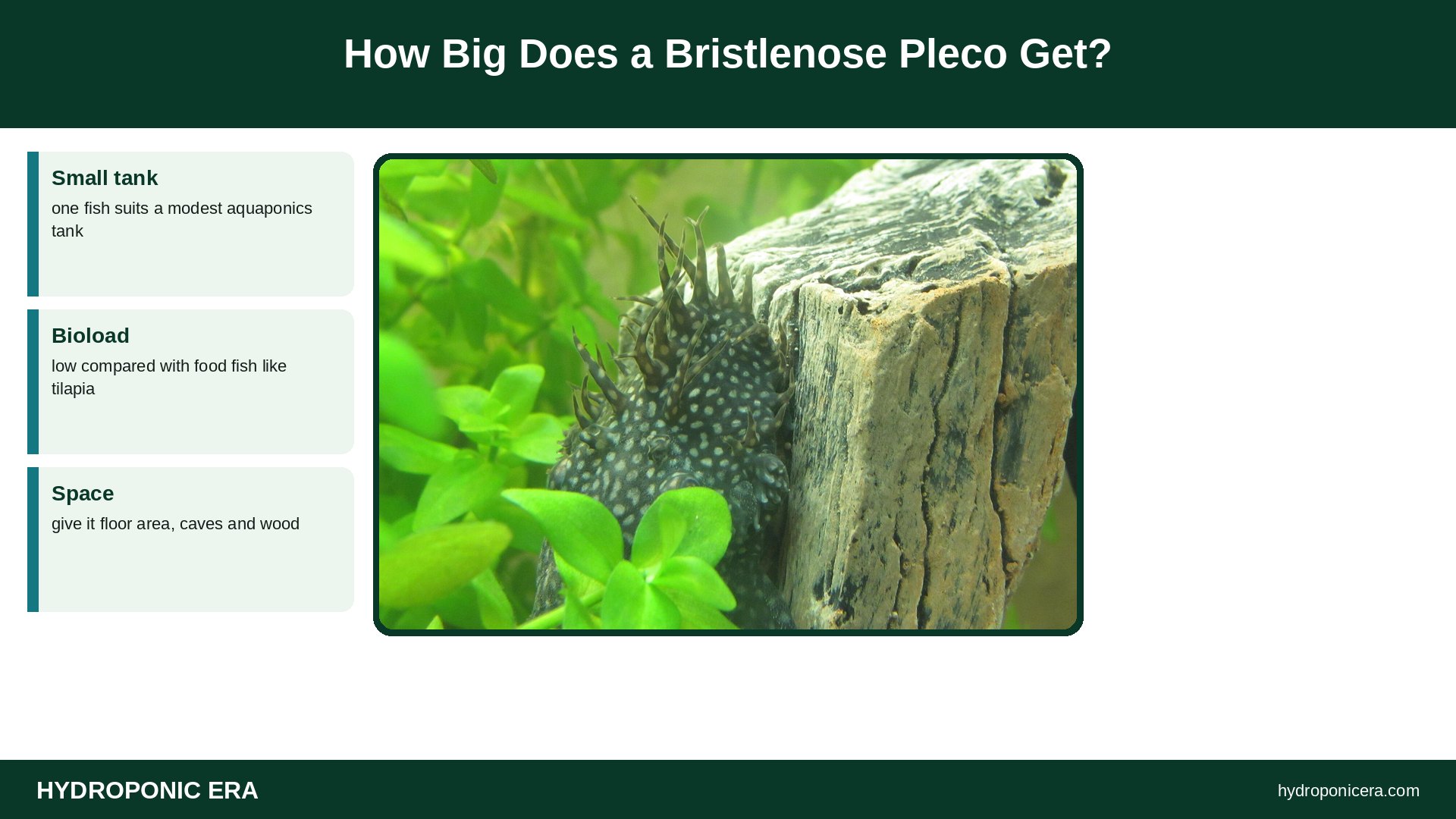
A bristlenose pleco is a catfish in the genus Ancistrus, part of the armored catfish family Loricariidae. USGS says the genus has about 50 described species, identified by fleshy tentacles on and around the snout. Only males grow the full, bushy tentacles. The fish is native to Central and South America.
FishBase lists Ancistrus cirrhosus, the species most often linked to the trade, as a tropical, bottom-dwelling algae eater from the Paraná River basin, with a maximum standard length of about 3.6 inches (9.1 cm).
How Big Does a Bristlenose Pleco Get?
This catfish stays small compared with common plecos. USGS cites a size of about 6 inches (15 cm) for the genus, and FishBase records 3.6 inches (9.1 cm) standard length for A. cirrhosus, measured without the tail. That small size makes it far better for home tanks than large plecos that outgrow aquariums.
- Small tank: one fish suits a modest aquaponics tank.
- Bioload: low compared with food fish like tilapia.
- Space: give it floor area, caves and wood.
For matching fish to tank volume, see our aquaponics fish tank size guide.
What Does a Bristlenose Pleco Eat?
It grazes algae and detritus. USGS says loricariid catfishes are benthic fish that primarily eat algae and detritus, and FishBase calls A. cirrhosus an algae eater. A 2022 genome study of Ancistrus triradiatus linked its biology to herbivory. In a clean tank, leftover algae is rarely enough, so add plant-based food.
- Offer sinking algae wafers in the evening.
- Add blanched vegetable slices and remove leftovers within a day.
- Keep a piece of driftwood in the tank to graze.
- Do not rely on it to clean up uneaten fish food.
Feeding more raises waste, which plant beds then use; see aquaponics fish food.
Can a Bristlenose Pleco Live in an Aquaponics Tank?
A bristlenose pleco can live in a heated aquaponics tank with other peaceful tropical fish. FishBase classifies it as a tropical freshwater fish, so unheated outdoor systems in cold climates are not suitable. USGS notes that Ancistrus can breathe air through a modified stomach, which helps it survive low oxygen, but strong aeration is still best.
- Pair it with livebearers like mollies or guppies.
- Cover pump intakes so it cannot get stuck.
- Keep a heater in tropical setups.
- Expect it to graze algae off tank walls, not grow-bed media.
How Does a Bristlenose Pleco Breed?
The species breeds in caves. USGS reports that breeding takes place in hollows and caves, where the female lays 20–200 adhesive eggs, usually on the ceiling. The male guards them, rarely leaving to feed. Eggs hatch in 4–10 days, and fry become free-swimming 2–4 days after that.
- Add a small cave or pipe section on the tank floor.
- Keep one male per cave to limit fighting.
- Leave the male undisturbed while he guards eggs.
- Feed fry finely crushed algae food once they leave the cave.
Is the Bristlenose Pleco Invasive?
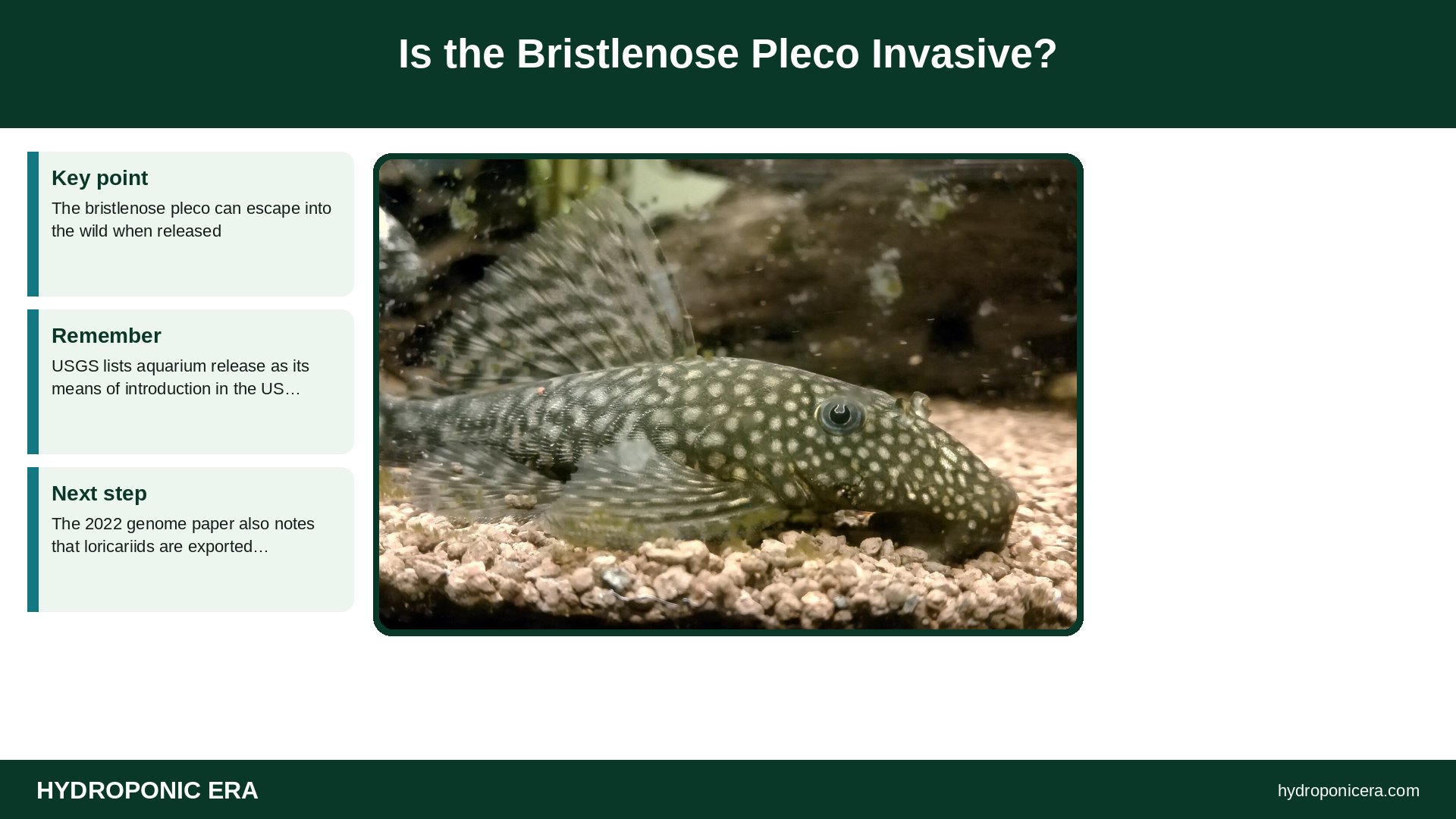
The bristlenose pleco can escape into the wild when released. USGS lists aquarium release as its means of introduction in the US and records its status as unknown; one study listed it as possibly established after a small fish was collected, but no further evidence was found. The 2022 genome paper also notes that loricariids are exported worldwide and that escaped fish can become a local threat.
- Never release fish or tank water into ponds or streams.
- Rehome extra fry through a local fish club or store.
What Mistakes Hurt a Bristlenose Pleco?
Common bristlenose pleco mistakes include starving it in a spotless tank, keeping it in cold water and leaving no hiding spots. Bright, bare tanks can stress a bottom-dwelling fish. Check that pumps, siphons and grow-bed drains are screened, because small catfish can slip into plumbing.
How big does a bristlenose pleco get?
USGS cites about 6 inches (15 cm) for the genus, and FishBase lists 3.6 inches (9.1 cm) standard length for Ancistrus cirrhosus.
What does a bristlenose pleco eat?
Mainly algae and detritus, per USGS and FishBase. In aquariums, add sinking algae wafers and vegetables.
Can a bristlenose pleco live with goldfish?
It is a tropical fish, per FishBase, while goldfish suit cooler water, so they are not an ideal pairing.
How do bristlenose plecos breed?
In caves. USGS says the female lays 20–200 eggs on the ceiling and the male guards them until fry swim free.
Is a bristlenose pleco a good aquaponics fish?
It is a good cleanup fish for small heated systems, but not a food fish and not a main source of nutrients for plants.
Sources
- USGS Nonindigenous Aquatic Species. Bristlenosed catfish (Ancistrus sp.) Species Profile.
- FishBase. Ancistrus cirrhosus.
- Lemopoulos, A., & Montoya-Burgos, J. I. (2022). Whole genome assembly of the armored loricariid catfish Ancistrus triradiatus highlights herbivory signatures. Molecular Genetics and Genomics.
- Photo credits (Wikimedia Commons, edited with titles): Ancistrus sp. in aquarium by Júlio Reis (CC BY-SA 4.0); Ancistrus sp. — NOT dolichopterus — male by Bernard Ladenthin (CC0); Fish farming on Øksfjorden in Loppa, Troms og Finnmark, Norway, 2022 August by Ximonic (Simo Räsänen) (CC BY-SA 4.0)