
What are root tabs for aquarium plants? Root tabs are slow-release fertilizer capsules you push into aquarium gravel next to rooted plants. They feed swords, crypts, vallisneria and stem plants through their roots. Tropica says its nutrition capsules hold nitrogen, phosphorus, iron and micronutrients and release them over 1–2 months. Place them with tweezers, close to the roots.
Key takeaway: Root tabs feed heavy root plants directly in the substrate, so you dose the water less. Push each capsule into the gravel near the roots of swords, crypts or vallisneria, replace them about every 1–2 months, and skip them for plants on wood like anubias and java fern. Use them alongside, not instead of, good light and CO2.
| Question | Root tab answer | Source |
|---|---|---|
| What they contain | Nitrogen, phosphorus, iron, micronutrients | Tropica |
| How long they last | About 1–2 months | Tropica |
| Where to place | In the gravel, close to the roots | Tropica |
| Best plants | Stem plants, crypts, swords, vallisneria | Tropica |
| Skip for | Plants grown on wood or rock | Tropica |
| Why roots matter | Rooted plants can take nutrients from sediment | Barko & Smart |
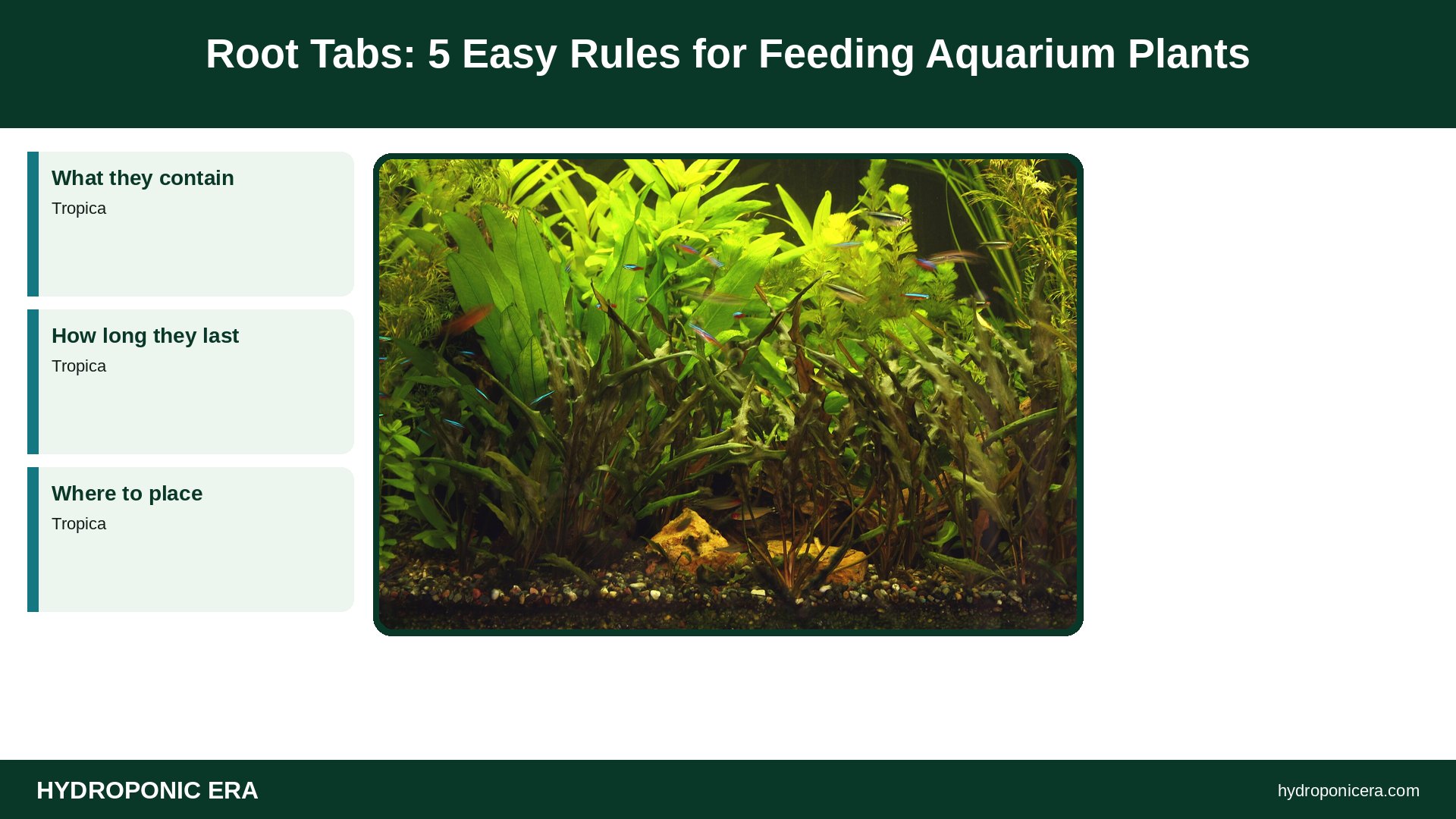
What Are Root Tabs?
Root tabs are small capsules or tablets of fertilizer made to sit in the substrate instead of dissolving in the water. Tropica describes its nutrition capsules as an extra supplement placed in the gravel close to the roots of fast-growing plants, containing nitrogen, phosphorus, iron and micronutrients that are released slowly as the plants need them.
They are most useful in tanks with plain gravel or sand, which hold few nutrients on their own. A nutrient-rich soil base needs them less at first, but even rich substrates run low over time. For a different approach that feeds plants from fish waste, see our aquarium aquaponics guide.
Do Root Tabs Really Work?
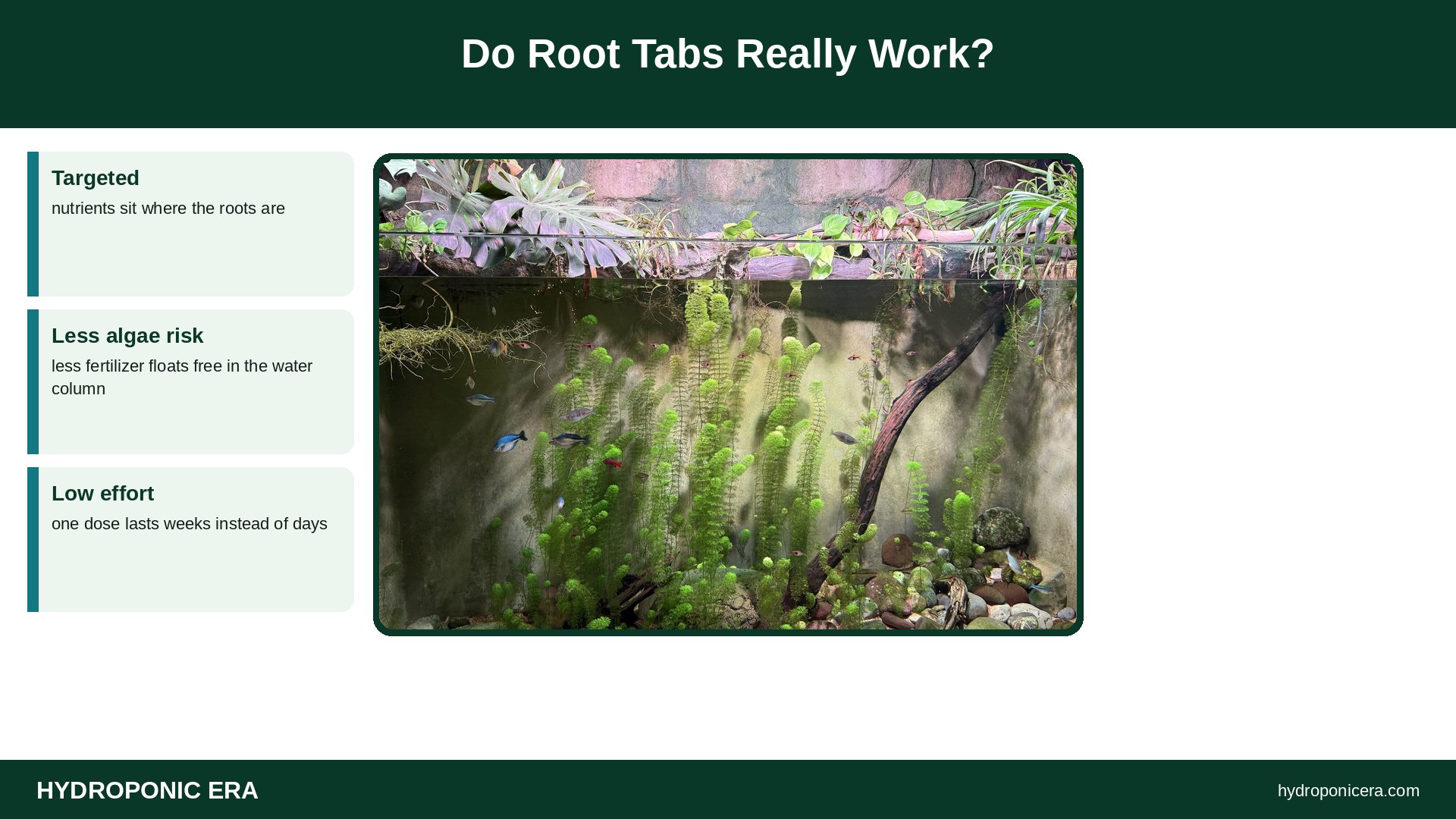
Root tabs work because many aquarium plants feed through their roots as well as their leaves. Tropica says aquarium plants can absorb all macronutrients both via roots and leaves. Research by Barko and Smart found submersed plants could draw all their phosphorus from sediment when the water held none, which supports feeding the root zone.
- Targeted: nutrients sit where the roots are.
- Less algae risk: less fertilizer floats free in the water column.
- Low effort: one dose lasts weeks instead of days.
For a broader look at feeding plants in water, read our guide to fertilizer for plants in water.
Which Plants Need Root Tabs?
Plants with sturdy roots need these capsules most. Tropica recommends its capsules for stem plants, Cryptocoryne, Echinodorus (Amazon swords) and Vallisneria, and says to place them close to the roots of large solitary plants. These heavy root feeders often show pale or slow new leaves in bare gravel without extra feeding.
Plants that grow attached to wood or rock, like anubias and java fern, do not root into the gravel, so they gain little. Floating plants feed from the water and need liquid fertilizer instead.
How Do You Place Root Tabs in an Aquarium?
Place root tabs with tweezers, pushing each one deep into the gravel close to the plant’s roots, as Tropica advises. Bury them fully so they do not float or leak nutrients into the water. Space them under the root zone of each large plant rather than scattering them evenly across the tank floor.
- Turn off the filter for a minute to keep debris from clouding the water.
- Grip the tab with long aquarium tweezers.
- Push it down near the bottom of the gravel, right beside the roots.
- Close the gravel over the hole with the tweezer tip.
- Note the date so you know when to replace it.
How Often Should You Add Root Tabs?
Add new root tabs about every 1–2 months. Tropica says its capsules release their nutrients over that period. Watch the plants: pale new leaves or slow growth on a sword or crypt are signs the supply is running low. Tropica also notes the small balls inside its capsules stay in the substrate after the nutrients are gone.
Can You Use Root Tabs With Liquid Fertilizer?
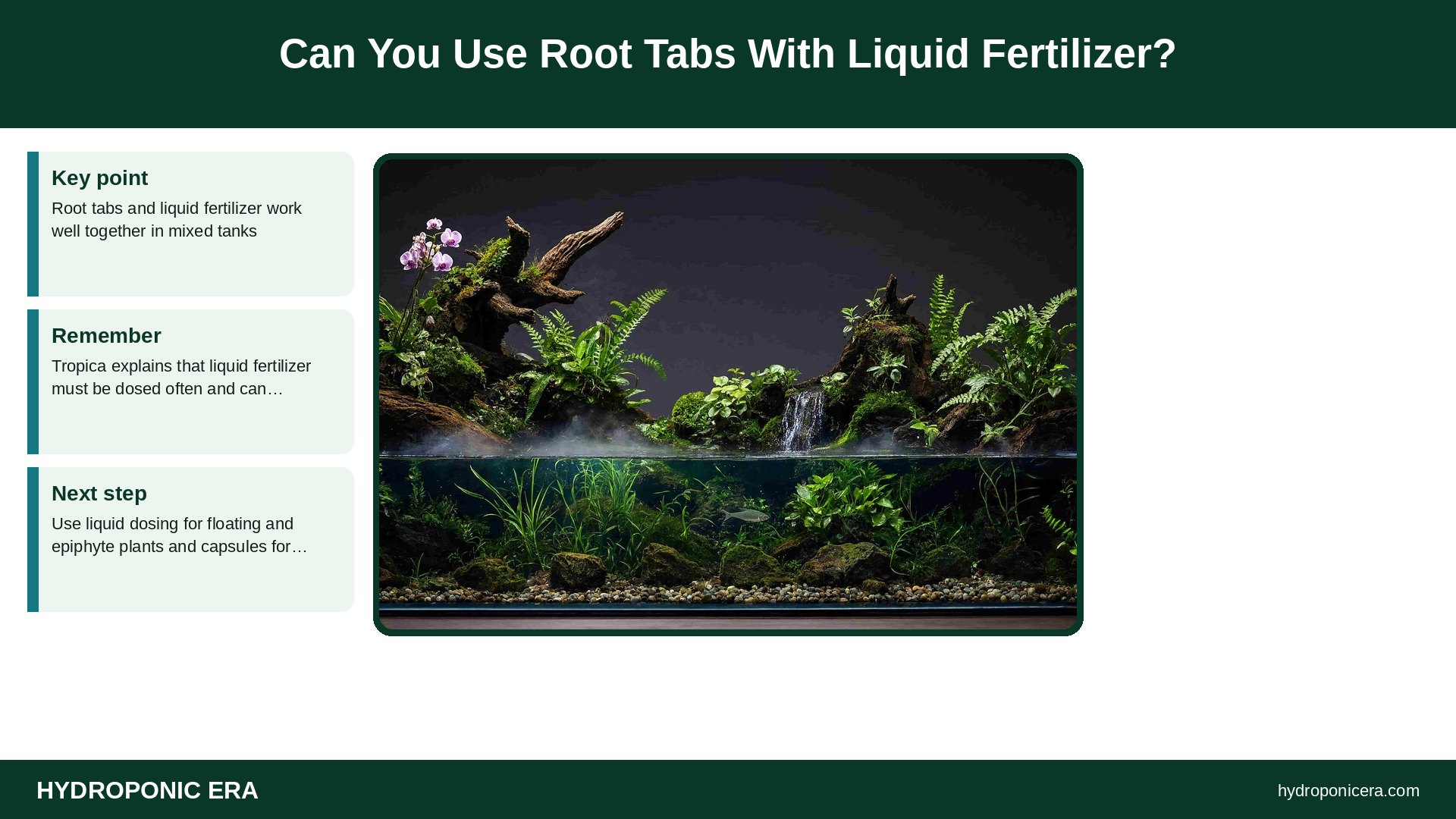
Yes. Root tabs and liquid fertilizer work well together in mixed tanks. Tropica explains that liquid fertilizer must be dosed often and can cause algae if plants cannot absorb it fast enough, while capsules feed the substrate. Use liquid dosing for floating and epiphyte plants and capsules for rooted ones, and cut back if algae rises.
Good light matters as much as feeding. Pair your plan with the right aquarium grow light so plants can use the nutrients.
What Mistakes Waste Root Tabs?
Common mistakes include leaving tabs half buried, using too many at once and placing them under plants that do not root in gravel. Shallow tabs can release nutrients into the water and feed algae. Start with one tab per large plant, wait a few weeks and judge the response before adding more. Keep a simple log of dates and plant positions; it makes the next round faster and stops you from stacking several capsules under one crypt while a sword across the tank goes hungry.
How long do root tabs last?
Tropica says its nutrition capsules release their nutrients over about 1–2 months.
Where should I put root tabs?
In the gravel, close to the roots of the plants you want to feed, placed with tweezers.
Do anubias need root tabs?
Not usually. Anubias grow on wood or rock and feed through leaves and roots in the water, not the gravel.
Can root tabs cause algae?
They can if left shallow or overused. Bury them fully and add only what your plants need.
Do I need root tabs with aquasoil?
Not at first. Nutrient-rich soils feed plants for a while, but tabs help once the soil runs low.
Sources
- Tropica Aquarium Plants. Nutrition Capsules.
- Tropica Aquarium Plants. Fertiliser and CO2 for Your Aquarium.
- Barko, J. W., & Smart, R. M. (1980). Mobilization of sediment phosphorus by submersed freshwater macrophytes. Freshwater Biology.
- Photo credits (Wikimedia Commons, edited with titles): Planted Tank 03 – Flickr – The Wandering Angel by The Wandering Angel from Makati City, Philippines (CC BY 2.0); A freshwater aquarium containing plants and small fish by Netha Hussain (CC0); Gravel Stones by Saral Shots (CC0); Nature Aquarium Aquascape by Dileepkumardr (CC0)