
Are platy fish good for small aquaponics? Yes. Platy fish are small, hardy livebearers that suit heated tabletop and aquarium aquaponics. FishBase lists a maximum of about 1.6 inches (4 cm) for males and 2.4 inches (6 cm) for females, a pH of 7.0–8.0 and water of 64–77°F (18–25°C). They breed fast, so plan for fry.
Key takeaway: Platy fish are easy, peaceful livebearers for small aquaponics systems. Keep water at 64–77°F (18–25°C) and pH 7.0–8.0, feed a varied diet, cycle the biofilter first and control breeding by keeping mostly one sex or rehoming fry. Never release platies outdoors, because USGS records escaped populations in several US states.
| Fact | Platy detail | Source |
|---|---|---|
| Species | Southern platyfish, Xiphophorus maculatus | FishBase, USGS |
| Size | Males 1.6 in (4 cm); females 2.4 in (6 cm) | FishBase, USGS |
| Temperature | 64–77°F (18–25°C), tropical | FishBase |
| Water | pH 7.0–8.0; dH 9–19 | FishBase |
| Breeding | Live young; 24–30 day gestation; 20–80 fry | FishBase |
| Maturity | 3–4 months in aquariums | FishBase |
| Minimum tank | About 24 in (60 cm) long | FishBase |
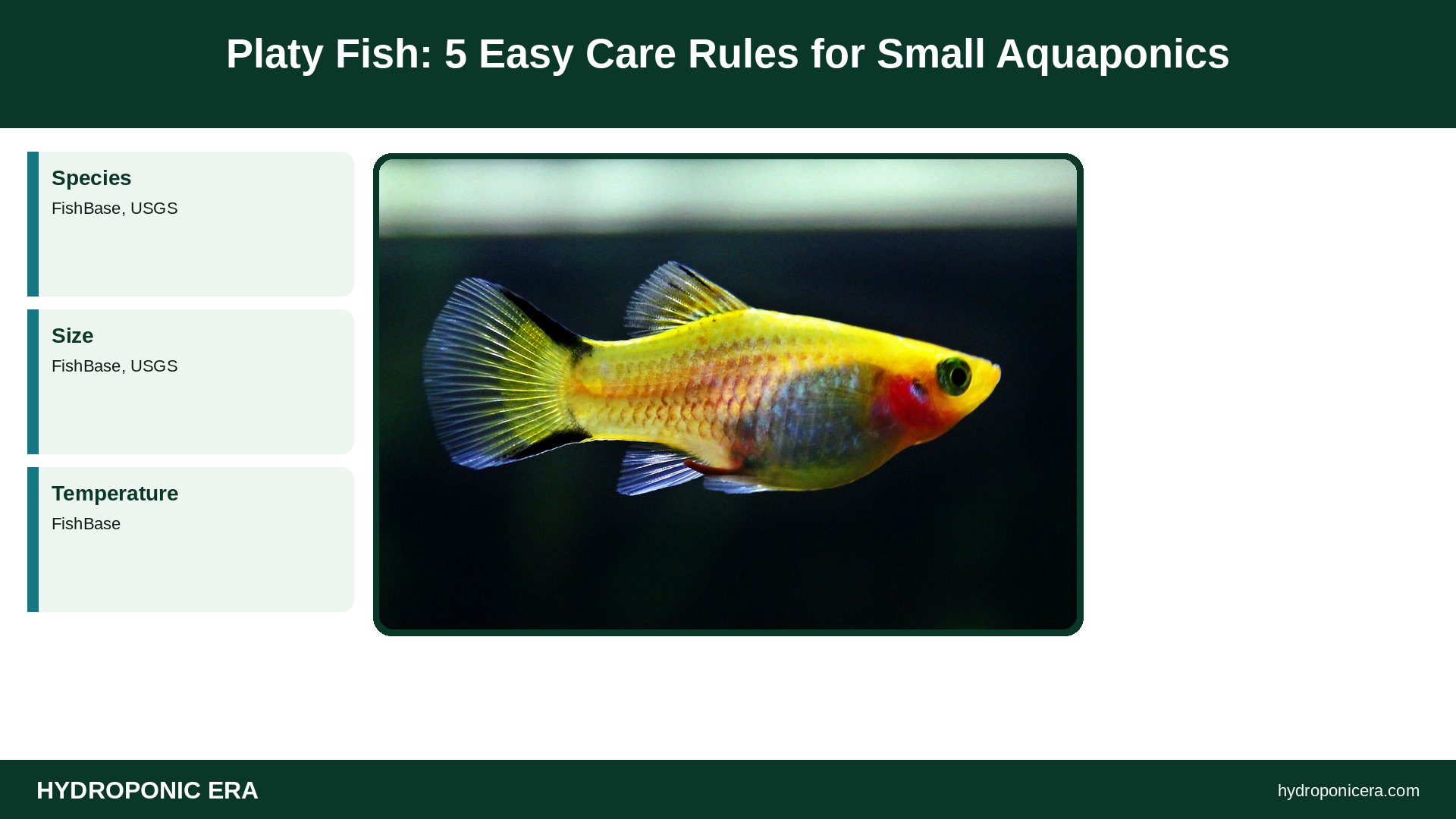
What Are Platy Fish?
Platy fish are the southern platyfish, Xiphophorus maculatus, a small livebearer in the family Poeciliidae. USGS gives its native range as the Atlantic slope of Middle America, from Veracruz, Mexico, to Belize. FishBase says wild adults live in warm springs, canals and ditches with slow water, silt bottoms and weedy banks.
The species has been bred into many color forms, and USGS notes it has long been a popular ornamental fish and a subject of genetic research. Store platies are domestic strains, but their care needs match the wild fish closely.
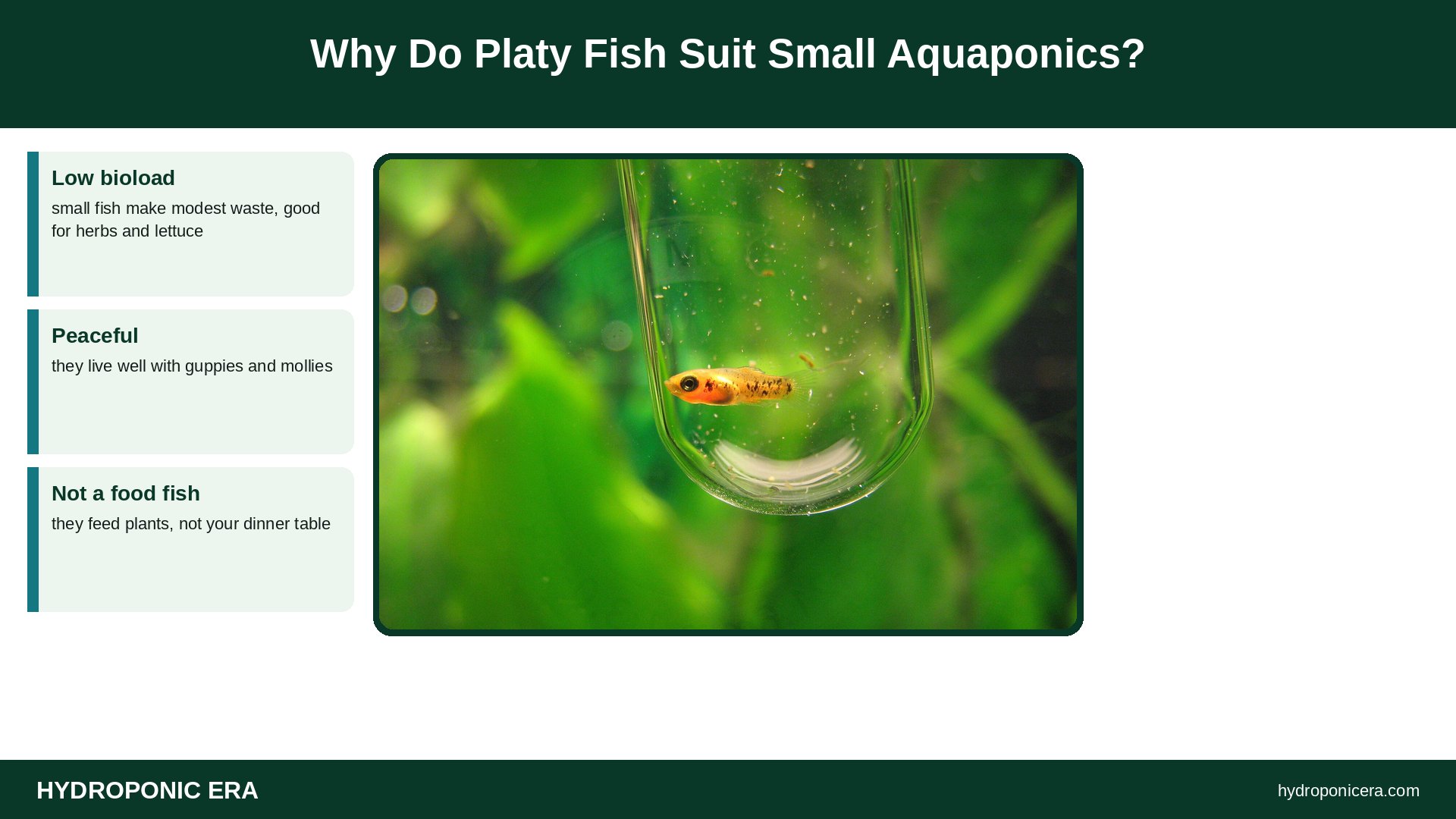
Why Do Platy Fish Suit Small Aquaponics?
Platy fish suit small aquaponics because they stay tiny, tolerate a range of hard, slightly alkaline water and eat almost anything. FishBase lists a pH range of 7.0–8.0 and hardness of 9–19 dH. That overlaps well with tap water in many areas and with the slightly alkaline water a nitrifying biofilter prefers.
- Low bioload: small fish make modest waste, good for herbs and lettuce.
- Peaceful: they live well with guppies and mollies.
- Not a food fish: they feed plants, not your dinner table.
To pick a stocking level, see our aquaponics fish to plant ratio guide.
What Water Do Platy Fish Need?
Platy fish need warm, clean water between 64 and 77°F (18–25°C), according to FishBase, which classes them as tropical. Most indoor systems need a small heater in winter. Keep pH near 7.0–8.0 and test ammonia and nitrite weekly, because small systems swing quickly after a heavy feeding or a dead plant root mass.
- Cycle the biofilter before adding fish.
- Add a heater if room temperature drops below 64°F (18°C).
- Test pH, ammonia and nitrite once a week.
- Top off with dechlorinated water.
SRAC explains that Nitrosomonas bacteria turn ammonia into nitrite and Nitrobacter turn nitrite into nitrate, which plants then use. A new biofilter needs time to build these bacteria, so stock slowly and watch nitrite. Our aquaponics biofilter guide covers setup.
How Big a Tank Do Platy Fish Need?
FishBase gives a minimum aquarium size of about 24 inches (60 cm) long for this species. A tank of that length suits a small group and a grow bed sized to match. Larger volumes stay more stable in temperature and water quality, which matters in aquaponics, where plant roots and fish share the same water.
For volume planning, read our aquaponics fish tank size guide.
What Do Platy Fish Eat?
In the wild they eat worms, crustaceans, insects and plant matter, FishBase reports. In aquaponics, feed a quality flake or small pellet once or twice a day, only what they finish in a few minutes. Add vegetable foods or duckweed for variety. Uneaten food raises ammonia fast in a small tank.
Leafy greens and herbs such as basil, mint and lettuce match the modest nutrient output of a few small fish. Fruiting crops like tomatoes usually need more fish or added nutrients. Start with a handful of plants, then expand the grow bed as the group grows and the water stays clean.
How Do You Control Platy Fish Breeding?
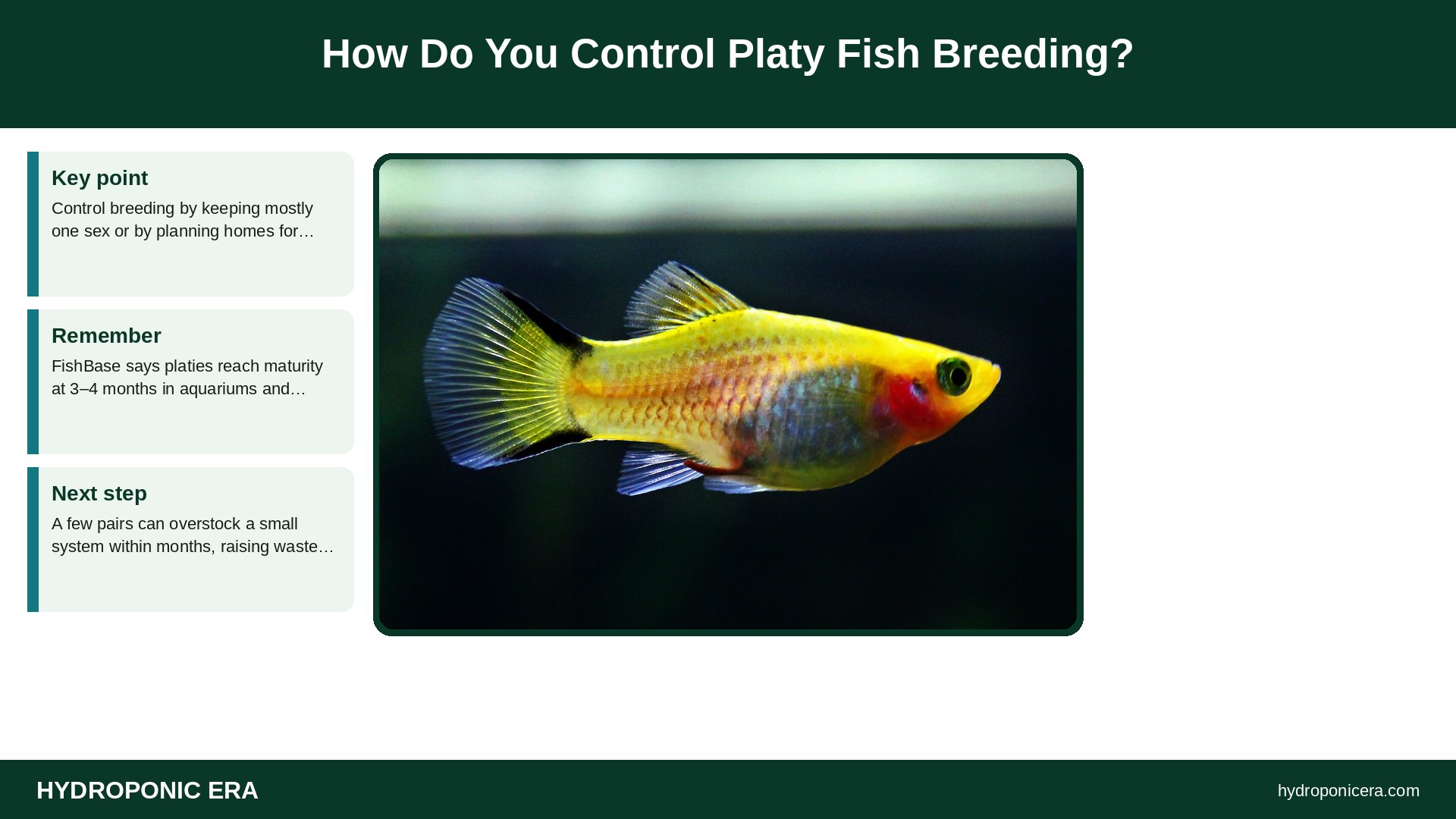
Control breeding by keeping mostly one sex or by planning homes for fry. FishBase says platies reach maturity at 3–4 months in aquariums and bear 20 to 80 live young after a 24 to 30 day gestation. A few pairs can overstock a small system within months, raising waste beyond what the plants can absorb.
- Keep an all-male group if you want no fry.
- Add floating plants so some fry survive, or move them out.
- Rehome extras through a local fish store or club.
Are Platy Fish Invasive?
Platy fish can establish outdoors in warm climates. USGS says introductions probably came from fish farm or aquarium releases and lists the species as locally established, or possibly established, in several states, including Florida. Never release platies or tank water into ponds, ditches or streams.
How big do platy fish get?
FishBase lists about 1.6 inches (4 cm) for males and 2.4 inches (6 cm) for females.
What temperature do platy fish need?
FishBase gives 64–77°F (18–25°C), so most indoor systems need a heater in winter.
How often do platy fish have babies?
FishBase reports a 24 to 30 day gestation with 20 to 80 young per brood.
Can platy fish live with guppies?
Yes. Both are peaceful livebearers with similar warm-water needs, which makes them good tankmates in small systems.
Are platy fish good for aquaponics?
Yes, for small heated systems growing herbs and greens. They are hardy and low waste, but they are ornamental, not food fish.
Sources
- FishBase. Xiphophorus maculatus, Southern platyfish.
- USGS Nonindigenous Aquatic Species. Southern Platyfish (Xiphophorus maculatus) Species Profile.
- Southern Regional Aquaculture Center. SRAC 4502: How to Start a Biofilter.
- Photo credits (Wikimedia Commons, edited with titles): Xiphophorus maculatus Platy by Usien (CC BY-SA 4.0); Xiphophorus maculatus young by Ude (CC BY-SA 3.0); Fish farming on Øksfjorden in Loppa, Troms og Finnmark, Norway, 2022 August by Ximonic (Simo Räsänen) (CC BY-SA 4.0)
1 thought on “Platy Fish: 5 Easy Care Rules for Small Aquaponics”