
When does a greenhouse need supplemental lighting? When the crop’s daily light integral (DLI) falls below target, usually in winter. Purdue Extension and Michigan State’s Erik Runkle recommend at least 10 to 12 mol·m⁻²·d⁻¹ for most ornamental finishing crops, with vegetables often higher. Greenhouse supplemental lighting fills that gap with HPS or LED fixtures.
Key takeaway: Greenhouse supplemental lighting pays off when you measure DLI at the crop and light only to close the gap.
| Item | Typical value | Source |
|---|---|---|
| Finishing target, most ornamentals | 10–12 mol·m⁻²·d⁻¹ | Purdue, Runkle |
| Low-light crops | 3–6 mol·m⁻²·d⁻¹ | Purdue |
| High-light crops | 12–18 mol·m⁻²·d⁻¹ | Purdue |
| Glazing and structure loss | 40–70% of outdoor light | Purdue |
| Typical HID output | 33–98 µmol·m⁻²·s⁻¹ | Purdue |
| Replace HPS bulbs | About 12,000 hours | Runkle (GPN) |
| Dirty lamps or reflectors | Up to 10–15% less light each | Runkle (GPN) |

What Is Daily Light Integral?
The total photosynthetic light a crop gets in one day. Purdue Extension compares DLI to a rain gauge: it adds up photosynthetically active radiation (400–700 nm) over 24 hours, in moles per square meter per day. A single foot-candle or lux reading only shows one instant, so it cannot tell you the day’s total.
For the indoor version of this math, see our guide to PPFD and DLI.
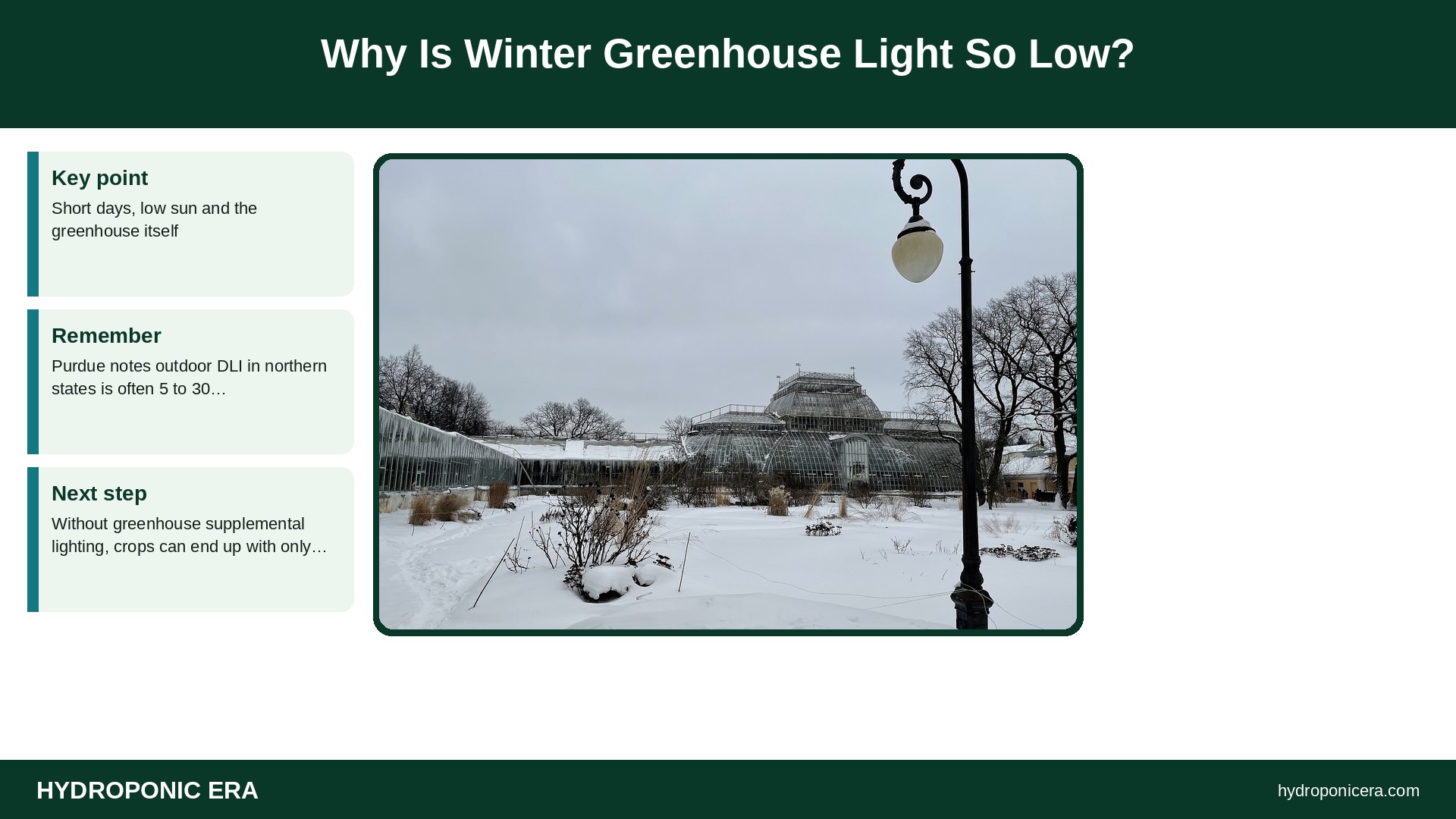
Why Is Winter Greenhouse Light So Low?
Short days, low sun and the greenhouse itself. Purdue notes outdoor DLI in northern states is often 5 to 30 mol·m⁻²·d⁻¹ from December to March, and glazing, structure and hanging baskets can cut that by 40 to 70 percent. Without greenhouse supplemental lighting, crops can end up with only 1 to 5 mol·m⁻²·d⁻¹.
How Much Light Should Greenhouse Supplemental Lighting Add?
Enough to reach the crop’s target DLI. Purdue sorts crops into low (3–6), medium (6–12), high (12–18) and very high (above 18) mol·m⁻²·d⁻¹ groups. Runkle’s GPN column says most ornamentals need an average of at least 10 to 12, while vegetable crops are often higher.
To size greenhouse supplemental lighting, multiply PPFD by hours and 0.0036 for added DLI. Purdue gives the example of HPS lamps at 52 µmol·m⁻²·s⁻¹ for 12 hours adding about 2.3 mol·m⁻²·d⁻¹.
When Should the Lamps Run?
Only at night and during cloudy weather. Runkle advises controlling greenhouse supplemental lighting with an environmental controller or quantum sensor rather than a simple timer, because there is little benefit when it is sunny. He suggests switching the system off once the average DLI exceeds 10 to 12, often by March or early April up north.
- Measure DLI at plant height with a logging quantum sensor.
- Compare it with your crop’s target group.
- Set lights to run on dark, cloudy periods first.
- Add a deadband so HPS lamps do not cycle often.
- Turn the system off as spring DLI rises.
Day length still matters for flowering; our light schedule guide covers photoperiod.
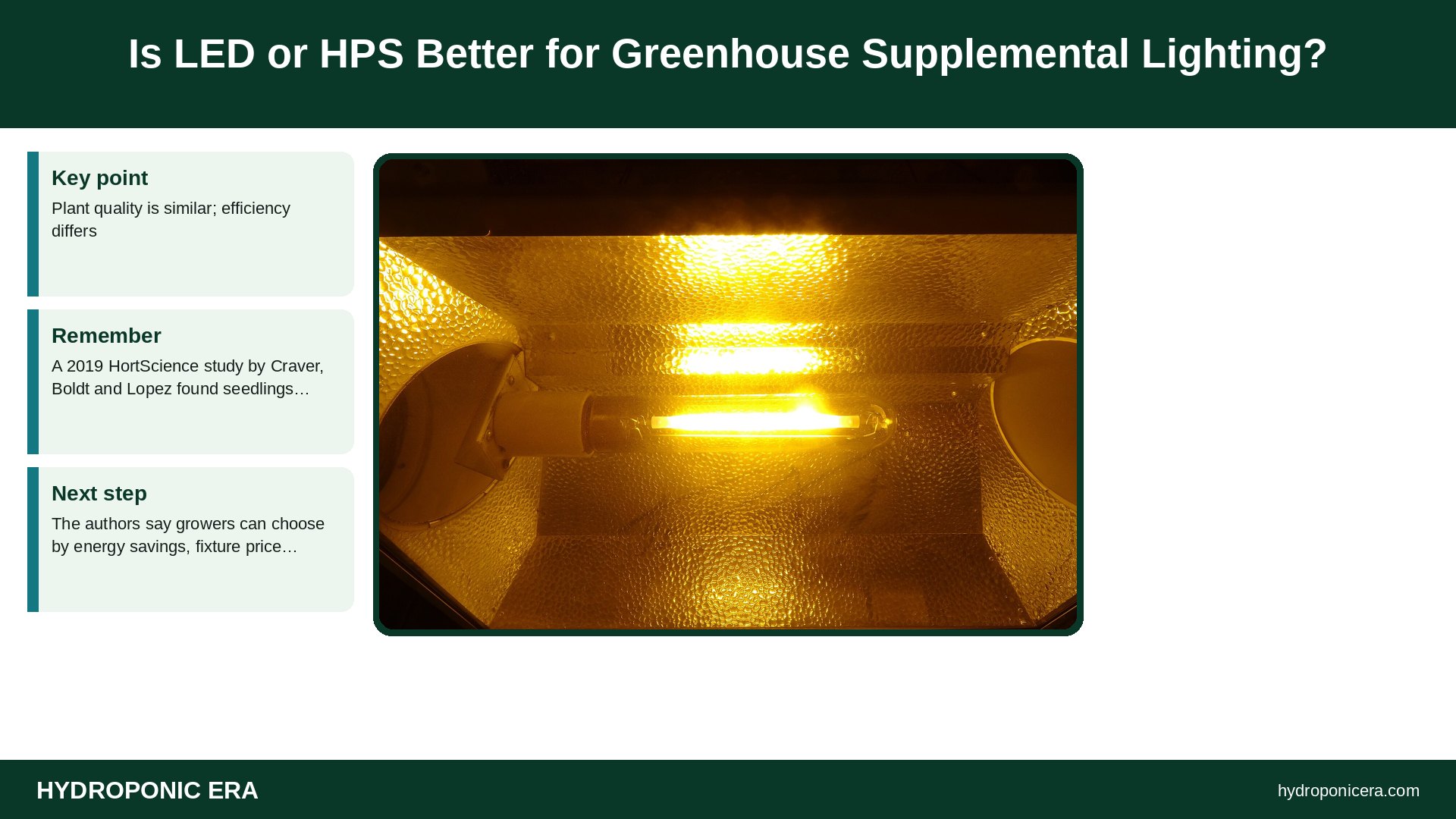
Is LED or HPS Better for Greenhouse Supplemental Lighting?
Plant quality is similar; efficiency differs. A 2019 HortScience study by Craver, Boldt and Lopez found seedlings under HPS or LED supplemental light were comparable, and both beat no added light. The authors say growers can choose by energy savings, fixture price and lifespan. Runkle adds that LEDs tolerate frequent on/off switching.
Compare running costs in our LED vs HPS grow lights guide.
How Do You Keep Lamps Delivering Full Output?
Clean and replace on schedule. Runkle writes that HPS bulbs are commonly replaced after about 12,000 hours, when output falls to 85 to 90 percent while power use stays the same. Utah State research he cites found dirty bulbs and reflectors can each cut light 10 to 15 percent. A uniform greenhouse supplemental lighting layout also keeps growth even.
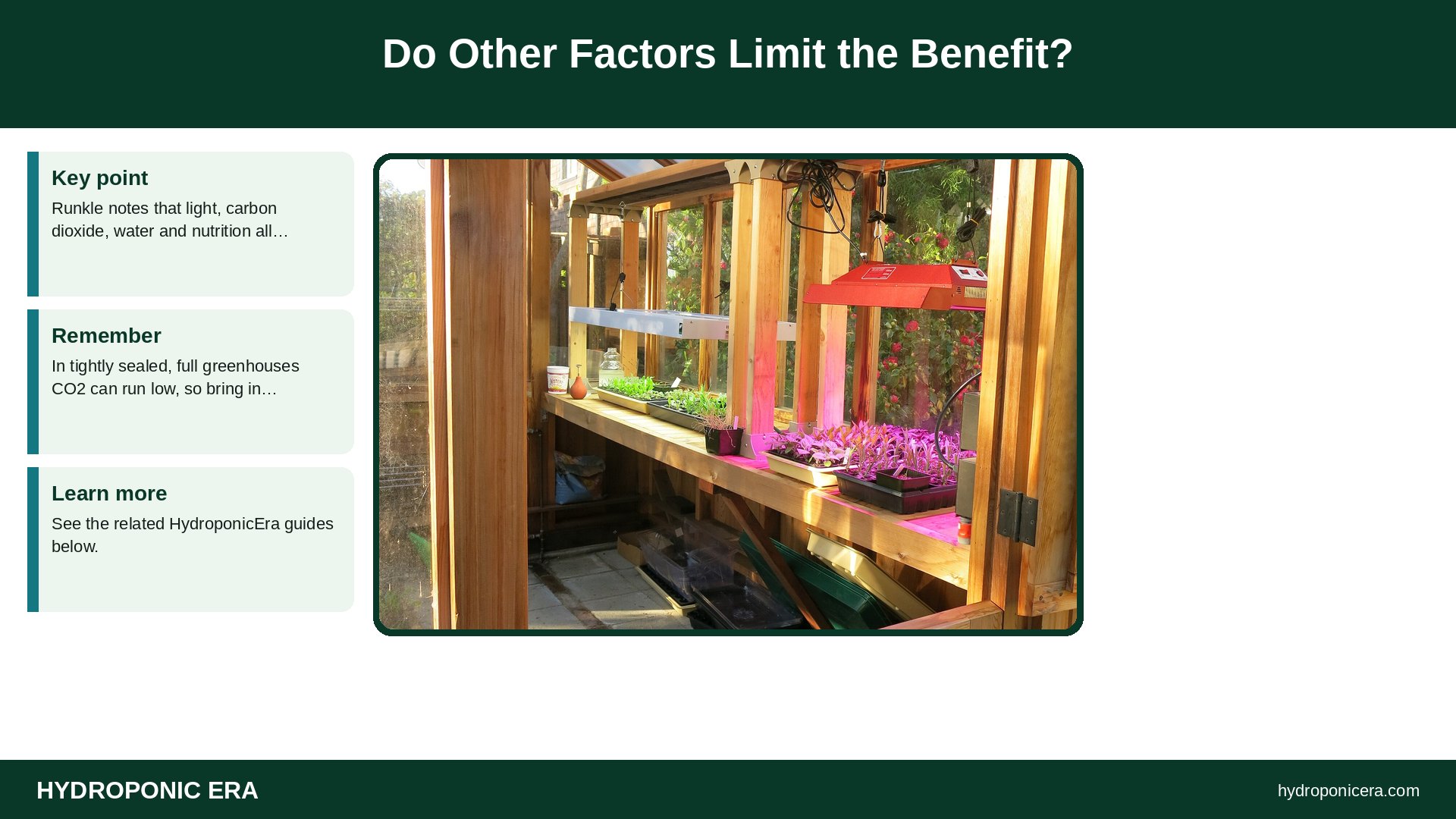
Do Other Factors Limit the Benefit?
Yes. Runkle notes that light, carbon dioxide, water and nutrition all drive photosynthesis, so a shortage of any one reduces the payoff from greenhouse supplemental lighting. In tightly sealed, full greenhouses CO2 can run low, so bring in fresh air or enrich it while lamps are on.
FAQ About Greenhouse Supplemental Lighting
What DLI do greenhouse tomatoes need?
Vegetables are often above the 10–12 ornamental target; check crop guides.
Can greenhouse supplemental lighting run on a timer?
Better to use a light sensor or controller.
Are foot-candles useful for DLI?
Not alone; they measure an instant of visible light.
How long do HPS bulbs last?
Replace after about 12,000 hours.
Do LEDs grow better seedlings than HPS?
Research found similar quality under both.
Sources
- Purdue Extension (Torres and Lopez) — Measuring Daily Light Integral in a Greenhouse, HO-238-W
- Greenhouse Product News, Erik Runkle (Michigan State) — Maximizing the Benefits of Supplemental Lighting
- HortScience 54(1), Craver, Boldt and Lopez — Comparison of Supplemental Lighting from HPS Lamps or LEDs
- Photo credits (Wikimedia Commons, edited with titles): Greenhouse in Kazakhstan by Gakon Netafim (CC BY-SA 4.0); Greenhouse of Saint Petersburg Botanical Garden winter outside by Afanasovich (CC BY-SA 4.0); HPS (High Pressure Sodium) grow light bulb by Plantlady223 (CC BY-SA 4.0); Greenhouse in Berkeley by Burkhard Mücke (CC BY-SA 3.0)