
What does Hydroguard do in hydroponics? Hydroguard is Botanicare’s bacterial root inoculant containing Bacillus amyloliquefaciens. The company says it helps decompose organic matter and may convert it into nutrients roots can absorb. The label rate is 2 mL per gallon (about 0.5 mL per liter) with every watering. It is not a substitute for cool, clean, well-oxygenated nutrient solution.
Key takeaway: This Bacillus product is an inoculant; research on related Bacillus products is promising but not a guarantee against root rot.
| Fact | Detail | Source |
|---|---|---|
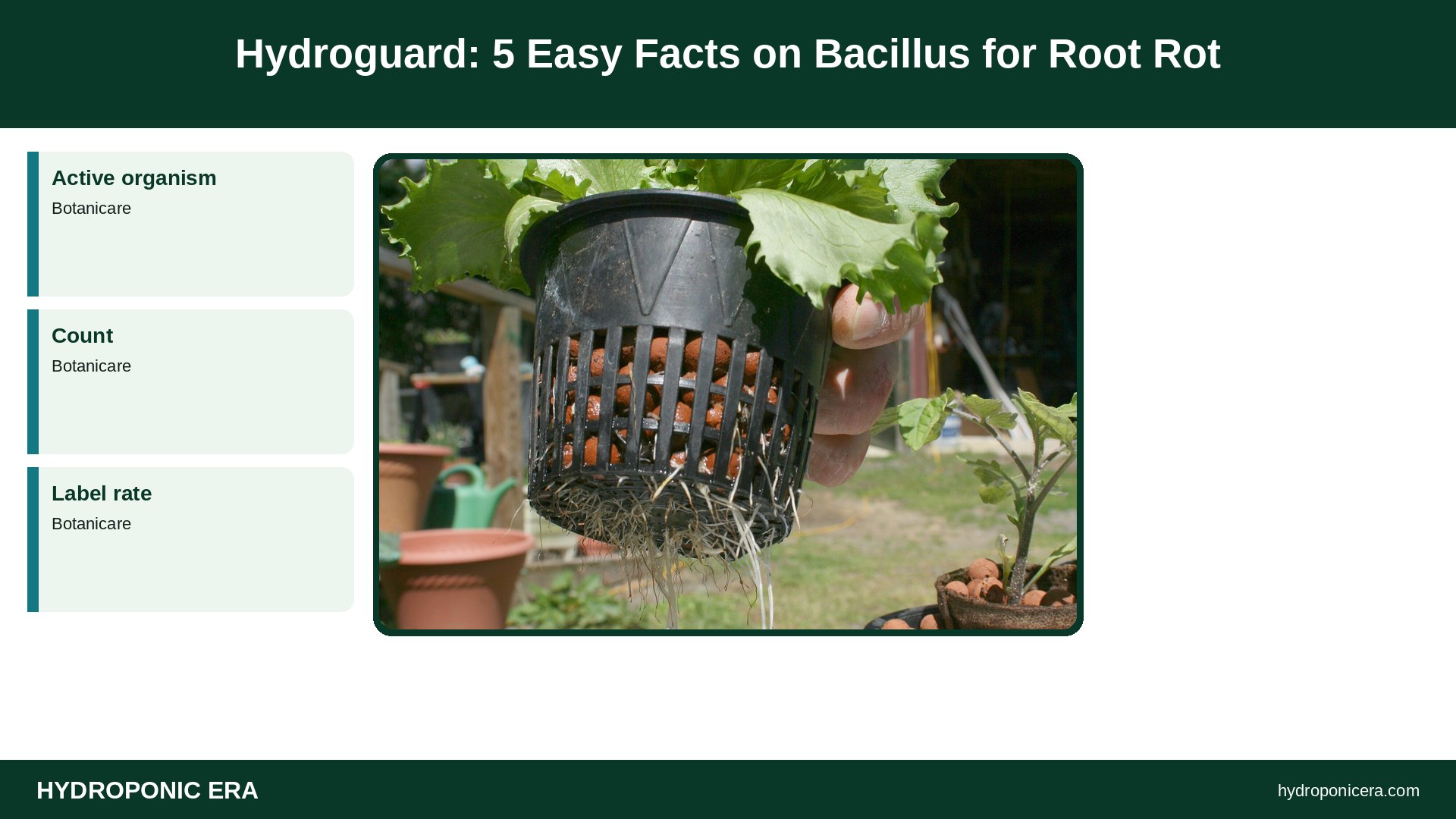
| Active organism | Bacillus amyloliquefaciens 0.038% | Botanicare |
| Count | Minimum 1.00×10^4 CFU per mL | Botanicare |
| Label rate | 2 mL per gallon (3.8 L) | Botanicare |
| When | Every watering, entire growth cycle | Botanicare |
| Mixing | Shake well; never mix concentrates | Botanicare |
| Feed chart | Stops at flush week | Botanicare feed sheet |
| Biggest root rot risk factor | High nutrient temperature | NSW DPI (VG04012) |
What Is in Hydroguard?
A single beneficial bacterium. Botanicare’s guaranteed analysis lists Bacillus amyloliquefaciens at 0.038 percent, with at least 10,000 colony-forming units per milliliter. The company describes Hydroguard as a root inoculant that helps break down organic matter. Note the wording: the product page does not claim to cure or prevent any named disease.
For how microbes fit into nutrient systems generally, see our guide to beneficial bacteria and enzymes.
How Do You Use Hydroguard?
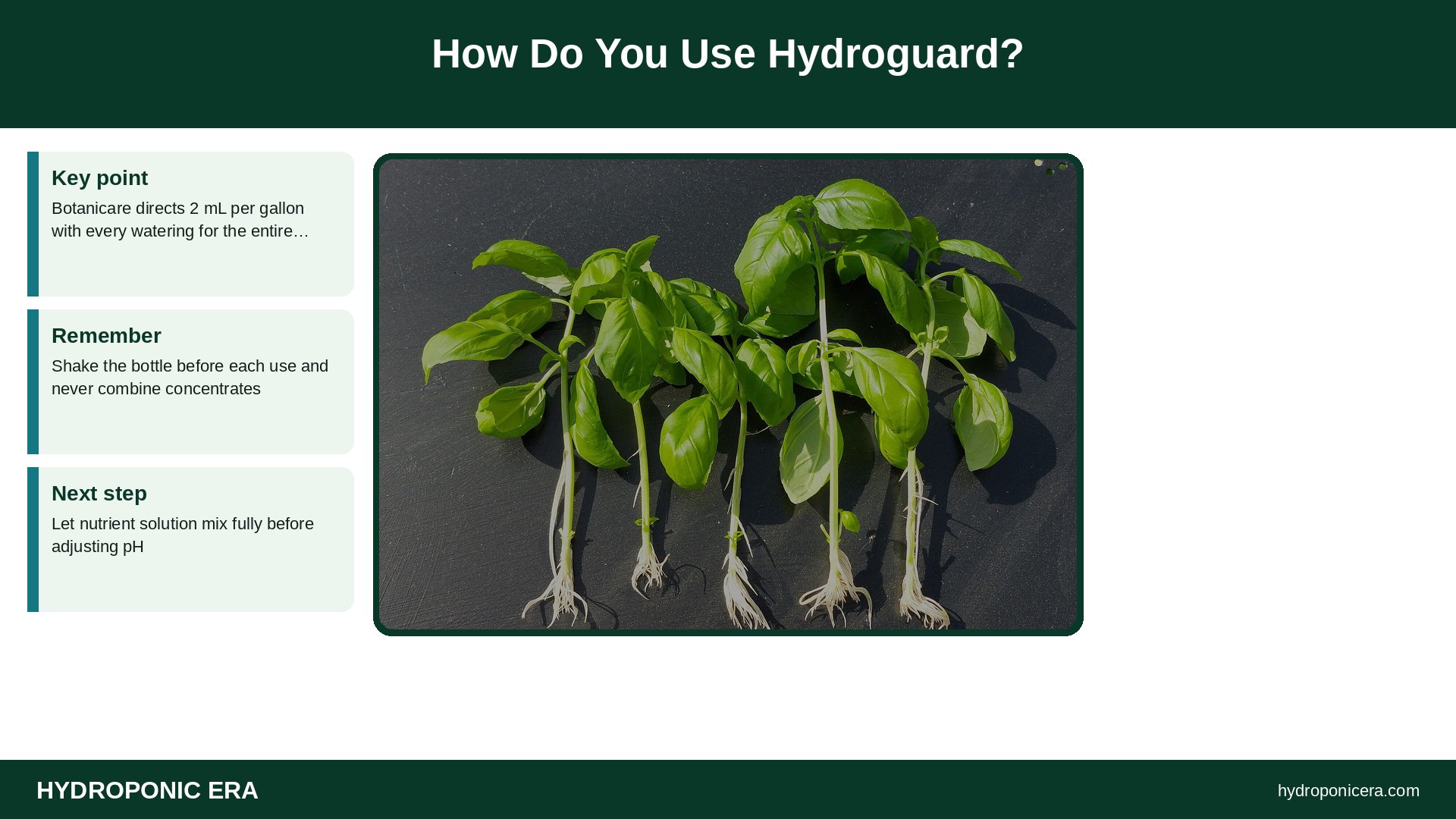
Follow the label. Botanicare directs 2 mL per gallon with every watering for the entire growth cycle. Shake the bottle before each use and never combine concentrates. Let nutrient solution mix fully before adjusting pH. The company’s feed sheet keeps Hydroguard at 2 mL through ripening and drops it during the final flush week.
- Fill the reservoir and add base nutrients one at a time.
- Shake the bottle well.
- Add 2 mL per gallon (about 0.5 mL per liter).
- Let the solution mix, then adjust pH.
- Repeat at each reservoir change or top-off watering.
Does Research Support Bacillus Against Root Rot?
Partly, though not for Hydroguard specifically. A PLOS One field study found the commercial strain B. amyloliquefaciens FZB42 colonized lettuce roots and reduced bottom rot (Rhizoctonia) from severe symptoms to slight ones on average. In NSW DPI hydroponic lettuce trials, a Bacillus subtilis product consistently suppressed Pythium and Phytophthora root rot to near uninfected levels.
Those are different strains, crops and pathogens, and the FZB42 work was in soil beds rather than recirculating water, so results may not transfer directly to your reservoir. Learn the symptoms in our Pythium root rot guide.
Can Hydroguard Fix Root Rot by Itself?
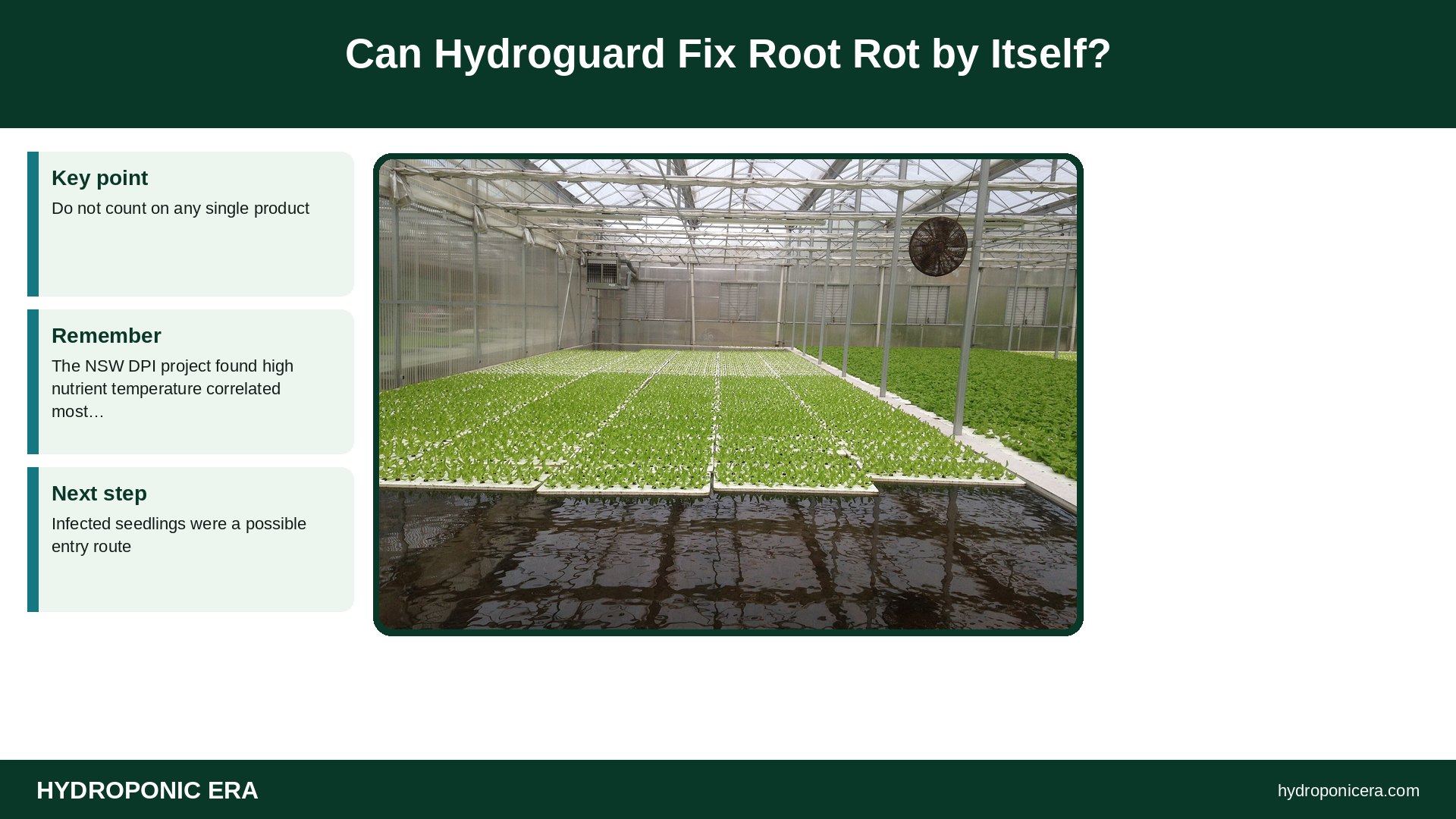
Do not count on any single product. The NSW DPI project found high nutrient temperature correlated most strongly with disease and was the biggest factor in total crop losses. Infected seedlings were a possible entry route. The report calls keeping solution cool a costly ongoing challenge. Treat a microbial inoculant as one layer of prevention, not the whole plan.
What Else Prevents Root Rot in Hydroponics?
Cool solution, clean seedlings and sanitation. NSW DPI growers cooled nutrients with evaporative coolers or heat-exchange coils and used shade cloth. The report adds that chemical disinfectants harm roots at pathogen-killing doses, so their use should be restricted to non-crop sanitation of farm and source water. Lettuce cultivars also differed widely in susceptibility.
Before you disinfect between crops, read our guide to hydrogen peroxide uses and risks first.
Can You Mix Hydroguard With Other Additives?
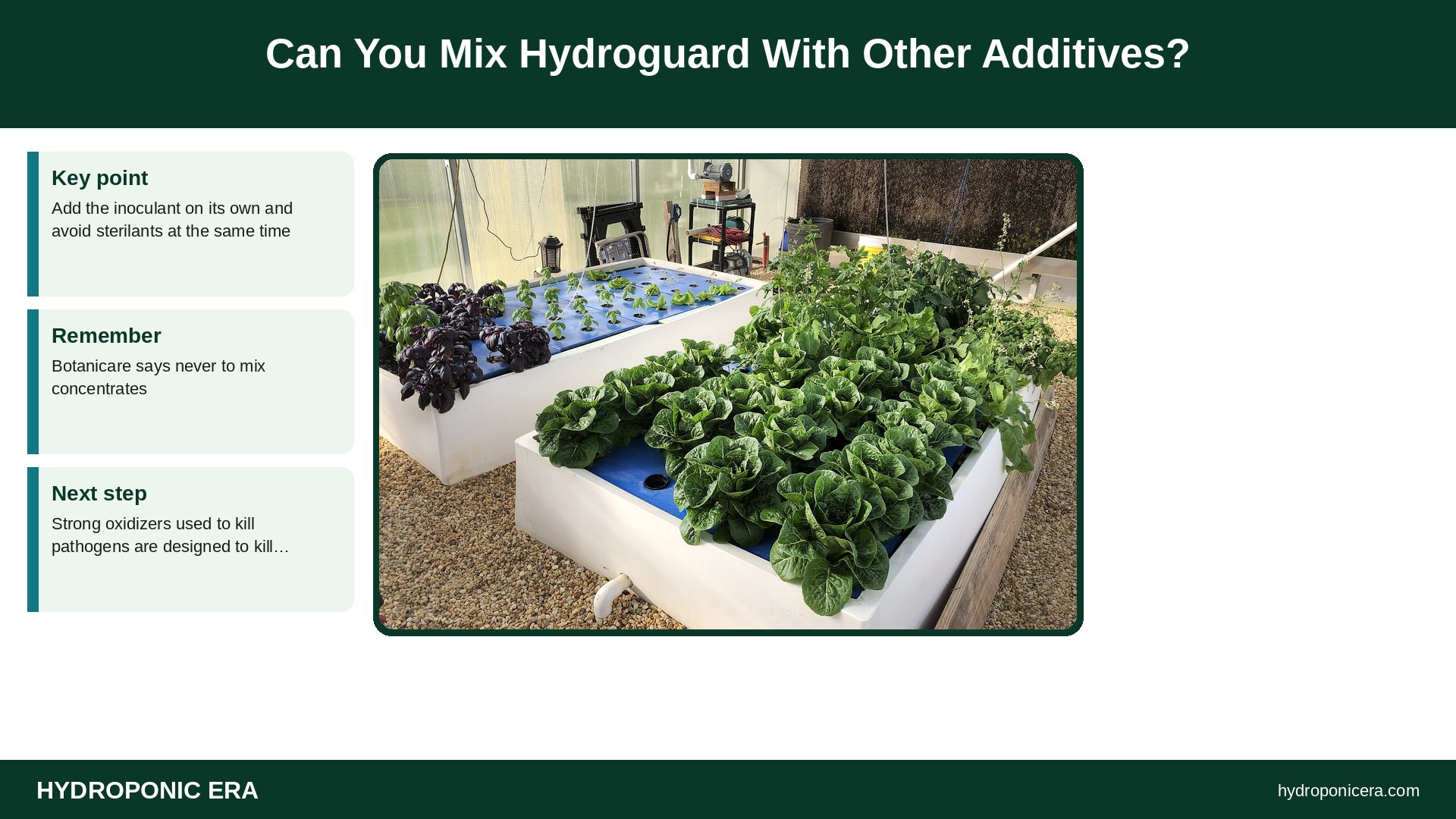
Add the inoculant on its own and avoid sterilants at the same time. Botanicare says never to mix concentrates. Strong oxidizers used to kill pathogens are designed to kill microbes, so applying them alongside a live bacterial inoculant works against it. Keep sterilants for empty-system cleaning, then restart beneficials with fresh solution.
What Signs Mean the Product Is Not Enough?
Watch roots, not the bottle. Healthy roots in water culture are white or cream and firm. Brown, slimy roots, a sour smell and midday wilting on plants that recover at night point to root rot that needs action now. Check solution temperature, aeration and dissolved oxygen first, then remove badly affected plants so they cannot spread inoculum.
Compare what you see with our guide to white fuzz on roots in water, which covers another common root symptom.
Is It Worth Buying for a Home System?
It depends on your risk. Small, cool systems with clean seedlings often run without additives. Warm rooms, recirculating reservoirs and past root rot raise the case for a preventive inoculant. Budget for the cost at 2 mL per gallon per change, and spend first on a chiller, air pump or shade if your solution runs warm.
FAQ About Hydroguard
How much Hydroguard per gallon?
2 mL per gallon, per Botanicare’s label.
Is Hydroguard a fungicide?
No. It is sold as a root inoculant with no disease claim on the product page.
Can I use it in DWC?
Yes; Botanicare says to use it with every watering.
Do I add it during flush?
Botanicare’s feed sheet shows 0 mL in flush week.
Will Hydroguard cure brown roots?
Not alone; fix temperature and oxygen too.
Sources
- Botanicare — Hydroguard product page and guaranteed analysis
- PLOS One, Chowdhury et al. — Effects of Bacillus amyloliquefaciens FZB42 on Lettuce Growth and Health under Pathogen Pressure
- NSW DPI / Horticulture Australia, Tesoriero et al. — Effective management of root diseases in hydroponic lettuce (VG04012)
- Photo credits (Wikimedia Commons, edited with titles): 2009-03-30 Lettuce roots by Ildar Sagdejev (Specious) (CC BY-SA 4.0); Basilikum (Ocimum basilicum) Stecklinge — Josef Schlaghecken by Schlaghecken Josef (CC BY-SA 4.0); Deep water culture by ArcadiYay (CC BY-SA 4.0); Deepwater Aquaponics Floating Rafts Growing Lettuce, Basil and Arugula by Alabama Extension (CC0)