
What is biofloc fish farming? Biofloc is a fish and shrimp farming method that lets waste solids and microbes build up in the culture water as suspended flocs. SRAC calls it a waste treatment system at heart. Bacteria turn ammonia into microbial protein that tilapia and shrimp can eat, so the water is rarely exchanged.
Key takeaway: Biofloc works best with shrimp, tilapia and carps that can eat floc and tolerate cloudy water. It needs constant aeration, carbon additions, alkalinity top-ups and weekly solids checks. SRAC warns it is a poor choice where power is unreliable or expensive, and it takes technical skill to run well.
| Fact | Detail | Source |
|---|---|---|
| Water exchange | 0.5–1% per day | SRAC 4503 |
| Best species | Shrimp, tilapia, carps | SRAC 4503 |
| Poor fits | Channel catfish, hybrid striped bass | SRAC 4503 |
| Target C:N ratio | 12–15:1 | SRAC 4503, Purdue |
| Settleable solids | 10–15 mL/L shrimp; 25–50 mL/L tilapia | SRAC 4503 |
| Alkalinity | Keep above 150 mg/L (shrimp) | Purdue |

How Does Biofloc Work?
Biofloc treats waste inside the fish tank instead of in a separate filter. SRAC explains that these systems encourage solids and their microbial community to accumulate, and that water quality stays under control as long as mixing and aeration keep an active floc in suspension. Purdue adds that the bacterial aggregates replace the biofilter of a clear-water recirculating system.
Each floc is a cluster of bacteria, algae, protozoa and organic particles. SRAC reports that biofloc protein content ranges from 25 to 50 percent, with most estimates between 30 and 45 percent, so the flocs double as a supplemental feed.
Why Do Farmers Use Biofloc?
The main reasons are feed, water and biosecurity savings. SRAC notes fish assimilate only about 20 to 30 percent of feed nitrogen, and biofloc recaptures part of the rest as microbial protein. Research with shrimp and tilapia suggests 20 to 30 percent of their growth can come from eating floc, which improves feed conversion.
- Water: exchange of only 0.5–1% per day, per SRAC.
- Biosecurity: less incoming water means fewer disease introductions.
- Land: intensive production on a small footprint.
- Cost: Purdue says removing the biofilter reduces costs and saves floor space.

Which Fish Grow Best in Biofloc?
Species that can eat floc and tolerate cloudy water do best. SRAC says nearly all biofloc systems grow shrimp, tilapia or carps, because shrimp and tilapia have adaptations to consume biofloc and digest microbial protein. Channel catfish and hybrid striped bass are poor candidates since they do not tolerate very high solids or filter them from water.
Learn more about the most common choice in our tilapia aquaponics guide.
How Do You Start a Biofloc System?
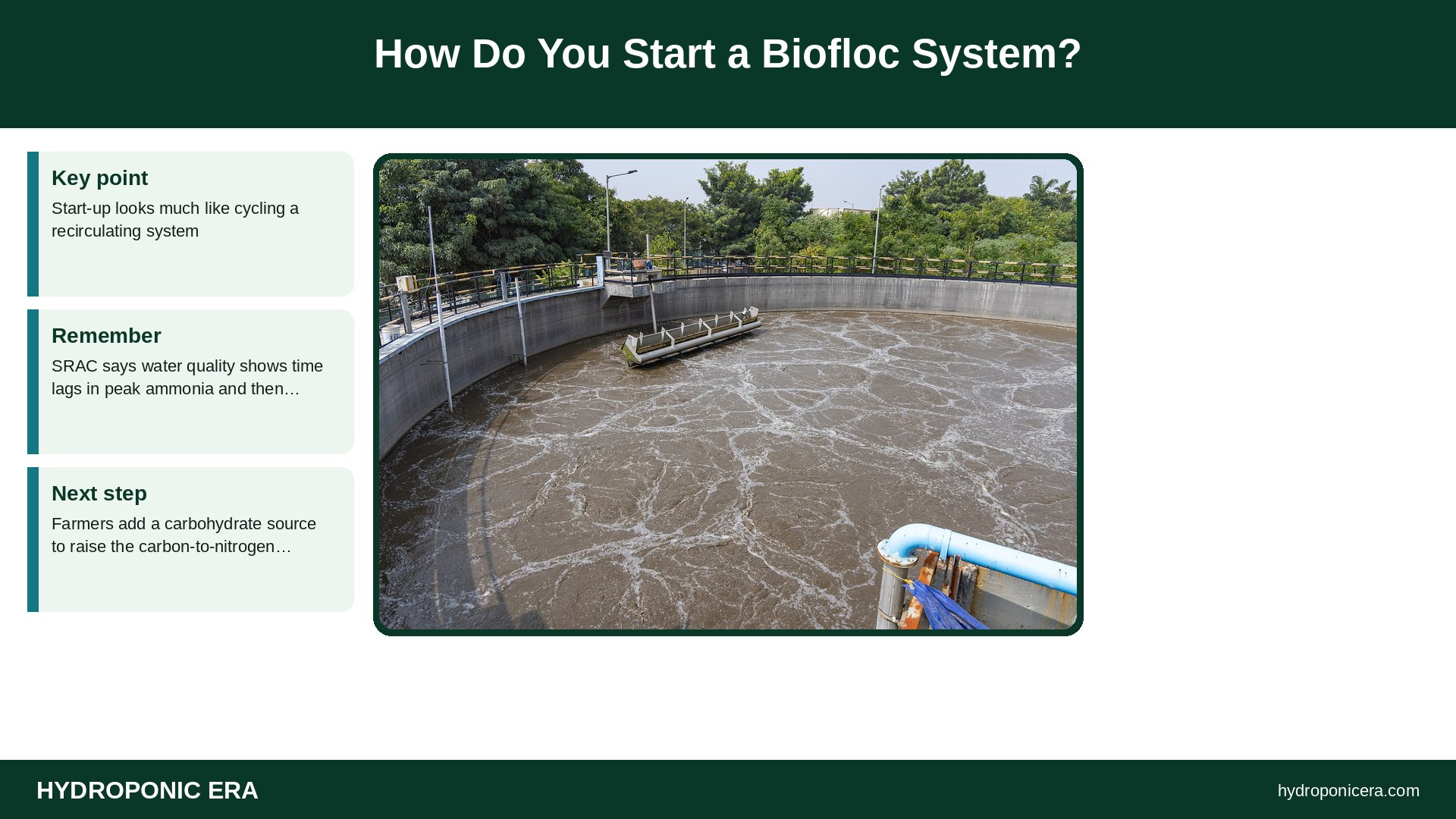
Start-up looks much like cycling a recirculating system. SRAC says water quality shows time lags in peak ammonia and then nitrite while bacterial populations develop. Farmers add a carbohydrate source to raise the carbon-to-nitrogen ratio, because heterotrophic bacteria need organic carbon to absorb ammonia. Purdue lists molasses, sugar, sucrose, dextrose and glycerin as additives.
- Use a lined pond or tank; SRAC says most systems are lined to prevent erosion.
- Install aeration that both oxygenates and mixes the whole water column.
- Stock and feed lightly while ammonia and nitrite peaks pass.
- Add dissolved carbohydrate; SRAC suggests 0.5 to 1 part sugar per part of 30–38% protein feed by weight.
- Test ammonia, nitrite, pH and alkalinity often.
Purdue advises diluting the carbon source before adding it so it does not sink to the bottom. The nitrification steps are explained in our aquaponics biofilter guide.
What Happens to Ammonia in the Water?
Three microbial routes remove it. Algae and heterotrophic bacteria absorb ammonia directly, while nitrifying bacteria oxidize it. SRAC 4502 explains that Nitrosomonas convert toxic ammonia to toxic nitrite, and Nitrobacter then convert nitrite to nitrate, which is non-toxic at the levels usually found in recirculating systems. Both steps consume oxygen, adding to aeration demand.
SRAC 4503 adds that sunlit ponds can abruptly shift from a green, algae-driven system to a brown, bacteria-driven one as feeding rates rise.
How Much Aeration Does Biofloc Need?
Far more than a normal pond. SRAC reports shrimp ponds of this type use about 10–14 hp per acre (25–35 hp/ha), and some intensive tilapia systems use 40–61 hp per acre (100–150 hp/ha). It calls aeration absolutely essential, since bacteria and fish all use oxygen, and warns biofloc is not a good choice where electricity is unreliable or expensive.
Purdue adds that suspended solids reduce how much oxygen water holds. For small setups, see our aquaponics air pump guide.
How Do You Manage Solids and Alkalinity in Biofloc?
Measure suspended solids weekly and replace lost alkalinity. SRAC recommends Imhoff cones read after 10 to 20 minutes of settling, targeting 10–15 mL/L for shrimp and 25–50 mL/L for tilapia. Nitrification consumes alkalinity, so regular liming is needed. Purdue keeps shrimp alkalinity above 150 mg/L, adding sodium bicarbonate at about 0.25 part per part of feed.
- Remove excess solids with settling tanks or clarifiers when cones exceed the target.
- SRAC warns uncontrolled solids can reach levels that clog gills.
- Our alkalinity and bicarbonate guide explains buffering basics.

Is biofloc good for beginners?
Not usually. SRAC says some technical sophistication is needed to run it well.
What fish are best for biofloc?
Shrimp, tilapia and carps, according to SRAC.
Why add sugar to biofloc?
Carbon helps heterotrophic bacteria absorb ammonia; Purdue targets a 12–15:1 C:N ratio.
How often is water changed?
SRAC reports only 0.5–1 percent exchange per day.
Can biofloc run without power?
No. Constant aeration and mixing are essential, so reliable power is critical.
Sources
- Southern Regional Aquaculture Center. SRAC 4503: Biofloc Production Systems for Aquaculture.
- Purdue Extension. FNR-495-W: Marine Shrimp Biofloc Systems, Basic Management Practices.
- Southern Regional Aquaculture Center. SRAC 4502: How to Start a Biofilter.
- Photo credits (Wikimedia Commons, edited with titles): Biofloc Tilapia Harvest by M Joko Apriyo Putro (CC BY-SA 4.0); Oreochromis-niloticus-Nairobi by Bjørn Christian Tørrissen (CC BY-SA 3.0); Aeration tank activated sludge process STP Bengaluru India by Vraj Acharya, WELL Labs (CC BY-SA 4.0); Fish Feed Pellets by Narek75 (CC BY-SA 4.0)