
Is cabomba easy to grow in an aquarium? It is a stem plant that needs good light. Tropica calls Cabomba aquatica the least demanding species in its genus, yet notes it still struggles in poorly lit tanks. Give it medium light or brighter. Never release it outdoors: USGS reports Carolina fanwort as an invasive aquarium escape in many US states.
Key takeaway: This plant rewards bright light, soft slightly acidic water and regular trimming with dense, fan-shaped green foliage. Plant it in groups toward the back of the tank. Because Carolina fanwort spreads from stem fragments and has clogged lakes and canals, bag all trimmings for the trash.
| Need | Detail | Source |
|---|---|---|
| Light | Medium; struggles in dim tanks | Tropica |
| CO2 | Low demand (C. aquatica) | Tropica |
| Height | 12–31 in (30–80 cm) | Tropica |
| Stem width | 2–3 in (5–8 cm) | Tropica |
| Temperature | 55–81°F (13–27°C) preferred range | USGS NAS |
| pH | 4.8–7.8; loses leaves in alkaline water | USGS NAS |
What Is Cabomba?
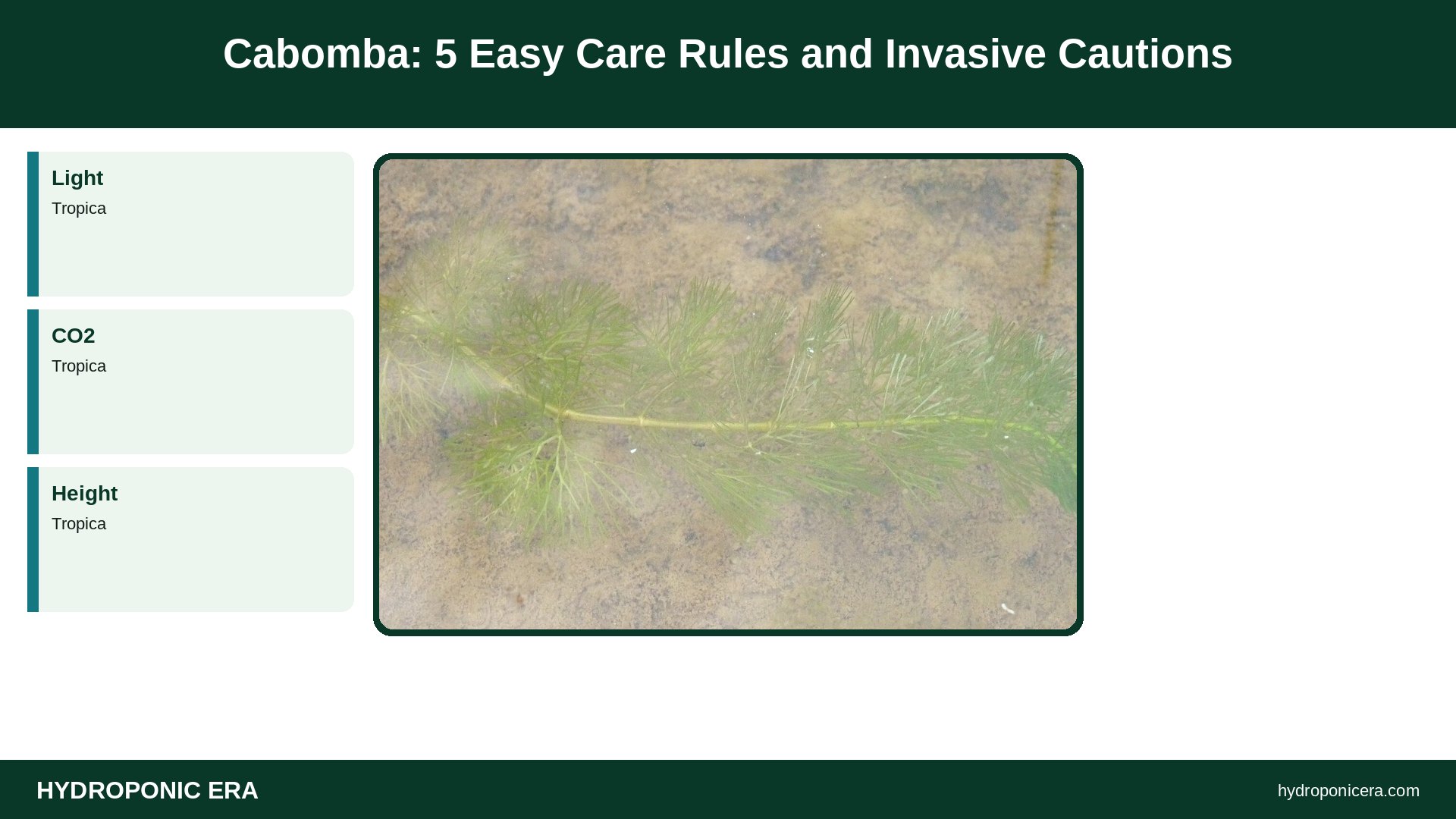
Cabomba, or fanwort, is a rooted aquatic stem plant with finely divided, fan-shaped leaves. UF/IFAS says Carolina fanwort’s underwater leaves are about 2 in (5 cm) across, with rare diamond-shaped floating leaves and white to purplish flowers about 0.5 in (1.3 cm) wide. Tropica describes Cabomba aquatica as a popular South American aquarium plant prized for its foliage.
USGS lists Cabomba caroliniana as native to southern Brazil, Paraguay, Uruguay, northeast Argentina and the southern and eastern United States. UF/IFAS calls it a common Florida native.
What Is the Difference Between Cabomba Aquatica and Carolina Fanwort?
They are related species with similar care. Tropica sells Cabomba aquatica, a South American plant it calls the least demanding of its genus, with stems 2–3 in (5–8 cm) wide. Carolina fanwort (C. caroliniana) is the species USGS tracks as invasive in the US. Both have finely divided, fan-shaped underwater leaves and can look alike in shops.
| Trait | C. aquatica | C. caroliniana |
|---|---|---|
| Origin | South America (Tropica) | South America and eastern US (USGS) |
| US status | Aquarium plant | Invasive escape in many states |
| Habitat | Aquarium plant | Water usually under 10 ft (3 m) deep |
UF/IFAS adds that fanwort’s submersed parts resemble Limnophila; look for small, diamond-shaped floating leaves to tell fanwort apart.
How Much Light Does Cabomba Need?
It needs at least medium light. Tropica rates Cabomba aquatica medium light demand and low CO2 need, but warns that even this least demanding species causes problems in poorly lit aquariums. If your light is weak, Tropica suggests Limnophila sessiliflora as an alternative that requires less light. Bright, steady light keeps stems compact and leafy.
- Choose a fixture with our grow light for aquarium guide.
- Add CO2 for faster growth; see our CO2 enrichment guide.

How Do You Plant Cabomba?
Split bundles into single stems and plant them in groups. Tropica advises removing the anchor, splitting the bunch, stripping leaves from the lowest 2 in (5 cm), removing damaged leaves and planting each stem with some space between. Roots develop soon after planting. Tropica says it is most decorative when planted in groups.
- Remove the lead anchor or foam band.
- Separate stems and trim damaged tips.
- Strip the lowest 2 in (5 cm) of leaves.
- Push each stem into the substrate with space between them.
- Place groups in the background, since stems reach 12–31 in (30–80 cm).
What Water Does Cabomba Prefer?
Soft, slightly acidic, nutrient-rich water suits it best. USGS reports Carolina fanwort grows well in high-nutrient, low-pH water, tends to lose leaves in more alkaline water, and is inhibited by high calcium. It prefers 55–81°F (13–27°C) and grows best in silty substrate, with reduced vigor in hard substrates.
- Test hardness with our GH and KH water tests guide.
- Feed with a liquid fertilizer; see fertilizer for plants in water.
- Hard, alkaline tap water is a common reason stems shed leaves.

Why Is Cabomba Considered Invasive?
It spreads easily from fragments. USGS says fanwort stems become brittle in late summer and break apart, and vegetative spread is its main route to new waters. Aquarium release was recorded in the Lake Michigan drainage in 1935, and it is now established in many US states. Dense growth can impede water flow and crowd out native plants.
USGS adds that Australia regards the species as a “Weed of National Significance,” and that decaying mats can cause dramatic oxygen drops and foul-smelling water.
How Do You Trim and Dispose of Cabomba Safely?
Trim tops and replant them, then trash the rest. Cut overgrown stems and replant the healthy tips. Never put cuttings in ponds, ditches or drains, because USGS reports that fragments start new populations. Seal surplus stems in a bag before disposal. Consider native or low-risk plants for outdoor water features.
- Cut tall stems a few inches below the surface.
- Replant healthy tops in the substrate.
- Bag extra cuttings and place them in household trash.
- Grow hornwort or anacharis if you want hardy alternatives, checking local rules first.
USGS notes large numbers of plants are shipped from Florida for commercial sale, and aquarists who release or lose plants are probably responsible for some introductions, so careful disposal genuinely matters.

Is cabomba good for beginners?
It is moderately easy if you have medium to bright light; Tropica says it struggles in dim tanks.
Does cabomba need CO2?
Tropica rates Cabomba aquatica low CO2 demand, though CO2 speeds growth.
Why is my cabomba losing leaves?
Low light, alkaline water or high calcium are common causes, per Tropica and USGS.
Can cabomba live in a pond?
Do not plant it outdoors; USGS documents it as an invasive escape.
How tall does cabomba grow?
Tropica lists 12–31 in (30–80 cm).
Sources
- Tropica Aquarium Plants. Cabomba aquatica/4431).
- U.S. Geological Survey. Carolina fanwort (Cabomba caroliniana) species profile.
- University of Florida IFAS. Cabomba caroliniana, fanwort.
- Photo credits (Wikimedia Commons, edited with titles): Cabomba caroliniana leaves by Show ryu (CC BY-SA 3.0); Cabomba aquatica 1 (Piotr Kuczynski) by Piotr Kuczynski (CC BY-SA 3.0); Glow light tetra by Jim Zamichieli (CC BY-SA 3.0); Planted Tank 03 – Flickr – The Wandering Angel by The Wandering Angel from Makati City, Philippines (CC BY 2.0)