
How do you grow pickerelweed in a pond? Plant pickerelweed in rich loam at the pond edge, in full sun, under up to 12 in (30 cm) of water. NC State Extension says it tolerates occasional flooding to 20 in (51 cm). Keep water above the soil but below the leaves year-round, and divide clumps regularly.
Key takeaway: Pickerelweed is a hardy native emergent plant with spikes of violet-blue flowers from summer into fall. It grows 2–4 ft (0.6–1.2 m) tall, spreads by thick rhizomes, and feeds bees, butterflies and ducks. It is easy as long as it never dries out, according to the Lady Bird Johnson Wildflower Center.
| Need | Detail | Source |
|---|---|---|
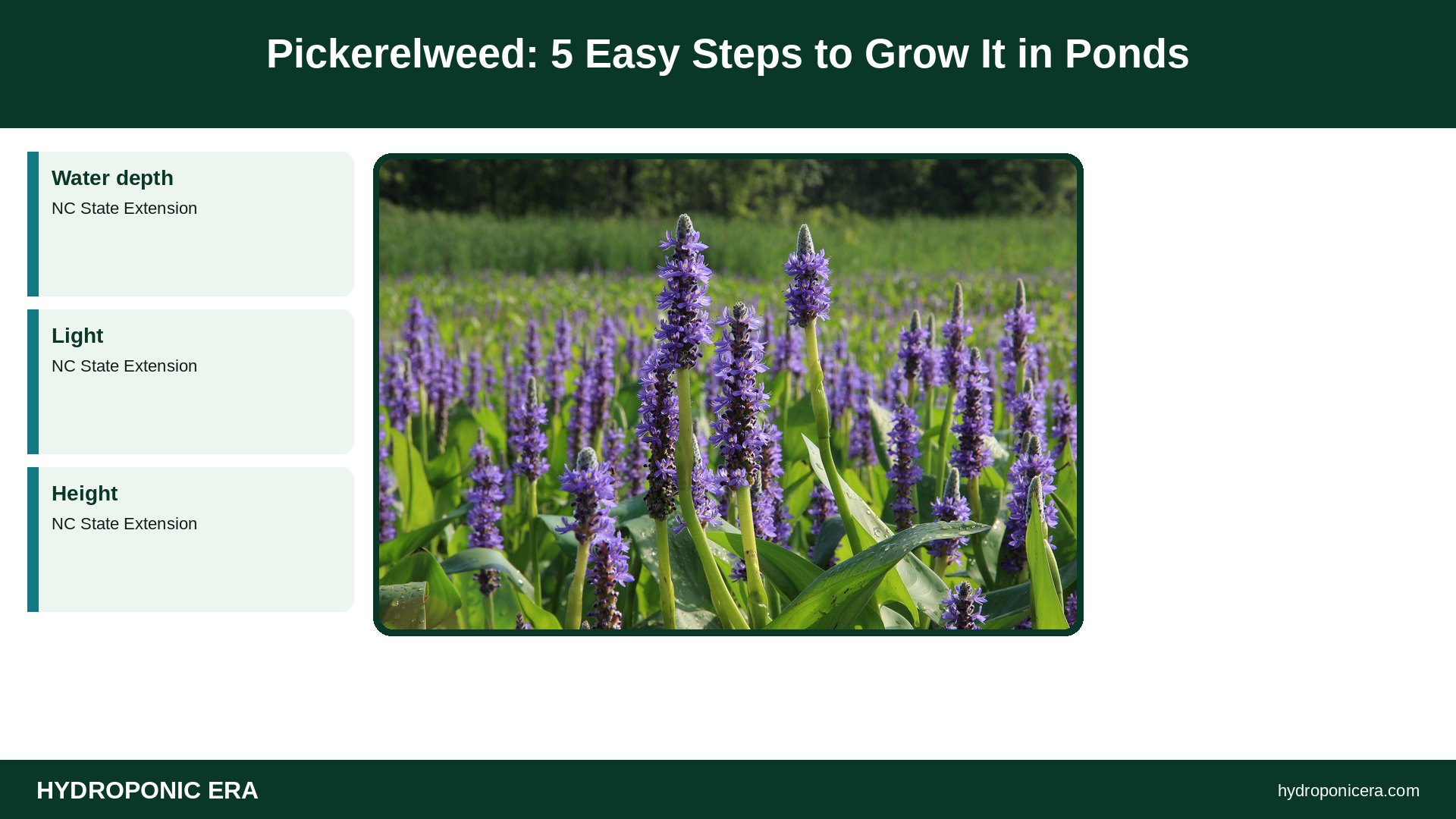
| Water depth | Up to 12 in (30 cm); floods to 20 in (51 cm) | NC State Extension |
| Light | Full sun to part shade | NC State Extension |
| Height | 2–4 ft (0.6–1.2 m) | NC State Extension |
| Hardiness | USDA zones 3a–10b | NC State Extension |
| Bloom | June to September (Texas data) | Wildflower Center |
| Soil | Rich loam, clay, sand or mud | NC State, Wildflower Center |
What Is Pickerelweed?
Pickerelweed (Pontederia cordata) is a native emergent perennial in the Pontederiaceae family. NC State Extension says it grows along shallow shorelines up to 4 ft (1.2 m) tall and spreads by thick rhizomes into large colonies. The Wildflower Center notes the name reflects that the plant and pickerel fish share the same shallow, quiet water habitat.
UF/IFAS describes leaves up to 5 in (13 cm) wide and usually twice as long, with heart-shaped or rounded bases. The Wildflower Center lists it as native to the lower 48 states and Canada.
How Deep Should Pickerelweed Be Planted?
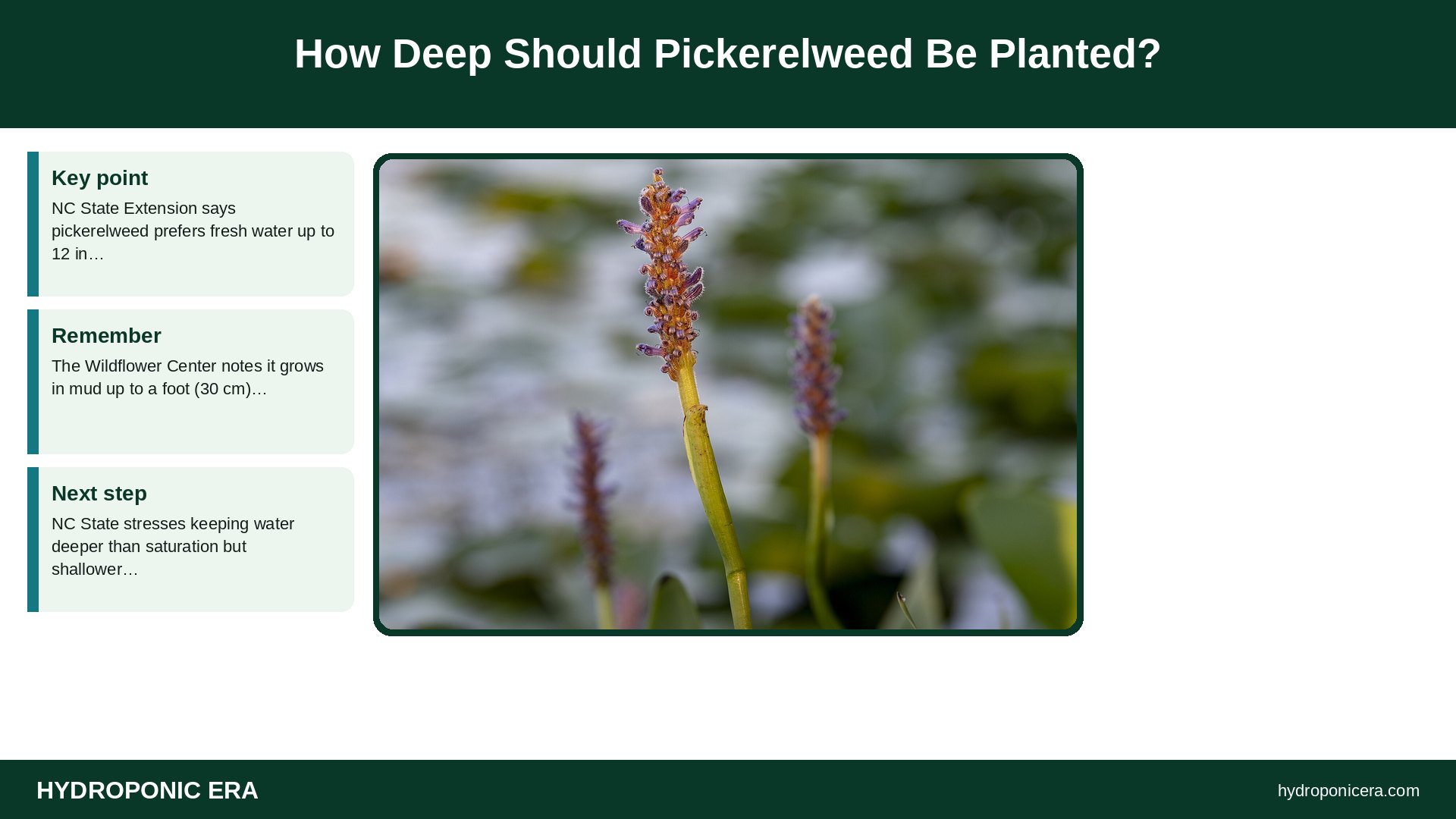
Shallow water is best. NC State Extension says pickerelweed prefers fresh water up to 12 in (30 cm) deep, tolerating occasional floods to 20 in (51 cm). The Wildflower Center notes it grows in mud up to a foot (30 cm) under water. NC State stresses keeping water deeper than saturation but shallower than the leaves all year.
- Fill a wide aquatic basket with heavy loam or clay soil.
- Set the rhizome just below the soil surface.
- Top with gravel to hold soil in place.
- Lower the basket onto a shelf so the crown sits under 12 in (30 cm) of water.
How Much Sun Does Pickerelweed Need?
Give it full sun for the best flowering. NC State Extension lists full sun, meaning six or more hours of direct light, and also part shade of two to six hours. It prefers rich loamy soils but tolerates poor soils and heat. The Wildflower Center rates its water use as high and its light needs as sun to part shade.
When Does Pickerelweed Bloom?
It flowers through summer. NC State Extension says the tall spikes of lavender-blue flowers last from summer through fall and stand well above the water. The Wildflower Center lists bloom from June to September, with flowers on a spike about 6 in (15 cm) long opening from the bottom up. UF/IFAS notes that in Florida it flowers year-round.
White-flowered forms exist; NC State lists the cultivar ‘Alba’.
Is Pickerelweed Good for Wildlife?
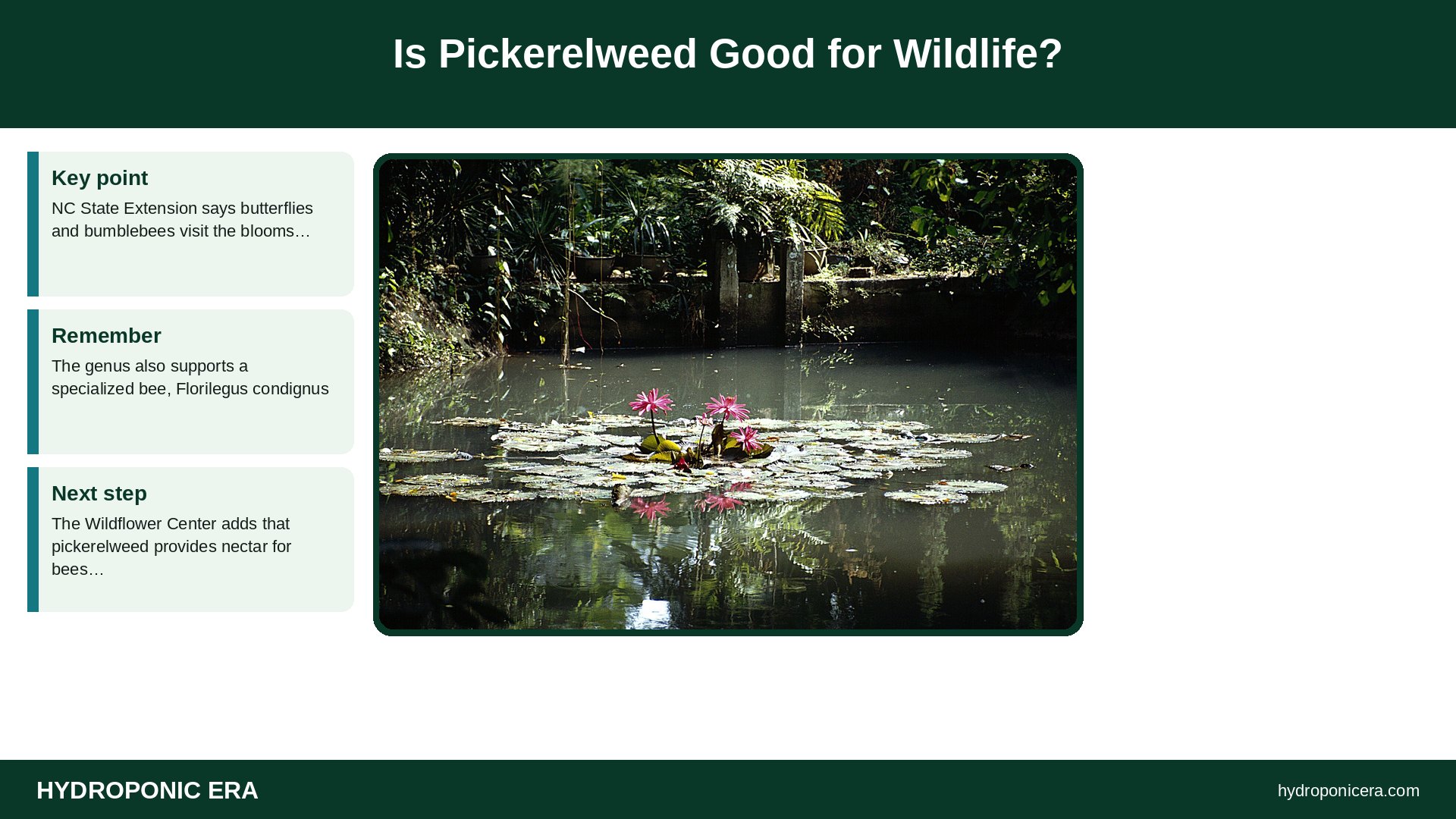
Yes. NC State Extension says butterflies and bumblebees visit the blooms, ducks eat the seeds, fish shelter among the underwater stems, and dragonflies and damselflies lay eggs on the stems. The genus also supports a specialized bee, Florilegus condignus. The Wildflower Center adds that pickerelweed provides nectar for bees and butterflies and suits wetland habitat gardens.
- Pair it with other plants in our koi pond plants guide.
- Use it in a planted bog filter for shallow, nutrient-rich zones.
- Plant it in a pond aquaponics edge bed.
Does Pickerelweed Help Balance a Pond?
It helps as part of a planted pond. Kansas State University Research and Extension recommends covering 50 to 75 percent of a water garden’s surface with plants, more in small or sunny ponds. It explains that shading reduces algae photosynthesis. Pickerelweed adds tall edge foliage, while lilies, floaters and submerged plants handle open water.
| Plant group | Role | Example |
|---|---|---|
| Emergent | Edge foliage, wildlife habitat | Pickerelweed |
| Lilies and floaters | Shade surface, keep water cool | Water lilies |
| Submerged | Compete with algae, shelter fish | Hornwort |
The Wildflower Center notes the U.S. Army Corps of Engineers rates it an obligate wetland plant (OBL) in every region listed, meaning it almost always grows in wetlands.
How Do You Keep Pickerelweed From Spreading Too Much?
Divide it regularly. The Wildflower Center advises regular division to keep the plant from growing too large, and UF/IFAS calls it a prolific grower that can cover large areas. Growing it in baskets limits rhizome spread in lined ponds. NC State suggests allowing 3–6 ft (0.9–1.8 m) of space and notes it has no serious pest or disease problems.
- Lift baskets in spring when new shoots appear.
- Cut rhizomes into sections, each with healthy shoots.
- Replant the best pieces and compost or share the rest.
- Remove spent leaves in fall to keep the pond tidy.
Unlike invasive floaters such as water hyacinth, pickerelweed is native across much of North America, but it can still crowd small ponds.
Is pickerelweed invasive?
It is native to much of North America, per the Wildflower Center, but can spread into large colonies.
Can pickerelweed grow in a container?
Yes. NC State Extension says it can be grown in a large container or water garden.
Is pickerelweed edible?
NC State says seeds can be eaten raw or dried and young leaves used in salads.
Is pickerelweed deer resistant?
NC State lists it as deer resistant, though the Wildflower Center notes deer feed on it.
How cold-hardy is pickerelweed?
NC State lists USDA zones 3a to 10b.
Sources
- NC State Extension. Pontederia cordata, North Carolina Extension Gardener Plant Toolbox.
- University of Florida IFAS. Pontederia cordata, pickerelweed.
- Kansas State University Research and Extension. MF2911: Water Gardening, Biological Balance.
- Lady Bird Johnson Wildflower Center, University of Texas at Austin. Pontederia cordata.
- Photo credits (Wikimedia Commons, edited with titles): Pontederia cordata 4 PP by Cephas (CC BY-SA 3.0); Slate Run – Pontederia cordata flower 1 by Sixflashphoto (CC BY-SA 4.0); RIBogorSeerose by Ziegler175 (CC BY-SA 4.0); Pond-edge plants at Achamore Garden – geograph.org.uk – 5446824 by M J Richardson (CC BY-SA 2.0)