
How do you convert lux to PPFD? To convert lux to PPFD, multiply the lux reading by a factor for your light source: 0.0185 for sunlight, about 0.0135 for cool white fluorescent, 0.0122 for HPS and roughly 0.014 to 0.018 for white LEDs. Apogee Instruments publishes these factors. The result is in µmol/m²/s, but treat it as an estimate.
Key takeaway: PPFD = lux x source factor; sunlight 0.0185, HPS 0.0122, white LEDs about 0.014 to 0.018.
| Light source | Lux to PPFD factor | 10,000 lux is about | Source |
|---|---|---|---|
| Sunlight | 0.0185 | 185 µmol/m²/s | Apogee |
| Cool white fluorescent | 0.0135 | 135 µmol/m²/s | Apogee |
| High pressure sodium | 0.0122 | 122 µmol/m²/s | Apogee |
| Metal halide | 0.0141 | 141 µmol/m²/s | Apogee |
| 3000K white LED | 0.0171 | 171 µmol/m²/s | Ashdown |
| 4000K white LED | 0.0143 | 143 µmol/m²/s | Ashdown |
What Is the Difference Between Lux and PPFD?
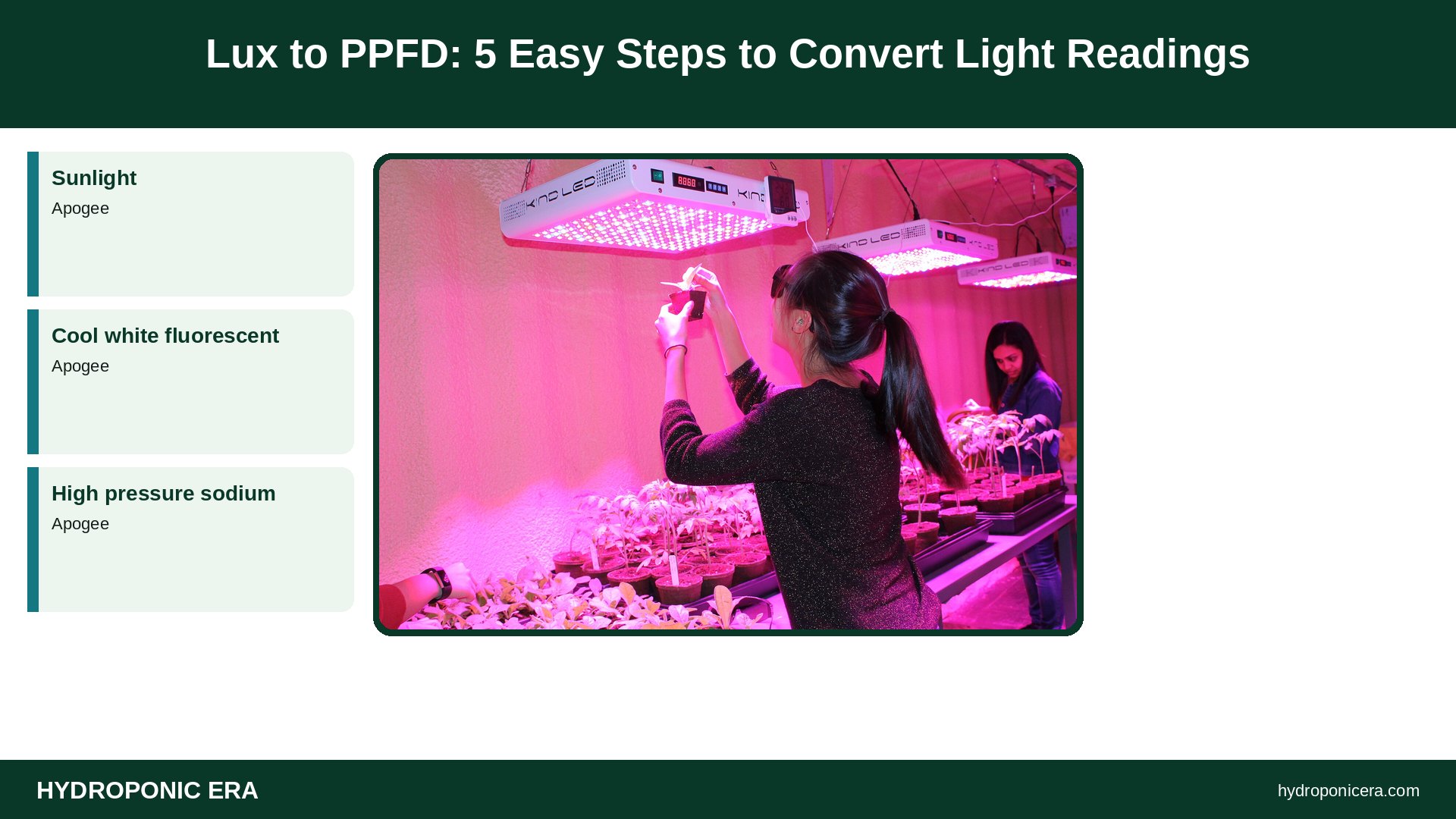
Lux measures light for human eyes; PPFD counts photons for plants. Apogee defines lux as one lumen per square meter. PPFD, in µmol/m²/s, counts photons from 400 to 700 nm. University of Hawaii CTAHR explains that a quantum meter measures PPFD, while lux weights wavelengths by human vision. That is why lux to PPFD needs a source-specific factor.
What Is the Lux to PPFD Formula?
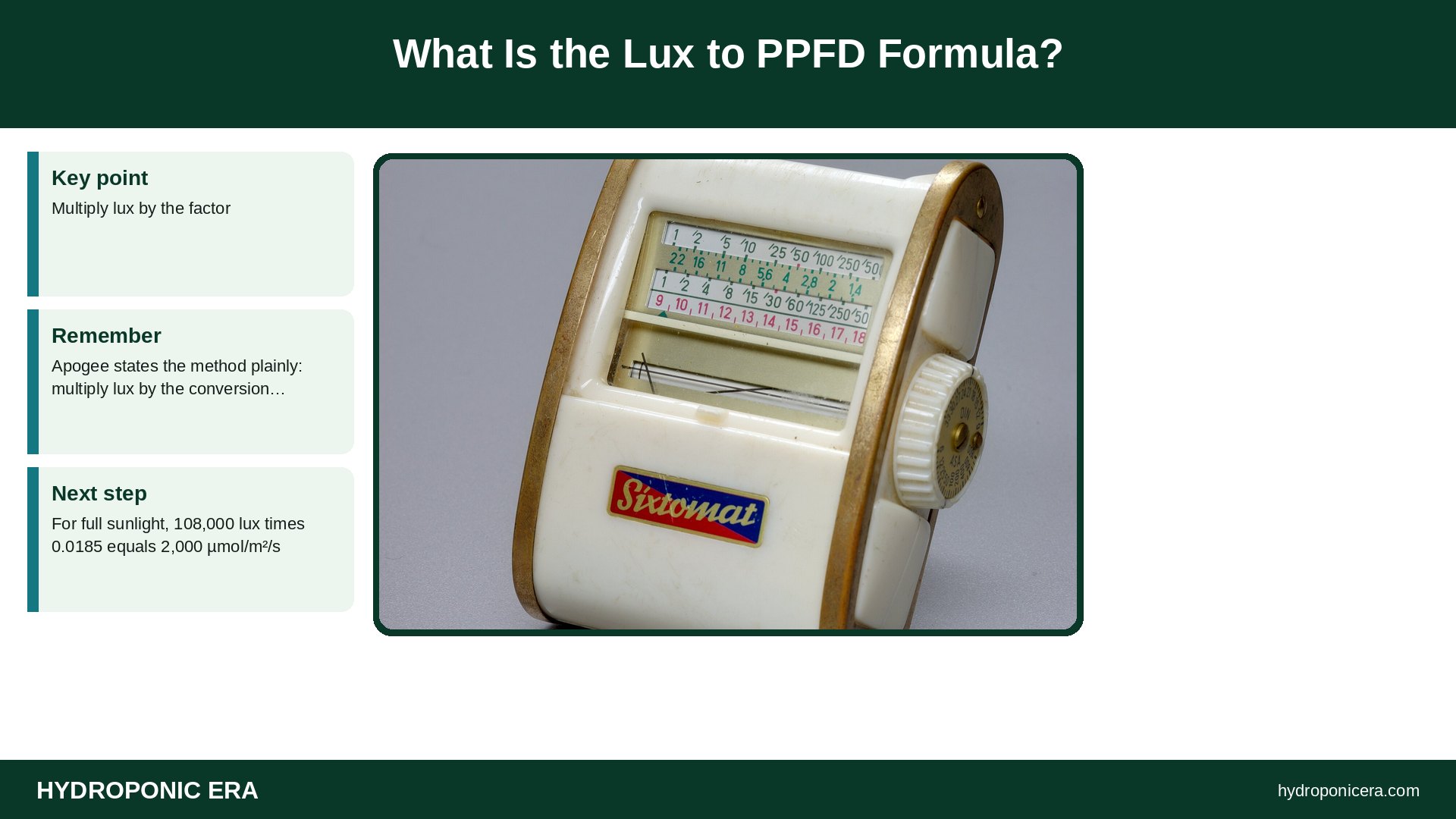
Multiply lux by the factor. Apogee states the method plainly: multiply lux by the conversion factor to get PPFD. For full sunlight, 108,000 lux times 0.0185 equals 2,000 µmol/m²/s. To go the other way, multiply PPFD by 54 for sunlight, 82 for mogul-base HPS, 71 for metal halide or 74 for cool white fluorescent.
How Do You Convert Lux to PPFD Step by Step?
- Identify the light source: sun, fluorescent, HPS, metal halide or LED color temperature.
- Take a lux reading at canopy height with the sensor level.
- Multiply by the matching factor from the table.
- Repeat at several canopy spots, center and edges, and average the readings.
- Compare the result with your crop’s target PPFD and daily light integral.
For targets by crop, see our guide to PPFD and DLI in hydroponics.
Why Do Lux to PPFD Factors Differ by Light Source?
Because spectra differ. Lighting scientist Ian Ashdown’s calculations show factors from 0.0117 for standard HPS to 0.0203 for incandescent light. Lux undercounts red and blue photons, which eyes see poorly but plants use well. Ashdown lists 0.0181 for a 2700K white LED, 0.0171 for 3000K, 0.0143 for 4000K and 0.0146 for 5000K.
Can You Convert Lux to PPFD for Red and Blue LEDs?
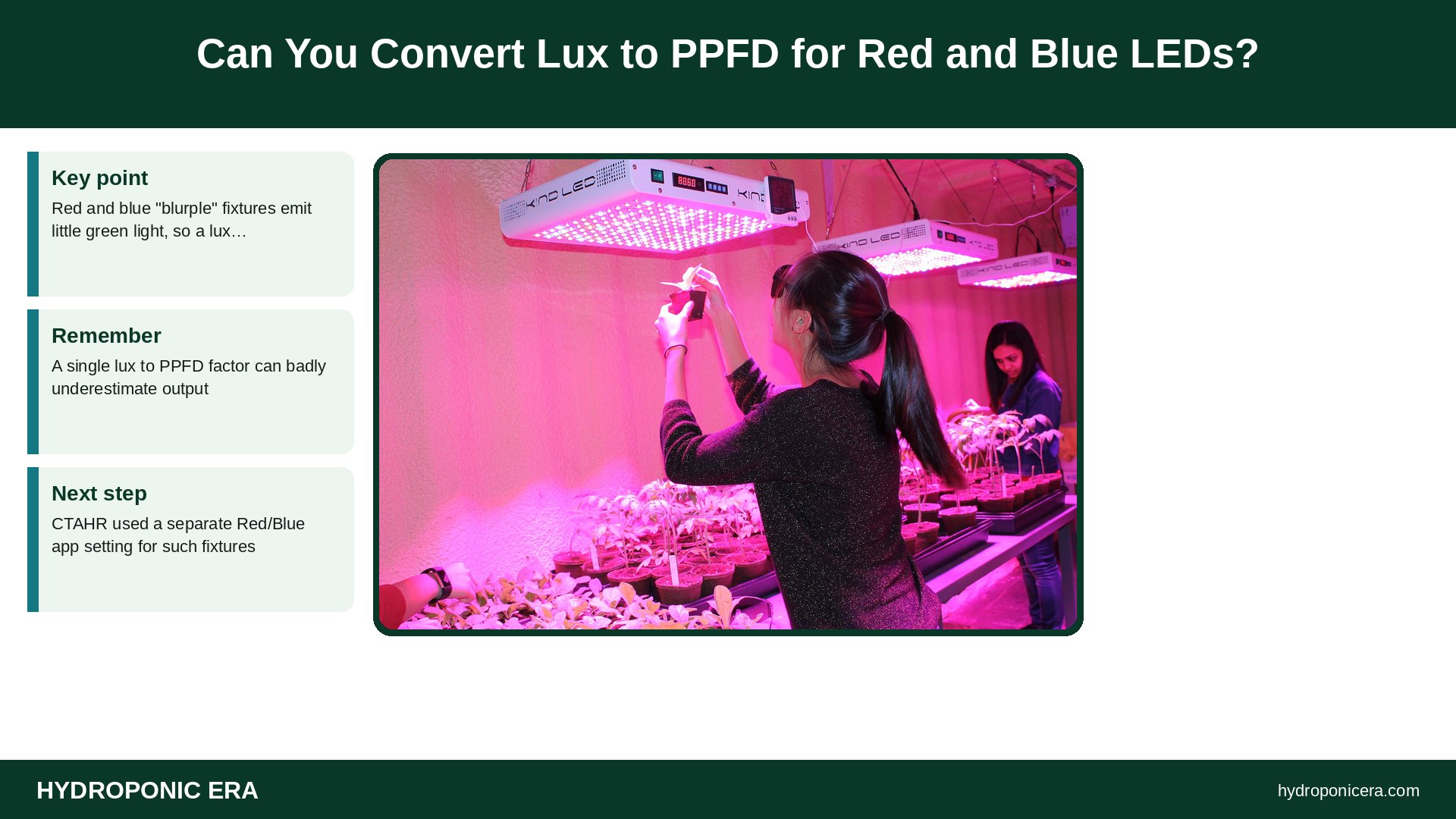
Not reliably. Red and blue “blurple” fixtures emit little green light, so a lux meter barely registers them while plants receive plenty of photons. A single lux to PPFD factor can badly underestimate output. CTAHR used a separate Red/Blue app setting for such fixtures. Use a quantum (PAR) meter for these lights instead.
Learn why spectrum matters in our guide to red vs blue light for plants.
How Accurate Are Phone Light Meter Apps?
Useful, but expect error. CTAHR tested two apps on a Google Pixel 6 under full-spectrum LEDs and found average errors of 27 and 47 µmol/m²/s with default settings. External calibration against a quantum meter cut that to about 21 and 19 µmol/m²/s. A low-cost custom sensor built in the study reached about 7 µmol/m²/s after calibration.
For a practical routine, read our guide to measuring canopy PPFD with a phone meter.
How Do Foot-Candles Fit In?
One step more. Apogee notes that lux differs from foot-candles by about a factor of 10; one foot-candle equals one lumen per square foot, or about 10.76 lux. Convert foot-candles to lux first, then apply the lux to PPFD factor. Older greenhouse references often use foot-candles, so this step helps you compare them with LED specs.
How Do You Turn PPFD Into Daily Light Integral?
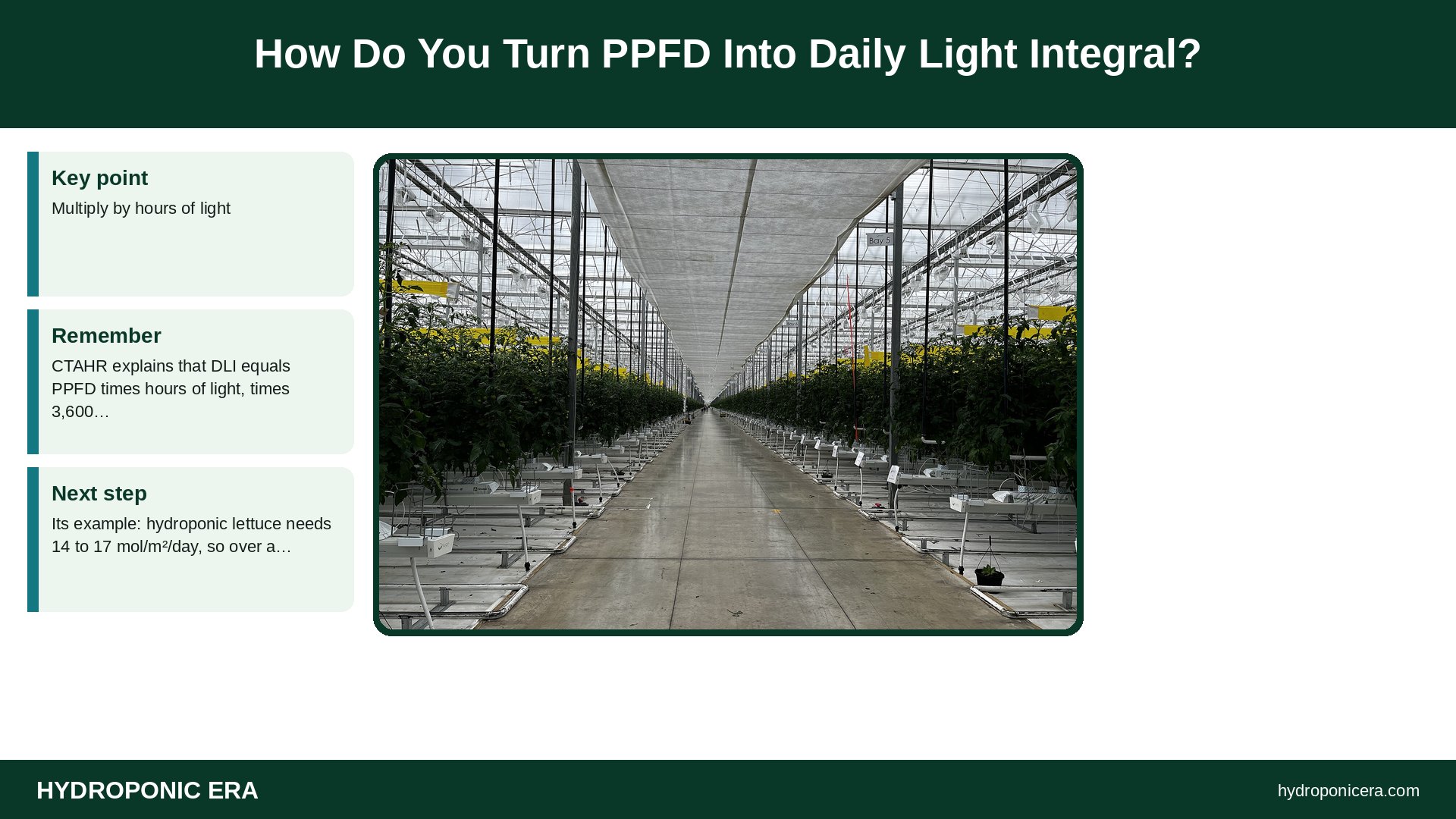
Multiply by hours of light. CTAHR explains that DLI equals PPFD times hours of light, times 3,600 seconds, divided by one million. Its example: hydroponic lettuce needs 14 to 17 mol/m²/day, so over a 16-hour photoperiod PPFD should be about 243 to 295 µmol/m²/s. Convert lux first, then calculate DLI.
FAQ About Lux to PPFD
How much PPFD is 20,000 lux of sunlight?
About 370 µmol/m²/s, using Apogee’s 0.0185 factor.
Is 1,000 lux enough for plants?
Under white LEDs that is only about 14 to 18 µmol/m²/s, too low for most crops.
Can I trust lux for my LED grow light?
Only roughly, unless the light is white; use a PAR meter for red and blue fixtures.
Who developed the conversion factors?
Apogee cites Thimijan and Heins, HortScience 18:818-822 (1983).
Does sensor angle matter?
Yes; keep the sensor level at canopy height for consistent readings.
Sources
- Apogee Instruments — PPFD to Lux Conversion
- Ian Ashdown, All Things Lighting Association — Photometry and Photosynthesis
- University of Hawaii at Manoa CTAHR, Kurasaki, Byrd and Kobayashi — Low-Cost Light Sensors for Indoor Agriculture, FST-68 (PDF)
- Photo credits (Wikimedia Commons, edited with titles): Terramera scientists working in a climate-controlled growth chamber located in Vancouver, BC. The space uses LED lighting, which supports plant growth. (50188965171) by Simon Fraser University – Communications & Marketing (CC BY 2.0); Sixtomat BW 1 by Berthold Werner (Public domain); Terramera scientists working in a climate-controlled growth chamber located in Vancouver, BC. The space uses LED lighting, which supports plant growth. (50188965171) by Simon Fraser University – Communications & Marketing (CC BY 2.0); U.S. Department of Agriculture (USDA) Rural Development (RD) Ohio business program staff visited Mucci Farms, a 75-acre greenhouse production farm in Huron, Ohio on September 25, 2024 – 2 by USDAgov (Public domain)
2 thoughts on “Lux to PPFD: 5 Easy Steps to Convert Light Readings”