
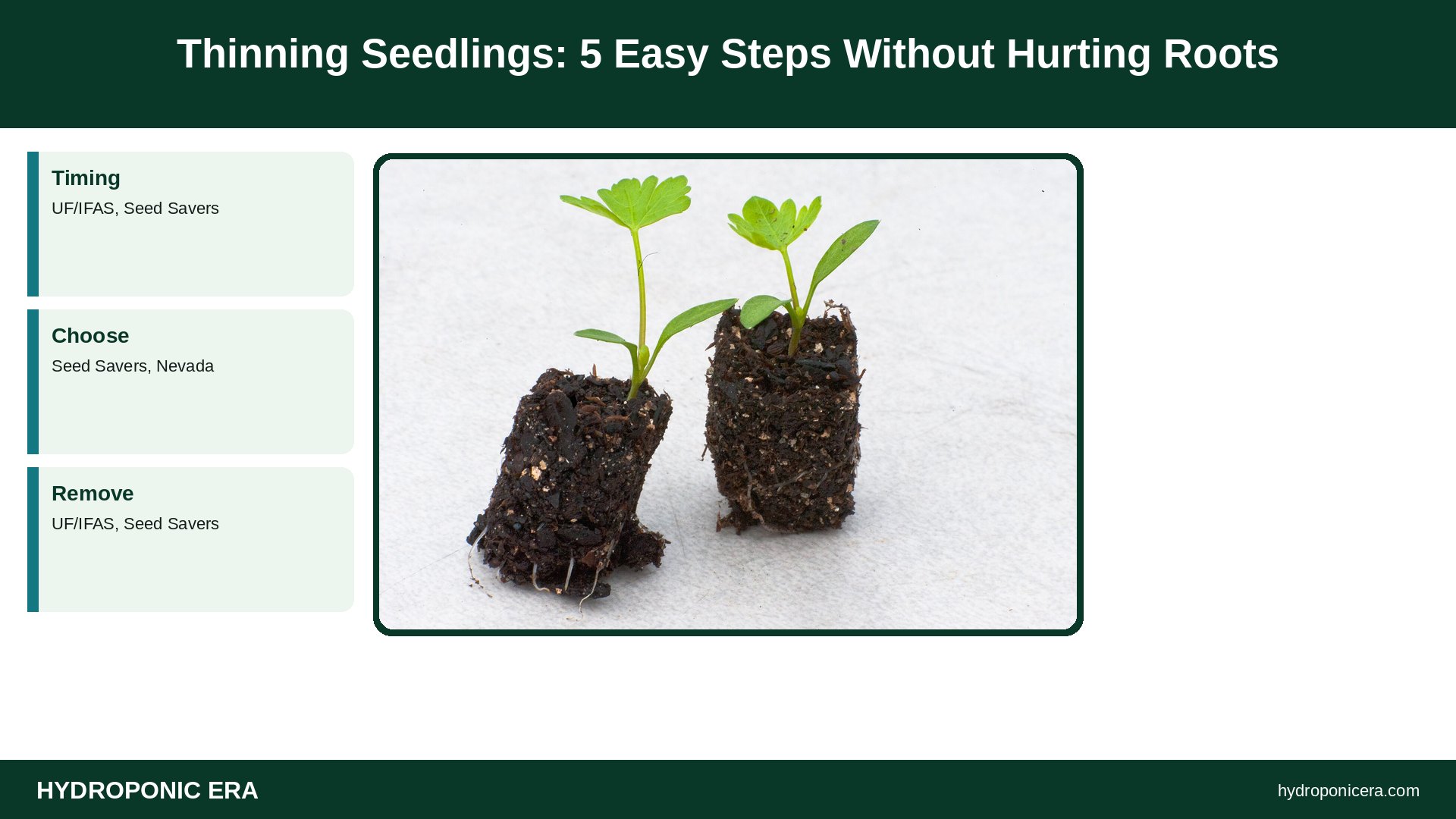
When and how should you do thinning seedlings? Start thinning seedlings at one to two sets of true leaves, or about 1 to 2 inches (2.5 to 5 cm) tall. Keep the strongest one per cell or spacing point and snip the rest at the surface with scissors instead of pulling, as UF/IFAS, Seed Savers Exchange and Nevada Extension advise.
Key takeaway: Thin at the first true leaves, keep the thickest stem, snip instead of pull, and space by the seed packet.
| Step | What to do | Why | Source |
|---|---|---|---|
| Timing | 1 to 2 sets of true leaves, or 1 to 2 in (2.5 to 5 cm) tall | Roots still small | UF/IFAS, Seed Savers |
| Choose | Keep the thickest, healthiest stem | Strongest plant wins | Seed Savers, Nevada |
| Remove | Snip at soil or plug level | Protects keeper roots | UF/IFAS, Seed Savers |
| Space | Follow seed packet spacing | Room for leaves and roots | Nevada, UF/IFAS |
| Aftercare | Water after thinning | Settles disturbed media | Nevada |
Why Is Thinning Seedlings Necessary?
Crowding stunts plants. Seed Savers Exchange says crowded seedlings compete for nutrients, water, air and root space, which stunts growth. Mississippi State Extension adds that close spacing reduces yields and makes plants more susceptible to disease. Nevada Extension warns that if you fail to thin, you can expect small, stunted and deformed produce.
When Should You Start Thinning Seedlings?
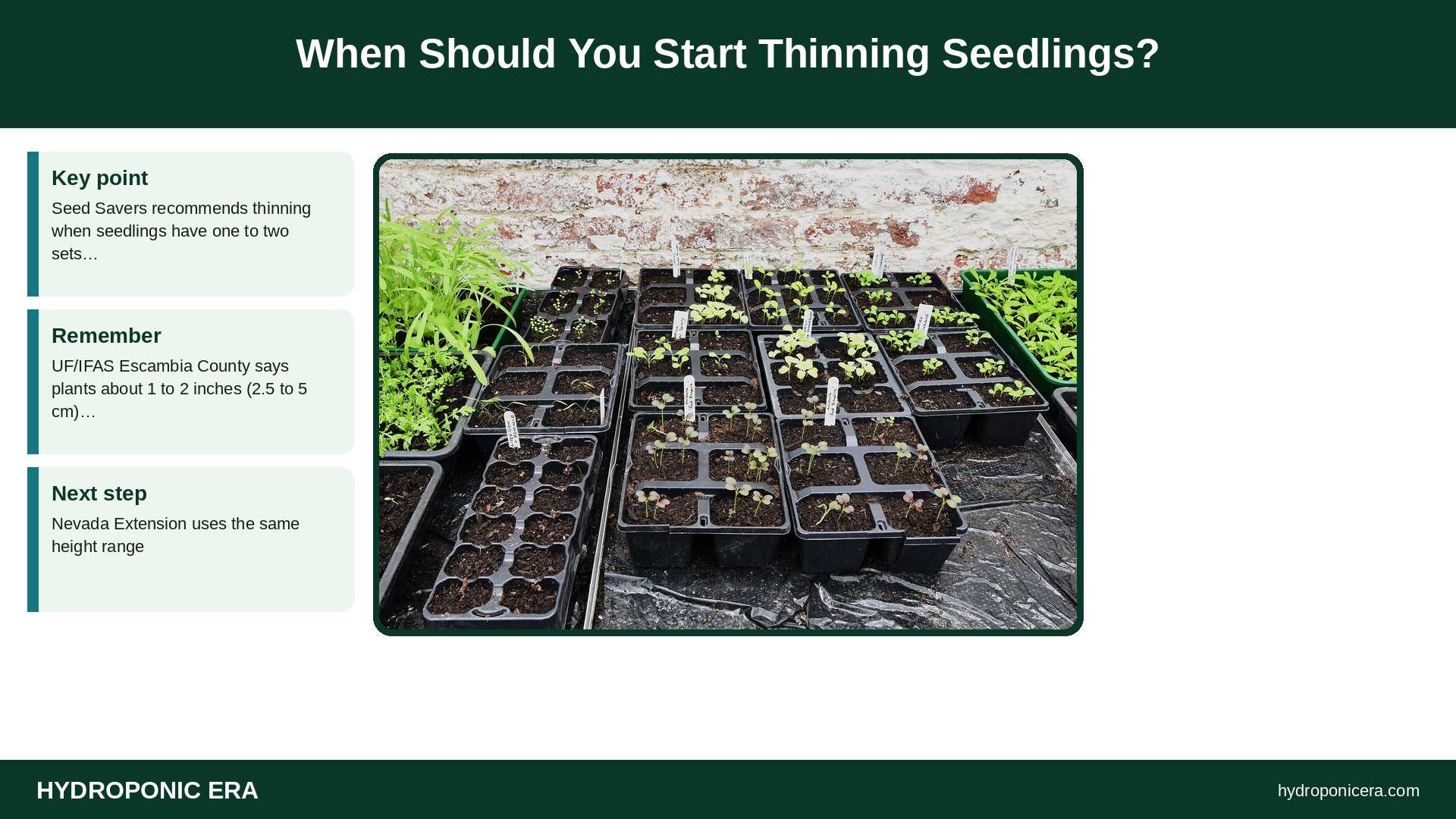
At the first true leaves. Seed Savers recommends thinning when seedlings have one to two sets of true leaves beyond the first seed leaves. UF/IFAS Escambia County says plants about 1 to 2 inches (2.5 to 5 cm) tall or with two sets of true leaves are ready. Nevada Extension uses the same height range.
If seedlings are stretching, see our guide to leggy seedlings in hydroponics.
Should You Pull or Cut Seedlings When Thinning?
Cut. Seed Savers’ preferred method is to snip, not rip: cut extra seedlings at soil level with scissors, because pulling can drag out the keeper if roots are tangled. UF/IFAS agrees that scissors prevent dislodging the roots of plants left to mature, though small seedlings can also be pulled by hand or with forceps.
Which Seedling Should You Keep When Thinning Seedlings?
The strongest one. Seed Savers says to look for the thickest stem, and if all are similar, pick the healthiest-looking seedling. Nevada Extension advises selecting the first healthy plant in the row, placing two fingers around it for protection and removing the excess plants, then moving to the next keeper.
How Does Thinning Seedlings Work in Cells or Plugs?
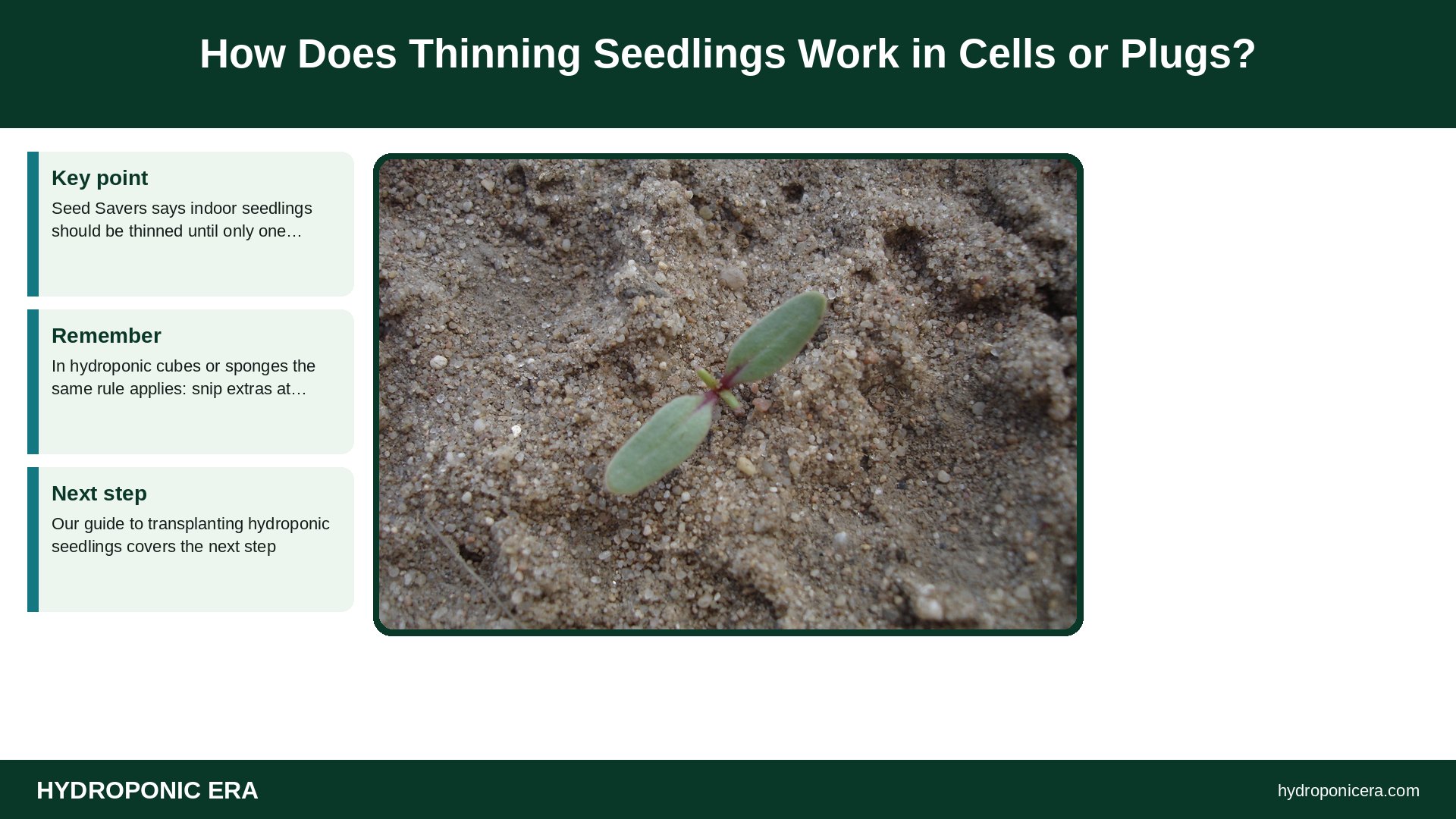
To one per cell. Seed Savers says indoor seedlings should be thinned until only one remains in each cell or pot. In hydroponic cubes or sponges the same rule applies: snip extras at the plug surface so you do not tear the media or the keeper’s roots before transplanting into net pots.
Our guide to transplanting hydroponic seedlings covers the next step.
How Far Apart Should Seedlings Be After Thinning?
Follow the packet. Nevada Extension gives examples such as head lettuce at 10 to 12 inches (25 to 30 cm) and carrots at 2 to 3 inches (5 to 8 cm). UF/IFAS points gardeners to its Florida Vegetable Gardening Guide spacing chart. In hydroponics, spacing depends on the system’s hole pattern and the crop’s mature size.
See hydroponic plant spacing for home systems for crop-by-crop numbers.
Can You Save the Seedlings You Thin?
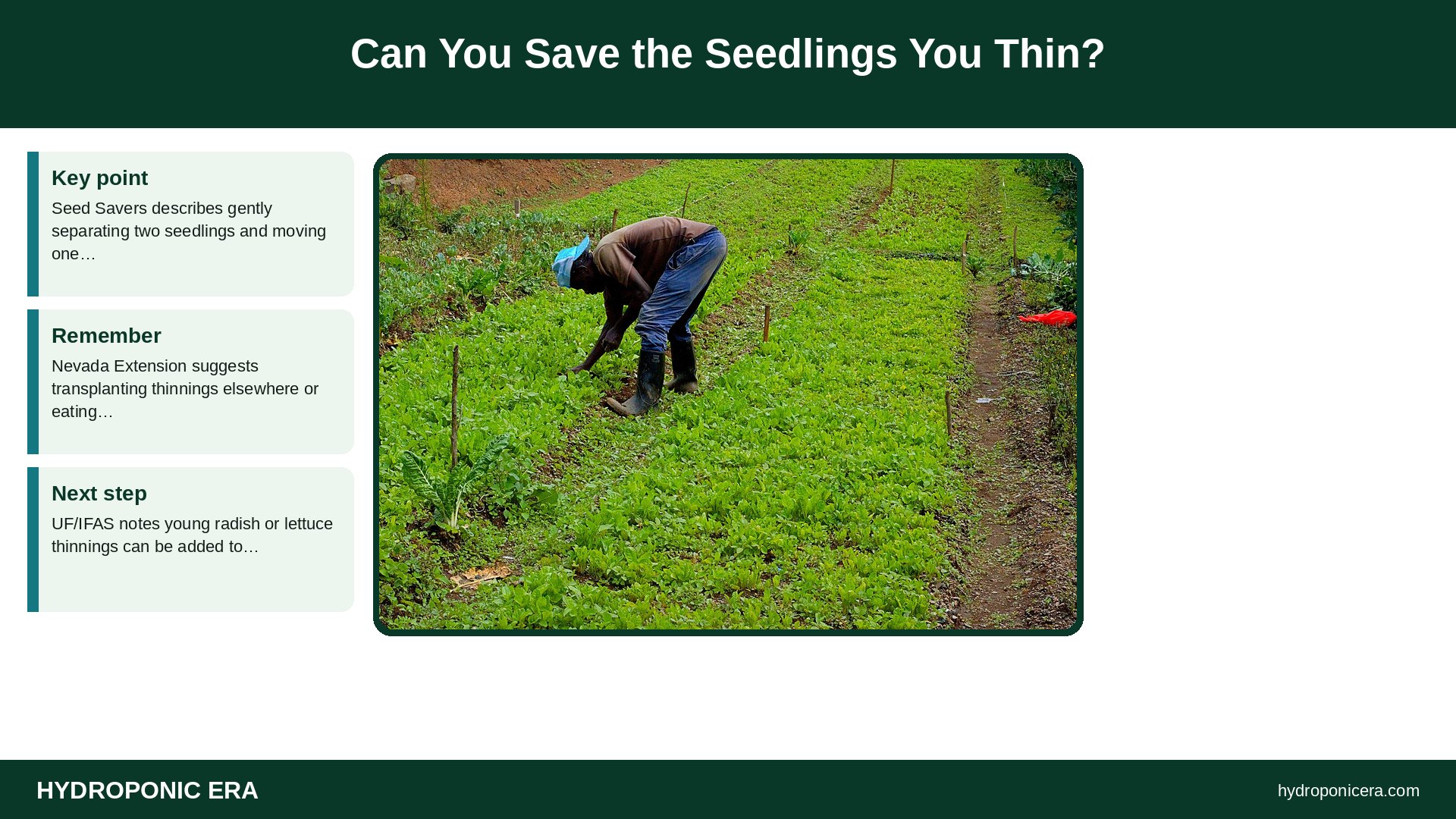
Sometimes. Seed Savers describes gently separating two seedlings and moving one to an empty cell, though delicate roots make this risky. Nevada Extension suggests transplanting thinnings elsewhere or eating them in salads or steamed like spinach. UF/IFAS notes young radish or lettuce thinnings can be added to dishes as sprouts.
- Water the media a day before.
- Pick the thickest, healthiest seedling.
- Snip the others at the surface.
- Repeat at the next spacing point.
- Water gently to settle the media.
How Does Thinning Differ for Hill-Planted Crops?
You thin to a set number per hill. Mississippi State Extension says sweet corn, okra and summer squash are thinned to one plant per hill, while pumpkins and melons are thinned to two. Beans, peas, beets and chard are often sown evenly down the row closer than final spacing, then thinned after seedlings establish.
How Can You Reduce Thinning Seedlings Work?
Sow fewer seeds per spot, so thinning seedlings takes minutes, not hours. Nevada Extension suggests marking the final spacing and planting three to four seeds at each point instead of along the whole row. Mississippi State says mixing tiny seeds with dry sand helps spread them thinly. Pelleted seed is another option for singulating small seeds like lettuce and carrots.
FAQ About Thinning Seedlings
Does thinning hurt the plants left behind?
Snipping instead of pulling avoids disturbing keeper roots, per UF/IFAS and Seed Savers.
Which crops need thinning most?
UF/IFAS lists small-seeded crops like lettuce, carrots, collards, basil and radish.
Should I water after thinning?
Nevada Extension advises irrigating after thinning.
How do I avoid crowding later?
See our net pot sizes and hole spacing by crop guide.
Sources
- UF/IFAS Extension Escambia County, Beth Bolles — Thinning Vegetable Seedlings
- Seed Savers Exchange, Sara Friedl-Putnam — Thinning Seedlings
- University of Nevada, Reno Extension — Fall Gardening Checklist for Southern Nevada
- Mississippi State University Extension — Vegetable Garden Tips
- Photo credits (Wikimedia Commons, edited with titles): Plugs ready for transplant (7027255351) by Dwight Sipler from Stow, MA, USA (CC BY 2.0); Temple Sowerby, Acorn Bank, Mizuna and lettuce seedlings – geograph.org.uk – 7625183 by Michael Garlick (CC BY-SA 2.0); Beta vulgaris cotyledons by Tepeyac (CC BY-SA 3.0); Man tending to seedlings of spinach by Cut angles (CC BY-SA 4.0)