
Can tomato late blight affect hydroponic tomatoes? Yes. Tomato late blight is caused by Phytophthora infestans, a water mold spread by airborne spores, so it can reach plants in any growing system. UC IPM says infection occurs in about 10 hours when humidity is above 90% and temperatures average 60–78°F (16–26°C). In hydroponics, prevention means clean transplants, low humidity and dry leaves.
Key takeaway: Tomato late blight is far more destructive than early blight. Wisconsin Extension says plants with symptoms cannot be saved and should be removed immediately. Indoor hydroponic growers rarely see it, but infected transplants or a humid greenhouse during a regional outbreak can bring it in.
| Factor | What sources report | Source |
|---|---|---|
| Cause | Phytophthora infestans, a water mold | UMN Extension |
| Favored conditions | Cool 60–70°F (16–21°C) and damp | UMN Extension |
| Fast infection | About 10 hours at 90%+ RH, 60–78°F (16–26°C) | UC IPM |
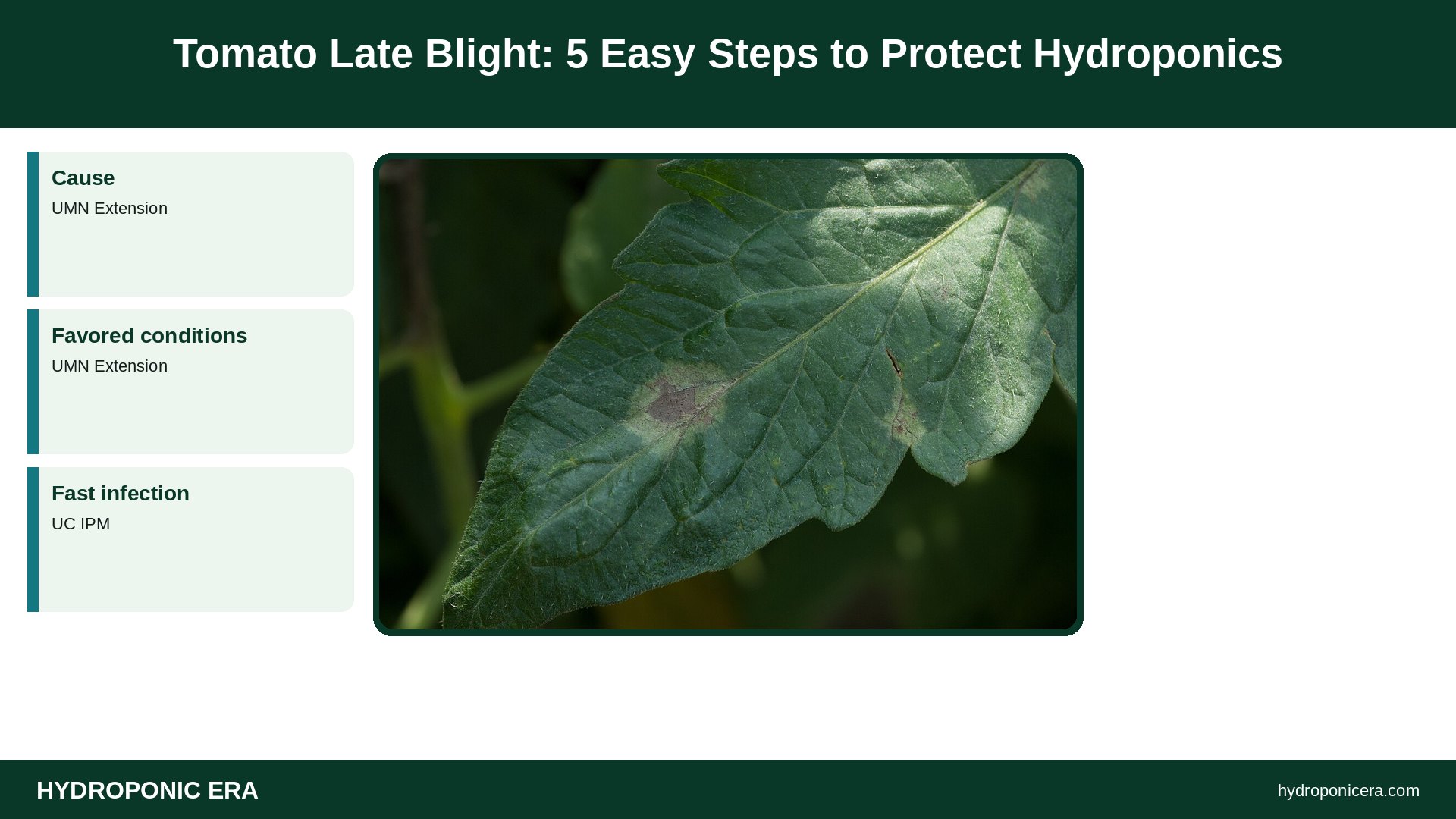
| Leaf symptom | Large dark blotches with green-gray edge | UMN Extension |
| Spore spread | Wind; thousands of sporangia per lesion | UMN Extension |
| Infected plants | Cannot be saved; remove them | Wisconsin Extension |
What Is Tomato Late Blight?
Tomato late blight is a fast-spreading disease of tomatoes and potatoes caused by Phytophthora infestans. University of Minnesota Extension notes it is a water mold, not a true fungus, and the same pathogen caused the Irish potato famine. It attacks leaves, stems and fruit and can cause total crop loss if untreated.
UMN says the pathogen favors cool 60–70°F (16–21°C), damp conditions, and prolonged hot, dry days halt its spread. NC State adds that nights in the 50s and 60s°F with days in the 80s°F plus rain, fog or heavy dew are ideal for infection.
How Do You Identify Tomato Late Blight?
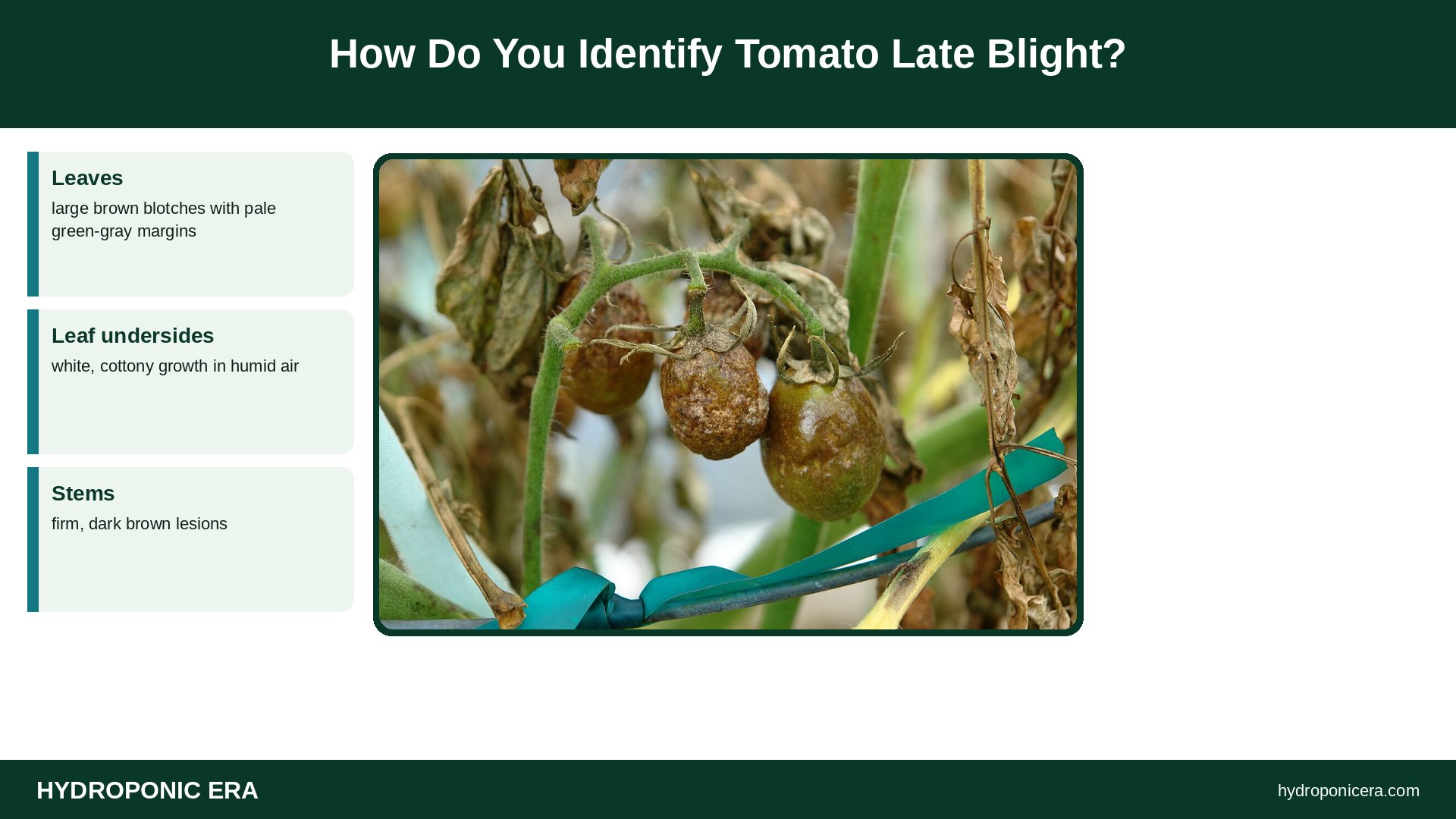
Identify tomato late blight by large, dark brown, greasy-looking blotches with a green-gray edge that are not limited by leaf veins. UMN describes firm, dark brown stem lesions and firm brown fruit spots. In high humidity, a thin white fuzzy growth appears on leaf undersides, stems and fruit.
- Leaves: large brown blotches with pale green-gray margins.
- Leaf undersides: white, cottony growth in humid air.
- Stems: firm, dark brown lesions.
- Fruit: firm brown patches, often on the shoulders.
UC IPM notes fruit symptoms usually begin on the shoulders because spores land from above. Rule out other causes of yellowing with our guide to hydroponic tomato yellow leaves before acting.
How Does Tomato Late Blight Reach Hydroponic Plants?
Tomato late blight reaches hydroponic plants mainly through infected transplants and windblown spores. UMN lists infected potato seed tubers, infected tomato transplants and windblown sporangia as the common routes. Under cool, wet conditions a single lesion can produce thousands of spores in under five days, so a greenhouse vent can let it in.
Fully indoor rooms with filtered air and seed-started plants are at low risk. Greenhouses and high tunnels near potato fields or gardens during an outbreak are at much higher risk.
How Do You Prevent Tomato Late Blight in Hydroponics?
Prevent tomato late blight by starting your own seedlings, keeping humidity below 90%, keeping leaves dry and removing nightshade weeds and volunteer potatoes nearby. UC IPM advises checking transplants before planting and avoiding sprinkler irrigation, which favors the disease. Choose resistant varieties if your area has outbreaks.
- Grow transplants from seed rather than buying them in.
- Keep relative humidity below 90% with fans and dehumidifiers.
- Water only at the roots; never mist foliage.
- Remove nearby volunteer potatoes and nightshades.
- Grow resistant varieties in outbreak-prone regions.
Wisconsin Extension lists late-blight-tolerant or resistant tomatoes including ‘Defiant PHR’, ‘Iron Lady’, ‘Jasper’ and ‘Matt’s Wild Cherry’. See best tomato varieties for hydroponics for system-friendly choices.
What Should You Do if Tomato Late Blight Appears?
If tomato late blight appears, remove infected plants immediately. Wisconsin Extension says symptomatic plants cannot be saved; pull them roots and all, seal them in plastic bags and do not compost them. Then lower humidity, inspect every remaining plant daily and clean tools and surfaces.
| Step | Action | Source |
|---|---|---|
| 1 | Bag and remove infected plants | Wisconsin Extension |
| 2 | Do not compost diseased material | Wisconsin Extension |
| 3 | Cut humidity and leaf wetness | UC IPM |
| 4 | Protect healthy plants with labeled products | UC IPM |
Clean the system after removal using our guide to cleaning and sterilizing a hydroponic system.
Is Tomato Late Blight Worse in Hydroponics or Soil?
Tomato late blight is not tied to soil, so hydroponics does not protect plants by itself. UMN notes the host range is mainly tomato and potato and that spores spread by air. The advantage of hydroponics is control: indoor rooms can stay drier, and sealed spaces block many airborne spores.
- Advantage: no overhead watering in most systems.
- Advantage: indoor humidity can be controlled.
- Risk: dense canopies hold moisture.
- Risk: bought-in transplants can carry the disease.
How Fast Does Tomato Late Blight Spread?
Tomato late blight spreads very fast in cool, wet conditions. UMN says a lesion can produce thousands of airborne sporangia in less than five days, and NC State says leaf lesions may appear within 3–5 days of infection, followed soon by white cottony growth. In a crowded greenhouse, a few days of humid weather can spread it widely.
That speed is why early scouting matters. Check lower and inner leaves every day during cool, damp weather, and look at leaf undersides for white growth. Any plant with suspicious blotches should be isolated at once while you confirm the diagnosis with your local extension office.
Do Hydroponic Greenhouses Need Fungicides for Tomato Late Blight?
Most fully indoor hydroponic growers never need fungicides for tomato late blight because they control humidity and transplants. UC IPM says protectant fungicides are needed mainly when disease appears during rainy periods or with overhead irrigation, and must be applied before disease develops. Always use products labeled for greenhouse tomatoes.
FAQ About Tomato Late Blight
Can tomato late blight survive in the nutrient solution?
Its main spread is by airborne spores; focus on leaves, transplants and humidity.
Can I save a plant with tomato late blight?
Wisconsin Extension says no; remove it immediately.
Can I eat tomatoes from a plant with late blight?
Discard fruit with lesions; secondary rot often follows.
Is tomato late blight the same as early blight?
No. Late blight is a water mold; early blight is caused by Alternaria fungi.
What weather favors tomato late blight?
Cool, wet conditions with high humidity, per UMN and UC IPM.
Sources
- University of Minnesota Extension — Late blight of tomato and potato
- UC Statewide IPM Program — Tomato late blight
- Wisconsin Horticulture Extension — Late blight
- NC State Extension — Tomato late blight
- Photo credits (Wikimedia Commons, edited with titles): Late blight on tomato leaf (7871756748) by Dwight Sipler from Stow, MA, USA (CC BY 2.0); Tomato late blight fruit rot (5816739820) by Scot Nelson from Honolulu, Hawaii, USA (CC0)