
Can septoria leaf spot affect hydroponic tomatoes? Yes. Septoria leaf spot is caused by the fungus Septoria lycopersici, which spreads by splashing water, workers, tools and insects, and can also arrive on infected seed. UW–Madison lists favorable conditions as high humidity, 68–77°F (20–25°C) temperatures and poor airflow, which a crowded grow room can provide. Dry leaves and sanitation prevent most outbreaks.
Key takeaway: Septoria leaf spot makes many small, round spots with gray-white centers and dark borders on lower tomato leaves. UMass notes all tomato cultivars are susceptible. Hydroponics removes soil splash, but humid canopies, contaminated stakes or cages and infected seed can still start it indoors.
| Factor | What sources report | Source |
|---|---|---|
| Cause | Septoria lycopersici (fungus) | NC State; Wisconsin |
| Spot size | Under 1/8 to about 1/4 inch (6 mm) | NC State; Wisconsin |
| Spot look | Tan-gray center, dark border, black specks | NC State; UMass |
| Favored conditions | High humidity, 68–77°F (20–25°C), poor airflow | UW–Madison Vegetable Pathology |
| Spread | Water splash, workers, equipment, insects | NC State; UMass |
| Fruit | Rarely infected | NC State; UMass |
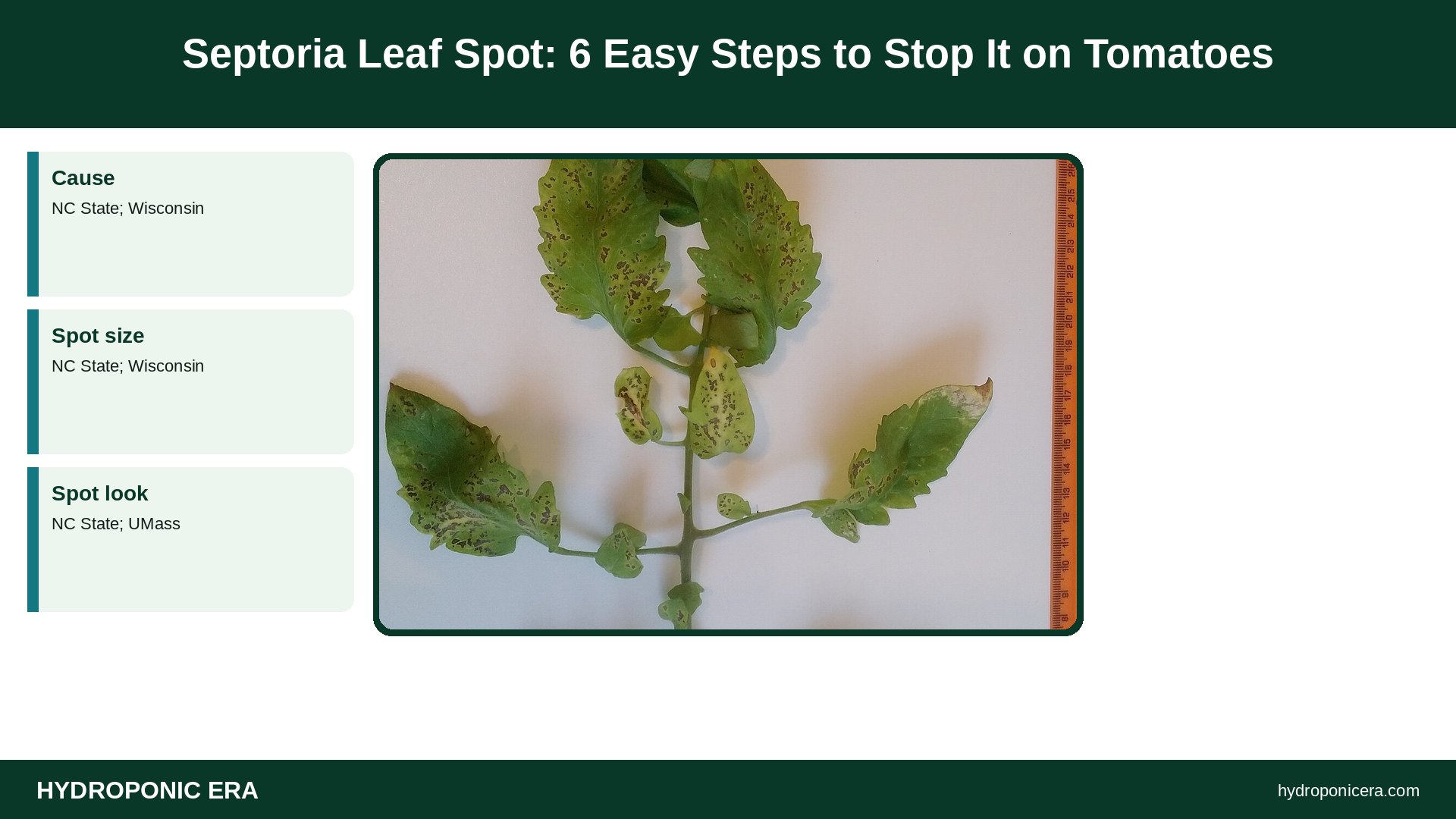
What Is Septoria Leaf Spot?
Septoria leaf spot is a fungal disease of tomato caused by Septoria lycopersici. NC State Extension says it is particularly destructive in seasons of moderate temperature and abundant moisture, and can reduce yields dramatically by stripping leaves. It mainly affects tomato, though some nightshade-family weeds such as horsenettle are hosts.
UMass calls it one of the most destructive diseases of tomato foliage. Symptoms usually appear on lower leaves after the first fruit develops, then move upward. Fruit infection is rare, but losing leaves exposes fruit to sunscald and lowers yield.
How Do You Identify Septoria Leaf Spot?
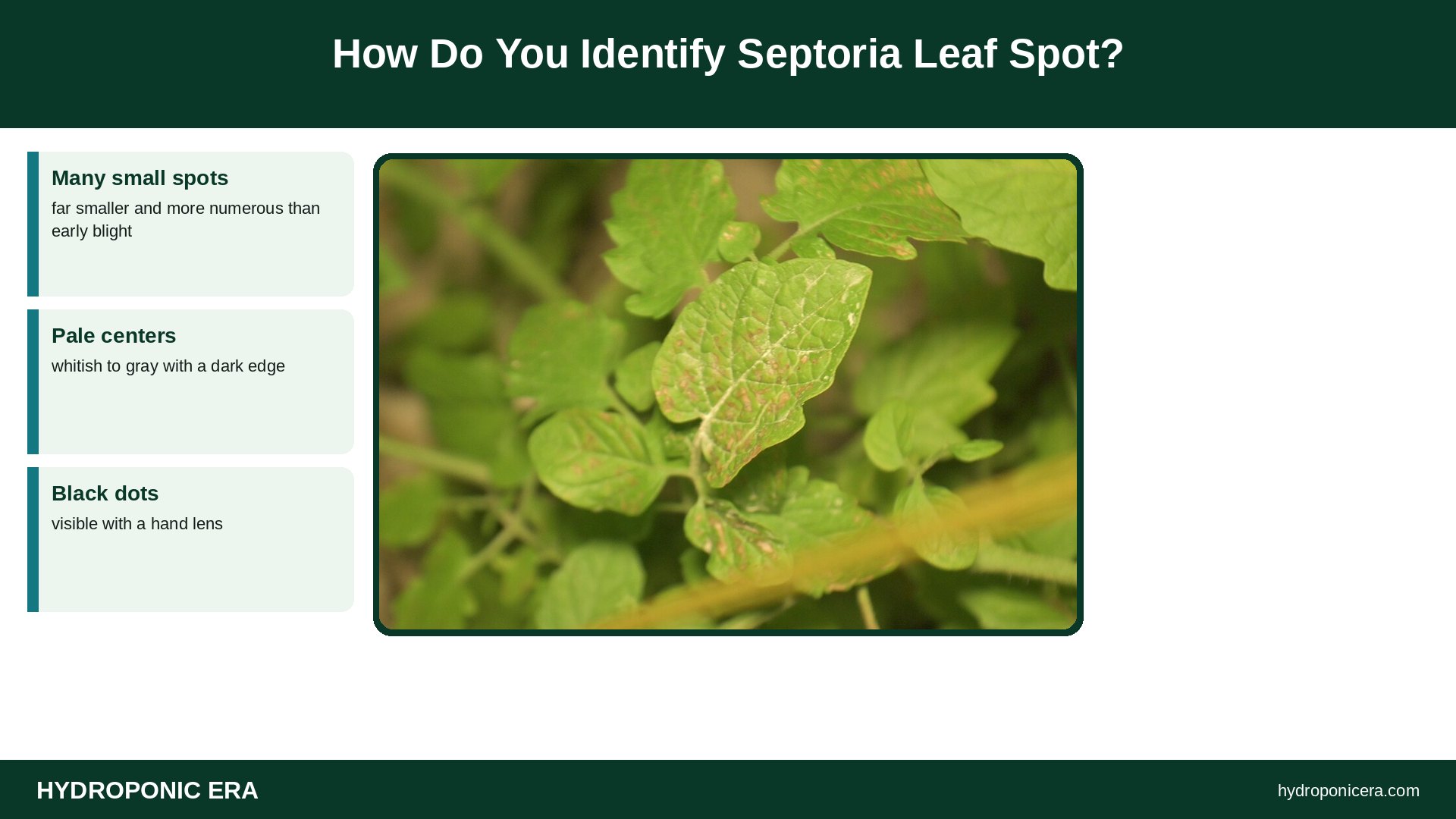
Identify septoria leaf spot by many small, circular spots with tan to gray centers and dark brown borders, often with tiny black specks inside. NC State says spots are usually under 1/8 inch (3 mm), and Wisconsin Extension gives about 1/4 inch (6 mm). The black specks are pycnidia, the spore-producing bodies.
- Many small spots: far smaller and more numerous than early blight.
- Pale centers: whitish to gray with a dark edge.
- Black dots: visible with a hand lens.
- Bottom-up spread: lower leaves yellow and drop first.
NC State notes early blight lesions are larger, darker and have concentric rings. Read our guide to hydroponic tomato yellow leaves to rule out nutrient problems.
How Does Septoria Leaf Spot Spread in Hydroponics?
The disease spreads when spores move in water droplets, on hands, tools and insects, or on reused stakes and cages. UMass says the fungus survives on stakes and cages and can be carried in seed. UW–Madison notes lesions develop about 5 days after spores enter leaves, with new spore bodies around 14 days later.
In hydroponic rooms, risk rises when canopies close, leaves stay wet after misting or condensation, and growers handle wet plants. Wisconsin Extension notes the disease often begins as plant canopies close, because dense foliage holds humidity.
How Do You Prevent Septoria Leaf Spot in Hydroponics?
Prevent septoria leaf spot by starting with disease-free seed and transplants, keeping leaves dry and spacing and pruning plants for airflow. UMass recommends avoiding work on wet plants and reducing the time foliage stays wet. Disinfect stakes, cages, clips and tools between crops, since the fungus survives on them.
- Use clean seed and inspect transplants.
- Prune lower leaves and suckers to open the canopy.
- Keep humidity moderate and run circulation fans.
- Avoid handling plants while leaves are wet.
- Disinfect trellis clips, cages and tools between crops.
- Scout lower leaves weekly and remove spotted ones.
See hydroponic tomato pruning and humidity and VPD in indoor hydroponics for practical steps.
How Do You Treat Septoria Leaf Spot on Hydroponic Tomatoes?
Treat it by removing infected leaves early and lowering humidity. Wisconsin Extension says control is difficult once symptoms appear, but thinning branches to increase airflow can slow it. Copper or chlorothalonil fungicides labeled for vegetables may help if applied very early and regularly. Always follow the product label.
| Action | Purpose | Source |
|---|---|---|
| Remove spotted leaves | Reduce spore load | NC State |
| Thin foliage | Faster leaf drying | Wisconsin Extension |
| Labeled fungicide | Protect new growth | Wisconsin; UMass |
| Clean up debris | Remove overwintering fungus | NC State; UMass |
Do not remove more leaves than the plant can spare at once; healthy upper foliage keeps fruit shaded and the plant productive. After the crop, strip and clean the system with our guide to cleaning and sterilizing a hydroponic system.
Which Tomatoes Resist Septoria Leaf Spot?
Resistance is limited. UMass says all tomato cultivars are susceptible, while Wisconsin Extension and UW–Madison recommend resistant varieties where available. In practice, environment control matters more than variety indoors: dry leaves, airflow and clean equipment give the best protection in a hydroponic tomato crop.
- Check seed catalogs: look for listed tolerance.
- Prioritize airflow: spacing beats any single variety.
- Keep records: note which plants show spots first.
Does Septoria Leaf Spot Affect Other Hydroponic Crops?
Septoria lycopersici mainly affects tomato. NC State says some nightshade-family weeds such as horsenettle are also hosts, and UW–Madison describes it as a disease of solanaceous crops. Other crops such as lettuce and celery have their own Septoria species, so a tomato outbreak does not mean your leafy greens will catch the same disease.
Still, sanitation habits that stop it on tomatoes protect every crop in the room. Clean tools, dry leaves and prompt removal of spotted foliage reduce many leaf diseases at once.
How Long Does Septoria Leaf Spot Survive Between Crops?
The fungus survives in infected plant debris and on stakes, cages and equipment, according to UMass and UW–Madison. In a hydroponic room, that means dropped leaves, old clips and unwashed trays. Remove all debris and disinfect equipment before the next tomato crop.
FAQ About Septoria Leaf Spot
Is septoria leaf spot dangerous to eat?
Fruit is rarely infected; unspotted fruit is fine to eat.
Can septoria leaf spot spread through the nutrient solution?
Spread is mainly by water splash, hands, tools and insects on leaves.
How fast does septoria leaf spot develop?
UW–Madison says lesions appear about 5 days after infection.
What is the difference between septoria leaf spot and early blight?
Septoria spots are smaller and more numerous; early blight spots are larger with rings.
Can I reuse tomato cages after septoria leaf spot?
Yes, after disinfecting them, since UMass notes the fungus survives on stakes and cages.
Sources
- NC State Extension — Septoria leaf spot of tomato
- Wisconsin Horticulture Extension — Septoria leaf spot
- UW–Madison Vegetable Pathology — Tomato septoria leaf spot
- UMass Amherst — Solanaceous, septoria leaf spot
- Photo credits (Wikimedia Commons, edited with titles): Septoria leaf spot symptoms on tomato leaf (Septoria lycopersici on Solanum lycopersicum leaf) by MerielGJones (CC BY-SA 4.0); Tomato septoria leaf spot 3047 by Wolan268 (CC0)