
Does Bacillus subtilis work in hydroponics? Yes, as a preventive. Bacillus subtilis is a beneficial bacterium sold as a biofungicide, and at least one strain (GB03, sold as Companion) is labeled for use in hydroponic nutrient solution. It helps protect roots from Pythium, Rhizoctonia and Fusarium, but it must be applied before disease starts and cannot rescue roots that are already rotting.
Key takeaway: Bacillus subtilis protects plants in several ways at once: UConn Extension says it produces antibiotics, blocks pathogen spores from germinating, interferes with their attachment and triggers the plant’s own defenses. The e-GRO greenhouse alert stresses that biofungicides are preventive and need repeated applications to keep a steady population in the root zone or nutrient solution.
| Fact | What sources report | Source |
|---|---|---|
| Organism | Naturally occurring soil bacterium that forms endospores | UConn |
| Hydroponic label | Strain GB03 (Companion) lists hydroponic nutrient solution | e-GRO |
| Root pathogens | Pythium, Rhizoctonia, Fusarium, Phytophthora | UConn; e-GRO |
| Restricted entry | 4 hours for listed greenhouse products | e-GRO |
| Powdery mildew | Less effective than oils or sulfur in research | UC IPM |
| Timing | Preventive; repeat applications needed | e-GRO |
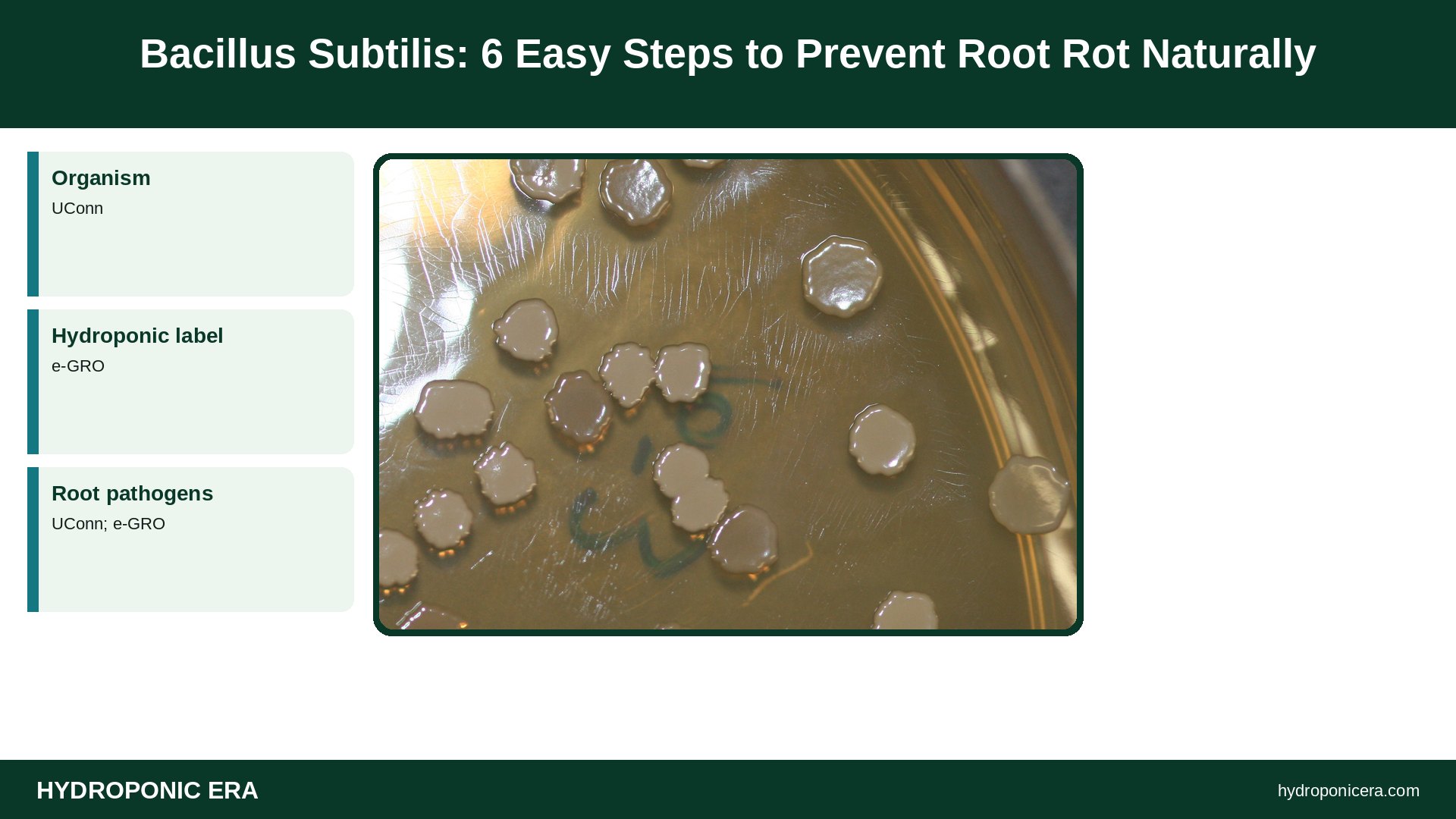
What Is Bacillus Subtilis?
Bacillus subtilis is a naturally occurring saprophytic bacterium, meaning it lives on dead organic matter. UConn Extension notes it forms a protective endospore that survives extreme conditions, which is why it can be sold as a shelf-stable powder or liquid. Different strains are sold commercially, and each product label lists its own crops and diseases.
In plant pathology, this kind of product is called biocontrol: microbes used against microbes. The e-GRO Edible Alert describes biofungicides as fungicides whose active ingredient is a living microorganism or one of its byproducts.
How Does Bacillus Subtilis Fight Plant Disease?
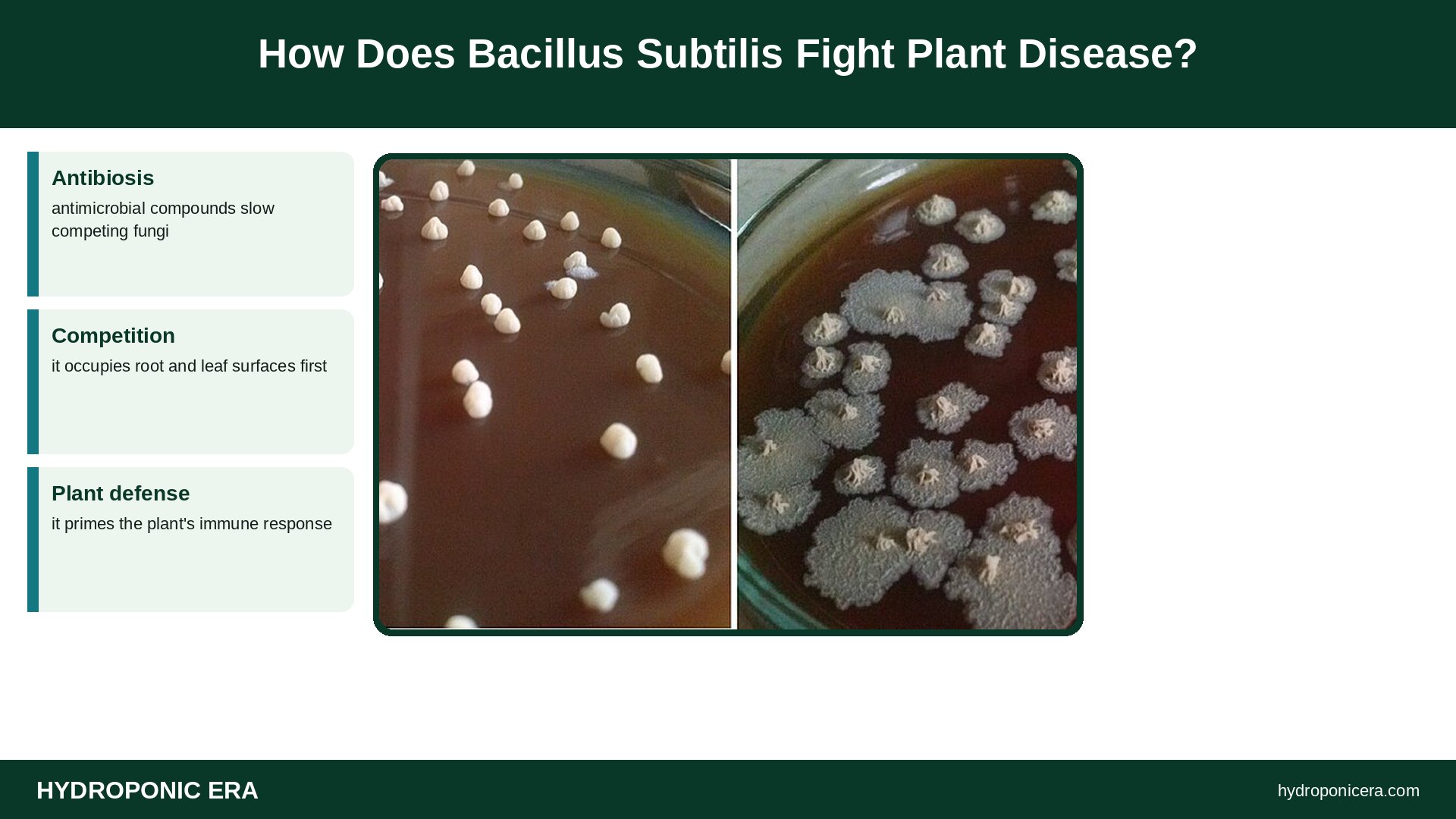
It works through several mechanisms instead of one. According to UConn Extension, Bacillus subtilis produces antibiotics, displaces pathogens by inhibiting spore germination, interferes with pathogen attachment to the plant and signals plant tissues to activate their natural defenses, a response called induced systemic resistance.
- Antibiosis: antimicrobial compounds slow competing fungi.
- Competition: it occupies root and leaf surfaces first.
- Plant defense: it primes the plant’s immune response.
e-GRO notes that because biocontrol agents use multiple modes of action, pathogens are less likely to develop resistance to them than to single-site synthetic fungicides.
Can You Use Bacillus Subtilis in a Hydroponic Reservoir?
Only with a product labeled for it. The e-GRO table of greenhouse biofungicides lists Bacillus subtilis strain GB03 (Companion) for drench, plug soak and hydroponic nutrient solution use, while strain QST 713 (Cease) is listed as a drench. Because the EPA regulates microbial biofungicides, you may use each product only on the crops and systems its label allows.
Root disease is the main reason growers look at it. e-GRO reports over a 25% drop in lettuce fresh weight from Pythium in research, and complete crop loss in a commercial hydroponic lettuce farm during summer. Learn the warning signs in our guide to Pythium root rot in hydroponics.
Which Diseases Does Bacillus Subtilis Control?
Mostly root rots and some leaf diseases. UConn’s biological fungicide table lists strain QST 713 as a soil drench for Rhizoctonia, Pythium, Fusarium and Phytophthora, and as a foliar spray for diseases including anthracnose, bacterial leaf spots and Botrytis blight. Always confirm the specific target on your product’s label.
| Strain | Product example | Listed use |
|---|---|---|
| GB03 | Companion | Drench, plug soak, hydroponic solution |
| QST 713 | Cease | Drench; foliar for leaf diseases |
| Source | e-GRO; UConn | Specimen labels |

Is Bacillus Subtilis Good for Powdery Mildew?
It helps, but it is not the strongest option. UC IPM says Bacillus subtilis and Bacillus amyloliquefaciens stop the powdery mildew fungus from growing and attaching to the plant, but research has not shown them to be as effective as oils or sulfur. Use it early, with good airflow, rather than as a rescue treatment.
For a full prevention plan, read our guide to powdery mildew in hydroponics.
When Should You Apply Bacillus Subtilis?
Before problems appear. e-GRO explains that the beneficial microbes must establish and multiply before they can protect plants, and most biofungicides need multiple applications over time to keep a steady population in the growing media or nutrient solution. Starting at seeding or transplant fits that guidance.
- Read the label to confirm hydroponic or drench use.
- Apply at seeding, plug soak or transplant.
- Repeat at the interval the label gives.
- Keep reservoir temperature and sanitation under control.
- Remove plants with advanced root rot instead of treating them.

What Should You Not Mix With Bacillus Subtilis?
Avoid products that kill bacteria. e-GRO advises against rotating biofungicides with fungicides or bactericides that can harm the beneficial microbe population. In hydroponics, that also means thinking twice about strong oxidizers in the reservoir, since they do not distinguish good microbes from bad ones; see our notes on hydrogen peroxide in hydroponics.
UConn notes one useful pairing: for bacterial diseases, growers can alternate Bacillus with copper fungicides to reduce the risk of plant injury that can come from repeated copper sprays.
Bacillus Subtilis vs Trichoderma: Which Should You Use?
They do similar jobs by different routes. UConn describes Bacillus subtilis as a bacterium that produces antibiotics and induces resistance, while Trichoderma is a fungus whose threads coil around roots to form a barrier and release enzymes that attack pathogen cell walls. UConn adds that combining T. harzianum and T. virens suppresses Pythium aphanidermatum.
Compare the fungal option in our guide to Trichoderma for plants.
How Is Bacillus Subtilis Different From Bacillus Amyloliquefaciens?
They are close relatives sold for similar jobs. UC IPM notes Bacillus amyloliquefaciens is also known as Bacillus velezensis, and UConn says it colonizes the root zone, stimulates plant growth and suppresses competing fungal and bacterial pathogens. e-GRO lists strain D747 (Double Nickel) as a greenhouse drench for root rots, alongside the Bacillus subtilis products.
FAQ About Bacillus Subtilis
Is Bacillus subtilis safe on edible crops?
Labeled products list vegetables and herbs; follow the label and REI.
Can Bacillus subtilis cure root rot?
No; e-GRO says biofungicides are preventive, not curative.
How long does Bacillus subtilis last on the shelf?
UConn lists Cease at 3 years stored at 70–75°F (21–24°C).
Is Bacillus subtilis organic?
UConn’s table lists Cease as an OMRI-certified product.
Does Bacillus subtilis survive in a reservoir?
Use only strains labeled for nutrient solution, and reapply as directed.
Does every Bacillus product work the same?
No; strains differ, so check each label’s uses.
Sources
- e-GRO Edible Alert — Biofungicides for Control of Root Diseases on Greenhouse-Grown Vegetables
- UConn Extension — Biological Fungicides
- UC IPM — Powdery Mildew on Ornamentals
- Photo credits (Wikimedia Commons, edited with titles): Bacillus subtilis colonies by Debivort at English Wikipedia (CC BY-SA 3.0); Colonies of Bacillus subtilis (1 day and 3 day old) by О2016льга (CC BY 4.0)