
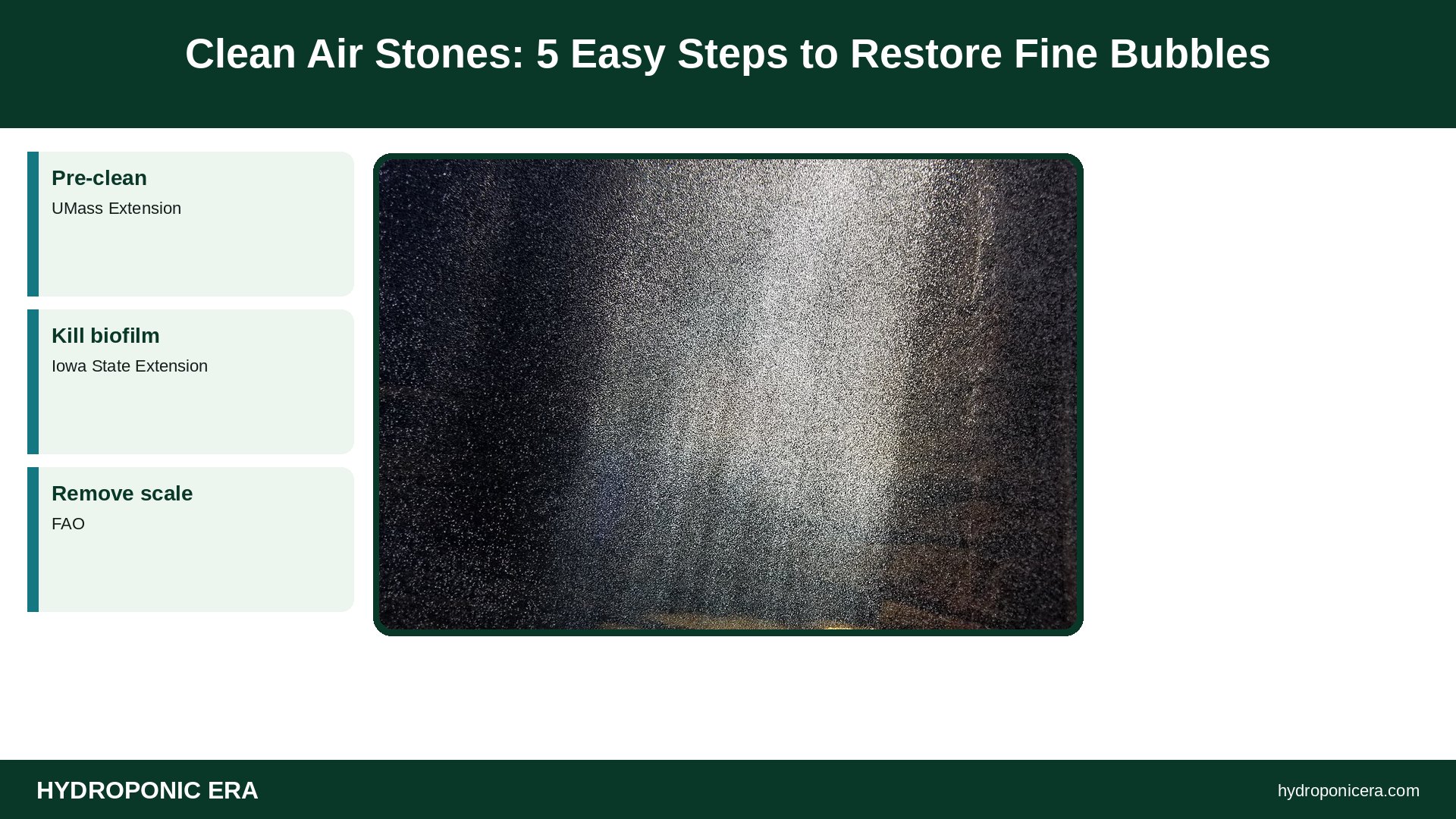
How do you clean air stones? To clean air stones, scrub off slime, soak them in a 1:9 bleach-to-water solution to kill the biofilm, rinse well, then soak in a mild acid such as vinegar only if mineral crust remains. Rinse and dry between steps and never mix the two. The FAO aquaponics manual recommends exactly this order: chlorine first, then a very mild acid, or replace the stone.
Key takeaway: Air stones clog in two ways: living biofilm and hard mineral scale. Both shrink the pores, so bubbles get bigger and uneven and the pump works harder. Knowing which one you have tells you which cleaner to use, and cleaning air stones on a schedule keeps dissolved oxygen steady for roots and fish.
| Step | What to use | Source |
|---|---|---|
| Pre-clean | Brush and rinse off slime | UMass Extension |
| Kill biofilm | 1 part bleach : 9 parts water, 10+ minutes | Iowa State Extension |
| Remove scale | Very mild acid (e.g., vinegar), if needed | FAO |
| Safety | Never mix bleach with acids | Washington State Dept. of Health |
| Replace | When bubble flow stays uneven | FAO |
Why Do Air Stones Get Clogged?
Biology and minerals block the pores. The FAO small-scale aquaponics manual says biofouling will occur on air stones and that they should be cleaned regularly. Bacterial slime coats the surface, while hard water leaves mineral deposits inside the pores. Our air pumps and air stones guide explains why fine bubbles matter.
- Biofilm: slippery brown or green coating.
- Mineral scale: white, gritty crust.
- Root and debris: fibers trapped around the stone.
How Do You Know When to Clean Air Stones?
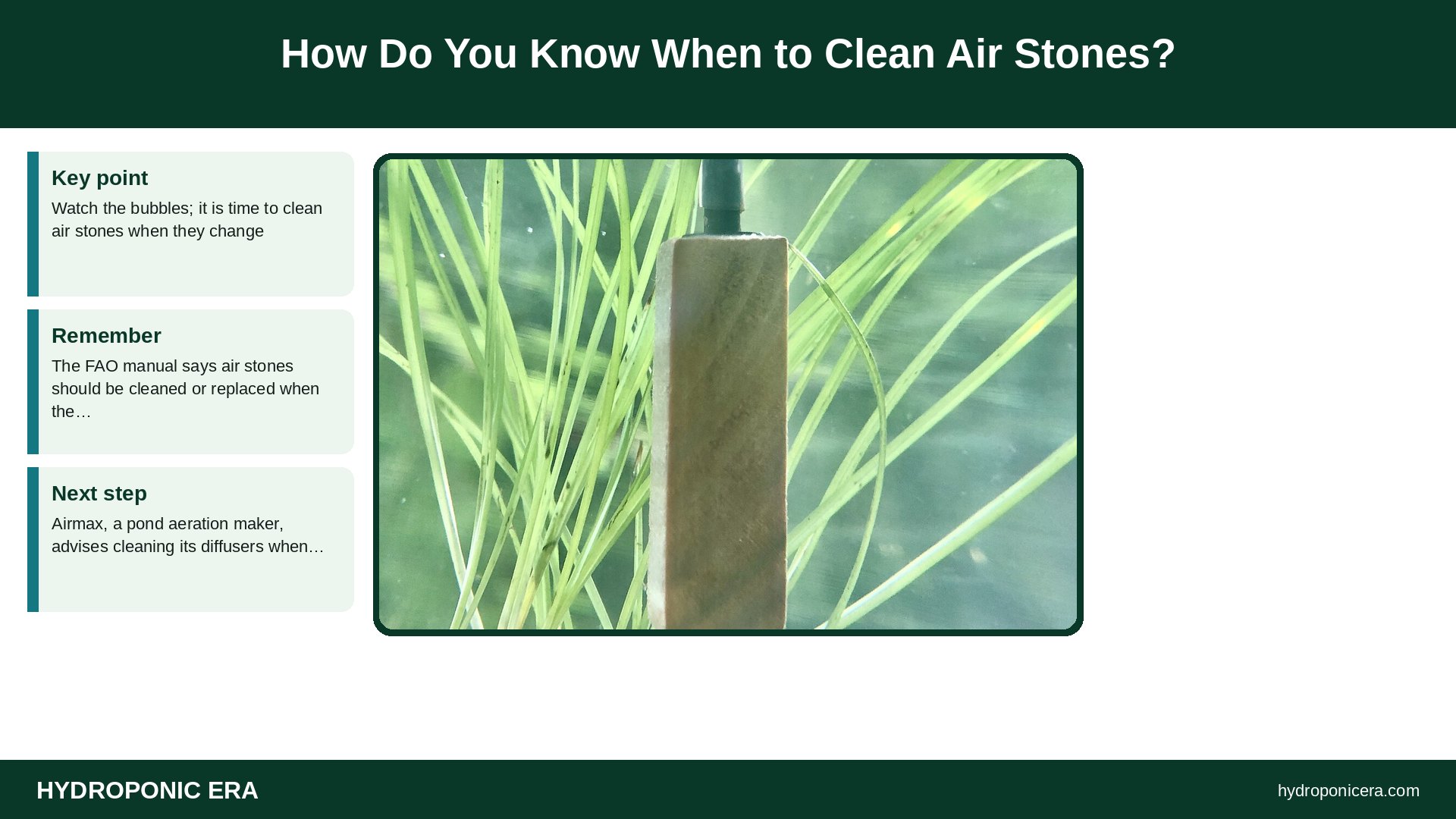
Watch the bubbles; it is time to clean air stones when they change. The FAO manual says air stones should be cleaned or replaced when the flow of bubbles is inconsistent. Airmax, a pond aeration maker, advises cleaning its diffusers when the pressure gauge reads significantly higher than normal or bubble output drops. Large bubbles from one side of a stone are a classic early sign.
- Bubbles larger or patchier than when new.
- Weaker flow from the same pump.
- Louder pump or higher line pressure.
- Visible slime or crust on the stone.
How Do You Clean Air Stones With Bleach?
Use bleach to clean air stones of biofilm, after a scrub. UMass Extension notes that organic residues reduce disinfectant effectiveness, so pre-clean first. For disinfecting plant containers, Iowa State University Extension recommends one part household bleach to nine parts water, a minimum 10-minute soak, then a rinse; add bleach to water, not water to bleach, and use the solution within two hours.
- Unplug the pump and pull the stone and airline.
- Scrub the surface with a soft brush under running water.
- Soak in 1:9 bleach solution for at least 10 minutes.
- Rinse thoroughly, then soak in clean water.
- Run air through it in a bucket of clean water before reuse.
For whole-system sanitizing, see our cleaning and sterilizing guide.
How Do You Clean Air Stones With Vinegar?
Vinegar targets mineral scale, not slime. The FAO manual recommends a very mild acid to remove mineralization only if needed after the chlorine step. White vinegar is a common mild acid for this. Soak until the crust softens, scrub, then rinse well. Washington State’s Department of Health lists vinegar as an acid product, so keep it away from bleach.
Is It Safe to Mix Bleach and Vinegar for Air Stones?
No. The Washington State Department of Health warns that mixing chlorine bleach with an acid releases chlorine gas, which irritates eyes, throat and nose, causes breathing problems and at very high levels can cause death. It lists vinegar among acid products and says bleach also reacts with hydrogen peroxide. Rinse and soak in clean water between steps.
- Bleach first, then a full rinse.
- Acid second, in a separate container.
- Ventilate the work area.
- Never combine bleach with vinegar, ammonia or peroxide.
Can You Boil Air Stones to Clean Them?
Some growers do, but none of the sources reviewed here recommend boiling, and many stones have plastic or glued fittings. The FAO, Iowa State and Airmax methods all rely on chemical soaks and brushing instead. If you try it with a plain ceramic or mineral stone, cool it fully before reuse and rinse in clean water.
How Often Should You Clean Air Stones?
Clean air stones whenever bubbles become uneven, and check them at every reservoir change. FAO says biofouling is inevitable and cleaning should be regular, but sets no fixed interval. Large pond diffusers last longer between cleanings: Airmax suggests inspecting or cleaning its membrane sticks every 24 to 36 months. Small hobby stones in nutrient solution usually need attention far sooner.
Pair stone checks with your biofilm and slimy reservoir routine.
Where Should Air Stones Sit After Cleaning?
Place them where they add oxygen without stirring up waste. The FAO manual advises positioning air stones so they do not re-suspend settling solids, which should leave through the tank’s center drain. For small aquaponics units with about 1,000-liter (264-gallon) fish tanks, FAO recommends at least two air lines with air stones in the fish tank and one in the biofilter.
- Keep stones off thick sludge layers.
- Spread several small stones rather than one large one.
- Re-check the bubble pattern a day after you clean air stones and reinstall them.
When Should You Replace an Air Stone?
Replace it when cleaning no longer restores even flow. The FAO manual names replacement as the fallback when bubbles stay inconsistent. Cheap stones are often easier to swap than to rescue, and keeping a spare means your plants or fish never go without air. Fine bubbles support the oxygen levels described in our dissolved oxygen guide.
FAQ About How to Clean Air Stones
What is the best way to clean air stones?
Scrub, bleach soak, rinse, then mild acid only if scale remains.
What bleach ratio cleans air stones?
1 part bleach to 9 parts water, the ratio Iowa State uses for containers.
Does vinegar clean air stones?
Yes, for mineral scale; it does not replace bleach for slime.
Can I use hydrogen peroxide with bleach?
No; Washington DOH says bleach reacts with peroxide.
How do I know an air stone is clogged?
Bubbles grow larger, weaker or uneven.
Should I rinse air stones after bleach?
Yes, thoroughly, then run air through clean water.
Sources
- Food and Agriculture Organization of the United Nations — Small-scale aquaponic food production (Fisheries Technical Paper 589)
- Iowa State University Extension — How to Clean and Disinfect Plant Containers
- Washington State Department of Health — Dangers of Mixing Bleach with Cleaners
- UMass Extension — Cleaning and Disinfecting the Greenhouse
- Airmax — ProAir 4 Diffuser Product Manual
- Photo credits (Wikimedia Commons, edited with titles): Bubbles in aquarium by Elizabeth Main (CC BY-SA 4.0); Lime Wood Air Diffuser in aquarium Germany 2024 01 by Nimmerwelk (CC BY-SA 4.0); Back-yard summer tilapia pond, aeration detail by Ursus sapien (CC BY-SA 3.0)