
What size hydroponic tubing do you need? Most home systems use 1/2-inch (about 13–16 mm) poly hydroponic tubing for the main supply line and 1/4-inch (about 4–6 mm) hydroponic tubing for drip lines or channel feeds, with wider pipe for drains. Virginia Cooperative Extension describes NFT systems as a header pipe feeding plant channels through smaller delivery tubing. Size hydroponic tubing to the flow you need.
Key takeaway: Hydroponic tubing size decides how much water reaches each plant and how hard the pump has to work. Too narrow and flow drops; too wide on a small pump and pressure falls off at the far end. The good news is that a few rules of thumb from extension and irrigation guides cover nearly every home setup.
| Line | Typical size | Source |
|---|---|---|
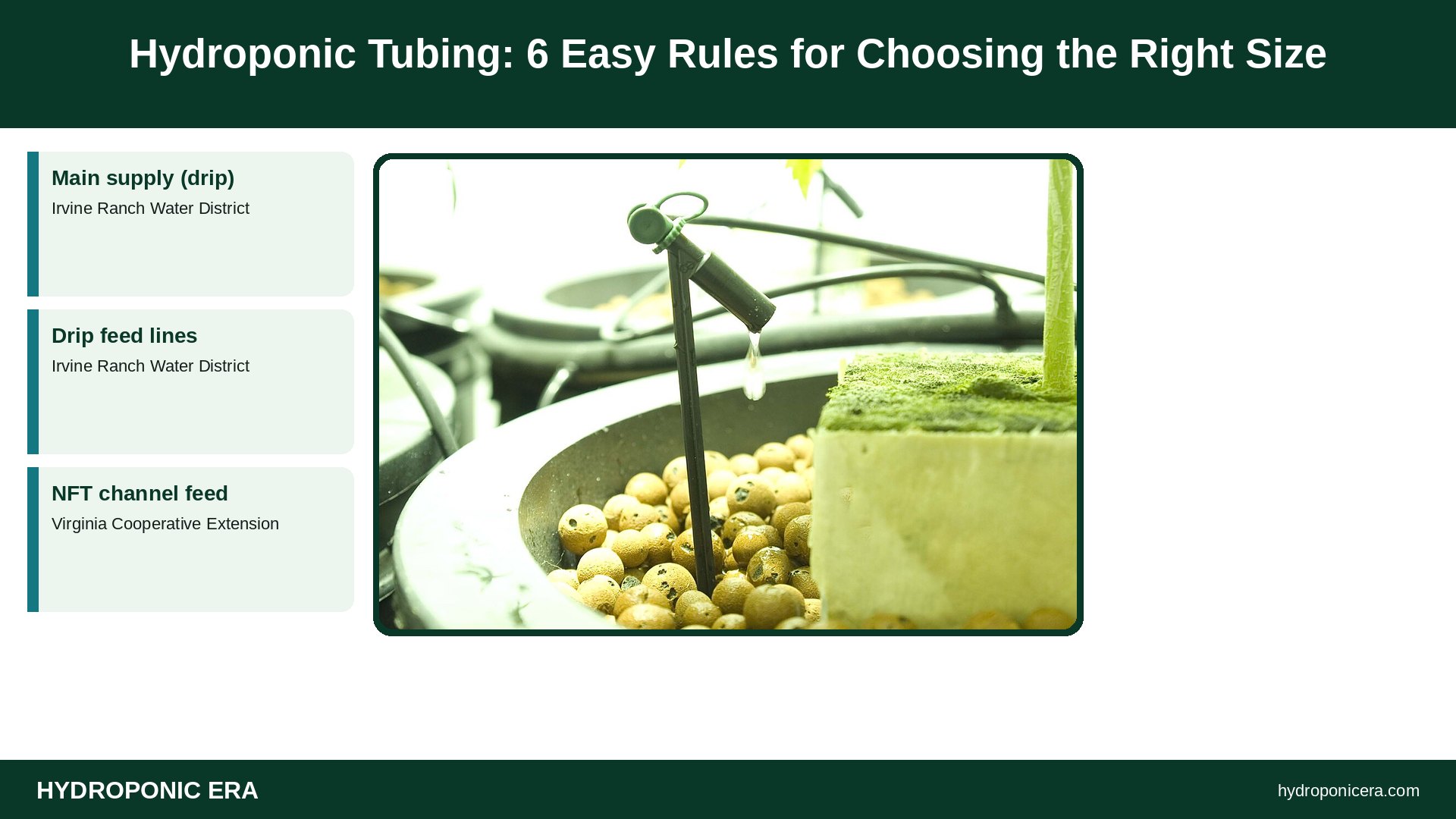
| Main supply (drip) | 1/2 in (13 mm) poly, 0.600 in (15 mm) ID | Irvine Ranch Water District |
| Drip feed lines | 1/4 in (6 mm) “spaghetti”, 0.170 in (4.3 mm) ID | Irvine Ranch Water District |
| NFT channel feed | 3–5 gal/hr (11–19 L/h) per channel | Virginia Cooperative Extension |
| Small aquaponics supply | 20–25 mm poly pipe | FAO |
| Fish tank exit / drains | 50 mm PVC | FAO |
What Size Hydroponic Tubing Do Most Systems Use?
Two sizes do most of the work. The Irvine Ranch Water District drip guide lists standard mainline tubing as 1/2 inch (13 mm), about 0.600 inch (15 mm) inside diameter, and “spaghetti” tubing as 1/4 inch (6 mm), about 0.170 inch (4.3 mm) inside diameter. Hydroponic drip and NFT kits use the same split: a larger header and smaller feeds.
- 1/2 in (13 mm) hydroponic tubing: supply line from the pump.
- 1/4 in (6 mm) hydroponic tubing: individual drip lines or channel feeds.
- Larger pipe: drains and returns to the reservoir.
Why Does Hydroponic Tubing Diameter Matter?
Narrow hydroponic tubing loses flow. The FAO small-scale aquaponics manual states that the smaller the pipe diameter, the larger the water flow loss, and that a 30 mm pipe carries twice the flow of a 20 mm pipe even with the same pump. Undersized tubing starves distant plants. Our water pump sizing guide covers matching the pump to the system.

How Much Flow Can 1/2-Inch and 1/4-Inch Tubing Carry?
The irrigation guide gives clear limits. It says 1/2-inch (13 mm) tubing handles a maximum of 240 gallons per hour (908 L/h) and can run up to 200 feet (61 m). Quarter-inch (6 mm) tubing handles a maximum of 30 gallons per hour (114 L/h) and should not exceed 19 feet (5.8 m); it also advises keeping individual 1/4-inch runs short.
- 1/2 in (13 mm) mainline: up to 240 gal/hr (908 L/h), 200 ft (61 m).
- 1/4 in (6 mm) line: up to 30 gal/hr (114 L/h), 19 ft (5.8 m).
- Practical tip: keep feed lines as short as the layout allows.
What Size Tubing for an NFT System?
NFT uses a manifold plus small delivery lines. Virginia Cooperative Extension says pump flow should be 3 to 5 gallons per hour (about 11–19 L/h) into each channel, delivered from a header or manifold pipe through smaller flexible tubing connected with emitters. Hobby channels are usually 2-inch Schedule 40 PVC, 4 to 12 feet (1.2–3.7 m) long. See our NFT flow rate and slope guide.
- Run a 1/2-inch manifold from the pump.
- Tap one small delivery line into each channel.
- Add a shut-off valve to balance flow.
- Drain channels into a larger collection pipe.
What Size Tubing for a Drip or Dutch Bucket System?
Use a 1/2-inch header with 1/4-inch lines to each plant. The irrigation guide recommends a 150 or 200 mesh screen filter, since small lines and emitters clog, and notes that drip systems run on low pressure between 15 and 35 PSI. Compression fittings are preferred on 1/2-inch tubing, while 1/4-inch tubing uses barbed fittings. Our drip emitters and manifolds guide shows layouts.
How Do You Measure Hydroponic Tubing Size?
Check the inside diameter, not just the label. Hydroponic tubing is sold by nominal size, but flow depends on the bore. The Irvine Ranch Water District guide lists 1/2-inch mainline at 0.600 inch (15 mm) inside and 0.700 inch (18 mm) outside diameter, so fittings must match the exact tubing you buy. Mixing brands with different walls is a common cause of leaks.
- Read the inside and outside diameter on the package.
- Buy fittings rated for that exact size.
- Test-fit one connection before buying in bulk.
- Add a screen filter before small lines, per the guide.
Our inline screen filters guide explains mesh choices.
What Size Pipe for Aquaponics Plumbing?
Aquaponics needs bigger pipe for solids. In its small-scale build guides, FAO uses polyethylene pipe of 20 and 25 mm (roughly 3/4 and 1 inch (2.5 cm)) for water supply, 50 mm (about 2 inch (5.1 cm)) PVC for the fish tank exit, and 25 mm pipes to drain each media bed into the sump. Wide drains keep fish waste from clogging returns.
- Supply: 20–25 mm poly pipe.
- Fish tank outlet: 50 mm PVC.
- Media bed drains: 25 mm.
Does Tubing Color Matter in Hydroponics?
Yes. Virginia Cooperative Extension advises choosing tubing color for your climate: white tubing reflects heat and keeps nutrient solution cooler, while black tubing has the opposite effect. Both the manifold and delivery tubing should be flexible.
What Material Is Best for Hydroponic Tubing?
Choose commercial-grade irrigation poly or food-safe hydroponic tubing. The irrigation guide recommends sticking with commercial-grade products from irrigation supply stores. Virginia Cooperative Extension describes flexible poly manifolds and delivery tubing for NFT. Avoid unknown hoses and recycled plastics in nutrient lines.
FAQ About Hydroponic Tubing
What size tubing for a hydroponic pump?
Match the pump outlet fitting; 1/2 inch (13 mm) is the standard drip mainline.
Is 1/4-inch tubing enough for hydroponics?
For drip lines and channel feeds, yes; keep runs under 19 ft (5.8 m).
What size tubing for NFT channels?
A 1/2-inch manifold with small feeds giving 3–5 gal/hr (11–19 L/h) per channel.
Does bigger tubing increase flow?
Yes; FAO says a 30 mm pipe carries twice the flow of 20 mm.
Should hydroponic tubing be black or white?
White in hot climates; it keeps solution cooler.
Do I need a filter for drip tubing?
Yes; a 150–200 mesh screen filter is recommended.
Sources
- Virginia Cooperative Extension — Hydroponic Production of Edible Crops: Nutrient Film Technique (NFT) Systems (SPES-463)
- Food and Agriculture Organization of the United Nations — Small-scale aquaponic food production (Fisheries Technical Paper 589)
- Irvine Ranch Water District — Drip Irrigation: The Basic System
- Photo credits (Wikimedia Commons, edited with titles): Drip emitter by Alan.ca (Public domain); Nutrient film technique hydroponics by Oregon State University (CC BY-SA 2.0); 1 inch PVC Valve and pipe-IMG 1061 by Bijay Chaurasia (CC BY-SA 4.0)