
Why are there fruit flies in my plants? Fruit flies in plants are usually visitors, not residents. They breed in fermenting fruit, drains, trash and damp rags, then rest on nearby pots. If the tiny flies are dark and hover over wet soil, they are more likely fungus gnats. The University of Wisconsin notes these two pests are often confused, and vinegar traps that catch fruit flies do not work on fungus gnats.
Key takeaway: Seeing fruit flies in plants, whether a houseplant or a hydroponic setup, does not automatically mean the plant is the source. Fruit flies and fungus gnats look alike at a glance, but they breed in different places and need different fixes. Identify the fly first, then remove the breeding site.
| Feature | Fruit flies | Fungus gnats |
|---|---|---|
| Size | About 1/8 in (3 mm) | About 1/8 in (3 mm) |
| Look | Tan front, dark rear, usually red eyes | Delicate, dark brown or black |
| Breeds in | Fermenting produce, drains, trash, mops | Moist potting soil |
| Life cycle | About 1 week (UKY); 8–10 days (UMD) | Eggs hatch in 3–6 days |
| Vinegar trap | Works | Does not work (UW) |

Are Fruit Flies in Plants Actually Fruit Flies?
Often they are fungus gnats. Wisconsin Horticulture says fungus gnats are often mistakenly identified as fruit flies but are two distinct insects. Fruit flies are about 1/8 inch (3 mm) long, tan to brownish with usually bright red eyes, per University of Maryland Extension. Fungus gnats are delicate, dark brown or black flies about the same size, commonly linked to overwatered houseplants.
- Red eyes, tan body, near the kitchen: fruit flies.
- Dark, slender, flying up from wet soil: fungus gnats.
- Stout dark flies on algae: possibly shore flies.
Our shore flies vs fungus gnats guide covers the third look-alike.
Why Are There Fruit Flies in Plants Indoors?
Something nearby is fermenting. University of Kentucky entomologist Michael Potter writes that fruit flies breed in ripened fruit and vegetables, drains, garbage disposals, empty bottles and cans, trash containers, mops and cleaning rags; all they need is a moist film of fermenting material. A fruit bowl beside your plants or a forgotten onion can supply flies that rest on the leaves.

Can Fruit Flies Breed in Potting Soil?
Not typically. The breeding sites UKY and Maryland Extension list are fermenting foods and moist organic residues, not healthy potting mix. That said, rotting fruit dropped on a pot, or a soil topped with kitchen scraps, could become such a site. If larvae are in the soil itself, Wisconsin’s potato-slice test points to fungus gnats instead.
- Place a raw potato slice on the soil surface.
- Check it after a few days for small larvae.
- Larvae present usually means fungus gnats.
- No larvae means search the room for fermenting sources.
How Do You Get Rid of Fruit Flies in Plants?
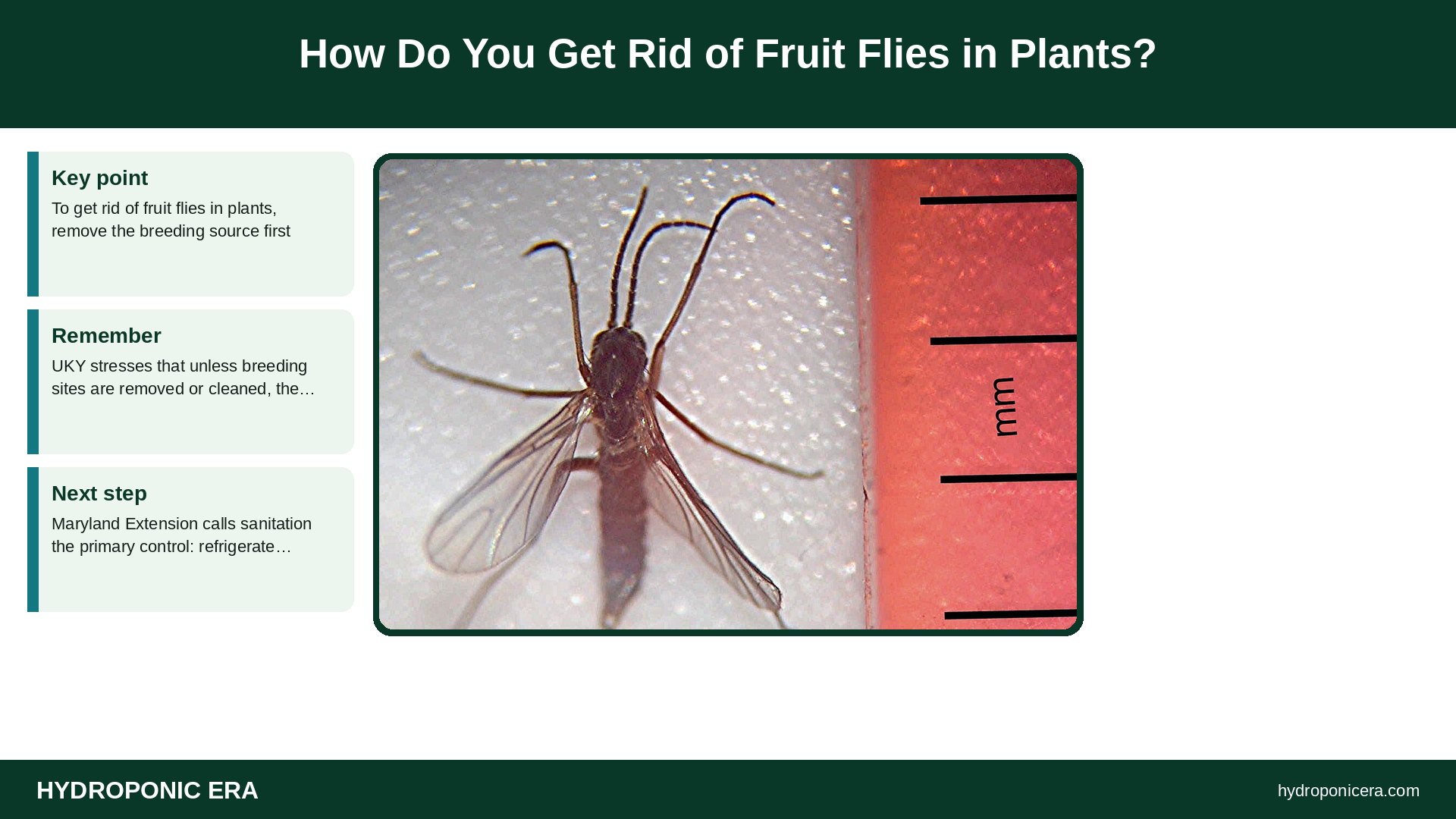
To get rid of fruit flies in plants, remove the breeding source first. UKY stresses that unless breeding sites are removed or cleaned, the problem continues no matter how often adults are sprayed. Maryland Extension calls sanitation the primary control: refrigerate fruit, rinse bottles and cans for recycling, and wring out and dry mops. Then trap the remaining adults.
- Refrigerate or eat ripe produce.
- Empty and rinse trash and recycling bins.
- Check drains by taping a clear bag over them overnight (UKY).
- Remove fallen leaves or fruit from pots.
- Set vinegar traps near the plants.
How Do You Make a Fruit Fly Trap?
Use cider vinegar and a narrow entry. Maryland Extension suggests pouring apple cider vinegar into a jar, adding a drop of dish soap, covering it with plastic wrap secured by a rubber band, and poking a tiny hole so flies enter but cannot escape. UKY describes a paper funnel in a jar baited with a few ounces of cider vinegar or a slice of banana.
UKY says this simple trap will soon catch the remaining adults once breeding sites are gone, and that a pyrethrum aerosol is only a follow-up step, never a substitute for sanitation.
How Fast Do Fruit Flies in Plants Multiply?
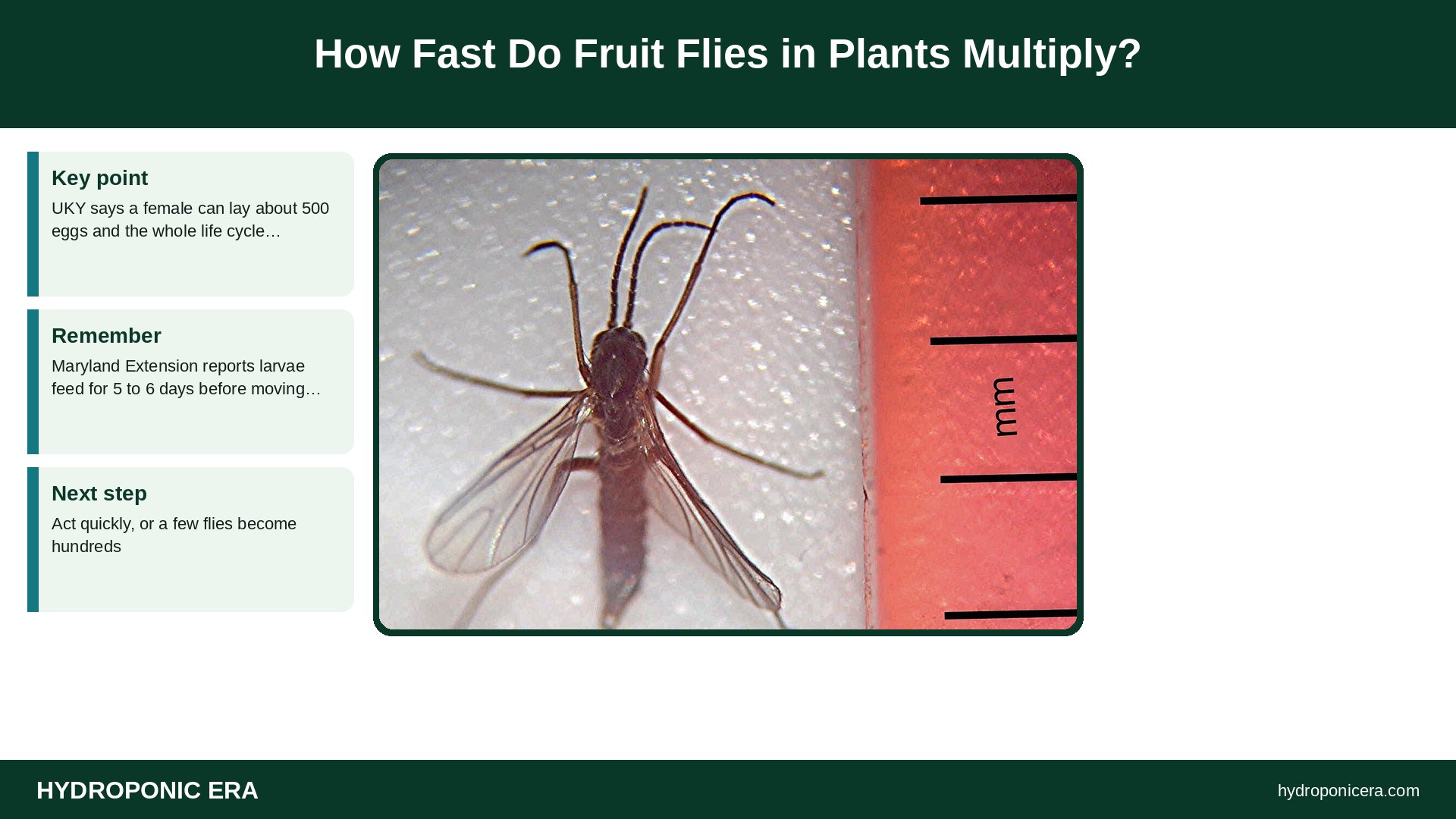
Very fast. UKY says a female can lay about 500 eggs and the whole life cycle from egg to adult can take about a week. Maryland Extension reports larvae feed for 5 to 6 days before moving to drier areas to pupate, with a full cycle of 8 to 10 days. Act quickly, or a few flies become hundreds.
What If the Flies Are Fungus Gnats Instead?
Change the watering, not the fruit bowl. Wisconsin Horticulture recommends letting the top inch (2.5 cm) of soil dry before watering, or bottom watering, and yellow sticky traps for adults. It lists Bacillus thuringiensis subsp. israelensis (Bti) products for larvae. See our fungus gnats in hydroponics and mosquito bits for fungus gnats guides.
Can Fruit Flies Live in a Hydroponic System?
They can visit one, but the warning signs differ from soil. A hydroponic reservoir is not fermenting fruit, yet the UKY list of breeding sites includes any moist film of fermenting material. Decaying roots, spilled nutrient sludge, rotting plant debris or a dirty drain line could qualify. If you see fruit flies in plants grown hydroponically, check for rot before blaming the plant.
- Remove dead leaves and dropped fruit from trays.
- Wipe spills and algae from reservoir lids.
- Inspect roots for brown, smelly rot.
- Clean nearby drains and trash bins.
Are Fruit Flies in Plants Harmful?
Fruit flies in plants are mostly a nuisance, not a plant pest. UKY calls fruit flies primarily nuisance pests, though it notes they can contaminate food with bacteria and other disease organisms. Their larvae feed in fermenting material rather than on living roots. Fungus gnat larvae, by contrast, feed in the soil, which is why identifying the fly matters. Our sticky trap placement guide helps you monitor.
FAQ About Fruit Flies in Plants
Do fruit flies lay eggs in plant soil?
Rarely; they prefer fermenting food, drains and trash.
What kills fruit flies in plants?
Removing breeding sites plus cider vinegar traps.
Do fruit flies harm plants?
No; UKY calls them nuisance pests.
How do I tell fruit flies from fungus gnats?
Fruit flies usually have red eyes and tan bodies.
Will a vinegar trap catch fungus gnats?
No; Wisconsin Horticulture says it does not work.
How long is the fruit fly life cycle?
About a week from egg to adult, per UKY.
Sources
- University of Kentucky Entomology — Fruit Flies (ENTFACT-621)
- University of Maryland Extension — Fruit Flies
- University of Wisconsin–Madison Extension — Fungus Gnats on Houseplants
- Photo credits (Wikimedia Commons, edited with titles): Drosophila melanogaster – side (aka) by André Karwath aka Aka (CC BY-SA 2.5); Fruit fly trap by Downtowngal (CC BY-SA 3.0); Trauerfliege by Python (Peter Rühr) (CC BY 3.0)