
How do you plant an Amazon sword plant? Plant an Amazon sword plant with its roots buried and its crown above the substrate. It is a heavy root feeder, so give it at least 4 inches (10 cm) of substrate if you can, add root tabs near the roots, and give moderate light. Expect some leaf drop.
Key takeaway: An Amazon sword plant is a big, hardy rosette that feeds through its roots. Use a deep, nutrient-rich substrate or root tabs, keep the crown above the substrate, watch iron levels and leave it alone, because the root system becomes huge.
| Need | Guideline | Source |
|---|---|---|
| Substrate depth | At least 4 in (10 cm) for large plants | TFH Magazine |
| Light | Moderate to bright | TFH Magazine |
| Root tab spacing | One tab about every 5–6 in (12–15 cm) | Aquarium Co-Op |
| Mature size | 16–20 in (41–51 cm) or more | TFH Magazine |
| Melt period | Several weeks up to a few months | TFH Magazine |
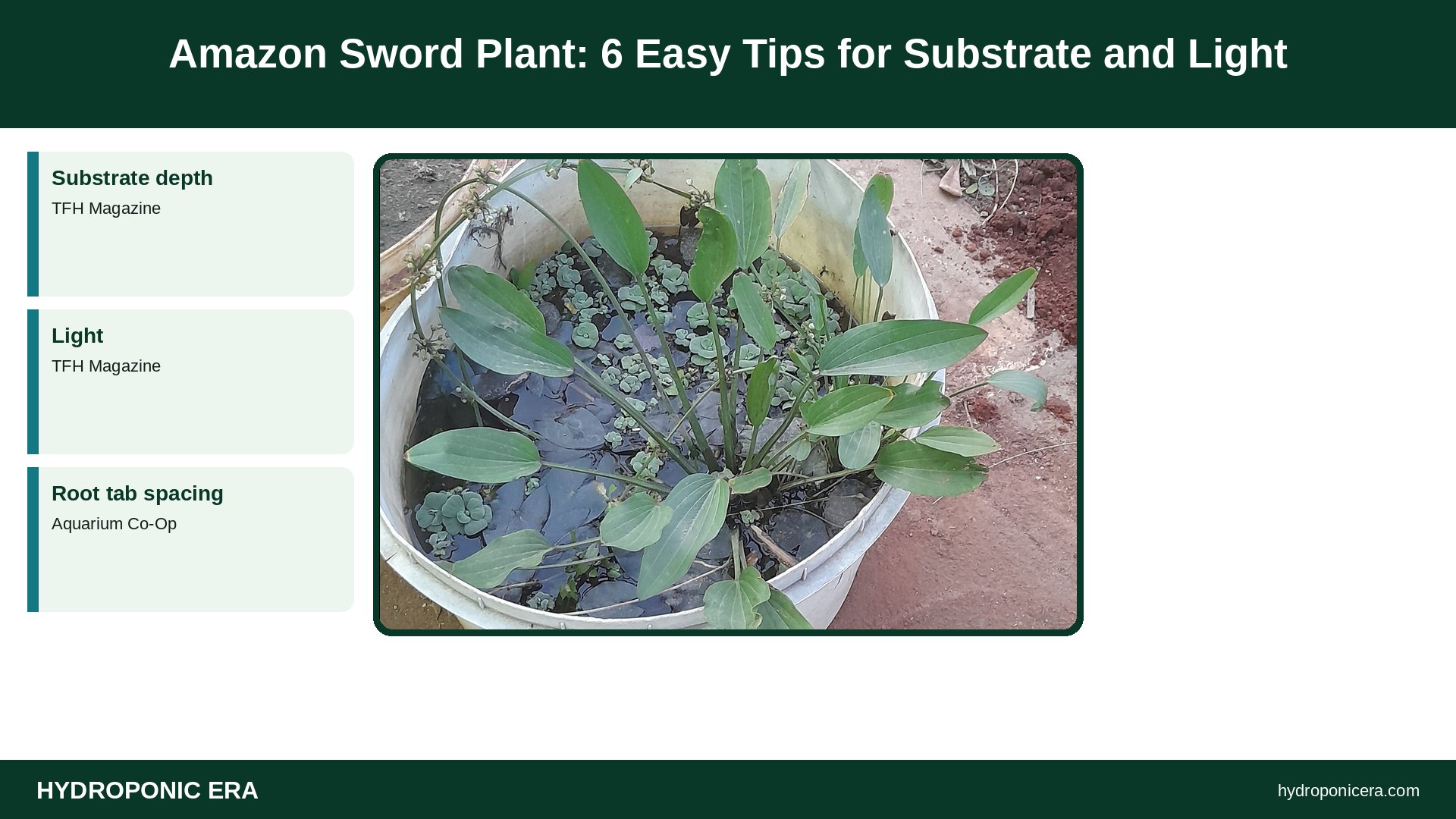
What Is an Amazon Sword Plant?
The Amazon sword plant is the common name for Echinodorus grisebachii, a large rosette plant from Central and South America. TFH Magazine says it has been used in aquariums for decades and tolerates soft or hard water across a wide pH range. It suits the background of large tanks, though many hobbyists use it as a midground focal point.
Its big leaves also give fish shelter, and egg-laying cichlids such as angelfish sometimes spawn on them.
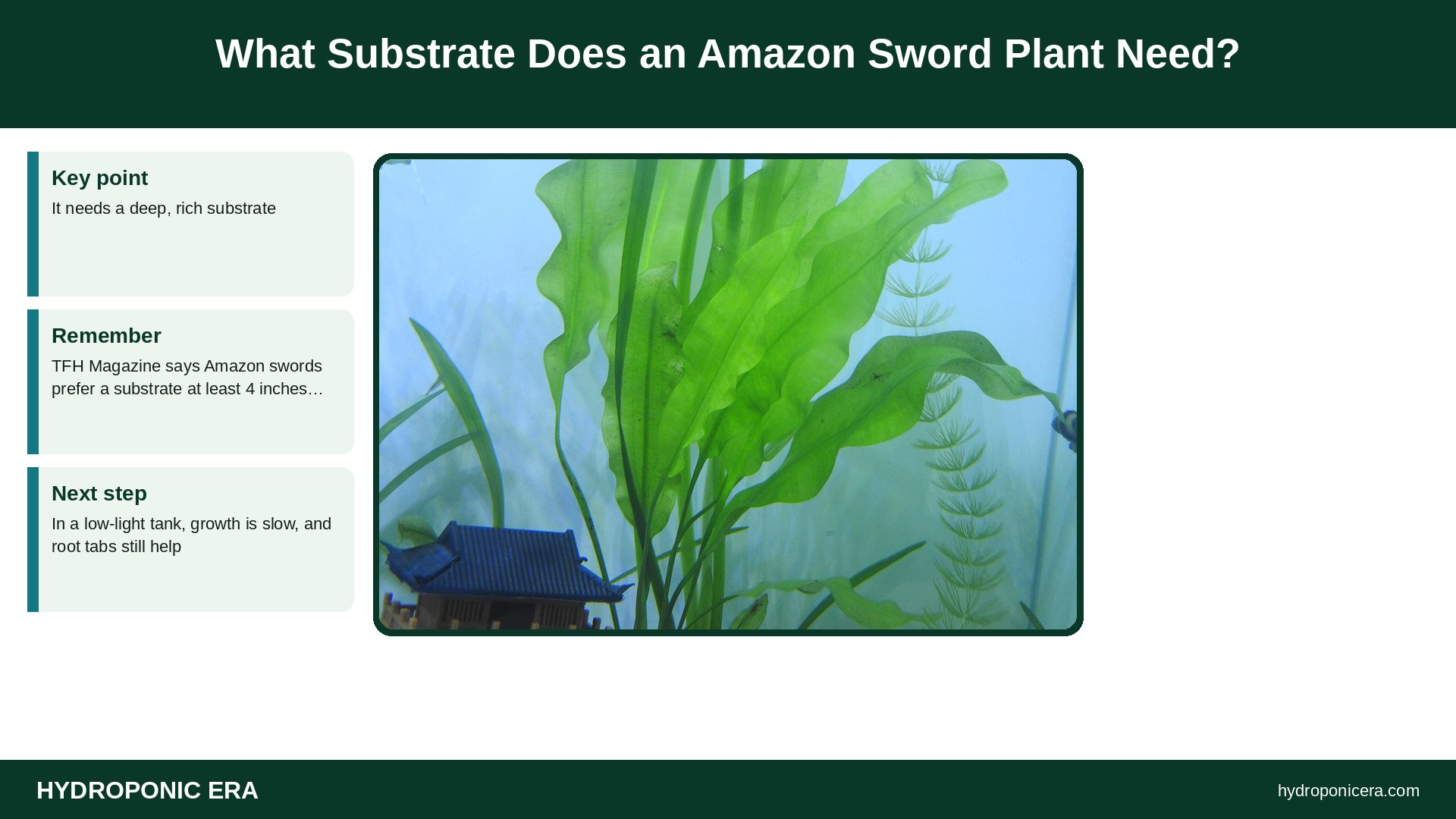
What Substrate Does an Amazon Sword Plant Need?
It needs a deep, rich substrate. TFH Magazine says Amazon swords prefer a substrate at least 4 inches (10 cm) deep to hold a massive root system, but this matters mainly under moderate to high light with added nutrients. In a low-light tank, growth is slow, and root tabs still help. Bury the roots, but keep the crown above the substrate.
- Rinse the plant, and trim dead or damaged leaves.
- Make a hole in the substrate deep enough for the roots.
- Spread the roots, and cover them.
- Keep the crown, the center where leaves emerge, above the surface.
- Add root tabs close to the roots.
How Do You Feed an Amazon Sword Plant?
Swords are heavy root feeders. Aquarium Co-Op says swords and crypts feed from the substrate and benefit most from root tabs. Push each tab deep into the substrate, near the roots, with one about every 5–6 inches (12–15 cm), and use several around large plants. Replace tabs about monthly, and add more as the plant grows. TFH adds that swords are particularly iron-needy, so watch for pale new leaves.
Avoid homemade root tabs or houseplant fertilizers in tanks, since Aquarium Co-Op warns these can spike ammonia. See our iron deficiency guide for how the symptoms look in other plants.
How Much Light Does an Amazon Sword Plant Need?
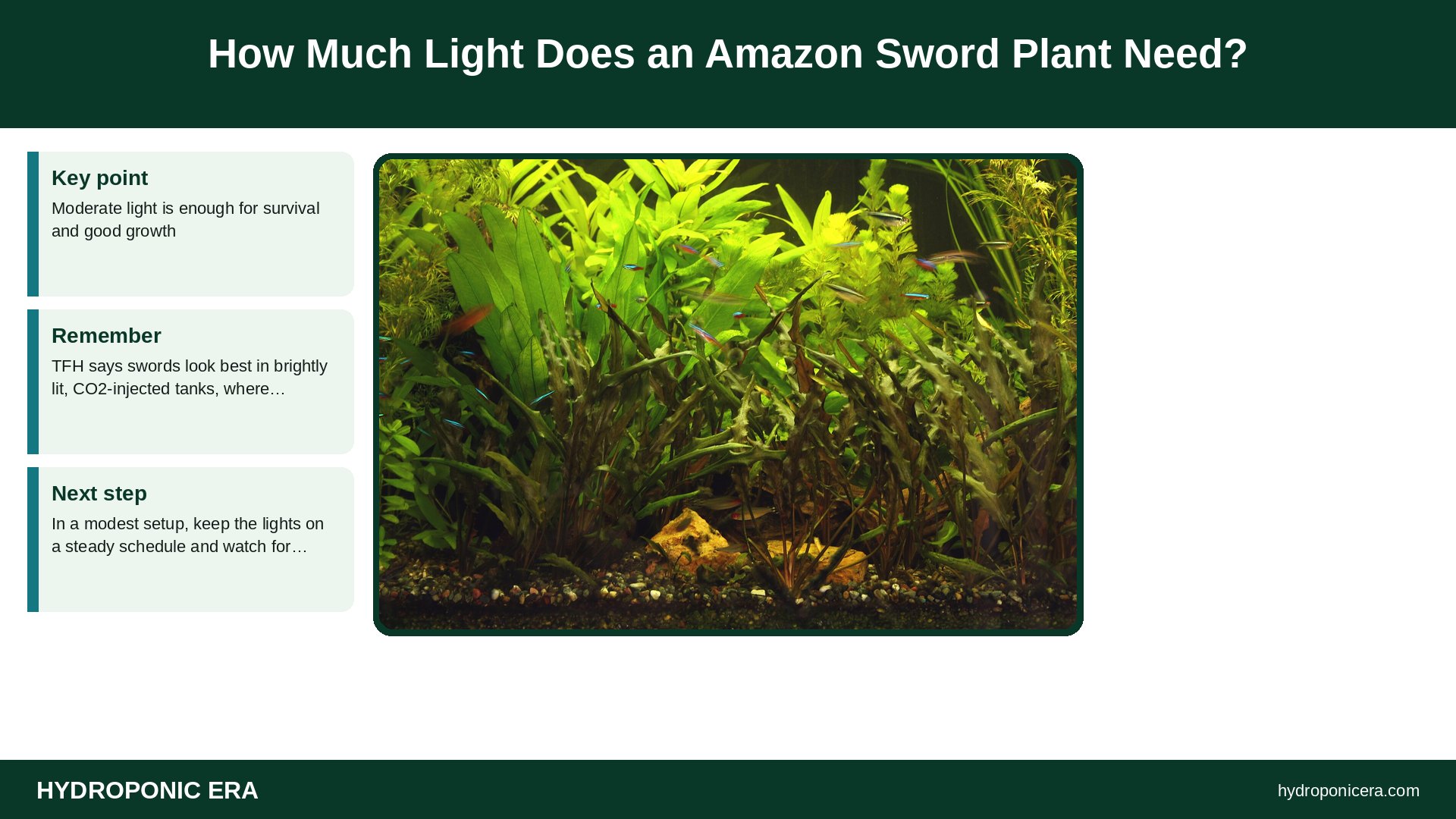
Moderate light is enough for survival and good growth. TFH says swords look best in brightly lit, CO2-injected tanks, where they grow large enough to shade smaller plants. In a modest setup, keep the lights on a steady schedule and watch for algae on the broad leaves. Bright light and extra nutrients also speed up the root system.
- Moderate light keeps it healthy.
- Bright light with CO2 gives huge growth.
- Shade from big leaves can starve nearby plants.
Why Is My Amazon Sword Plant Losing Leaves?
Many swords are grown above water by nurseries. In your tank, the plant sheds its stiff, brittle emersed leaves and grows softer underwater ones. TFH says acclimation can take several weeks to a few months. If the crown turns to mush, the plant is dead. Otherwise wait, cut off dying leaves and keep light and nutrients steady.
How Big Does an Amazon Sword Plant Get?
TFH reports that the former E. amazonicus reaches 16–20 inches (41–51 cm), while the variety formerly called E. bleherae can pass 20 inches (51 cm) in height and width. That is large for a small tank. Smaller swords exist, but swords in general suit big tanks. Plan the spot before you plant, because the root system becomes massive and hard to move without uprooting neighbors.
Where Should You Place an Amazon Sword Plant?
Put it in the back or midground, where its large leaves contrast with smaller plants. TFH notes that a sword can also hide heaters, filter intakes, cords and thermometers behind its dense leaves. Leave space around it so water flows, and keep it away from small carpet plants that its leaves would shade.
Choose the final spot carefully. Swords form massive root structures, and relocating one can uproot half the tank. For other substrate ideas, see our growing media guide and GH and KH water tests.
What Are Common Amazon Sword Plant Mistakes?
- Burying the crown, which can rot.
- Using thin, nutrient-free gravel with no root tabs.
- Moving the plant after it settles.
- Using garden fertilizers that spike ammonia.
- Throwing the plant away in the first month of leaf drop.
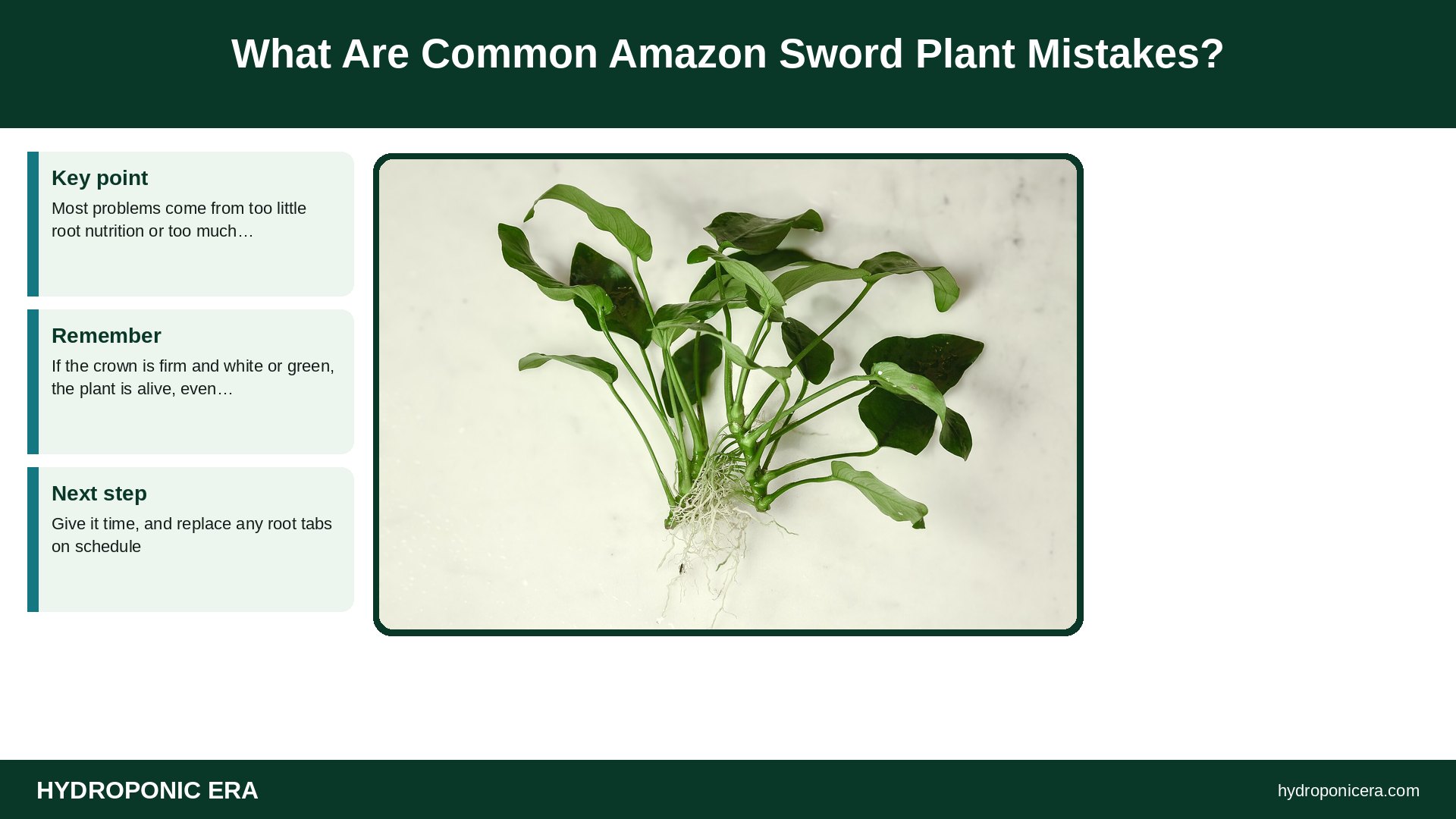
Most problems come from too little root nutrition or too much disturbance. If the crown is firm and white or green, the plant is alive, even when most leaves are gone. Give it time, and replace any root tabs on schedule.
How Do You Propagate an Amazon Sword Plant?
Two methods work. Split a large plant by removing it and cutting the crown, or let it send up submersed stalks that form plantlets. Remove the plantlets after they grow roots, or leave the stalk attached to produce many baby swords. TFH says this can produce a steady supply of new plants over time.
Can an Amazon Sword Plant Grow Outdoors?
In warm weather, yes. TFH says swords thrive as marginal pond plants in pots, and they work well in summer tubs, where the crown shelters young fish. In the Gulf states, keep non-natives and hybrids only in closed ornamental ponds, since escapes could outcompete natives. See our water lily container guide for another contained pond option.
FAQ About Amazon Sword Plant
Does an Amazon sword plant need CO2?
No, though bright light with CO2 grows it larger.
Why are the leaves turning yellow?
Often iron or root nutrient shortage. Add root tabs, and check iron.
How deep should the substrate be?
At least 4 inches (10 cm) for large plants.
Can I move it?
Avoid it. The roots become massive.
Is it good for beginners?
Yes, once it settles in.
Sources
- TFH Magazine — Echinodorus grisebachii
- TFH Magazine — Swordplants: not just for Amazonian fish tanks
- Aquarium Co-Op — How to use root tabs to fertilize aquarium plants
- Photo credits (Wikimedia Commons, edited with titles): Echinodorus grisebachii-2-jayantinagar-bengaluru-India by Yercaud-elango (CC BY-SA 3.0); Echinodorus amazonicus-2-veda aquarium-bengaluru-India by Yercaud-elango (CC BY 4.0); Planted Tank 03 – Flickr – The Wandering Angel by The Wandering Angel from Makati City, Philippines (CC BY 2.0); Anubias barteri var. nana by Abhik.Mazumdar.73 (CC BY 4.0)