
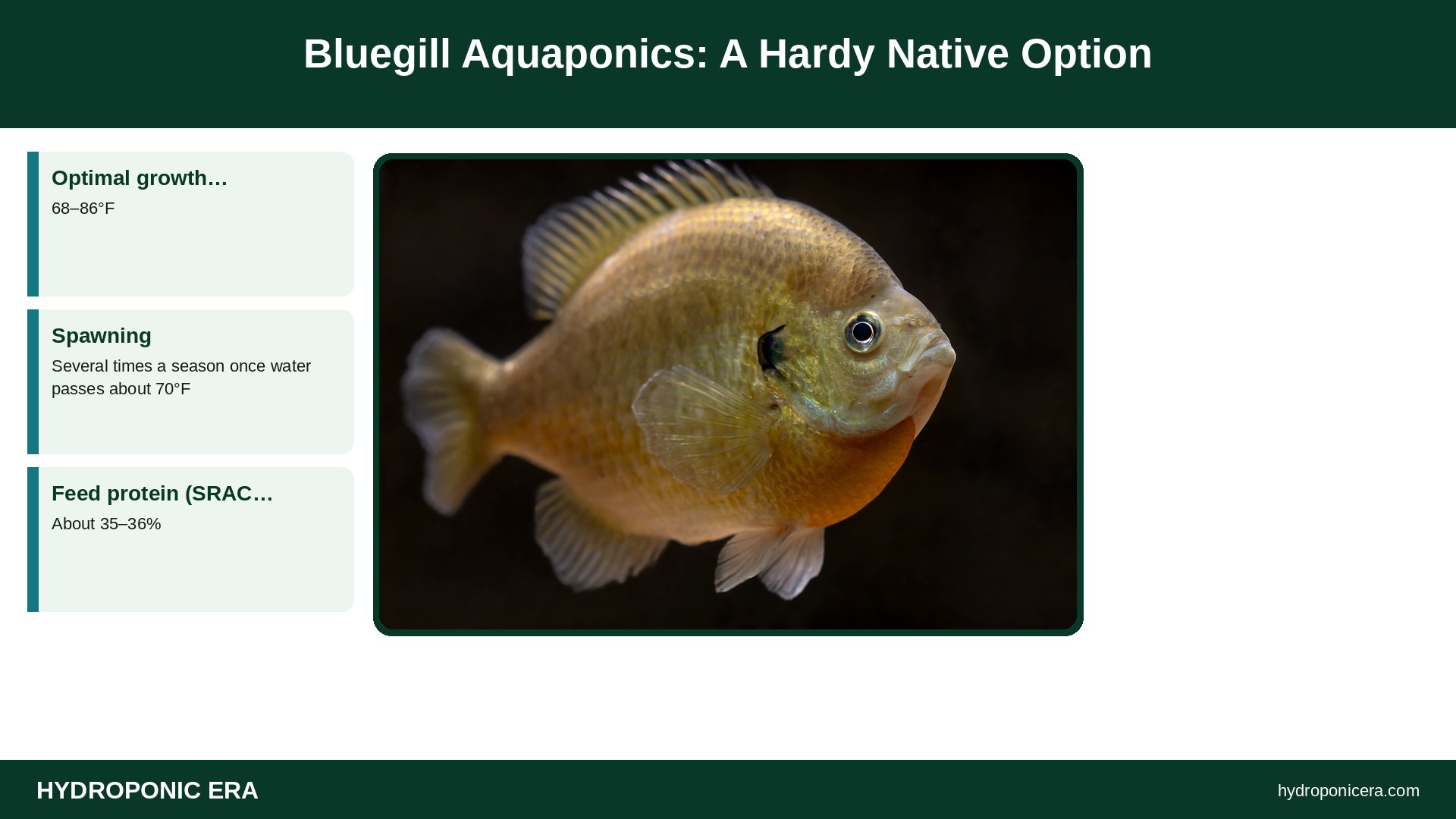
Bluegill aquaponics works well for growers who want a native, legal-almost-everywhere fish that tolerates cooler water than tilapia. The Southern Regional Aquaculture Center (SRAC) lists 68–86°F as the optimal range for sunfish growth, and notes growth keeps rising up to about 86°F. Bluegill are small, slow-growing panfish, so they’re best for hobby food production, mixed-species tanks, and beginners in states where tilapia is restricted. Hybrid sunfish (most often a male bluegill crossed with a female green sunfish) grow faster, accept pellets more readily, and handle cooler water better than pure bluegill.
Key takeaway: Bluegill are forgiving and widely legal, but they won’t reach big fillet sizes quickly. Consider hybrid sunfish if growth matters.
| Factor | Bluegill / hybrid sunfish |
|---|---|
| Optimal growth temperature (SRAC) | 68–86°F |
| Spawning | Several times a season once water passes about 70°F |
| Feed protein (SRAC, hybrids) | About 35–36% |
| Daily feed at 72°F+ (SRAC, ponds) | About 3% of body weight |
| Feedings per day for best growth (SRAC) | Three |
| Native to US | Yes, widely stocked in ponds |
| Growth speed | Slow; panfish size |
Why Choose Bluegill Aquaponics?
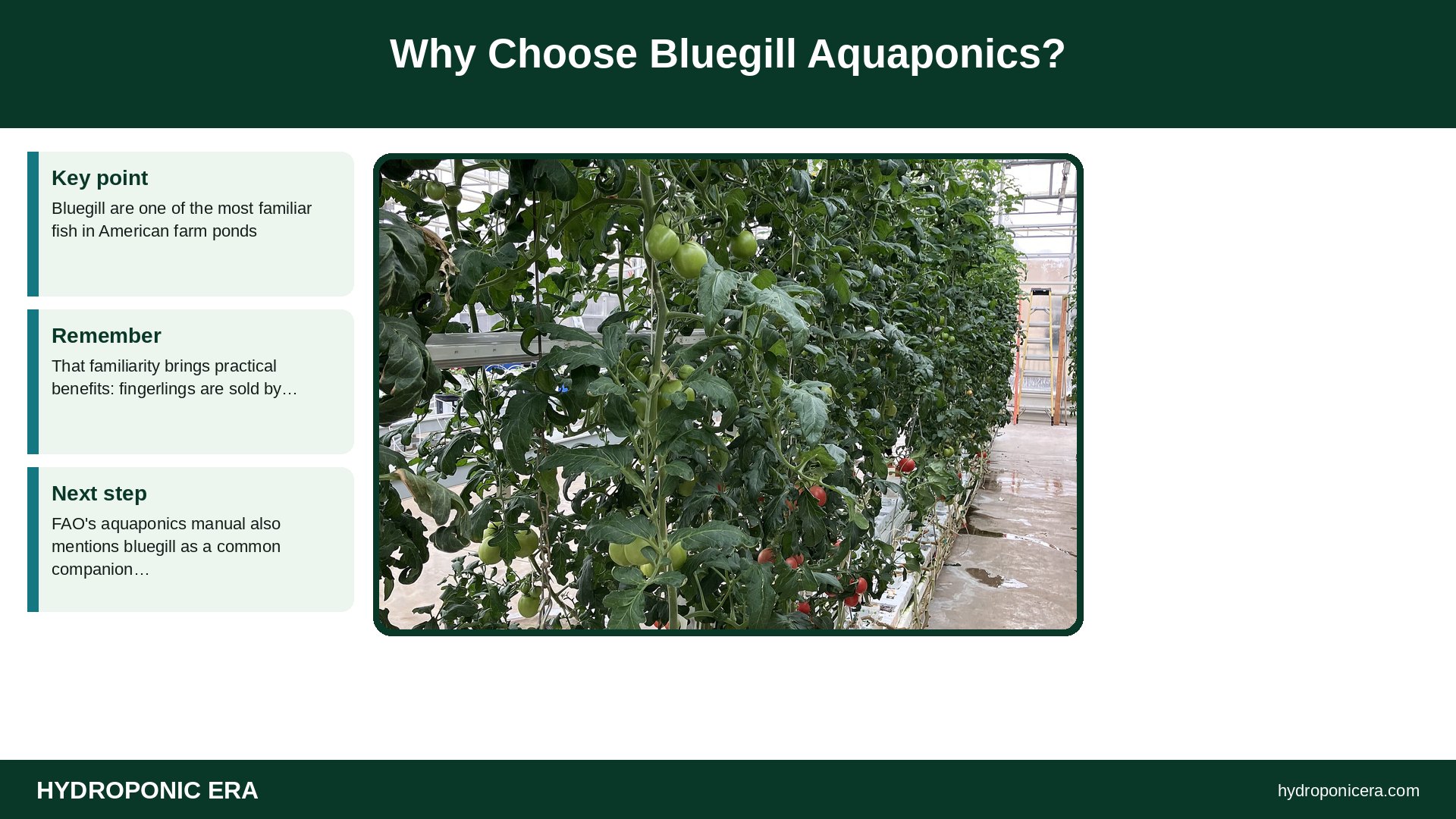
Bluegill are one of the most familiar fish in American farm ponds. That familiarity brings practical benefits: fingerlings are sold by many pond-stocking suppliers, they’re native or long-established across most of the country, and they’re usually easier to keep legally than tilapia. FAO’s aquaponics manual also mentions bluegill as a common companion species for catfish, because bluegill use the upper part of the tank while catfish stay on the bottom.
Bluegill vs Hybrid Sunfish
SRAC’s hybrid sunfish profile explains that the most common cross, a female green sunfish and a male bluegill, produces offspring with “hybrid vigor.” That shows up as:
- Faster growth than either parent species.
- Greater acceptance of formulated feeds.
- Greater tolerance of cooler water and poor conditions.
- A heavily male-skewed sex ratio, which limits reproduction.
For an aquaponics tank, those traits make hybrids attractive: they eat pellets well and are less likely to overpopulate. Pure bluegill spawn readily in warm water, which can lead to many small fish competing for food.
Realistic Bluegill Aquaponics Growth
Be honest with yourself about size in bluegill aquaponics. Bluegill are panfish. SRAC reports that in an NCRAC-funded recirculating trial, hybrid sunfish stocked as age-1 fish had not reached marketable size within 30 months, and an Iowa study found hybrids had not reached food size after 17 months in ponds plus 12 months indoors. Results vary with genetics, grading, and temperature, but bluegill aren’t a fast food fish. They’re best when your main goal is plant production, a hardy fish, or a legal option in a tilapia-restricted state.
Temperature and Seasons
Sunfish grow best between 68 and 86°F according to SRAC, so they fit well in outdoor systems across much of the US in summer and in heated or greenhouse systems year-round. Research from Southern Illinois University found hybrid sunfish continued to grow at low temperatures where channel catfish lost weight, which is useful for northern growers. In cold water they’ll survive but eat very little; feed lightly and watch for leftovers. See heaters for tanks.
Feeding Fish in Bluegill Aquaponics
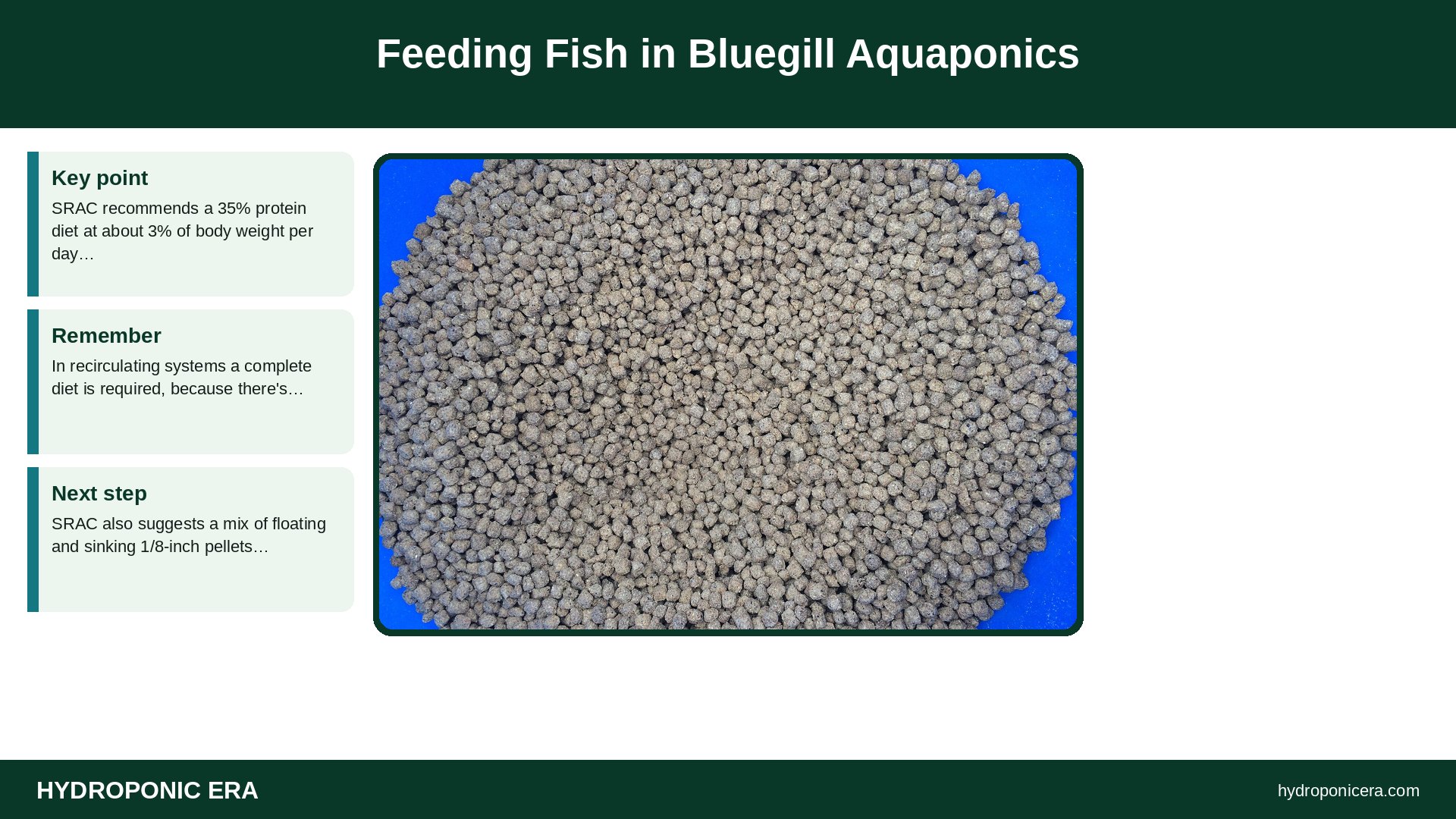
SRAC recommends a 35% protein diet at about 3% of body weight per day once water reaches about 72°F for pond-raised hybrids, and notes three daily feedings produced the highest growth rates. In recirculating systems a complete diet is required, because there’s little natural food. SRAC also suggests a mix of floating and sinking 1/8-inch pellets: floating feed lets you watch them eat, sinking feed is cheaper. In aquaponics, floating feed is easier to manage because you can see and remove uneaten pellets. See fish farming basics.
Bluegill Aquaponics Water Quality
Sunfish are hardy, but bluegill aquaponics still requires clean water. Use FAO’s general aquaponics targets: ammonia and nitrite below 1 mg/L (ideally near zero), dissolved oxygen above 5 mg/L, and pH around 6–7. Test weekly once the system is stable and more often during cycling. See dissolved oxygen and pH meters.
Stocking Bluegill
FAO recommends small-scale aquaponic systems stay below about 20 kg of fish per 1,000 liters (about 0.17 lb per gallon). Because bluegill are small, you’ll keep more individual fish for the same weight. Start below the limit and add fish only as your biofilter and plant area can handle the feed. Grading by size helps, because larger sunfish can bully smaller ones away from food.
Controlling Breeding
In bluegill aquaponics, pure bluegill spawn several times a season once water passes about 70°F, according to SRAC. In a tank, that can mean many fry. Options:
- Stock hybrid sunfish, which are mostly male.
- Remove fry or eggs regularly.
- Keep a predator fish if your state allows it and the tank is large enough, though this adds complexity.
Plants for Bluegill Aquaponics
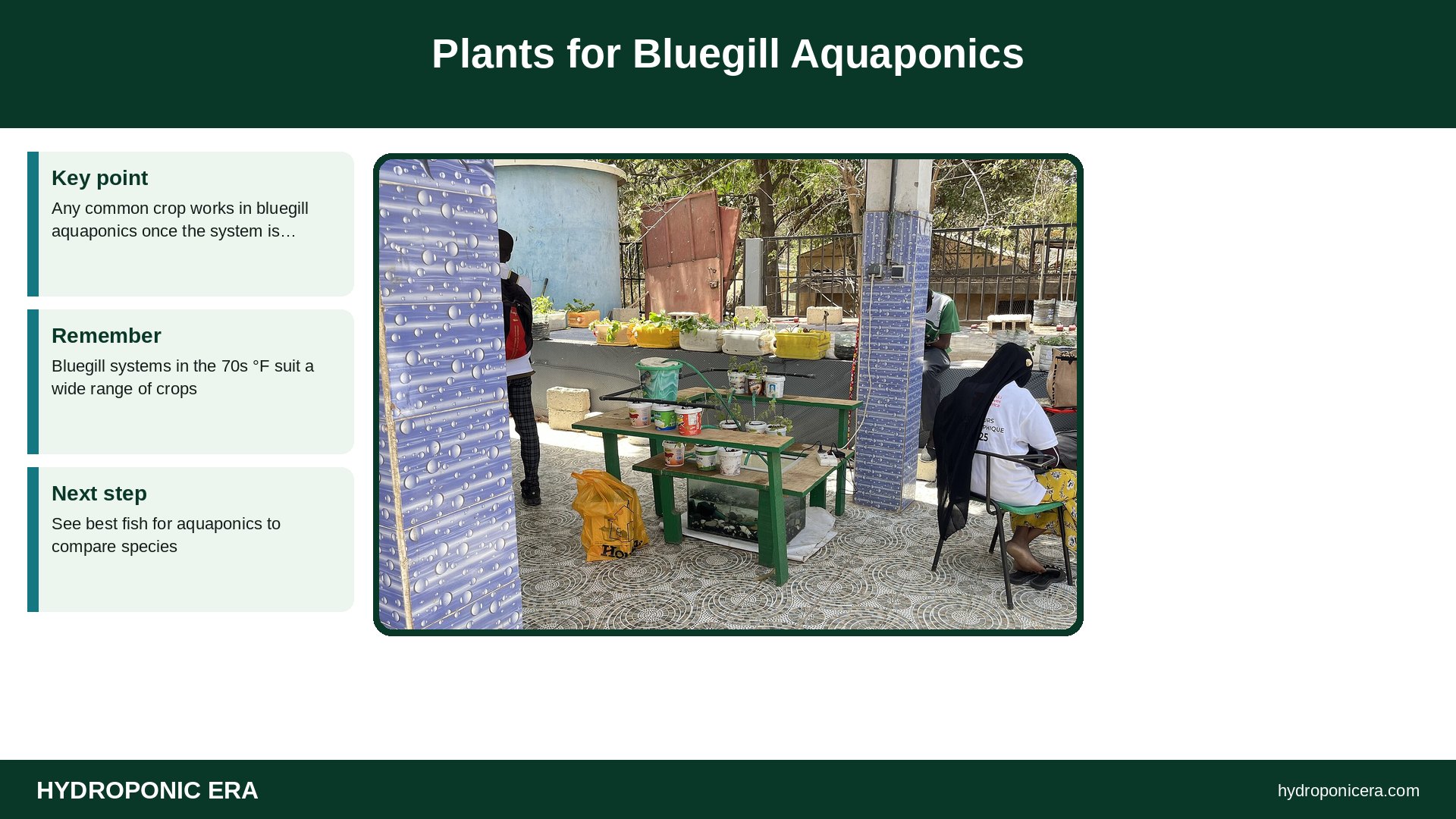
Any common crop works in bluegill aquaponics once the system is cycled: lettuce, kale, chard, basil, mint, and tomatoes. Bluegill systems in the 70s °F suit a wide range of crops. See best fish for aquaponics to compare species.
Legal Checks
Bluegill are widely stocked, but many states still regulate buying, transporting, or selling live fish, or require an aquaculture license if you plan to sell. Check with your state fish and wildlife or agriculture department before stocking, especially for hybrids or if you plan to sell fish.
Bringing Bluegill Into a New System
Pond-raised bluegill often travel in bags from a farm-pond supplier. FAO’s acclimation method applies: float the sealed bag for at least 15 minutes, then add system water in small amounts for another 15 minutes or more. If pH differs by more than 0.5, hold the fish in an aerated tub and blend in system water over at least 24 hours. Wild-caught fish aren’t a good idea; many states restrict moving live wild fish, and they can carry parasites.
Grading and Aggression
Sunfish set up pecking orders, which is a common bluegill aquaponics issue. The largest fish claim the feed and can nip smaller ones. Feed in several spots at once so subordinate fish get their share, and grade by size every few months, moving the biggest fish to harvest or a separate tank. SRAC’s hybrid sunfish profile notes three daily feedings gave the best growth, and spreading feed over more meals also reduces competition at each feeding.
Harvest and Flavor
Bluegill are a classic pan-fried fish. Because tank-raised fish can pick up off-flavors from algae and certain bacteria, FAO recommends purging fish for 3–5 days in clean, aerated water without feed before eating them. Use that purge water to top up your system afterward. Keep tanks shaded to limit algae growth.
FAQs: Bluegill Aquaponics
Is bluegill aquaponics worth it?
Yes, for hardiness and legal access. They’re slow-growing, so they’re better for hobby systems than for big harvests.
What temperature do bluegill like?
SRAC lists 68–86°F as optimal for sunfish growth.
What is a hybrid sunfish?
Usually a cross between a female green sunfish and a male bluegill. Hybrids grow faster and are mostly male.
What do fish eat in bluegill aquaponics?
A complete pellet around 35% protein, fed up to three times daily in warm water.
Can bluegill live with catfish?
Yes. Bluegill use the upper tank and catfish the bottom, a pairing FAO mentions.
Sources
- Southern Regional Aquaculture Center — Species Profile: Hybrid Sunfish (SRAC 7205)
- FAO — Small-scale aquaponic food production
- Southern Illinois University — Growth of Hybrid Sunfishes and Channel Catfish at Low Temperatures
- Photo credits (Wikimedia Commons, edited with titles): Bluegill (Lepomis macrochirus) black background by USFWS Mountain Prairie (Public domain); Solanum lycopersicum in aquaponics at the NC Greenhouse Nursery by Gogerr (CC BY-SA 4.0); Fish farming on Øksfjorden in Loppa, Troms og Finnmark, Norway, 2022 August by Ximonic (Simo Räsänen) (CC BY-SA 4.0); Fish Feed Pellets by Narek75 (CC BY-SA 4.0); AQUAPONIE by Hopeballa (CC BY-SA 4.0)