
Is chayote hydroponics practical? It is possible but demanding. Chayote is a perennial vine that UF/IFAS says can reach 50 feet (15 m), needs a 6-foot trellis, 12-hour days to flower and temperatures above 54°F (12°C). A large Dutch bucket or deep container with a whole sprouted fruit is the realistic soilless setup.
Key takeaway: Chayote hydroponics is a big-plant project. UF/IFAS describes chayote as a vigorous perennial vine with tuberous roots that grows up to 50 ft (15 m), flowers at 12-hour day length and dies below 54°F (12°C). It is planted as a whole fruit. Use a large Dutch bucket, a strong trellis and cucumber-style feeding, and expect fruit about 35 days after pollination.
| Fact | What sources report | Source |
|---|---|---|
| Plant type | Monoecious perennial climbing vine with tuberous roots | UF/IFAS HS1454 |
| Vine length | Up to 50 ft (15 m) | UF/IFAS HS1454 |
| Temperature | Best days 66–86°F (19–30°C), nights above 60°F (16°C); dies below 54°F (12°C) | UF/IFAS HS1454 |
| Flowering | Needs about 12-hour day length | UF/IFAS HS1454 |
| Fruit timing | About 35 days after pollination | UF/IFAS |
| Planting | Whole fruit laid on its side | UF/IFAS, Texas A&M |
| Feeding | Follow cucumber guidance; target pH 6.0 in soil | UF/IFAS HS1454 |
Can You Grow Chayote Hydroponically?
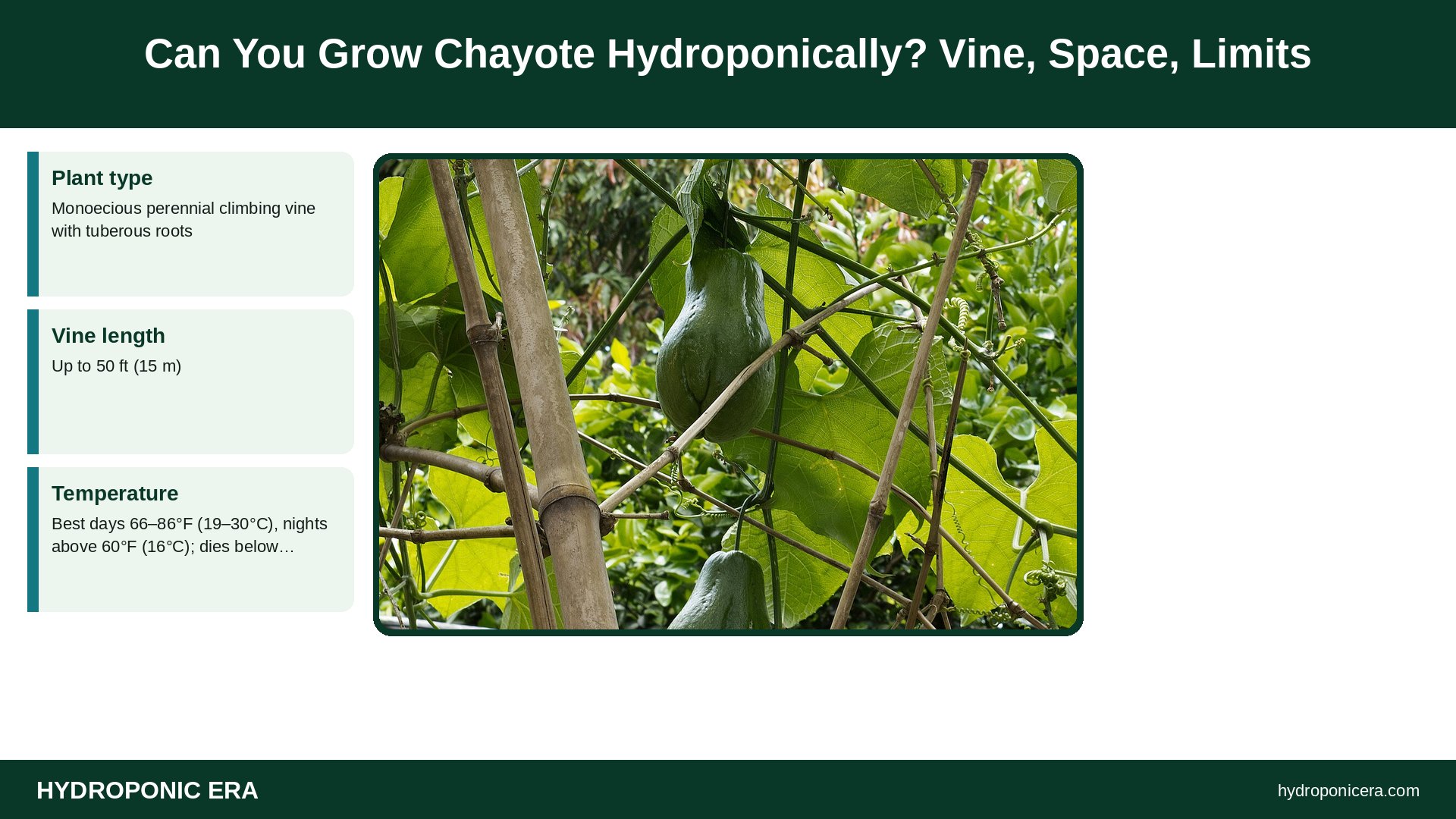
Yes, but there is no published chayote hydroponics recipe that we could find, and the plant is huge. UF/IFAS says the vine can grow up to 50 feet (15 m) and needs a trellis about 6 feet (1.8 m) tall. Texas A&M spaces plants at least 8 to 10 feet (2.4 to 3 m) apart. That is a greenhouse or patio project, not a countertop one.
The workable approach is a soilless container system: a large Dutch bucket or a 20-gallon (76 L) or bigger pot of coco and perlite on drip feed. See Dutch bucket hydroponics for the hardware. Deep water culture is a poor fit, because the sprouting fruit must not sit in water.
- Best fit: Dutch bucket or large drip-fed container.
- Poor fit: NFT or small DWC; the vine and roots are too big.
- Support: a strong overhead trellis; see hydroponic trellising.
How Do You Start Chayote Hydroponics From a Fruit?
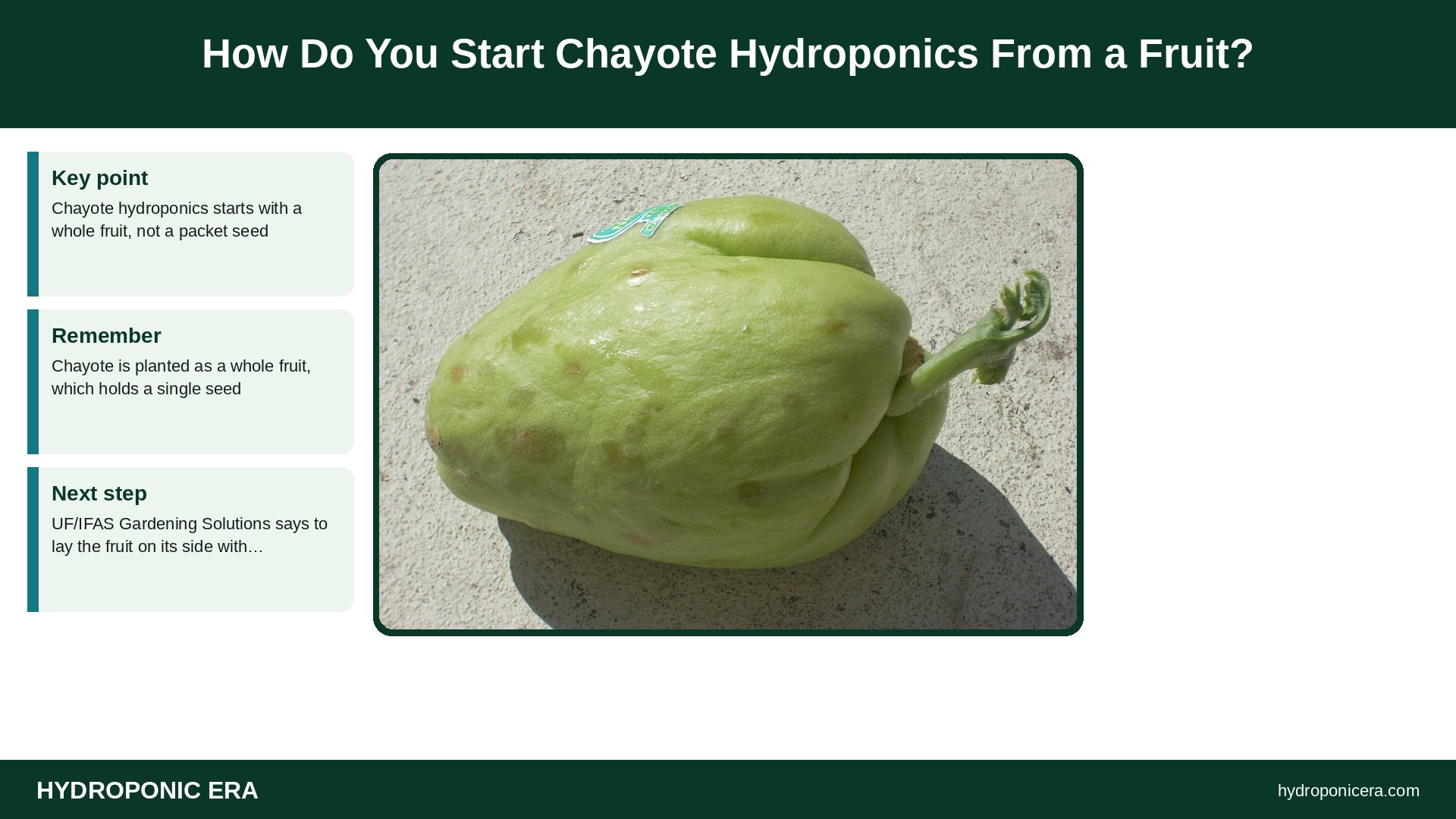
Chayote hydroponics starts with a whole fruit, not a packet seed. Chayote is planted as a whole fruit, which holds a single seed. UF/IFAS Gardening Solutions says to lay the fruit on its side with the narrow end sloping upward. Texas A&M says to plant after all danger of frost. For eating, Texas A&M advises against sprouted fruit, but a sprouted fruit is what you want for planting.
- Buy a firm, unbruised fruit and let it sprout at room temperature.
- Wait for a shoot several inches long from the broad end.
- Set the fruit on its side in damp coco or perlite, about half buried.
- Keep the shoot end exposed and the media moist, not wet.
- Start drip feeding once roots reach the container walls.
- Train the first vine up a string or trellis.
What pH, EC and Temperature Does Hydroponic Chayote Need?
For chayote hydroponics, borrow a cucumber feed. UF/IFAS says no specific fertilizer guide exists for chayote in Florida and suggests following cucumber recommendations, with a soil pH target of 6.0. For hydroponics, use a cucumber nutrient at pH 5.8 to 6.2 and EC around 2.0 to 2.5 mS/cm; those are our cucumber-based targets, not chayote trial data.
- pH: 5.8–6.2 in solution.
- EC: about 2.0–2.5 mS/cm once vining; lower for young plants.
- Day temperature: 66–86°F (19–30°C), per UF/IFAS.
- Night temperature: above 60°F (16°C); below 54°F (12°C) is fatal.
- Humidity: UF/IFAS cites 80–85% relative humidity.
Texas A&M warns that heavy fertilization pushes extra vine growth and lowers yields. Our cucumber hydroponics guide has a full feeding schedule to adapt.
How Much Light and Day Length Does Chayote Need?
Chayote grows in full sun or part shade, according to UF/IFAS, but it needs about a 12-hour day length to flower. That helps explain why outdoor vines in much of the US tend to bloom late in the season. Indoors, keeping lights near 12 hours once the vine is large can help trigger bloom; longer days may keep it vegetative.
How Long Does Chayote Hydroponics Take to Harvest?
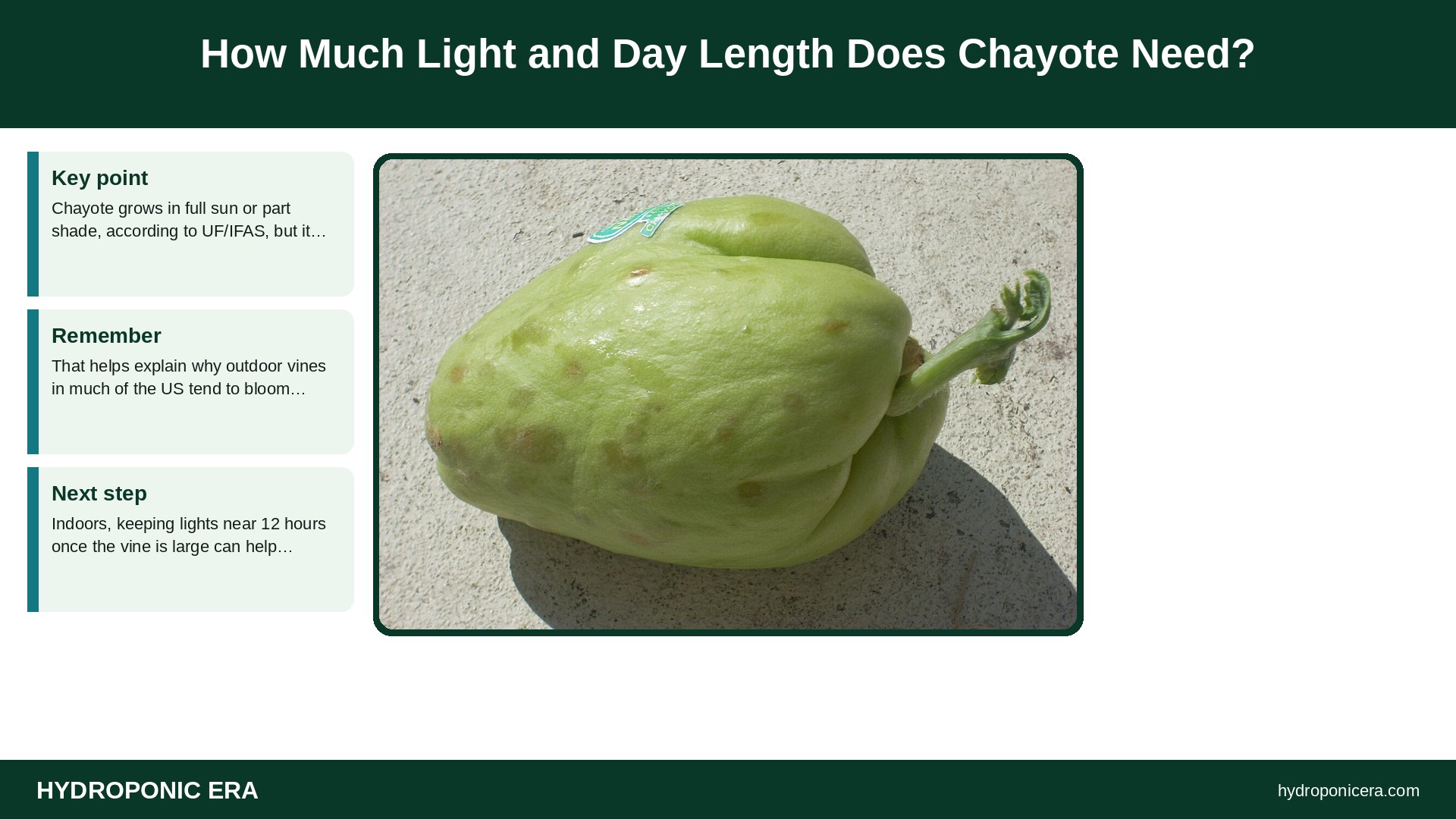
Chayote hydroponics is a long project. UF/IFAS says plants may start flowering 1 to 2 months after germination, and fruit develops about 35 days after pollination. Chayote has separate male and female flowers and is mainly cross-pollinated by bees and wasps, so indoor vines need hand pollination. Pick fruit young, when the rind and seed are soft.
- Flowering: 1–2 months after sprouting, if day length allows.
- Fruit: about 35 days after pollination.
- Yield potential: UF/IFAS cites 80–100 fruits per plant per season in field conditions.
- Pollination: see indoor pollination.
What Are the Limits of Chayote Hydroponics?
Space, cold and day length are the main limits of chayote hydroponics. The vine needs a large frame, any temperature below 54°F (12°C) kills it, and it will not bloom under long summer days. UF/IFAS also notes the regular production cycle is 1 to 3 years, so plan for a perennial plant that stays in one container.
- Cold: move indoors or heat the greenhouse before nights drop below 60°F (16°C).
- Size: prune side shoots to keep the vine manageable.
- Storage: Texas A&M stores fruit at 50–59°F (10–15°C) and 90% humidity.
FAQ About Chayote Hydroponics
Can chayote grow in water?
A sprouted fruit should not sit in water; use a drip-fed soilless container.
How big does a chayote vine get?
Up to 50 feet (15 m), according to UF/IFAS.
How long until chayote fruits?
Flowers can appear 1–2 months after sprouting; fruit about 35 days after pollination.
Why is my chayote not flowering?
It needs about 12-hour days to bloom.
What temperature kills chayote?
UF/IFAS says it cannot survive below 54°F (12°C).
Does chayote need a pollinator?
Yes; it is mainly cross-pollinated by bees and wasps.
Sources
- UF/IFAS (Qiu and Liu) — HS1454: Chayote, A Potential Vegetable Crop for Florida
- UF/IFAS Gardening Solutions — Chayote
- Texas A&M AgriLife Extension — Chayote, Specialty Crops of Texas
- Photo credits (Wikimedia Commons, edited with titles): Chayote on vine Central America by Ll1324 (CC0); Sprouting-chayote-november by User:Jengod (CC BY-SA 3.0)