
What is the difference in coco coir vs peat moss? In coco coir vs peat moss, coir is a washed coconut husk product with a pH near 6 to 7 that re-wets easily and keeps more air. Peat moss is decomposed bog matter with a pH near 3.9 to 4.5 that holds more water but needs lime.
Key takeaway: Coco coir vs peat moss is the most common choice in soilless growing, and both work. Oklahoma State University Extension notes coir holds moisture very well yet still allows good root aeration, while peat can hold up to 10 times its dry weight in water. This guide compares pH, salts, water, air, seed starting and sustainability.
| Property | Coco Coir | Peat Moss |
|---|---|---|
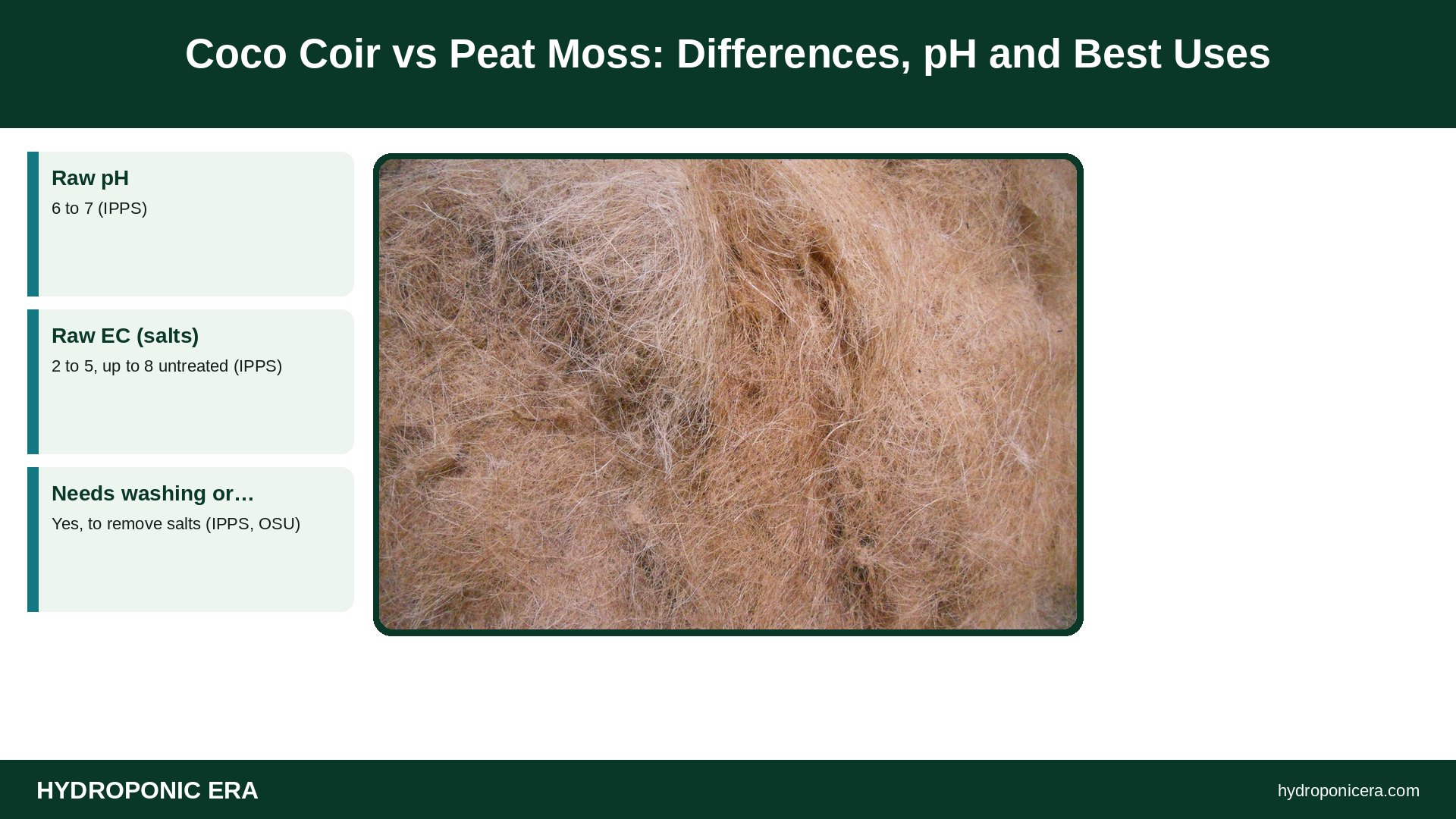
| Raw pH | 6 to 7 (IPPS) | 3.9 to 4.1 (IPPS); 3.8 to 4.5 (OSU) |
| Raw EC (salts) | 2 to 5, up to 8 untreated (IPPS) | About 0.10 (IPPS) |
| Needs washing or buffering? | Yes, to remove salts (IPPS, OSU) | No; needs lime for pH (our guidance) |
| Water holding | Holds moisture well (OSU) | Up to 10x its dry weight (OSU) |
| Air content | High, even when fine (IPPS) | Lower; perlite often added (IPPS) |
| Re-wetting | Easy; acts as a wetting agent (IPPS) | Needs a wetting additive (IPPS) |
| Sustainability | Coconut industry co-product (Iowa State) | Bog extraction is not sustainable (OSU) |
What Is the Difference Between Coco Coir and Peat Moss?
Origin and chemistry. Cost also differs by region: compressed coir bricks ship light, while peat bales are bulky (our guidance). In coco coir vs peat moss, coir is shredded coconut husk sold as bricks that expand up to six times when soaked, per OSU. Peat is partially decomposed marsh plants, and sphagnum peat is the most desirable type. Raw coir runs pH 6 to 7 but carries salts; raw peat is very acidic and low in salts.
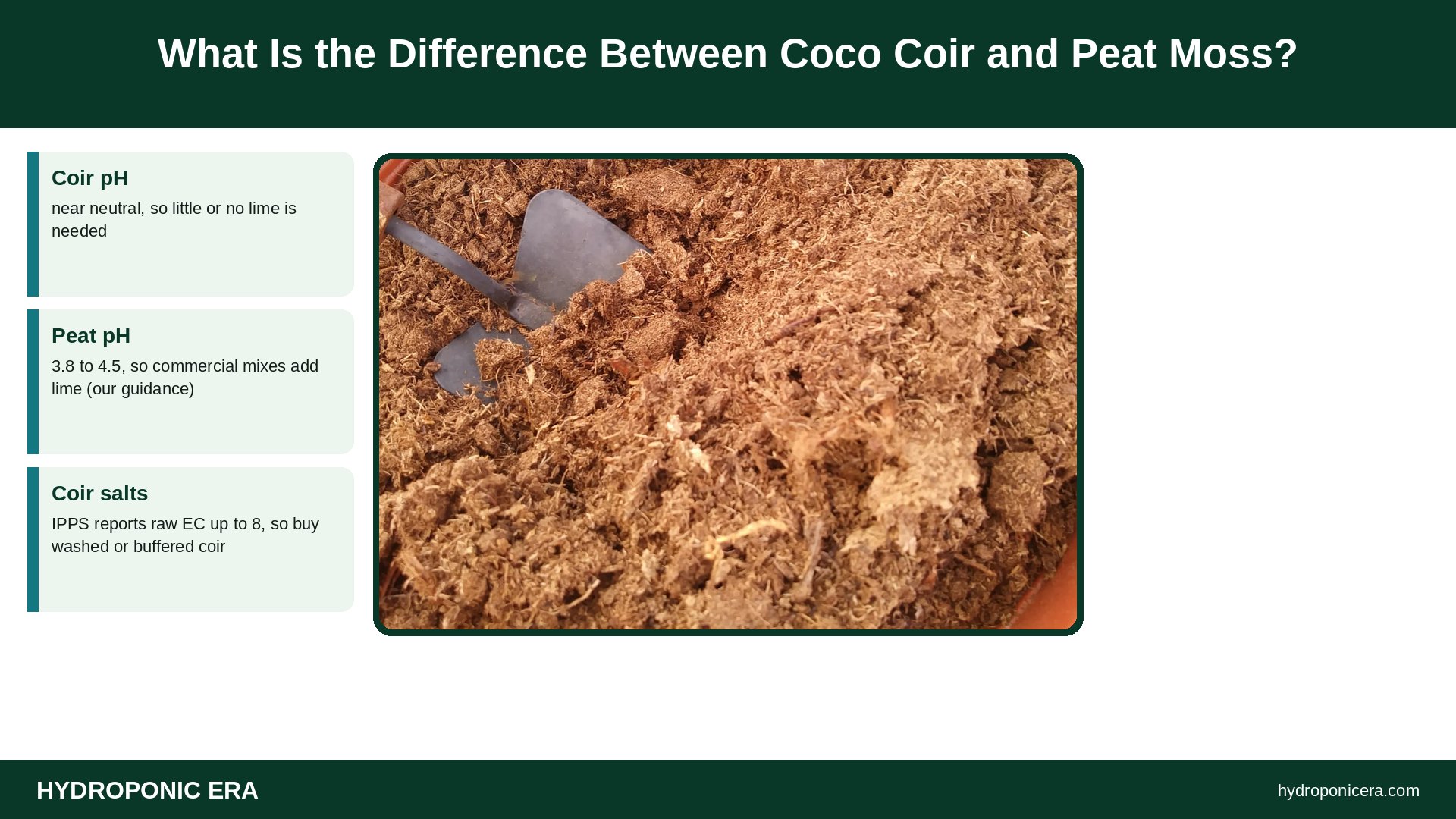
- Coir pH: near neutral, so little or no lime is needed.
- Peat pH: 3.8 to 4.5, so commercial mixes add lime (our guidance).
- Coir salts: IPPS reports raw EC up to 8, so buy washed or buffered coir.
- Calcium and magnesium: OSU notes coir is often treated with Ca and Mg; see coco coir hydroponics.
Which Holds Water Better, Coco Coir or Peat Moss?
Peat holds more easily available water; coir holds more air. The IPPS Jiffy paper explains that the more peat a mix contains, the wetter it will be, while more coir means less easily available water and higher air content. For coco coir vs peat moss in a hydroponic drip system, that extra air in coir is the main advantage.
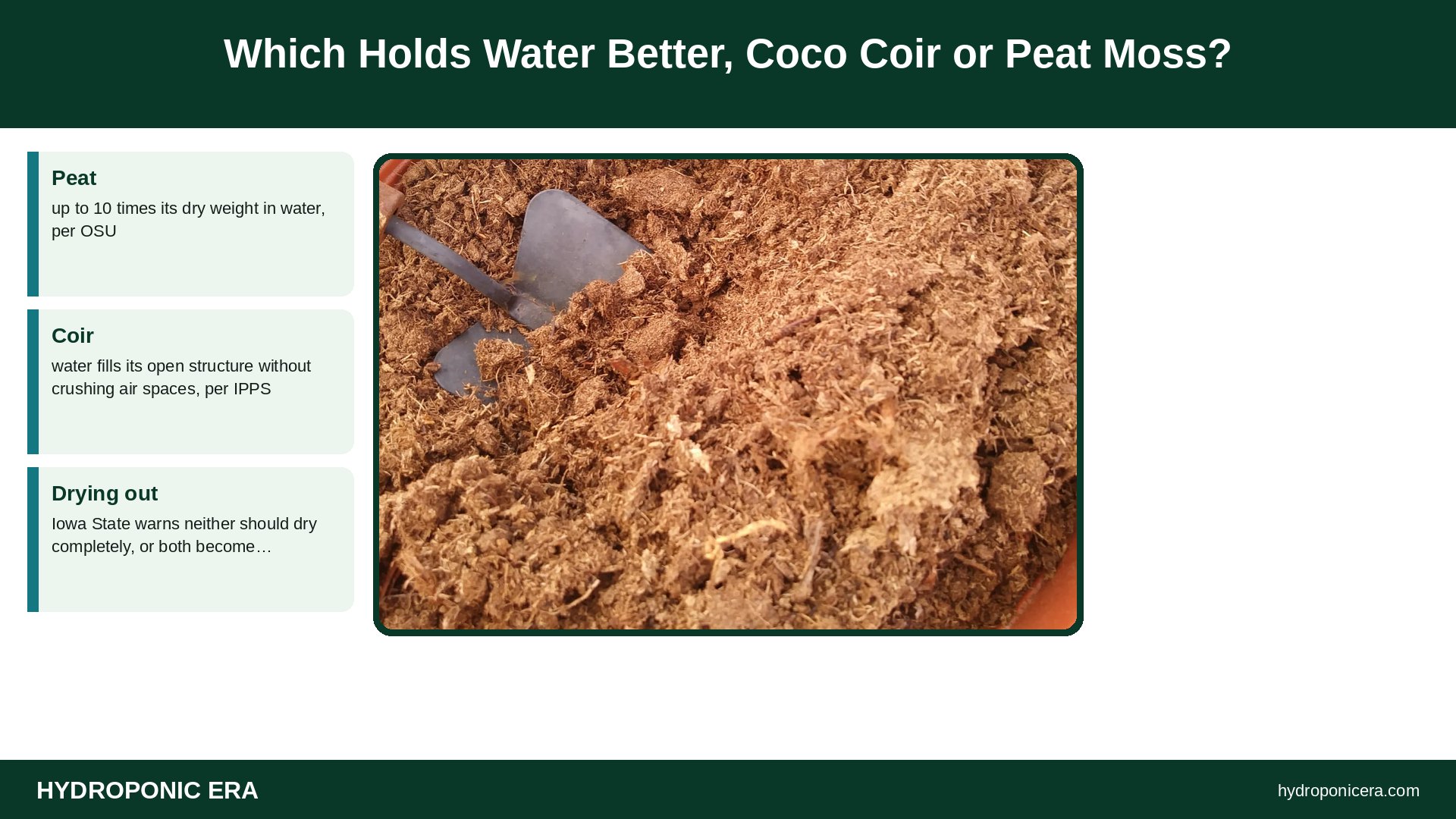
- Peat: up to 10 times its dry weight in water, per OSU.
- Coir: water fills its open structure without crushing air spaces, per IPPS.
- Drying out: Iowa State warns neither should dry completely, or both become hydrophobic.
- Fix: coir re-wets easily; dry peat needs a wetting agent and patience.
Which Is Better for Seed Starting?
Both work, and blends are common, so coco coir vs peat moss is a close call for seeds. OSU notes coir is widely used as a starting medium for seeds and a rooting medium for cuttings. IPPS describes peat, coir or a blend of the two as the base for an optimum propagation substrate, with coir improving re-wetting and air in peat. For tiny seeds, a fine peat-based mix stays evenly moist (our guidance).
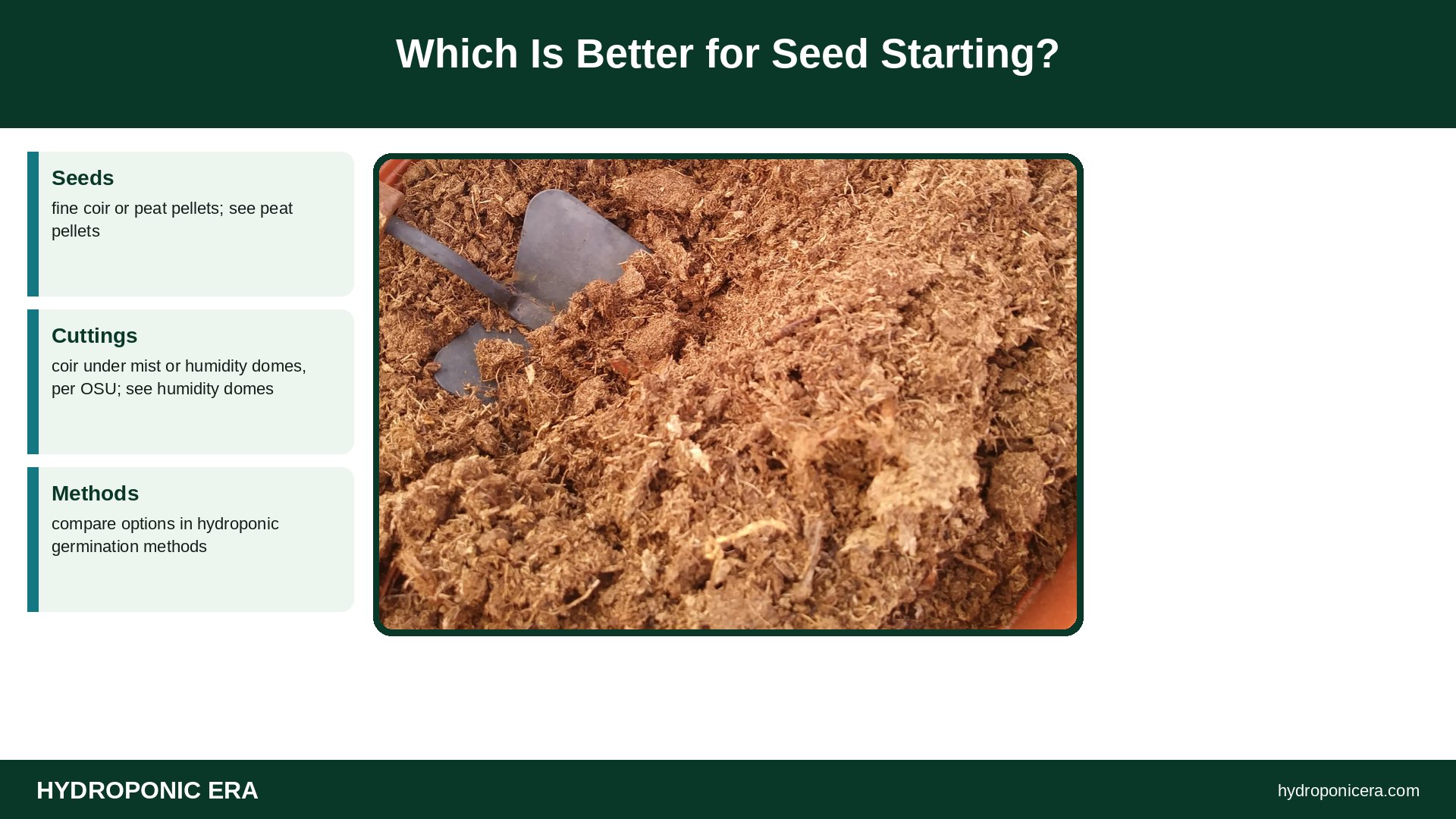
- Seeds: fine coir or peat pellets; see peat pellets.
- Cuttings: coir under mist or humidity domes, per OSU; see humidity domes.
- Methods: compare options in hydroponic germination methods.
- Blends: a 50:50 mix balances water and air (our guidance).
Is Coco Coir or Peat Moss More Sustainable?
Coir has the edge on sustainability. Iowa State Extension calls coir a co-product of the coconut industry that can replace peat moss. OSU states plainly that peat extraction is not sustainable, because it removes bog layers that took centuries to form. Coir does have a shipping footprint, since most comes from South Asia and other tropical regions (our guidance).
- Coir: renewable husk waste, but must be processed and washed.
- Peat: slow-forming natural resource harvested from bogs.
- Reuse: both break down over time; coir chunks are more stable, per IPPS.
If sustainability decides coco coir vs peat moss for you, coir is the clear pick. Peat-free mixes based on coir, bark and perlite are now widely sold for home growers (our guidance).
How Do You Use Coco Coir vs Peat Moss in Hydroponics?
Coir is the usual hydroponic choice. IPPS notes coir is used heavily in hydroponics, and its high air content suits drip, ebb-and-flow and Dutch bucket systems. Peat is better as a seed-starting or potting base. Whatever you pick, check runoff pH and EC often.
- Soak the coir brick in water and let it expand.
- Rinse unbuffered coir until runoff EC is low (our guidance).
- Buffer with a cal-mag solution before planting (our guidance).
- Add perlite to peat mixes for drainage, as IPPS suggests.
- Track pH; see pH control.
In short, coco coir vs peat moss is less about which is better and more about matching water and air to your system.
FAQ About Coco Coir vs Peat Moss
Is coco coir better than peat moss?
For hydroponics usually yes; coir holds more air and re-wets easily.
Does coco coir need lime?
Rarely; raw coir pH is about 6 to 7.
Why is peat moss so acidic?
Raw peat pH is about 3.8 to 4.5.
Do I need to wash coco coir?
Yes, unless it is sold washed or buffered, because raw coir is salty.
Can I mix coco coir and peat moss?
Yes; coir improves air and re-wetting in peat.
Which is more eco-friendly in coco coir vs peat moss?
Coir, since peat bog extraction is not sustainable.
Sources
- Oklahoma State University Extension — Soilless Growing Mediums (HLA-6728)
- International Plant Propagators’ Society — Coir and Peat: an Optimum Rooting Substrate for Propagation
- Iowa State University Extension — Potting Media: Components and Handling
- Photo credits (Wikimedia Commons, edited with titles): Coir fibery by Fotokannan (CC BY-SA 3.0); Sphagnum Peat by Affitisciuto (CC BY-SA 4.0)
1 thought on “Coco Coir vs Peat Moss: Differences, pH and Best Uses”