
What causes drain flies in hydroponics? Drain flies in hydroponics breed in the slimy biofilm that builds up on wet, organic surfaces such as runoff trays, drain lines and dirty reservoirs. University of Maryland Extension notes they breed in saucers under potted plants and condensate pans. Removing the slime by scrubbing is the most effective control, not pouring chemicals down drains.
Key takeaway: Drain flies in hydroponics, also called moth flies, are small, fuzzy, weak-flying flies whose larvae feed in gelatinous slime. Alabama Extension calls physical removal of larval breeding sources the most effective control. Find the source with a sticky trap or cup overnight, scrub the biofilm away and keep runoff areas dry and clean.
| Fact | What sources report | Source |
|---|---|---|
| Family | Psychodidae (moth flies) | CT Agricultural Experiment Station |
| Adult size | 1/16–1/4 in (1.6–6.4 mm) | UMD Extension |
| Egg to adult | 7–28 days | UMD Extension; CT CAES |
| Adult life | Up to about 2 weeks | UMD Extension |
| Eggs per mass | 30–200 | CT CAES |
| Best control | Physical removal of breeding slime | Alabama Extension |
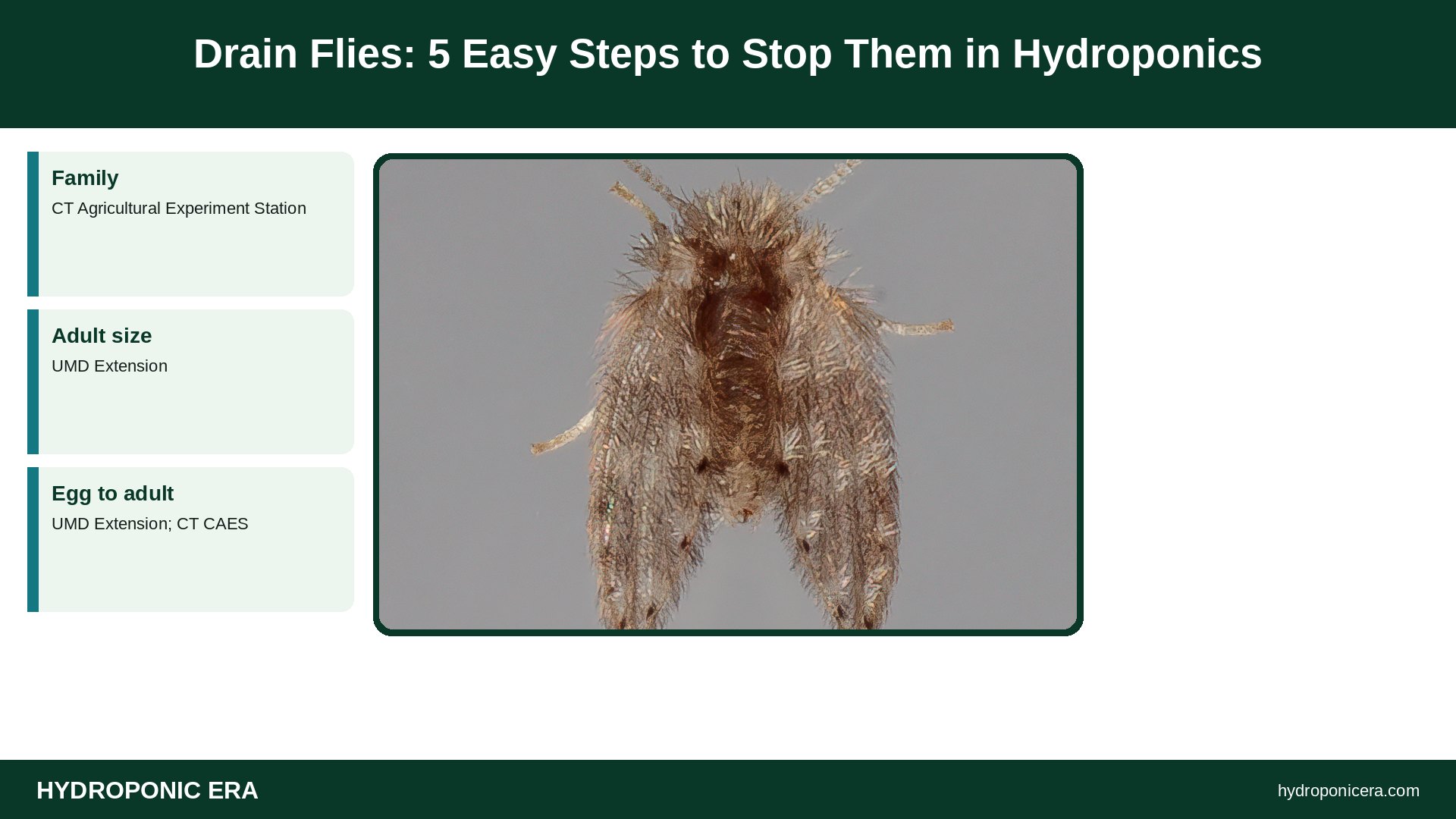
What Are Drain Flies in Hydroponics?
Drain flies in hydroponics are moth flies (family Psychodidae) that breed in the gelatinous organic film on wet surfaces. The Connecticut Agricultural Experiment Station describes them as small, hairy flies that do not bite. Alabama Extension notes they are weak, erratic fliers, which helps tell them apart from other small flies around a grow room.
Their larvae are legless, wormlike and about 3/8 inch (8–10 mm) long, with a breathing tube at one end, according to Alabama Extension. They live in slime, so you rarely see them unless you inspect the film closely.
Where Do Drain Flies in Hydroponics Breed?
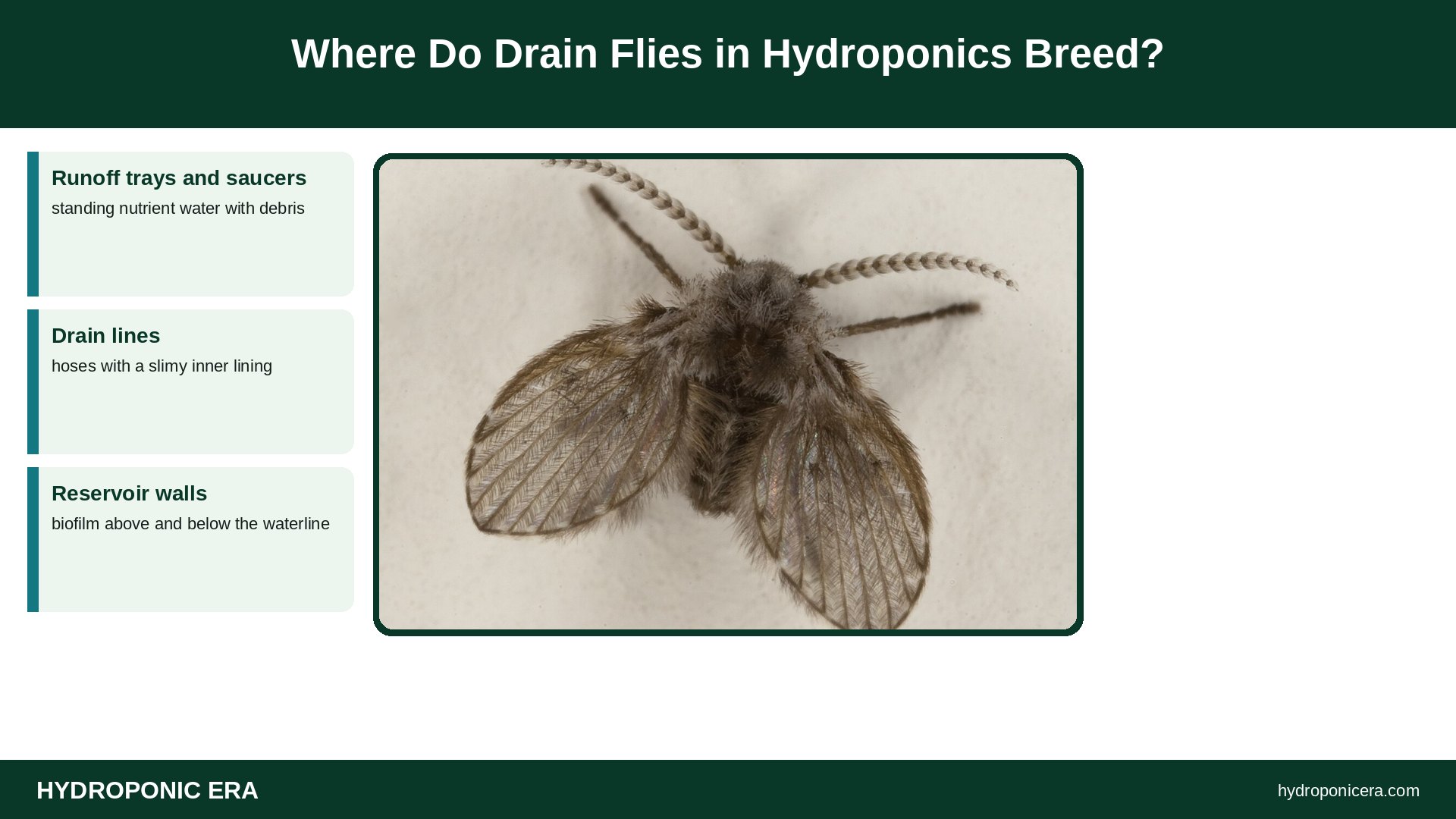
They breed wherever moist organic slime collects. University of Maryland Extension lists drains and traps plus saucers under potted plants and condensate pans under refrigerators and air conditioners. In a hydroponic setup, the matching spots are runoff trays, drain hoses, standing water under racks and reservoirs with slimy walls.
- Runoff trays and saucers: standing nutrient water with debris.
- Drain lines: hoses with a slimy inner lining.
- Reservoir walls: biofilm above and below the waterline.
- Floor drains: grow-room drains that rarely get flushed.
Our guide to biofilm and slimy reservoirs explains how that film forms.
Are Drain Flies in Hydroponics Harmful to Plants?
Drain flies are mostly a nuisance and a sign of poor sanitation, not a direct plant pest. The CT Agricultural Experiment Station says their larvae feed on algae, bacteria, fungi and other microorganisms and decaying organic matter in the slime they live in. Alabama Extension adds that adults may carry germs from the surfaces where they land, so cleaning matters.
Do not confuse them with fungus gnats, which can harm roots. Read shore flies vs fungus gnats and our guide to fungus gnats in hydroponics to sort out small black flies.
How Do You Find the Source of Drain Flies in Hydroponics?
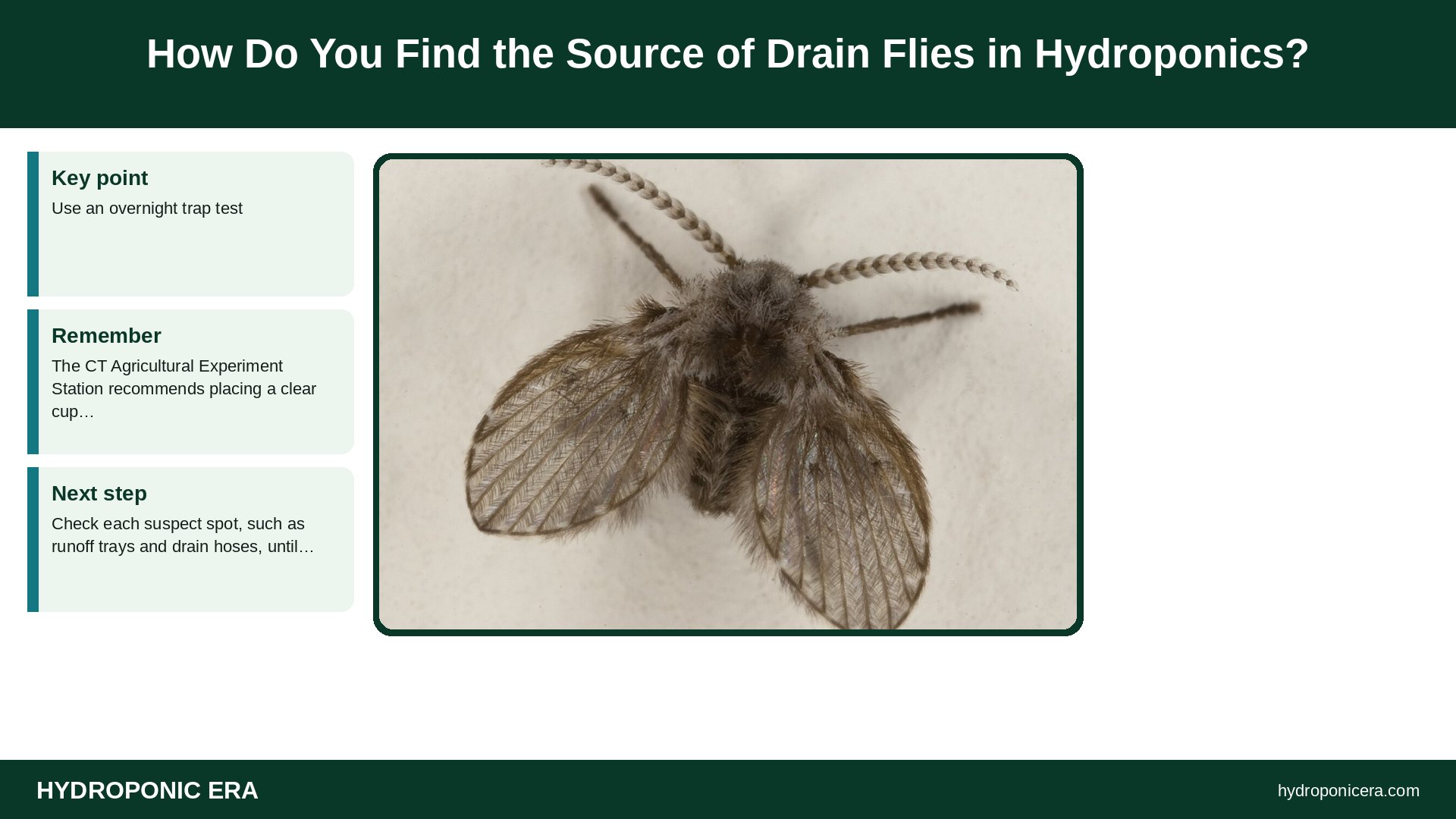
Use an overnight trap test. The CT Agricultural Experiment Station recommends placing a clear cup over a drain or outflow and leaving it overnight; flies coming from that source will rest inside the cup. Check each suspect spot, such as runoff trays and drain hoses, until you find where the adults emerge.
- Turn off fans so flies are not blown around.
- Cover a suspect drain or tray outlet with a clear cup.
- Leave it overnight.
- Check for flies resting inside the cup in the morning.
- Repeat at each suspect spot.
How Do You Get Rid of Drain Flies in Hydroponics?
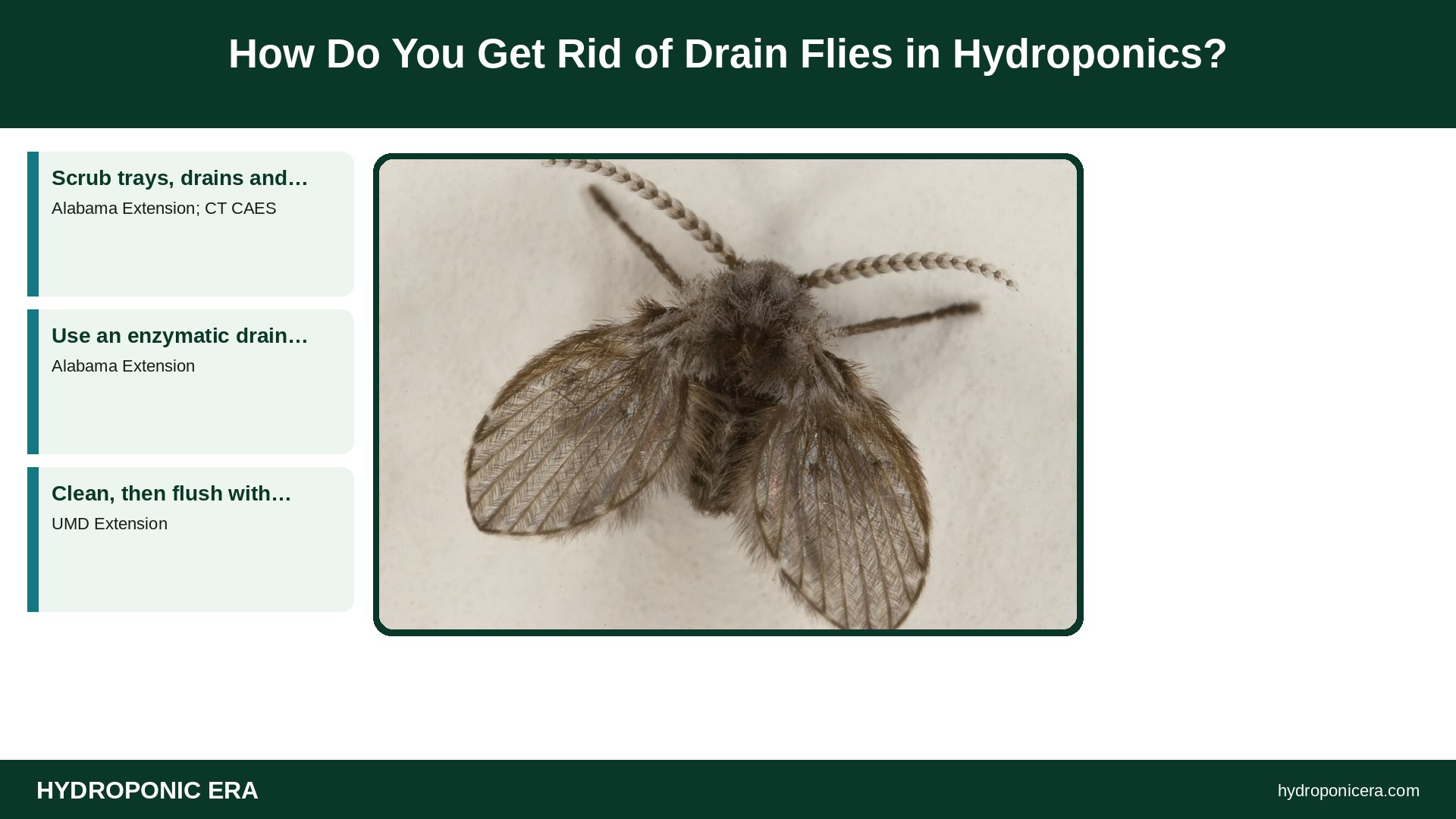
Scrub away the slime they breed in. Alabama Extension says physical removal of larval breeding sources is the most effective method, using a stiff brush to remove all slime and sludge. It also warns that pouring baking soda, bleach, vinegar or boiling water down drains is ineffective and may damage pipes.
| Action | Why | Source |
|---|---|---|
| Scrub trays, drains and hoses with a stiff brush | Removes the breeding slime | Alabama Extension; CT CAES |
| Use an enzymatic drain cleaner for deep pipes | Reaches buildup in drainpipes | Alabama Extension |
| Clean, then flush with hot water | Removes remaining residue | UMD Extension |
| Never pour insecticide down a drain | Unsafe and ineffective | Alabama Extension |
| Never mix ammonia and bleach | Releases hazardous gas | Alabama Extension |
Clean the whole system between crops using a routine like our guide to cleaning and sterilizing a hydroponic system. Keep runoff from pooling under racks.
How Do You Prevent Drain Flies in Hydroponics?
Prevent them by removing standing water and slime before flies find it. Empty runoff trays often, keep drain lines flowing, wipe reservoir walls when you change nutrients and fix leaks that create wet corners. Because development can take as little as 7 days, according to UMD Extension, weekly cleaning breaks the cycle.
How Do You Tell Drain Flies From Fungus Gnats?
Look at the body and the way it flies. Drain flies are fuzzy and moth-like, with dense hair on the body and wings, according to Alabama Extension, and they fly weakly and erratically. UMD Extension describes them as 1/16–1/4 inch (1.6–6.4 mm) long and pale brownish-gray to black. UMD also notes that fungus gnats can breed in drains, so check the insect closely.
- Drain flies: fuzzy, moth-like wings held over the body.
- Breeding site: slime in trays, hoses and drains.
- Larvae: gray, wormlike, with a breathing tube.
If the flies are slender and dark with clear wings, they are more likely fungus gnats.
How Fast Do Drain Flies in Hydroponics Multiply?
Quickly, once slime is available. The CT Agricultural Experiment Station says females lay masses of 30 to 200 eggs, which hatch in 32 to 48 hours at 70°F (21°C). Larvae feed for 9 to 15 days before pupating, and UMD Extension notes that flies emerge daily once an infestation is underway. That steady emergence is why a few flies soon become many.
FAQ About Drain Flies in Hydroponics
Do drain flies in hydroponics bite?
No; the CT Agricultural Experiment Station says moth flies do not bite.
Will bleach kill drain flies in hydroponics?
Alabama Extension says pouring bleach down drains is ineffective.
How long do drain flies live?
Adults live up to about 2 weeks, per UMD Extension.
Are drain flies the same as fungus gnats?
No; drain flies are fuzzy moth flies that breed in slime.
Can drain flies breed in a reservoir?
Yes, if slimy organic film builds up on the walls.
Sources
- University of Maryland Extension — Drain Flies
- Alabama Cooperative Extension System — Drain Flies in the Home
- Connecticut Agricultural Experiment Station — Moth Flies (Psychodidae)
- Photo credits (Wikimedia Commons, edited with titles): Psychoda alternata by Victor Engel (CC BY-SA 4.0); Clogmia Albipunctata or moth fly by Sanjay Acharya (CC BY-SA 3.0)