
How do you stop flea beetles on hydroponic greens? Flea beetles are tiny jumping beetles that chew small round “shotholes” in arugula, mustard, bok choy, radish and other brassica leaves. Seedlings and tender Asian greens suffer most. Stop flea beetles with sealed row covers or screened growing spaces, transplants instead of direct seeding, daily scouting, clean crop residue and, if needed, organic-allowed sprays such as spinosad.
Key takeaway: Utah State University Extension says adult flea beetles are only 1/15 to 1/6 inch (1.7 to 4.2 mm) long, with enlarged hind legs that let them jump like fleas. University of Kentucky entomologists note that the shothole damage can kill seedlings, delay growth and make leafy greens unmarketable, which matters most for growers selling salad greens.
| Fact | What sources report | Source |
|---|---|---|
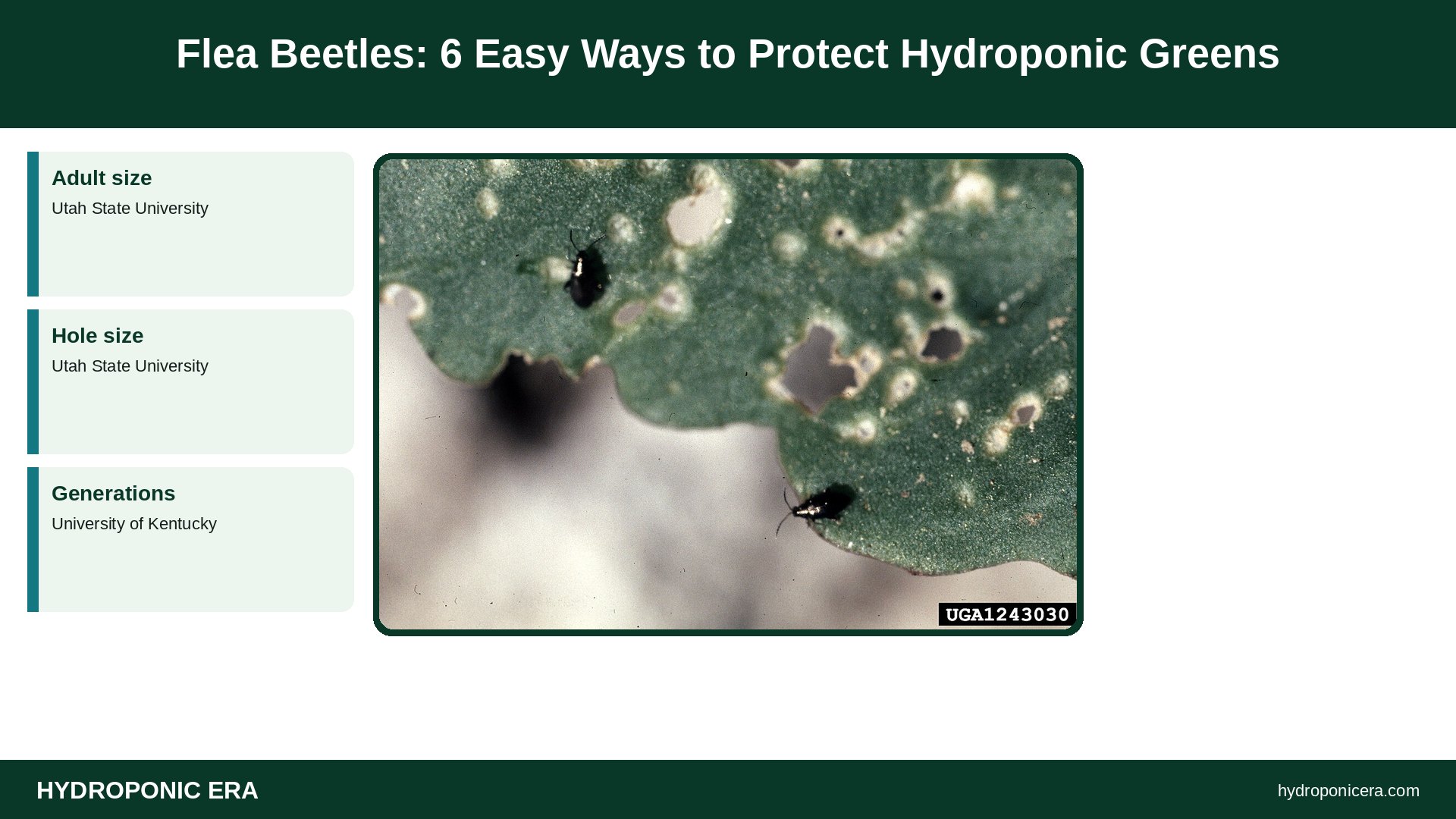
| Adult size | 1/15–1/6 inch (1.7–4.2 mm) | Utah State University |
| Hole size | 1/16–1/8 inch (1.5–3.2 mm) | Utah State University |
| Generations | 1–2 per year (crucifer flea beetle) | University of Kentucky |
| Adults emerge | Around 50°F (10°C) in spring | University of Vermont |
| Action threshold | Average of 2–5 beetles per plant | University of Vermont |
| Organic-allowed sprays | Pyrethrin and spinosad | University of Kentucky |
What Are Flea Beetles?
Flea beetles are small leaf beetles that jump when disturbed. Utah State University Extension describes adults as 1/15 to 1/6 inch (1.7 to 4.2 mm) long, often shiny black, bronze, blue or striped, with enlarged hind legs. The crucifer flea beetle and striped flea beetle are the main pests of cabbage-family crops, and other species attack eggplant, tomato and potato.
The University of Vermont says adults overwinter in brushy areas, emerge when temperatures reach about 50°F (10°C), feed on leaves, and lay eggs in soil. The larvae feed on roots, then pupate in the soil for 11 to 13 days before new adults appear.
What Does Flea Beetle Damage Look Like?
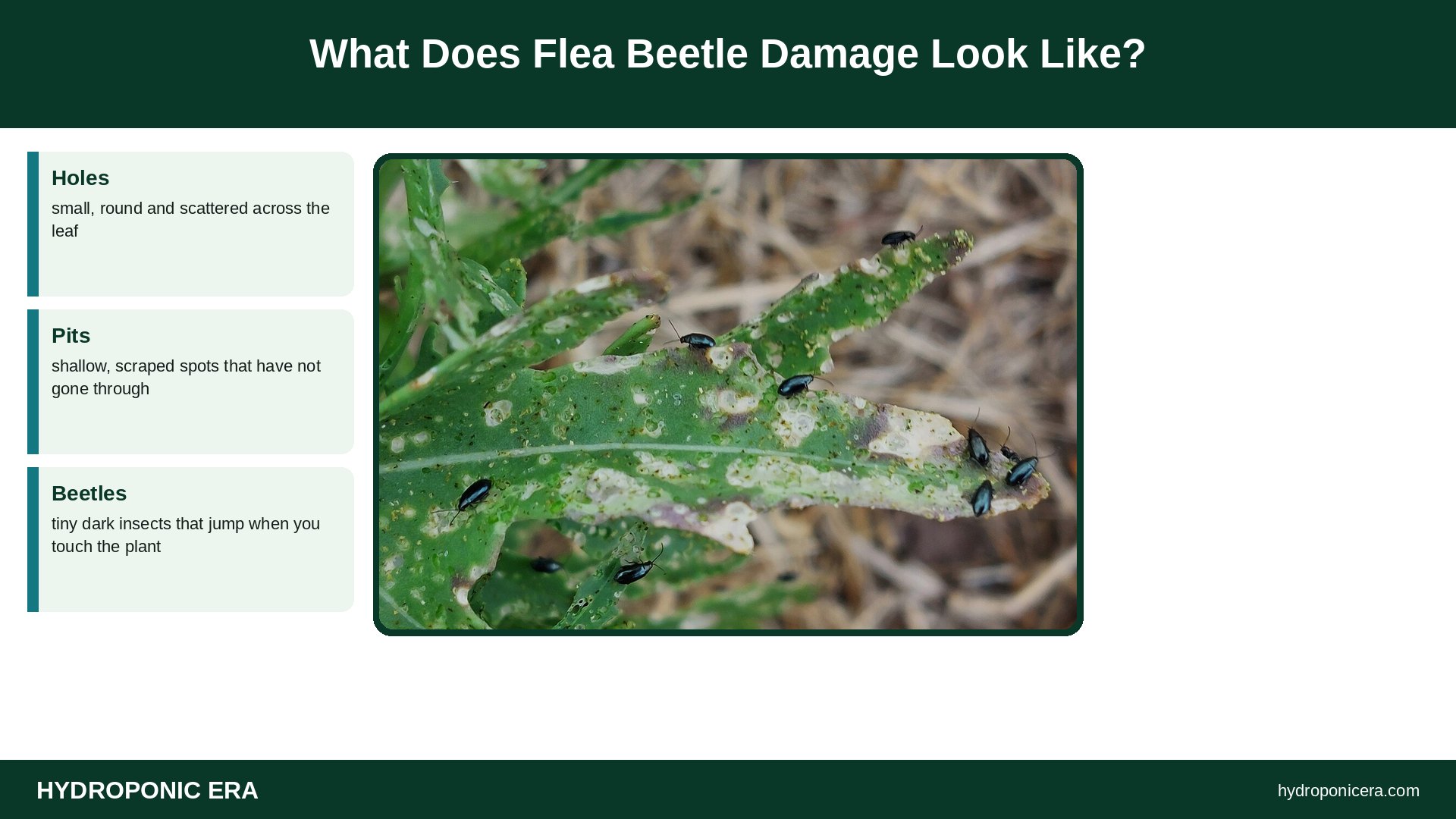
Look for many small round holes. Utah State University Extension says flea beetles chew shotholes 1/16 to 1/8 inch (1.5 to 3.2 mm) across, often with a pitted, scraped look on thicker leaves. Seedlings are the most sensitive stage, and heavy feeding can kill them outright. On older leaves the holes may run together and form ragged patches.
- Holes: small, round and scattered across the leaf.
- Pits: shallow, scraped spots that have not gone through.
- Beetles: tiny dark insects that jump when you touch the plant.
- Timing: worst damage in spring on young plants.
Which Hydroponic Greens Do Flea Beetles Attack Most?
Tender brassicas top the list. The University of Vermont says Asian brassicas with non-waxy leaves stay vulnerable at all stages, including Chinese cabbage, tatsoi, mizuna, komatsuna, turnip, mustards and red Russian kale. Radish, daikon and arugula are also favorites. Waxier European cabbage-family crops are less vulnerable after the 2 to 3 leaf stage.
That list overlaps with popular NFT and tower crops, such as mizuna and tatsoi, arugula and mustard greens. Outdoor towers, open greenhouses and seedlings raised outside are most exposed to flea beetles.
How Do Row Covers Stop Flea Beetles?
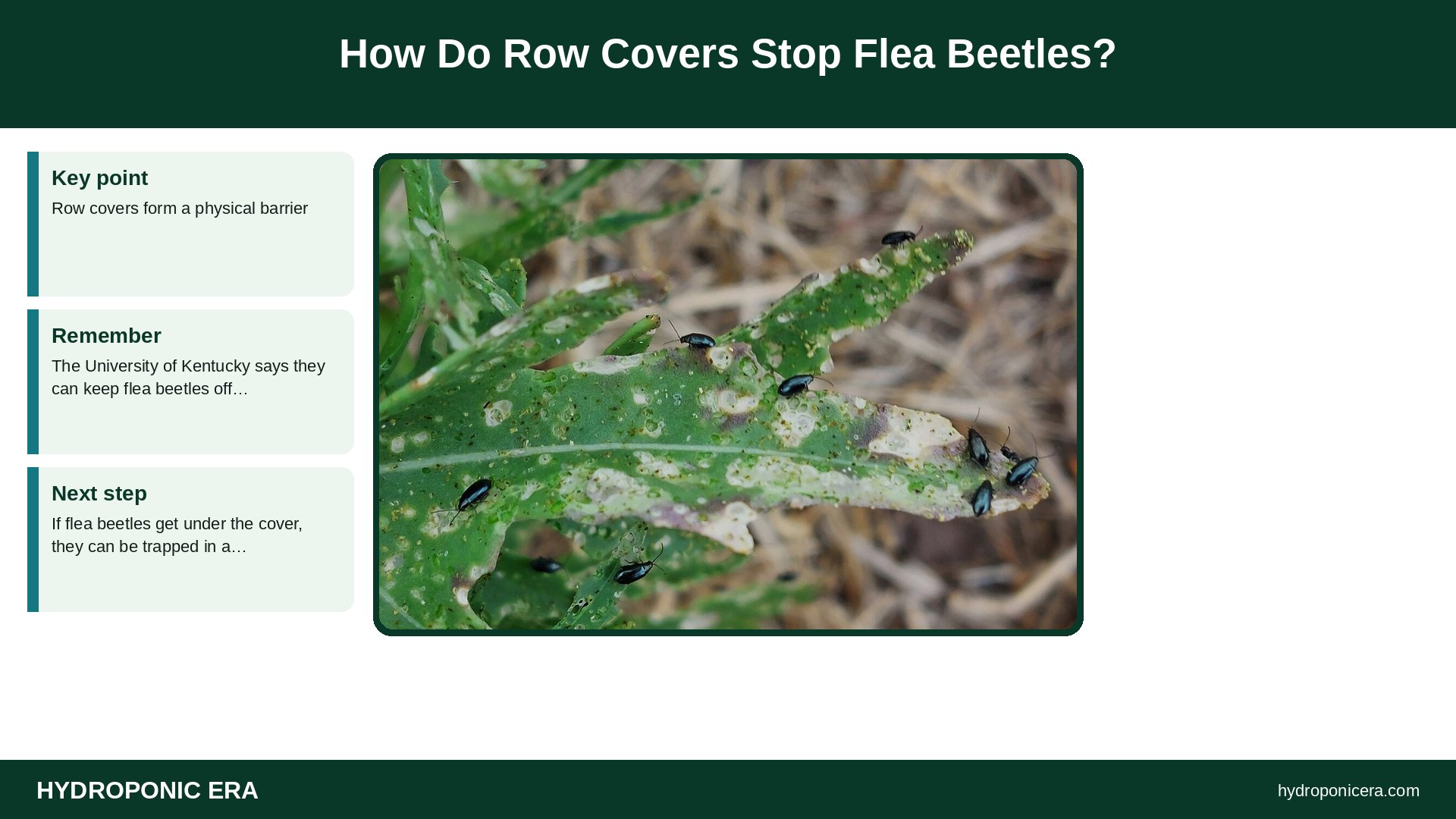
Row covers form a physical barrier. The University of Kentucky says they can keep flea beetles off plants, reduce feeding damage and raise yield, but only if installed immediately after planting. If flea beetles get under the cover, they can be trapped in a sheltered space with no natural enemies and cause extensive damage, so seal every edge.
- Put covers on the same day you seed or transplant.
- Seal edges with a continuous layer of soil, as the University of Vermont suggests.
- Check covers for tears or gaps every few days.
- Rotate crops so beetles do not emerge from soil under the cover.
Indoors, the same logic applies to vents and doors. Fine screening keeps beetles out, and a short quarantine for new plants stops hitchhikers.
When Should You Treat Flea Beetles?
Scout first, then act. The University of Vermont recommends checking plants every day or two once they emerge, and suggests a threshold of an average of 2 to 5 beetles per plant. Utah State University Extension adds that mature plants can lose more than 20% of leaf area before yield drops, but leafy greens lose market value much sooner.
- Seedlings: act quickly, because they can die.
- Leafy greens: low tolerance, because holes ruin sales.
- Older heading crops: can tolerate more feeding.
Utah State University Extension says yellow or white sticky traps are useful for monitoring only. Our guide to sticky trap placement explains how to read them.
Which Sprays Work on Flea Beetles?
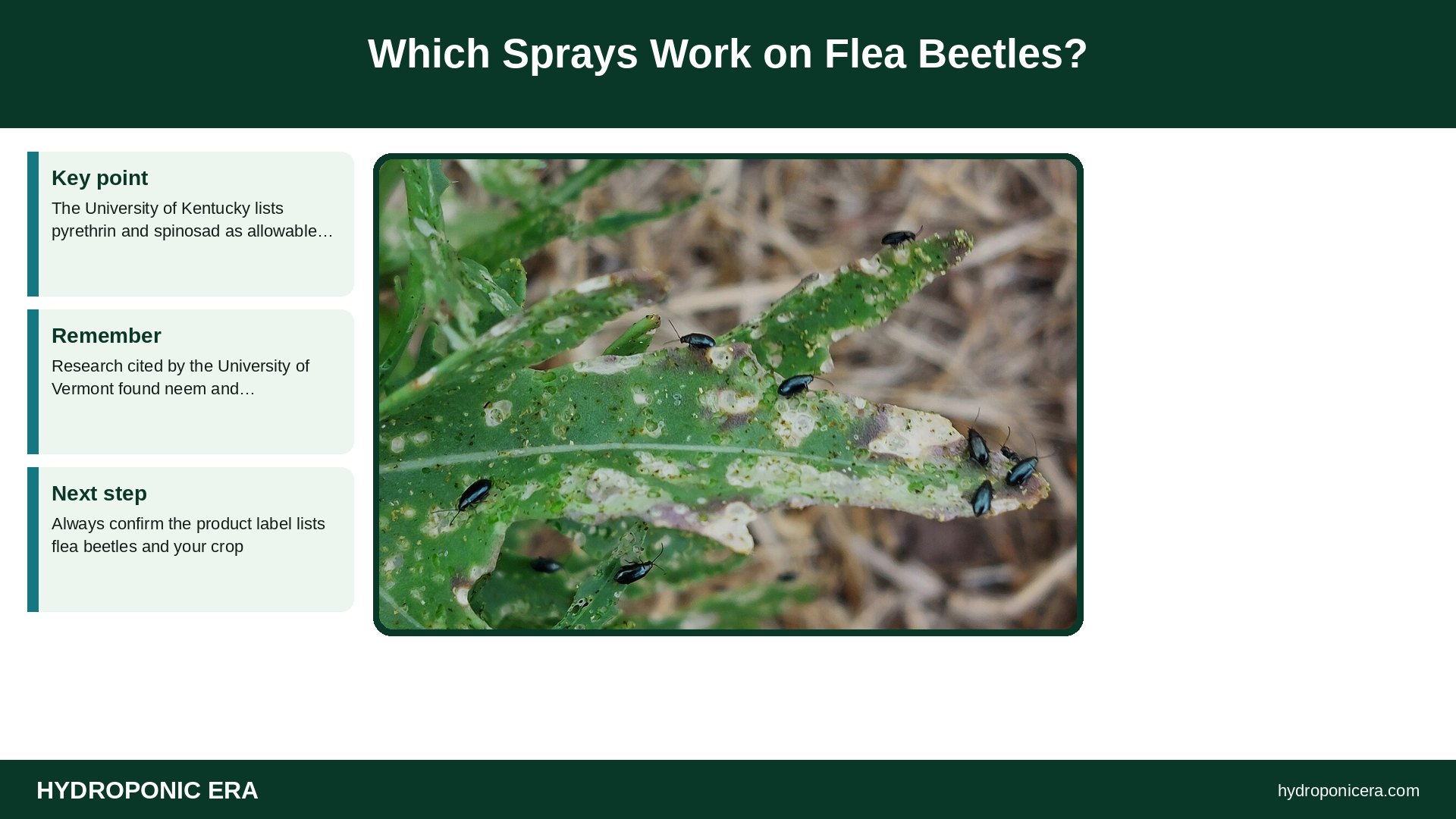
Results vary. The University of Kentucky lists pyrethrin and spinosad as allowable options for organic growers. Research cited by the University of Vermont found neem and insecticidal soap were not very effective, pyrethrins and kaolin clay gave mixed results, and spinosad gave consistently good control. Always confirm the product label lists flea beetles and your crop.
For label details, read our spinosad guide. Never spray into a recirculating reservoir, and follow label harvest intervals on leafy greens.
What Else Helps Prevent Flea Beetles?
Timing and clean-up help. The University of Kentucky says transplanting rather than direct seeding gives crops a head start, because flea beetles do most harm to young plants. It also advises removing brassica crop residue after harvest, since residue can shelter overwintering adults. The University of Vermont describes a Chinese ‘Southern Giant’ mustard trap crop to draw beetles away.
- Transplant: set out larger plants instead of seeding in place.
- Trap crop: a border of mustard to lure beetles.
- Clean up: remove old brassica plants after harvest.
- Nematodes: the University of Vermont notes beneficial nematodes can target larvae in soil.
FAQ About Flea Beetles
Do flea beetles live in hydroponic water?
No; larvae develop in soil, so pure hydroponics breaks part of their cycle.
How long do flea beetle larvae stay in soil?
The University of Vermont says they pupate there for 11 to 13 days.
Can lettuce get flea beetles?
Yes; Utah State lists lettuce among hosts of some flea beetle species.
Do neem and soap kill flea beetles?
Research cited by the University of Vermont found them not very effective.
Do yellow sticky traps control flea beetles?
Utah State says they are for monitoring only.
When are flea beetles worst?
In spring, when overwintered adults emerge and plants are young.
Do flea beetles attack waxy cabbage?
Waxy European types are less vulnerable after the 2 to 3 leaf stage.
Sources
- University of Kentucky Entomology — Flea Beetle IPM in Brassica Production (EF330)
- University of Vermont Extension — Flea Beetles Management
- Utah State University Extension — Flea Beetles on Vegetables
- Photo credits (Wikimedia Commons, edited with titles): Phyllotreta cruciferae (03) by Whitney Cranshaw, Colorado State University, Bugwood.org (CC BY 3.0 us); Rucola Erdflöhe-5-Josef Schlaghecken by Schlaghecken Josef (CC BY-SA 4.0)