
How does cucumber green mottle mosaic virus spread in hydroponics? Cucumber green mottle mosaic virus (CGMMV) is a very stable tobamovirus of cucumbers, melons and other cucurbits. It spreads on hands, knives and seed, and through hydroponic nutrient solution, irrigation water and root-to-root contact. There is no cure, so growers rely on tested seed, strict hygiene, quick removal of suspect plants and a full clean-up between crops.
Key takeaway: AHDB warns that cucumber green mottle mosaic virus can be in plant sap well before symptoms appear, so it can spread widely before anyone notices. Alberta Agriculture says the virus can survive several months in a greenhouse and for years on stored seed. For hydroponic cucumber growers, that makes prevention far cheaper than any clean-up.
| Fact | What sources report | Source |
|---|---|---|
| Virus group | Tobamovirus | Pacific Pests, Pathogens & Weeds |
| Hosts | Cucumber, melon, watermelon, gourds and others | Pacific Pests, Pathogens & Weeds |
| Hydroponic spread | Nutrient solution, irrigation water, root contact | Pacific Pests, Pathogens & Weeds |
| Seed treatment | Dry heat at 158°F (70°C) for 3 days | AHDB |
| Greenhouse survival | Several months | Alberta Agriculture |
| Debris survival | More than a year | AHDB |

What Is Cucumber Green Mottle Mosaic Virus?
Cucumber green mottle mosaic virus is a member of the tobamovirus group, the same group as tobacco mosaic virus. The Pacific Pests, Pathogens & Weeds fact sheet says it is found worldwide and infects members of the cucumber family, including cucumber, melon, watermelon, and bitter and bottle gourds. It calls CGMMV a very serious disease that is difficult to manage.
For the broader virus family, see our guide to tobacco mosaic virus. Do not confuse it with aphid-spread cucumber mosaic virus, which is a different virus.
What Are the Symptoms of Cucumber Green Mottle Mosaic Virus?
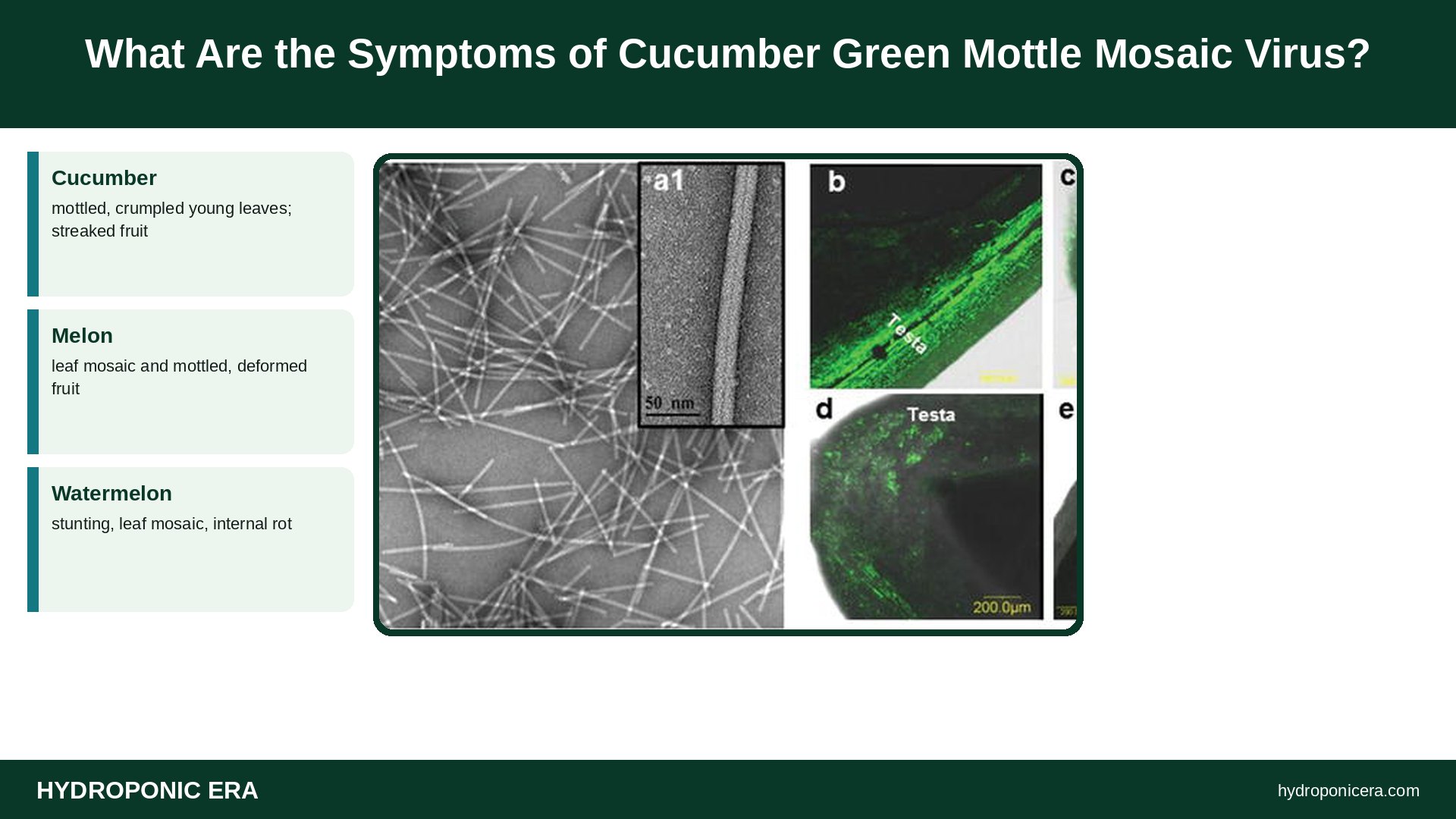
Symptoms depend on the crop. On cucumber, the Pacific Pests fact sheet lists crumpling, green mottling and mosaic patterns on young leaves, fruit with irregular light green spots or streaks, and plants that may collapse. Watermelon can show stunting and internal fruit rots, while pumpkin and squash may show no symptoms at all.
- Cucumber: mottled, crumpled young leaves; streaked fruit.
- Melon: leaf mosaic and mottled, deformed fruit.
- Watermelon: stunting, leaf mosaic, internal rot.
- Squash: often symptomless leaves.
Because symptoms vary and overlap with other viruses, the fact sheet says confirmation needs serological or molecular tests.
How Does Cucumber Green Mottle Mosaic Virus Spread in Hydroponics?
Many ways, including the water. The Pacific Pests fact sheet lists hydroponic nutrient solutions, irrigation water, tools, machinery, clothing, root-to-root contact, handling, grafting and bees during pollination. Alberta Agriculture adds that insects with chewing mouthparts, such as beetles, can carry it mechanically. Seed and soil move it over long distances.
- Solution: recirculating feed carries virus between plants.
- Hands and knives: pruning and harvesting spread sap.
- Leaves: infected leaves rubbing healthy ones.
- Seed: infected seed lots start outbreaks.
How Long Does Cucumber Green Mottle Mosaic Virus Survive?
A long time. Alberta Agriculture says the virus is extremely stable, can survive several months in a greenhouse environment, and can survive on seed in storage for several years. AHDB says it can remain active for more than a year in plant debris, so debris must never be left on site after a crop.
How Do You Prevent Cucumber Green Mottle Mosaic Virus?
Start clean and stay clean. Alberta Agriculture says the most effective defense is seed tested and certified free of the virus using approved protocols. AHDB recommends dry heat seed treatment at 158°F (70°C) for three days, while Alberta notes seed treatments are not completely effective because the virus is so stable. Use both tested and treated seed.
- Ask the seed company for a CGMMV test certificate.
- Keep visitors out, or give them coveralls, gloves and shoe covers.
- Wash hands in hot soapy water before entering the crop.
- Place foot dips where they cannot be avoided.
- Walk the crop daily to spot symptoms early.
Our guide to quarantining new plants and clones explains how to keep new material separate.

What Should You Do if You Suspect Cucumber Green Mottle Mosaic Virus?
Act fast and remove carefully. AHDB recommends sampling the tops of suspect plants for lab analysis and removing the rest of the plant. Take out the whole slab, not just the plant: remove drippers first, let plants wilt for a few hours so infected solution does not leak, then bag the plant, stakes and slab at the end of the day.
- Mark the row: do work there last each day.
- One knife per row: AHDB describes this Dutch practice.
- Dip hands and knives: between plants when possible.
- Change clothes: before returning to healthy crops.
How Do You Clean a Hydroponic System After Cucumber Green Mottle Mosaic Virus?
Remove everything, wash, then disinfect. AHDB says all crop debris must leave the growing house, removed while wilting rather than dry and brittle. Infected growing media should not be reused unless steam disinfected. Wash structures with a high-pressure washer and soapy water before disinfecting, since disinfectants work poorly on dirty surfaces. Use only authorized products.
Alberta Agriculture recommends washing the structure from the top down and removing weeds and volunteer plants to avoid a “green bridge” between crops. Follow our checklist for cleaning and sterilizing a hydroponic system.

Can Grafted Cucumbers Carry Cucumber Green Mottle Mosaic Virus?
Yes. The Pacific Pests fact sheet lists grafting onto tolerant rootstocks as a route of spread. Alberta Agriculture says both scion and rootstock seed should be tested and found free of the virus, and recommends strict hygiene and an effective disinfectant, such as 2% Virkon, to decontaminate tools during grafting.
FAQ About Cucumber Green Mottle Mosaic Virus
Is there a cure for cucumber green mottle mosaic virus?
No; remove infected plants and sanitize thoroughly.
Can you test for cucumber green mottle mosaic virus at home?
Alberta Agriculture says simple test kits can be used in the greenhouse.
Does alcohol gel stop cucumber green mottle mosaic virus?
AHDB says hot soapy water works better than alcohol gel alone.
Can bees spread cucumber green mottle mosaic virus?
Yes; the Pacific Pests fact sheet lists bees during pollination.
Can I reuse slabs after CGMMV?
AHDB advises against it unless steam disinfected.
Does CGMMV survive on stored seed?
Alberta Agriculture says it can survive on stored seed for several years.
Sources
- AHDB — Control of Cucumber Green Mottle Mosaic Virus (CGMMV)
- Pacific Pests, Pathogens & Weeds — Cucumber Green Mottle Mosaic Fact Sheet
- Alberta Agriculture — Managing Cucumber Green Mottle Mosaic Virus in Alberta Greenhouses
- Photo credits (Wikimedia Commons, edited with titles): DOI.10.5772.F1 by Aviv Dombrovsky and Elisheva Smith (CC BY 3.0); DOI.10.5772.F3 by Aviv Dombrovsky and Elisheva Smith (CC BY 3.0)