
Can you grow ground cherry plants hydroponically? Yes. Ground cherry (Physalis pruinosa) is a tomato relative that grows well in a Dutch bucket or large deep water culture tote. Start seeds 6–8 weeks before transplant on a 75–85°F (24–29°C) heat mat, give 8 or more hours of light, and harvest only when the papery husks dry and the fruit drops.
Key takeaway: The golden, cherry-sized berries ripen about 10–11 weeks after transplant. Unripe fruit and the leaves are toxic, so only eat fully ripe berries.
| Growth factor | Target | Source |
|---|---|---|
| Seed start | 6–8 weeks before transplant | K-State Research and Extension |
| Germination heat | 75–85°F (24–29°C) heat mat | University of Minnesota |
| Light | 8+ hours of direct sun | K-State Research and Extension |
| Plant spacing | 18–24 in (46–61 cm) | University of Minnesota |
| First ripe fruit | 10–11 weeks after transplant | K-State Research and Extension |
| Storage in husk | Up to 3 months | K-State Research and Extension |
What Is a Ground Cherry?
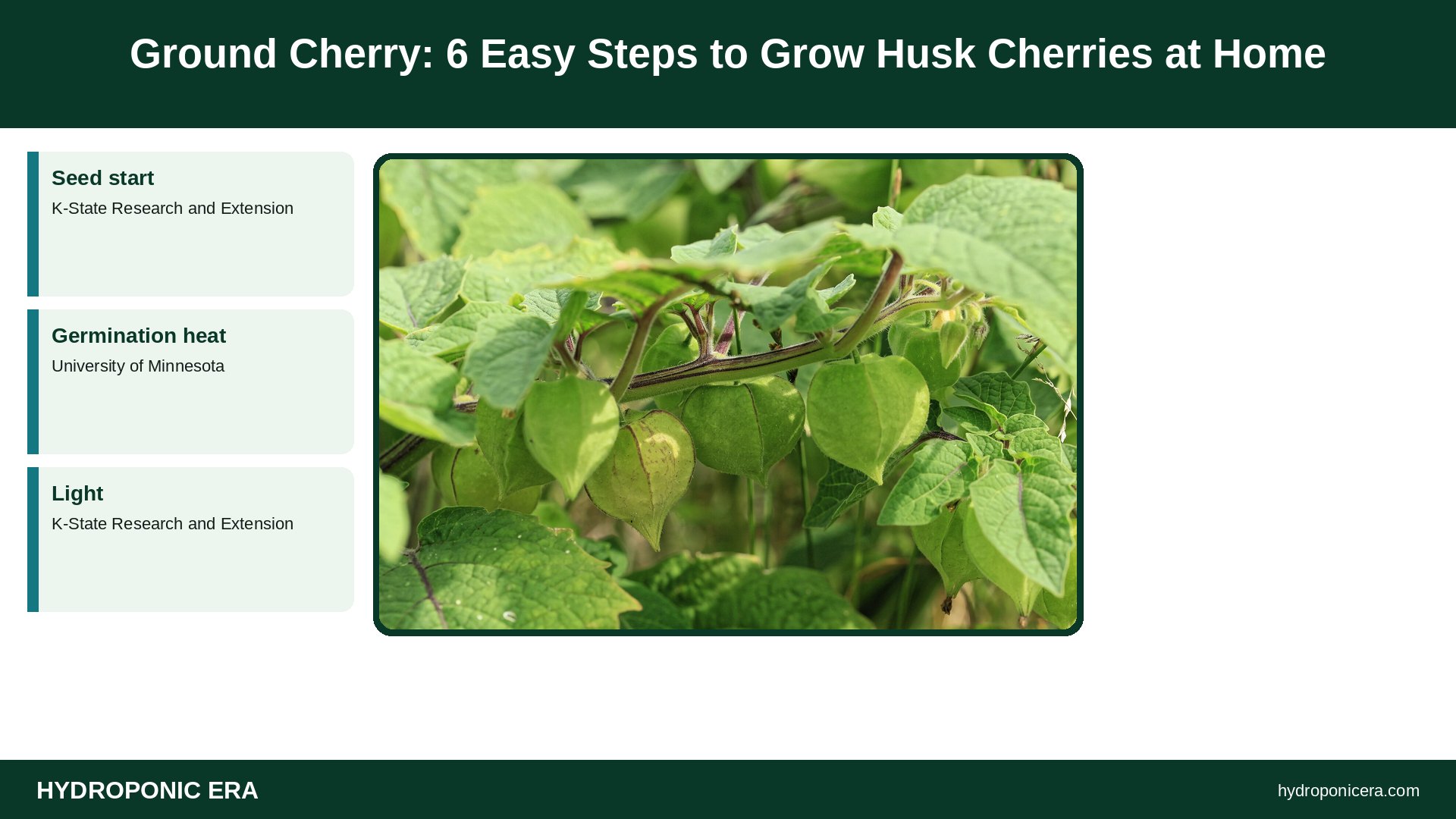
A ground cherry is a small husk-covered fruit in the nightshade family, related to tomatoes and tomatillos. K-State Research and Extension describes Physalis pruinosa as a sprawling plant 1–3 ft (30–90 cm) tall. The cherry-sized fruit turns from green to golden-yellow inside a papery husk, with juicy pulp and many small edible seeds. ‘Aunt Molly’s’ is a popular variety.
Growers often compare it with its larger cousin; see how to grow tomatillos hydroponically.
How Do You Start Ground Cherry Seeds?
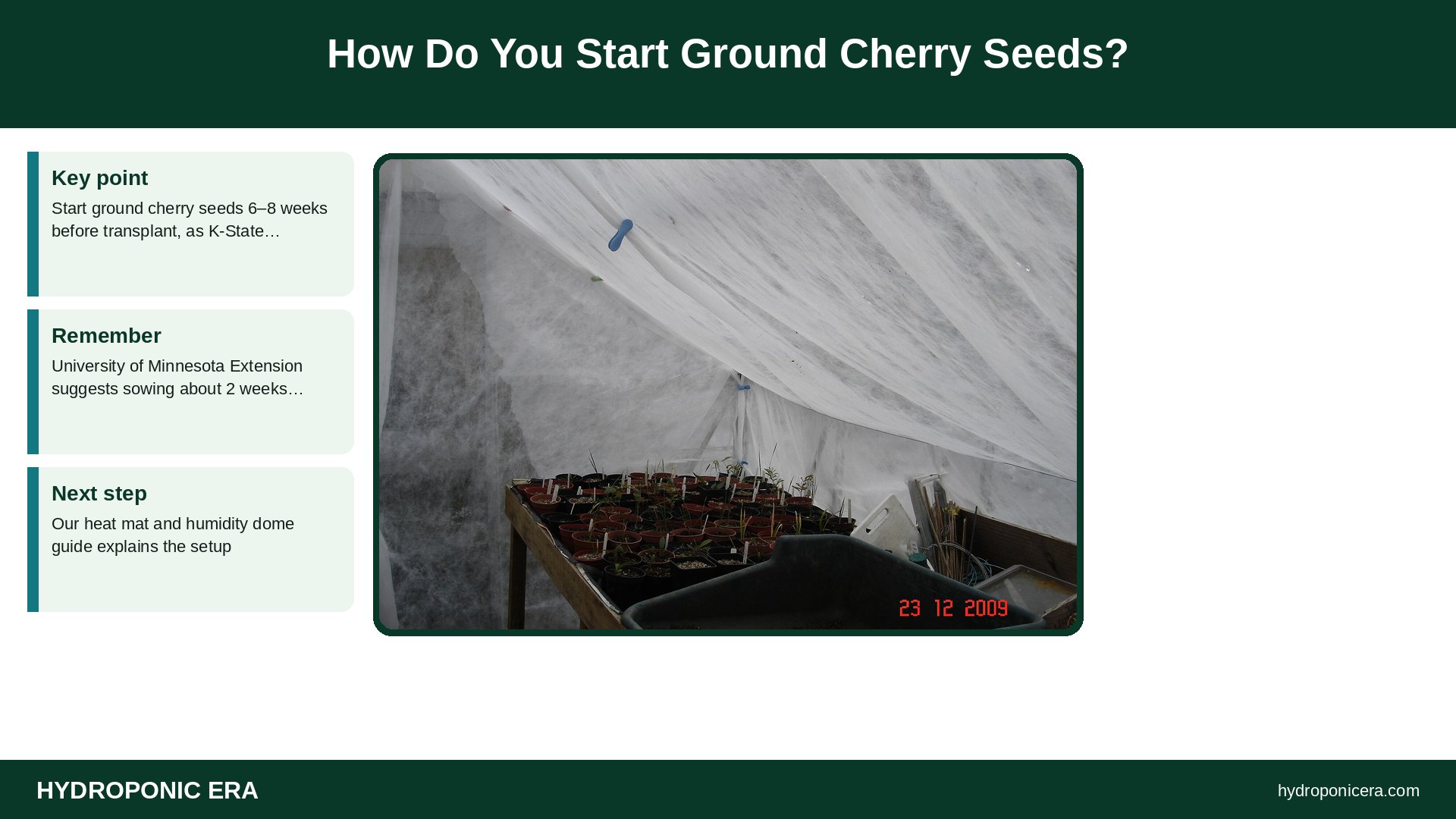
Start ground cherry seeds 6–8 weeks before transplant, as K-State advises. University of Minnesota Extension suggests sowing about 2 weeks before tomatoes and using a heat mat at 75–85°F (24–29°C). Our heat mat and humidity dome guide explains the setup.
- Sow seeds on rockwool cubes or starter plugs.
- Keep them warm and evenly moist.
- Give strong light after sprouting.
- Transplant once roots poke through the cube.
- Set plants at the same depth; K-State notes stems do not root like tomato stems.
Which Hydroponic System Suits Ground Cherry Plants?
Dutch buckets suit ground cherry best, because the plants sprawl wide and live for months. K-State says plants spread and recommends 4 ft (1.2 m) of room per plant in gardens, while Minnesota Extension suggests 18–24 in (46–61 cm) spacing. Use one 3–5 gallon (11–19 L) bucket per plant. See our Dutch bucket guide for beginners.
K-State suggests tomato cages to keep plants from sprawling as far, which also works well over a bucket.
What Temperature and Light Do Ground Cherries Need?
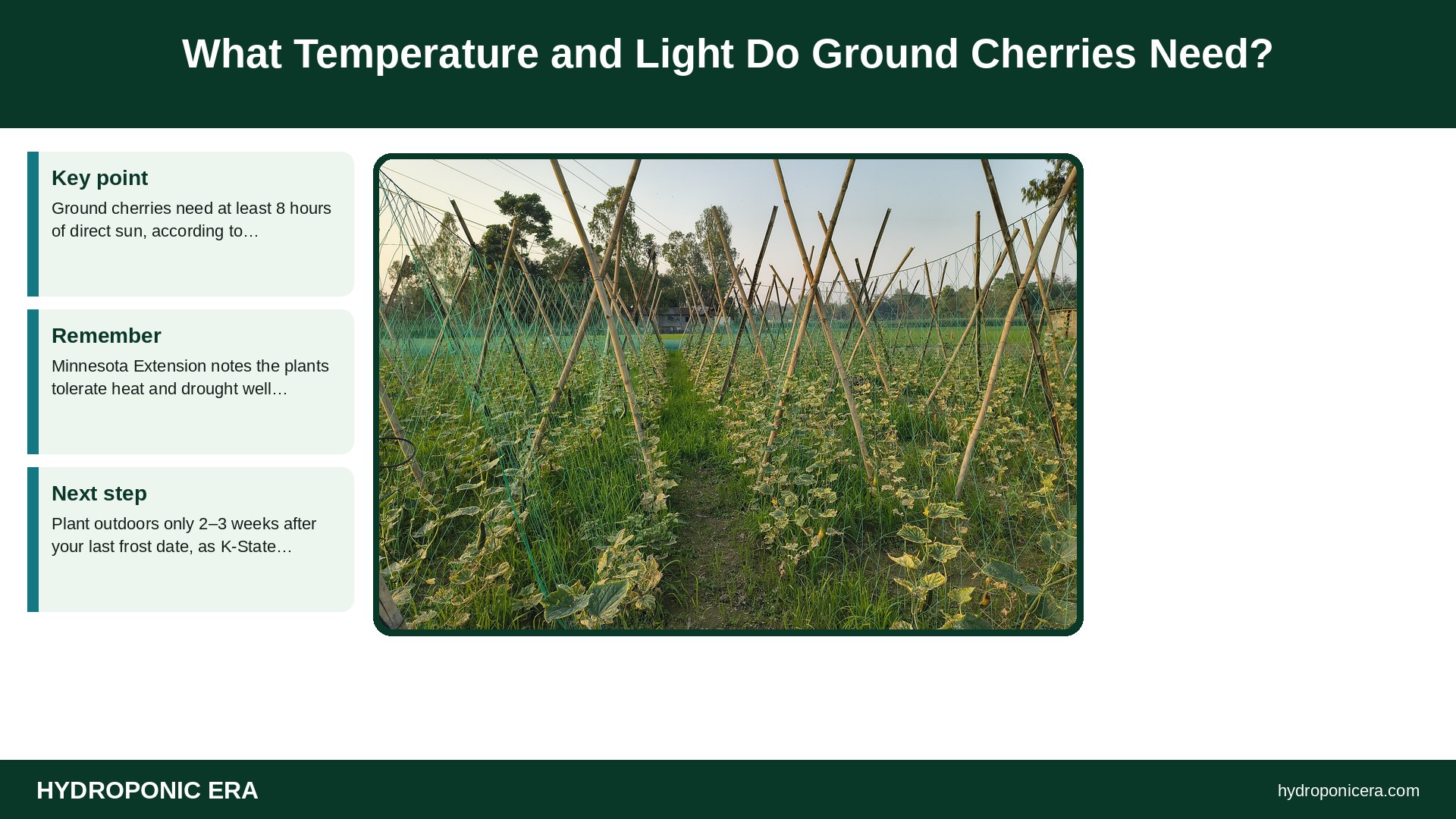
Ground cherries need at least 8 hours of direct sun, according to K-State, or strong grow lights indoors. Minnesota Extension notes the plants tolerate heat and drought well, but temperatures above 90°F (32°C) or below 55°F (13°C) can make flowers abort. Plant outdoors only 2–3 weeks after your last frost date, as K-State advises.
For more on heat-related flower loss, read our guide to blossom drop in tomatoes and peppers.
How Should You Feed Husk Cherry Plants?
Feed lightly at first. K-State advises fertilizing lightly at planting and adding nitrogen after the first fruit set. In hydroponics, that means a mild vegetative solution for young plants, then a fruiting solution like a tomato mix once flowers turn into fruit. Raise strength slowly and watch new leaves for pale color or burned tips.
- Young plants: start with a half-strength tomato or fruiting formula.
- After first fruit set: move to full strength.
- Keep the reservoir topped up; K-State gives 1–1.5 in (2.5–3.8 cm) of water a week in soil, a sign the plants like steady moisture.
- Check EC and pH at every top-up; see our hydroponic ppm chart.
When Are Ground Cherries Ripe?
Ground cherries are ripe when the husk turns dry and papery and the fruit falls to the ground on its own. K-State says fruit ripens about 10–11 weeks after transplant and warns not to pick it from the plant before it drops. Under a hydroponic setup, place a tray or cloth below plants to catch fallen fruit.
- Collect dropped fruit every day or two.
- Leave fruit in the husk for storage.
- K-State says fruit keeps up to 3 months in husks, 2–3 weeks in the fridge, or 6 months frozen.
- Minnesota Extension gives a shorter 1–2 weeks for husked fruit at room temperature.
Are Ground Cherries Poisonous?
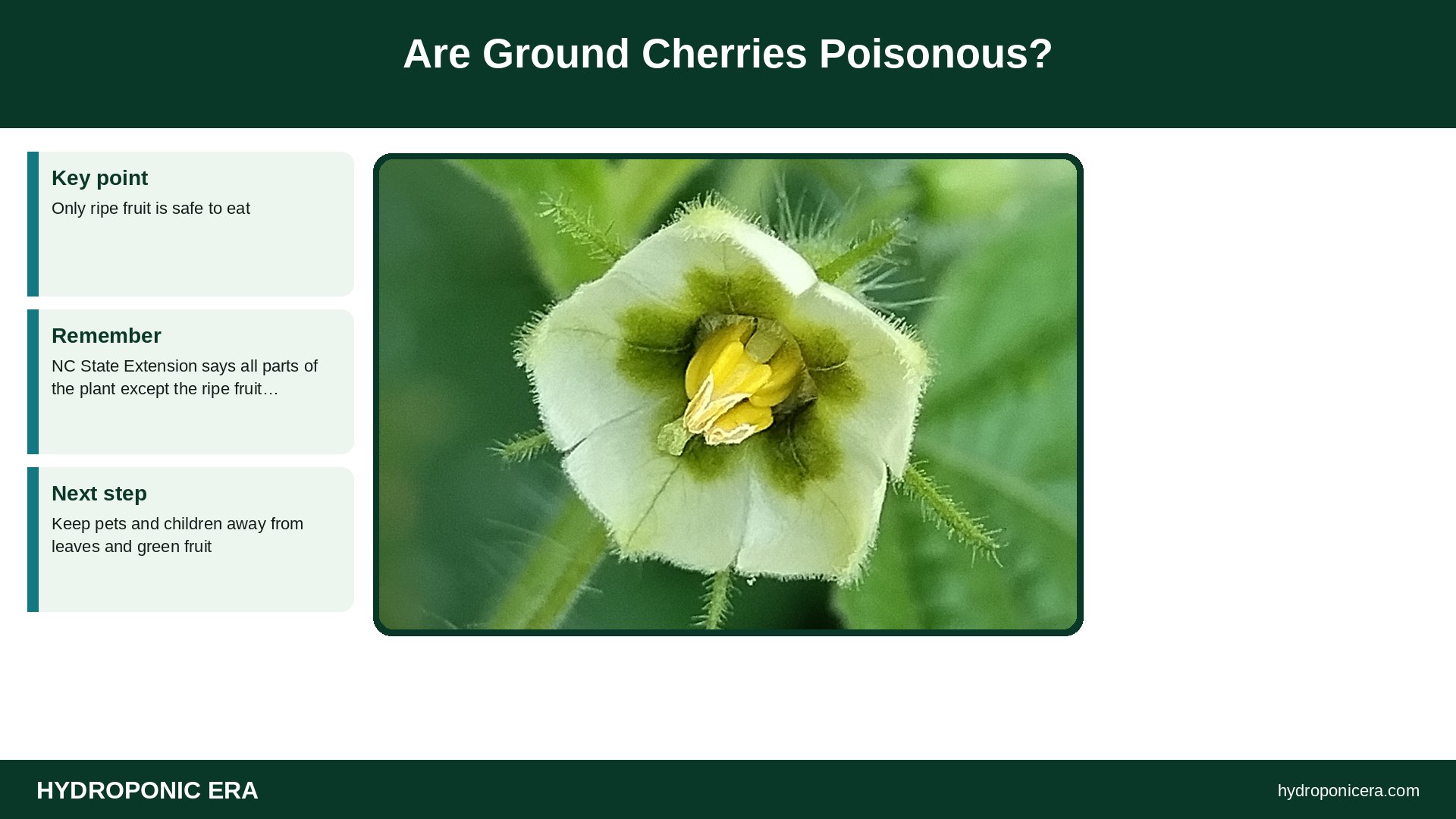
Only ripe fruit is safe to eat. NC State Extension says all parts of the plant except the ripe fruit are toxic, and K-State notes solanine levels are highest in immature berries. Keep pets and children away from leaves and green fruit. Discard any berry that is still green inside the husk.
What Pests and Problems Affect Physalis Plants?
Tobacco and tomato hornworms are the most common pests, according to K-State, so check plants for large green caterpillars and dark droppings. Ground cherries also self-seed freely, Minnesota Extension notes, and NC State adds that some Physalis spread by rhizomes. Indoors, hand-pick pests and remove fallen fruit you do not want to sprout.
FAQ About Ground Cherry Hydroponics
Are ground cherries the same as tomatillos?
No; both are Physalis, but tomatillos are larger and need two or more plants to set fruit, per Minnesota Extension.
How big do ground cherry plants get?
Usually under 30 in (76 cm) tall, per Minnesota Extension.
How do you use ground cherries?
K-State lists jams, jellies, salsa and drying like sun-dried tomatoes.
Can I eat ground cherry leaves?
No; only the ripe fruit is edible.
Why are my flowers dropping?
Heat above 90°F (32°C) or cold below 55°F (13°C).
Sources
- K-State Research and Extension, Butler County — Groundcherry
- University of Minnesota Extension — Growing Tomatillos and Ground Cherries
- NC State Extension Plant Toolbox — Ground Cherry (Physalis)
- Photo credits (Wikimedia Commons, edited with titles): Kluse – Physalis pruinosa – Ananaskirsche 05 ies by Frank Vincentz (CC BY-SA 3.0); Fleece lined greenhouse potting tray and seed pots – Flickr – peganum by peganum from Small Dole, England (CC BY-SA 2.0); Cucumber cultivation on a trellis, Kurigram, Bangladesh by Tanvir Rahat (CC BY-SA 4.0); Physalis pruinosa iNaturalist obs 183781317 by Flako cyanocorax, Itzel Rojas & Santiago Rosales (CC0)